International
179 confirmed dead, two survive in South Korea’s worst plane crash


Two victims on board the deadly Jeju Air plane crash on Sunday were Thai, according to South Korean authorities.
A father of one of the victims, Boonchuay Duangmanee, told the Associated Press that he “never thought that this would be the last time we would see each other forever.”

Duangmanee’s daughter, Jongluk, had been working in a factory in South Korea for several years, he told the AP. She had been back In Thailand visiting family before departing on the flight from Bangkok to Muan International Airport.
“I heard that the plane exploded in Korea this morning. But I did not expect at all that my daughter would be on this flight,” he said.


A man who witnessed Sunday’s plane crash in Muan, South Korea, said he is “devastated” by the disaster, describing the scene of the accident to Reuters.
Im Young Hak, who owns a seafood restaurant near the site of the crash, told Reuters he saw “a big dark smoke” and heard multiple explosions around 9 a.m. local time Sunday (7 p.m. ET on Saturday).
He first thought the noise was from an oil tanker accident, as there are many oil tankers nearby, Reuters reported. When he realized it was a plane that crashed, he thought that wild geese could have caused the disaster.
“I feel devastated,” Young Hak said, according to Reuters. “It happened right here, not far (away). We feel bad for an accident happening the other side of the globe, but it happened right here. It is traumatic. I’m not sure how long I will feel this way, but it won’t be a short time — that I know.”
One of the two survivors of Sunday’s Jeju Air crash in South Korea is conscious and talking, despite suffering multiple fractures, according to Ju Woong, the director of Seoul’s Ewha Hospital, where the 33-year-old is being treated.
The hospital director said the man was admitted to the intensive care unit on Sunday afternoon and examinations revealed fractures in his back, which have restricted the patient’s movement. He is currently under intensive monitoring.
The hospital’s psychiatry department is expected to help manage the man’s post-traumatic stress, the director added.
“We did not ask detailed questions about the accident. Considering the potential trauma and the patient’s current condition, we decided not to probe further,” the director said.
The man apparently told doctors, “When I woke up, I realized I had been rescued,” according to the director.
Both of the crash survivors were members of the flight crew, according to fire officials. They were rescued from the plane’s tail section after the airliner burst into flames.
The female survivor of Sunday’s crash is being treated at Seoul Asan Hospital, according to a hospital briefing.
Relatives of passengers that were on the plane react at Muan International Airport in South Korea on December 29.
Relatives of passengers that were on the plane react at Muan International Airport in South Korea on December 29. Kim Hong-Ji/Reuters
Just two of the 181 people on board a South Korean airliner survived when the passenger jet crash-landed at an airport in the country’s southwest Sunday morning local time.
The aircraft skidded down a runway at Muan International Airport on its belly before bursting into flames. The two survivors — both crew members, one male and one female — were rescued from the plane’s tail section, the only part of the aircraft that retained some of its shape, emergency services said. The ages of those on board ranged from 3 to 78.
It Is the deadliest aviation disaster to hit South Korea since 1997, when a Korean Airlines Boeing 747 crashed in the Guam jungle, leaving 228 people dead.
Here’s what to know:
Fiery crash: Footage of Sunday’s crash-landing showed the Jeju Air flight sliding on its belly at high speed, hitting an earthen embankment and erupting into a fireball. Videos showed neither the back nor front landing gear were visible as smoke poured from the back of the sliding aircraft.
Search for a cause: Both local fire officials and aviation experts say some sort of landing gear malfunction was likely. Lee Jeong-hyun, the head of the Muan Fire Department, told reporters the cause was “estimated to be the occurrence of a bird strike or bad weather.” But the crash investigation could take years, and experts have urged local officials not to speculate on its cause — even as they face a demand for answers from passengers’ loved ones.
Strong safety record: US aviation giant Boeing has had a turbulent time in recent years, including two 737 Max crashes. But the plane involved in the latest crash, a Boeing 737-800, is described by analysts as a reliable workhorse of the skies with an extremely strong safety record. Jeju Air, South Korea’s largest low-cost airline, also has a strong record.
Two “black boxes” found: ?Both black boxes from the airliner have been recovered, including flight data and voice record, according to a briefing from South Korea’s land ministry. The devices offer aviation safety investigators critical facts when piecing together what happened.
Final moments: Just before the flight crash-landed, a passenger texted their friend to say a bird struck the plane, according to messages published on CNN affiliate JTBC. “Should I leave my last words?” the passenger said, before contact was lost.
Backdrop of political crisis: The tragic plane crash comes as South Korea’s government faces a full-blown political crisis and leadership remains uncertain in the country. Acting President Choi Sang-mok, who has only been in the job since Friday, visited Muan International Airport on Sunday.
Moments before the Jeju Air flight crash-landed, a passenger on board texted their friend to say a bird struck the plane, according to messages widely shared in South Korean media, including CNN affiliate JTBC.
“Wait a minute… we can’t land because a bird (or birds) caught in our wing,” the passenger said at 9 a.m. local time Sunday on a Korean messaging platform, KakaoTalk.
“Since when?” the other person asked.
“Just now… Should I leave my last words?” the passenger responded, before contact was lost.
Investigation underway: Local fire officials and aviation experts say some sort of landing gear malfunction was likely, and the pilot also made a mayday call shortly after the control tower warned about birds in the area, but the official crash investigation could take years.
Experts have urged local officials, who are facing demands for answers from loved ones of those killed in the aviation disaster, not to speculate on its cause until more information is available.
The final death toll from the plane crash in South Korea is 179, meaning just two people survived, the fire service says.
Two crew members survived the Jeju Air crash after being pulled from the plane’s tail, the fire service previously said. Both are in hospital, but their condition is not yet known.
Among the dead, 84 are male and 85 are female while the genders of 10 people have not been confirmed, according to the authority.
South Korea’s acting President Choi Sang-mok has declared a week-long mourning period from Sunday to January 4, following the deadly airliner crash at Muan International Airport.
He added that 17 memorial altars would be set up nationwide.
The call for unity comes as South Korea faces a full-blown political crisis.
Just two days ago, the country’s parliament voted to impeach prime minister and acting president Han Duck-soo, weeks after President Yoon Suk Yeol was stripped of his powers over his short-lived declaration of martial law.
The Jeju Air cr’sh in South Korea on Sunday is the deadliest aviation disaster to hit the country since 1997, when a Korean Airlines flight crashed in the Guam jungle, killing 228 people.
There have been several incidents since 1997, but few involved any reported fatalities.
According to the Aviation Safety Network, there have been no other accidents involving fatalities on passenger flights in South Korea since April 2002.
In that April 2002 incident, an Air China Boeing 767-2J6ER crashed into a mountain while attempting to land in Gimhae, South Gyeongsang Province, according to an accident report published by the Korea Aviation–Accident Investigation Board.
Of the 166 people on board, 129 of them, including two copilots, were killed, the report said.
The youngest passenger on board the Jeju Air flight which crash-landed on Sunday at Muan International Airport was a three-year-old child, and the oldest was a 78-year-old, according to the fire service, citing the passenger manifest.
So far, the death toll of the devastating crash stands at 177, the fire service said, leaving just two of the 181 people who were on board the plane unaccounted for.
Two crew members – one male and one female – survived the crash and are in hospital.
A week of mourning will be held in South Korea’s Jeolla province to remember the victims of the plane crash, a provincial official said during a briefing on Sunday.
The death toll of the plane crash in Muan, South Korea, has risen again, to 177, according to the fire service.
This leaves only two out of the 181 people who were on board the plane unaccounted for.
The number of survivors remains at two – both crew members, one male and one female – according to the fire service. The pair were pulled from the aircraft’s tail.
More than 1,570 personnel from the military, police and government have been deployed to Muan in South Korea’s Jeolla province to provide support for the recovery effort, an official from the country’s transport ministry said.
The official added that the ministry will interview control tower staff to gather additional information, including whether there were visibility issues.
Communication data between the cockpit and the control tower will also be reviewed, the official added.
Remember: The crash occurred approximately two minutes after the airliner made a mayday call to the control tower, which instructed the plane to land in the opposite direction on the runway.
Rescue workers are making their way through the wreckage of Jeju Air flight 7C 2216, which crash-landed at South Korea’s Muan International Airport.
The aircraft was carrying 175 passengers and six crew when it crashed. Two crew members have been pulled from the wreckage, while dozens of people have been confirmed dead. It is the deadliest aviation disaster to hit South Korea since 1997, when a Korean Airlines Boeing 747 crashed in the Guam jungle, with the loss of 228 lives.
Experts told CNN that the plane’s undercarriage – specifically, the wheels used for takeoff and landing – appeared not to have fully deployed before landing. But what caused this failure to deploy is still unclear.
The two confirmed survivors of the Jeju Air crash in South Korea were rescued from the plane’s tail section, the only part of the aircraft that retained some of its shape, Muan fire chief Lee Jung-hyun told a briefing.
The survivors of the crash, a male and a female crew member, are being treated in hospital.
“Only the tail part retains a little bit of shape, and the rest of (the plane) looks almost impossible to recognize,” the fire chief said.
Video and images from the scene show the mottled and charred remains of the aircraft, most of it turned black from the fire. Only the tail section is visibly intact.
There will be questions asked about the response of the ground team at Muan International Airport in South Korea, where a Jeju Air flight crashed on Sunday killing at least 176 people, an aviation journalist told CNN.
“There are a lot of questions here about the response to this incident from the ground perspective,” said Geoffrey Thomas, editor of Airline News.
In a situation like this one, more preparations could have been put in place by ground operatives before the plane reached the runway, Thomas suggested.
“With an emergency like this, why (weren’t) the fire tenders [tankers] out there beside the runway? Why hadn’t they put foam on the runway?” he asked.
There are also questions around the situation on board the plane, Thomas said, including why the aircraft’s undercarriage was not lifted when it tried to land.
This could have happened because of hydraulic issues, though a bird strike, one of the speculated reasons behind why the plane crashed, “would not have probably caused that issue,” he said.
The death toll of the plane crash in Muan, South Korea, has risen again, to 176, according to the fire service.
Among these 176 people, 82 are male and 83 are female, while the gender of 11 victims has not yet been confirmed.
This means that three of the 181 people who were on board the plane are still missing.
Two crew members of the Jeju Air aircraft survived the crash, the fire service previously said.
?Both black boxes from the South Korean airliner that crashed at the Muan International Airport on Sunday have been recovered, including flight data and voice record, according to a briefing from the Land Ministry.
The ministry said that it appears from videos that the plane’s landing gears were not out, but they will investigate further using flight data from the recording device.
Runways at the international airport will be closed until 5 a.m. local time January 1 (3 p.m. ET December 31), the ministry said.
Rescue work is still underway, the ministry added.
The investigation into what caused the South Korean plane crash may take up to three years, the country’s land ministry said in a briefing.
Investigations into commercial flights can take between six months and three years, it said.
Considering the plane was manufactured outside of South Korea, investigators will need to consult the manufacturers of major parts of the plane, which might mean the investigation takes a long time, the land ministry said. (CNN)












International
France braces for another weekend of protests as authorities launch massive security operation
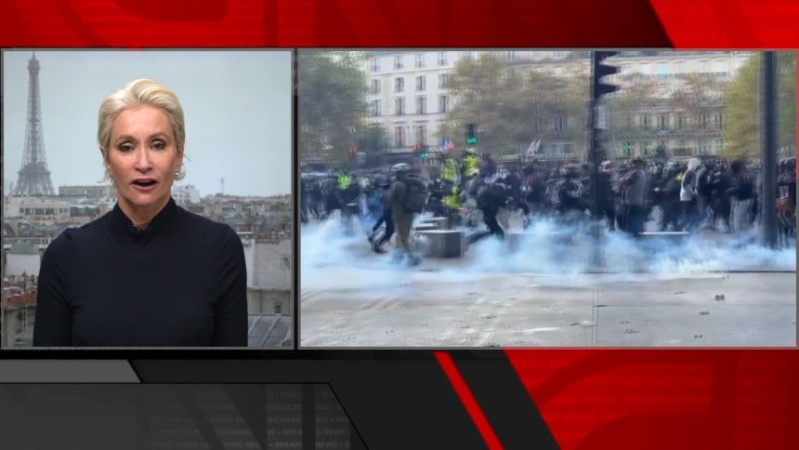
France is bracing for yet another wave of protests this weekend with authorities racing to prevent a repeat of the kind of violence and riots that hit the nation last week.
French authorities will be launching a massive security operation with some 70,000 police officers deployed across the country over the weekend, according to the interior ministry.
Specialist SWAT units, helicopters, armored vehicles, police dogs and water cannons will all be part of the operation. On top of that, the number of French army soldiers that normally patrol Paris as part of the country’s counter-terrorism measures will be increased to free the police from stationary guard duties.
Interior Minister Laurent Nuñez issued a stark warning on Friday to anyone looking for trouble, saying the government would be “uncompromising with those who engage in destruction.”
Last week’s violence followed weeks of protests over education, dismal job prospects and the cost of living. Initially peaceful and attended mostly by students, the demonstrations quickly turned into the worst wave of deadly, nationwide violence in years.
This week, curfews were imposed in some cities to help maintain calm.
Bracing for Saturday
A large demonstration has been called for Saturday afternoon in Paris and French media are expecting hundreds of thousands of people to attend.
The protest is organized by France’s main student union, UNEF, with one of the country’s biggest trade unions, CGT, announcing it would join. Other groups are expected to attend, including farmers, climate activists and the Yellow Vests, the movement that first emerged in 2018 during the protests over fuel costs.
While the protest in Paris has been authorized by the authorities, French President Emmanuel Macron on Thursday banned all non-trade union protests on Saturday as he seeks to control the civil unrest.
But the preparations go well beyond bans and police warnings, especially since last week’s riots sparked criticism of the authorities for not taking the threat seriously enough.
A police officer ties in place a perimeter tape near Chatelet – Les Halles to enforce a curfew, in central Paris on October 20.
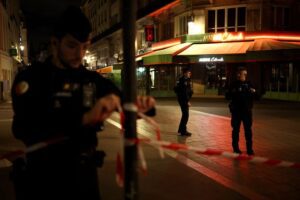
A police officer ties in place a perimeter tape near Chatelet – Les Halles to enforce a curfew, in central Paris on October 20.
Simon Wohlfahrt/AFP/Getty Images
The City of Paris announced earlier this week it was clearing public spaces of equipment and materials that could be used to cause damage, including barriers, bins, construction material and other items.
Many of the main tourist sites in the French capital, including world-famous museums like the Louvre, the Musée d’Orsay and the Musée de l’Orangerie will be closed on Saturday.
Art Basel finished the Paris version of its fair on Friday, two days earlier than scheduled. The Paris National Opera cancelled its performances on Saturday, citing the protests as the reason, and at least two dozen metro stations will also be closed for much of the day, according to Paris municipal authorities.
An NFL game between Pittsburgh Steelers and New Orleans Saints is set to take place at the Stade de France just outside of the capital on Sunday. While the match is scheduled to go ahead, a Steelers fan event in Paris was cancelled by the NFL.
During last weekend’s riots, at least two people died and multiple others suffered serious injuries, including two people who lost their hands. French Justice Minister Gérald Darmanin said some 2,700 people were held for questioning and 232 have been incarcerated in connection to the riots. (CNN)
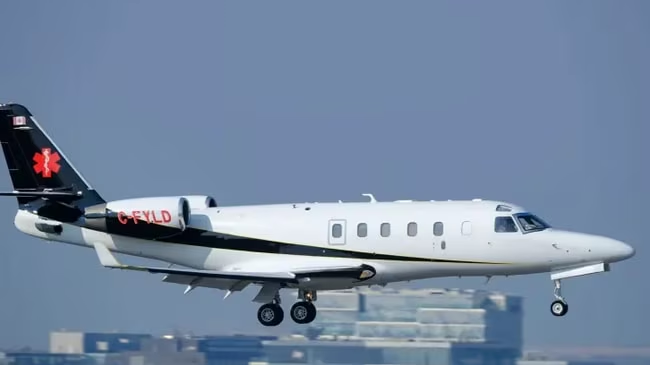
There are grave fears for the passengers of a private plane that suddenly vanished mid-flight, sparking a major search off the coast of the US.
US authorities say the Gulfstream G100 lost contact with air traffic control about 2am local time on Saturday (4pm Saturday AET) while flying from L.F. Wade International Airport in Bermuda to Boston Logan International Airport.
The US Coast Guard said the Federal Aviation Administration alerted it after contact was lost with the aircraft – which plummeted from 23,500 feet to 11,000 feet in just three minutes, according to FlightAware data.
“We are praying for a safe outcome,” a spokesperson for Latitude Air Ambulance, which operates the missing plane, told City News.
A search is now under way off Nantucket in the air and on water as crews work to locate the missing jet, the Coast Guard said. Data from FlightRadar24 showed a number of aircraft searching south of the island.
Six people are missing after a private jet vanished, sparking a major search off the coast of Nantucket in the US.
The plane was en route from Bermuda to Boston when it vanished.
“Air & surface crews have launched in search of the aircraft. Updates will be provided here as info becomes available,” the Coast Guard Northeast District said on X.
The plane was carrying out a medical evacuation in Bermuda – a British overseas territory in the north Atlantic Ocean, according to Clarence Togeretz, Director of Flight Operations at Latitude Air Ambulance.
“We always get rather concerned when our crew doesn’t report to us in a timely manner,” he told NBC News.
“But I will say that again, optimistically and positively, that doesn’t mean that the worst has happened.”
Seventeen people were killed when eight gunmen stormed a bar close to Johannesburg on Saturday evening, with 15 more injured.
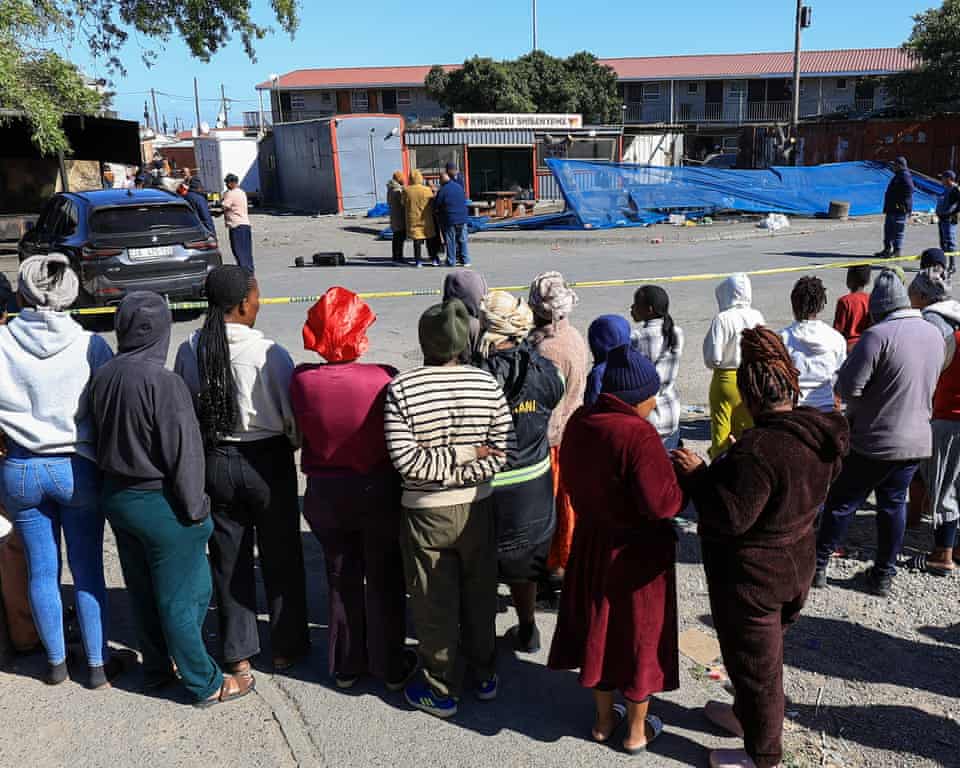
In a separate shooting in the early hours of Sunday morning, 10 people were killed outside an entertainment venue in a township near Cape Town and a further 11 were injured.
South Africa has one of the highest murder rates in the world and has struggled to contain gang-related gun violence in recent years. Police have not indicated a motive for either of the latest attacks.
In Johannesburg, gunmen opened fire on customers outside the bar before continuing the attack inside and torching two vehicles before fleeing.
Police said thirteen men and four women were killed.
Deputy provincial police commissioner Maj Gen Fred Kekana said the attack may have been a retaliation for an incident last month, in which one person was killed and another wounded, according to AFP news agency.
Speaking at the scene, he said police had clear pictures and in some cases names for the suspects.
In Cape Town, five victims died at the scene and a further five people died in hospital.
No arrests had been made in either case on Sunday morning.
The two mass shootings came days after 11 people were killed in the city of Duban when gunmen stormed a house in the KwaMakhutha township.

Illegal weapons are prevalent in South Africa and gun violence has been a persistent problem for decades, with about 60 murders recorded every day in the country of 62 million.
But a recent spate of mass shootings has raised fears that the problem is deepening, with violence often linked to turf wars between gangs engaged in drug trafficking and illegal mining.
In February, President Cyril Ramaphosa called organised crime “the most immediate threat to our democracy, our society and our economic development”.
Earlier this year the military was deployed alongside police in areas with the highest murder rates in an effort to reduce armed violence.
On Saturday a tenth woman’s body was found in Ekurhuleni, to the east of Johannesburg, with local police saying they were unable to rule out a serial killer operating in the area with similarities between the deaths. (BBC)
-
 Features8 hours ago
Mmesoma Umeorini: When Love Turns Deadly, and a Young Woman Pays With Her Life
-
Features3 days ago
Kogi’s Kidnapping Crisis: Why Do Forests Remain Safe Havens for Criminals Under Ododo’s Watch?
-
News3 days ago
Kidnappers kill seven-year-old boy after ransom demand
-
News2 days ago
Macron Postpones Planned Visit to Nigeria Until 2027
-
News2 days ago
UBA Commences Contempt Proceedings Against WEMPCO Directors over Alleged Disobidence of Court Order
-
News1 day ago
Mbah: Why We Built 268 Smart Green Schools Across Enugu State
-
News2 days ago
Enugu CP Orders Probe into Death of Izuchukwu During Police Raid
-
Features6 hours ago
Why Igbos Celebrate New Yam Festival Worldwide: The History, Cultural Significance and Lessons For The Younger Generation