Education
Enugu Smart School Debate and Mbah’s Relentless Vision

By Dan Nwomeh
I have taken time to peruse the avalanche of comments that have trailed the Enugu Government and Sujimoto saga. They range from those who genuinely mean well, to those who think they have finally found the soft underbelly of Governor Peter Mbah’s administration to viciously attack, sometimes for unrelated grudges, to the habitual armchair critics who neither understand nor care to understand the concept of the Smart Green School, nor even what it looks like. I noticed some private school entrepreneurs and their beneficiaries who are threatened by the very idea of tuition-free, free-uniforms, free-learning-materials, and free-meals-per-day Smart Schools. There are also those who persist in asking why the government should construct new schools rather than renovate the existing dilapidated ones, most of them relics of the colonial era, eyesores that stand shamefully beside magnificent churches in many of our villages.

But let us pause and ask: Who among these loud critics would renovate a crumbling family house left by their grandfather when they have the resources and desire to build a new home designed for modern living? Who among them would patch up cracked walls, replace leaking roofs and broken windows, instead of constructing a brand new house with electricity, ensuite rooms, screeded walls and tiled floors, POP ceilings, conduit wiring and plumbing, solar lights, internet connectivity, smart security doors, and CCTV camera surveillance? Who does that? If no one in their right senses does that for their family, why do we want such treatment visited on our children, especially those who cannot afford expensive private schools? Why should we condemn them to learning in depressing classrooms that belong to the past, while their age mates elsewhere enjoy environments tailored for today’s realities and tomorrow’s opportunities? And would those who advocate for renovation alone send their own children to those schools? If not, what does that say of their wish for other people’s children, so long as nobody asks them to pay taxes?
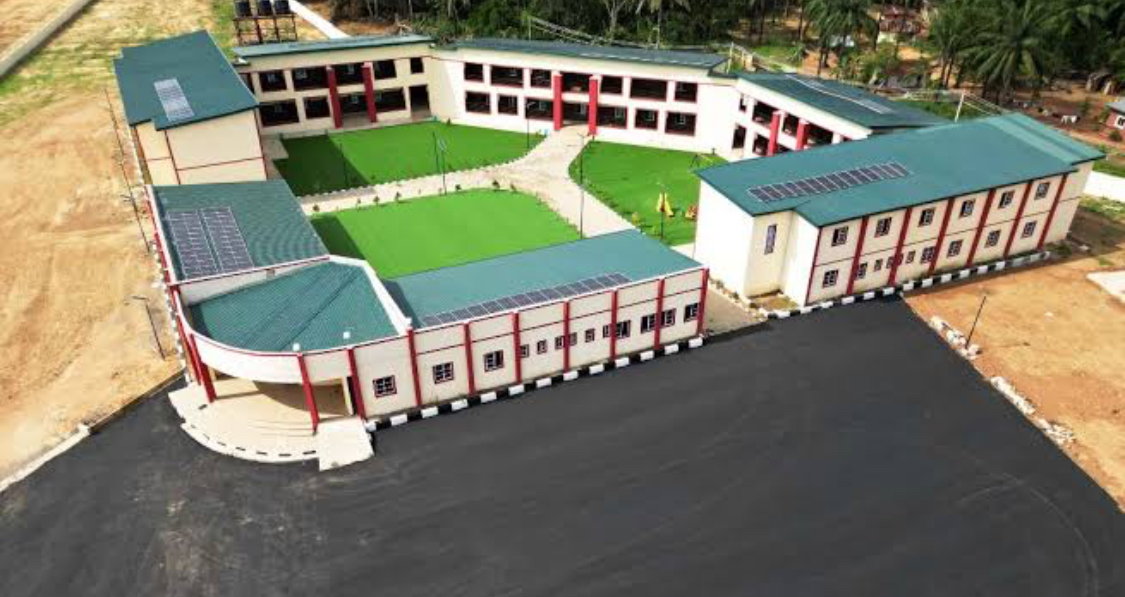
The Smart Schools initiative is not about erecting just another set of classrooms; it is about redefining the very idea of education in Enugu State. The brick and mortar, 260 expansive pentagon-shaped buildings across all wards, are only the beginning. Within those walls lie the foundations of an entirely new model of learning, a complete shift from rote memorization to experiential, hands-on education. A space where tech and innovation are embedded into daily learning — coding and robotics, digital labs and libraries, innovation hubs, and multimedia studios. These schools are designed to prepare our children not only to pass exams, but to create tools, solve problems, and compete with their peers across the world. The children of Enugu deserve better. For too long they have been cheated, their today and tomorrow denied and mortgaged, forced to endure outdated structures and outmoded methods while their counterparts in organized societies moved ahead.

Entrance to an Enugu Smart School structure

Governor Mbah has left no one in doubt as to the depth of his commitment. He has said repeatedly that his dream is for his grandchildren, if not his children, to be educated in the Smart Schools right here in Enugu. He is not allocating 33% of the state budget to education, back-to-back in two years, if he did not consider this the most consequential paradigm shift in the life of our state. Investment and spending are always a statement of priority, and in Mbah’s case, he is literally putting our money where our mouths are.
It is therefore astonishing that some would question the integrity of the governor, who has shown uncommon transparency in this entire matter. When questions arose over Sujimoto, owned by Olasijibomi Ogundele, it was the governor himself who invited the Economic and Financial Crimes Commission (EFCC), opened the books, and placed every transaction on the table for scrutiny. Who does that if he has anything to hide? Which leader engaged in shady deals has so openly embraced accountability, welcoming investigators to track the financial trails? If anything, this is the clearest sign that the governor has nothing to conceal, only a determination to deliver a bold vision for our children.
Some have even raised the disappointing argument of why 22 Smart Schools were awarded to a Yoruba contractor in the first place. But this is petty tribalism at its worst, however it is dressed. Let’s face it: should an Enugu boy who conquered the downstream oil sector in Lekki, Lagos, thanks to the accommodation and support he enjoyed there, end his story by erecting walls of ethnic suspicion at home? Do Igbo contractors not get contracts in Lagos, Abuja, Kano, and elsewhere? Why then should 22 schools out of 260, a mere 8.4 percent, be turned into an ethnic slur? What matters is whether the job is delivered, not where the contractor comes from. A Yoruba contractor may have failed Ndi Enugu, but his failure lies squarely with him.
Sujimoto tried to rationalize his failure by citing price increases. Yet other contractors delivered the same Smart Schools within the same cost framework. He also argued that N523 million per school (buildings only, it must be added) was insufficient, but that claim only further demolishes the falsehoods of government critics. If indeed the amount was not enough, then it proves there was no contract padding, and no excess slush funds to siphon. This is a case of a contractor with fraudulent motive ab initio, a contractor defaulting on a contractual agreement, not of a government conniving in fraud.
Our people love to speak of Lee Kwan Yew of Singapore, the man who transformed a small island into a global economic powerhouse. Yet very few care to understand the painful side of reforms, the sacrifices the people endured for the tomorrow they now enjoy. Smart Schools are that kind of reform. They may disrupt the old order, they may demand more investment and patience, but they are the road to a future where Enugu’s children are no longer left behind. Greatness is never built on convenience; it is built on vision, sacrifice, and perseverance.
The Smart Schools are far too advanced to be derailed. Beyond the hoopla, the construction and equipping of these schools are ongoing across the state, with many already completed and equipped. The vision is undimmed and the pace undeterred, whatever the minor challenges. The governor remains focused on giving our children a new learning experience, one that rivals the best private schools and outclasses anything public education in this state has ever known. It is not about optics; it is about outcomes. It is about ensuring that the child in my village of Ozalla, or in Umuida, or Nkwe, has the same chance at a 21st-century education as the child in advanced societies.
In the end, the voices of destructive criticisms and sponsored attacks will fade. Those attacking the government today will tomorrow return to praise it because results will speak louder than rhetoric. When the Smart Schools open their doors, when children in uniform sit behind computers, design robots, create gadgets, act on modern stages, learn in well-lit classrooms cooled by solar power, use digital boards and android tablets with internet access, and are inspired by teachers trained in modern pedagogy, the truth will be undeniable that Enugu State has raised a new standard in public education and produced new generations of tech-savvy children equipped to take on the world.
Again and again, Governor Mbah will not be deterred by detractors. He is not in the business of appeasing cynics or seeking public applause or cheap popularity. He is in the business of preparing our children for a tomorrow that is already here.











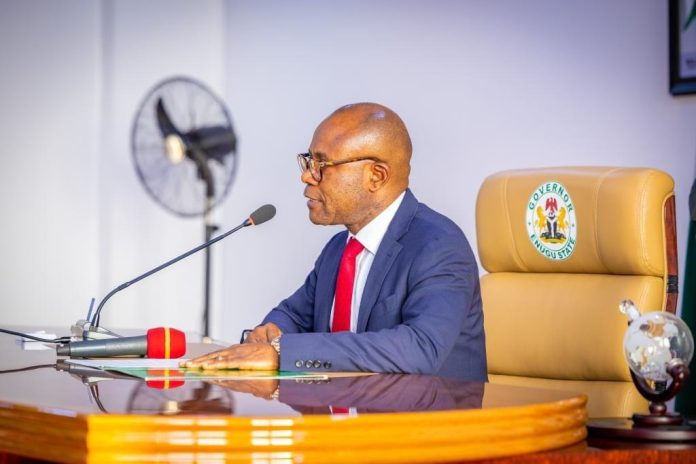
The approval was contained in a letter signed by the Secretary to the Enugu State Government, Prof. Chidiebere Onyia, dated August 11, 2026, and addressed to the Accountant General of the state.
According to the letter, the approval followed a report submitted by the Joint Action Committee on Trade Union (JACTU) in ESUT over issues surrounding a one-month strike ultimatum issued by the university’s unions.
The government also approved an across-the-board increase of N50,000 for all other categories of staff of the university.
The SSG directed the Accountant General to fully implement the approval of Governor Peter Ndubuisi Mbah.
The directive referenced an earlier Government House letter dated August 7, 2026, on the matter.
The letter, which was copied to the Vice-Chancellor of ESUT, Professor Aloysius-Michaels Okolie, for information and necessary action, is expected to take effect from September 1, 2026.
Education
Digital Economy Boost: NCC Leases Digital Industrial Park, Learning Centre to Enugu State Gov’t

…NCC’s CEO lauds Mbah’s Smart Schools, infrastructural, digital capacity initiatives
In a major boost to President Bola Tinubu’s digital economy agenda, the Nigerian Communications Commission (NCC) and the Enugu State Government, on Tuesday, sealed a strategic 15-year lease of the agency’s Digital Industrial Park and Learning Centre to the Enugu State Government.
The move would see the Enugu State Government take over and optimise the facilities located in the state capital as the Enugu Talent City and Artificial Intelligence (AI) Institute in line with the digital economy drive of the Governor Peter Mbah Administration.
Speaking during the lease agreement signing ceremony at Government House, Enugu, the Executive Vice Chairman/CEO of NCC, Dr. Aminu Maida, said the arrangement fully aligned with the Renewed Hope Agenda of the President Bola Tinubu Administration, and its ambition to grow Nigeria into a $1 trillion economy driven by productivity, innovation and private sector growth.

Maida stressed that Mbah had shown a clear agenda to build Enugu State into a digital economic powerhouse through deliberate investment in education, infrastructure, innovation and digital capacity, maintaining that the Mbah Administration was well positioned to advance the objectives for which these facilities were established.
“Our expectation is that this partnership will support Enugu’s ambition to become a leading destination for digital services, artificial intelligence, startup incubation, outsourcing, research and technology-enabled enterprise.
“We also expect these facilities to become spaces where young people acquire relevant skills, entrepreneurs transform ideas into viable businesses and local enterprises connect to opportunities beyond Enugu and Nigeria.
“These facilities were conceived as platforms for innovation, entrepreneurship and human capital development. They were designed to deepen digital skills, support startups, attract investment, create jobs and position Nigeria as a competitive destination for business process outsourcing, knowledge process outsourcing and other technology-enabled services.
“In essence, they were built not merely as physical assets, but as platforms for developing the people and enterprises that will power Nigeria’s digital economy.
“So, for us at the NCC, completing physical infrastructure is only the beginning. Buildings alone do not create innovation. People do. Ideas do. Entrepreneurs do. And partnerships bring all these elements together,” he said.
The NCC boss also commended Governor Mbah’s investment in Smart Green Schools, saying he was building an economy prepared for the future.
“Physical infrastructure is essential to development, but infrastructure alone cannot deliver lasting prosperity. This is what makes the Smart Green Schools initiative significant. It recognises that preparing our children for tomorrow must begin today. Technology-enabled schools, digital learning facilities, robotics and artificial intelligence laboratories demonstrate an understanding that education must evolve alongside technology. That is leadership with the future in mind.
“Investment in education and skills raises productivity, expands economic opportunity and strengthens the ability of individuals and businesses to create value.
“This is even more important today. Artificial Intelligence is reshaping industries. Automation is changing the nature of work. Digital technologies are transforming how governments serve citizens and how businesses operate,” he concluded.
Speaking, Governor Peter Mbah commended President Tinubu for recognising the centrality of the digital economy to the $1 trillion economy he seeks to build, as well as for understanding that much of that growth would come from the states.
He noted that AI would contribute about $20 trillion to the global economy by 2030, saying, “It is not a space you want your young ones to be missing.”
“We also believe that our talents, our brightest talents, should not be exported in person. We believe that they should export their talents outside the country from here, and that is why we see huge benefits in these assets in terms of job creation and opportunities for our young people.
“We are also looking at transforming the Digital Bridge Institute into a world-class AI institute. We will also transform the Digital Industrial Park. If you have followed the news, we have already taken steps, working with some teams from Qatar, to make sure that it becomes a certification centre for AI on the continent.
He said the NCC would not regret its decision to temporarily hand over the facilities to Enugu State.
“I am sure that a few years down the line, we can come back here and be very proud of the decision we made today to activate these assets and to make sure that they are productive,” he concluded.
Earlier in his remarks, the Special Adviser to the Enugu State Governor on Digital Economy and Micro, Small and Medium Scale Enterprises (MSMEs), Arinze Chilo-Ofia, thanked the FG and NCC for the confidence reposed in Enugu State to activate and optimise the two strategic assets and ensure the realisation of the objectives for which they were conceived and built.

The Joint Admissions and Matriculation Board (JAMB) has announced the sales of registration forms for the 2026 Unified Tertiary Matriculation Examination (UTME) and Direct Entry (DE) admissions for the 2026/2027 academic session.
JAMB stated this in a post on its X handle on Tuesday night.
“UTME is open to suitably qualified candidates for admission into Nigerian tertiary institutions for the 2026/2027 academic session,” the photo statement signed by its Registrar, Ishaq Oloyede, read.

“Registration commences January 2026 and closes March 2026 (exact dates to be announced by JAMB),” the post read, disclosing that the UTME examination is scheduled to hold in April 2026.
“The period of registration for UTME candidates, including those from foreign countries, is from Monday, 26th January, 2026 to Saturday, 28th February, 2026,” the statement read in part.`
According to JAMB, candidates must have obtained their National Identification Number (NIN) before registration.
The agency said, “Only candidates who will not be less than 16 years old by 30th September, 2026 are generally eligible to apply/be considered.”
But it clarified that, “Candidates less than 16 years old by 30th September, 2026 will have to undergo an intensive evaluation to determine their eligibility for a waiver. Such must have scored not less than 80% in each of UTME/ALEVEL, PUTME, SSCE, and in the exceptional candidate assessment.”
“The UTME results of the underage candidates will be released only at the conclusion of the complete evaluation process,” JAMB said.
For Direct Entry candidates, the “Sale of 2026 Direct Entry (DE) application documents and E-PIN vending would commence from Monday, 2nd March, 2026, and end by Saturday, 25th April, 2026, and would only be at the Board’s State and Zonal Offices.”
“The 2026 UTME will commence on Thursday, 16th April, 2026 and end on Saturday, 25th April, 2026,” JAMB wrote. “Mock-UTME (optional) shall hold on Saturday, March 28th, 2026.”
-
 News1 day ago
2027: Why I wont attend every campaign rally – Tinubu
-
News14 hours ago
How Senator Mandiya died after bathroom fall in Abuja Home – Ningi
-
News12 hours ago
Senate fumes over death of NYSC Corps member at Enugu Camp, orders probe
-
Features2 days ago
Aguleri/Umuoba Anam Crisis: The Bloody Battle Between Close Neighbours
-
News1 day ago
EFCC probes Atiku over alleged corruption committed as Vice President
-
News2 days ago
‘Anyone who attempts suicide and fails will go to jail,’ says Akpabio
-
News3 days ago
BREAKING: Soludo, Wike, Adeleke, others appointed member of APC Presidential Campaign Council
-
Features3 days ago
Enugu Political Flashpoint: Mbah orders Impartial Probe as NDC Incidents Trigger Controversy