Faith
Run away from that leprosy


By Gabriel Agbo
Gehazi
We saw how Gehazi, the Elisha’s servant brought the generational curse of leprosy upon himself, his children, and his descendants forever; just because of greed, deception and disloyalty. God had used Prophet Elisha to cure Naaman; an Aramean army general of his leprosy. The soldier with joy and gratitude brought gifts to the man of God; which he rejected. As the general (now a new convert) was going home, promising to serve the God of Israel, the greedy Gehazi ran after him. Gehazi met him and lied to him that his master Elisha sent him to collect some of those gifts he had earlier rejected. He collected and hid them. But as he was coming in, the prophet told him all about his treacherous actions and promptly issued a generational curse upon him.

“Because you have done this, you and your children and your children’s children will suffer from Naaman’s leprosy forever’ When Gehazi left the room, he was leprous; his skin was as white as snow.”
2 kings 5: 27
Gehazi was indeed a treacherous person. Greed pushed him to run after Naaman. When he caught Naaman, he lied with his master’s name and when he was coming back he hid the ill-gotten gifts. As if that was not enough, he again lied to his master, who was asking him where he was coming from. I wonder what he had been learning from the prophet while he was with him. He was indeed deceptive, disloyal and treacherous. For all these, he succeeded in destroying his and his descendants’ destinies forever. Falsehood, deception, disloyalty and betrayal can never go unpunished. Never!

Gibeonites
The Gibeonites also resorted to deception to save themselves from the Israelites and that action eventually turned them and their generations into wood choppers and water carriers. Be careful! See it:
“Joshua did not allow the people of Israel to kill them. But that day he made the Gibeonites the woodchoppers and water carriers for the people of Israel and for the altar of the LORD – wherever the LORD would choose to build it. That arrangement continues to this day.”
Joshua 9:26-27.
Paying Evil for Good
Another treacherous act that brings generational curse upon an individual, family or people is paying evil for good. That is when you deliberately reward somebody who has done well to you with evil. This brings terrible curses not just to the individual, but to their family. The bible said in Proverbs 17:13 that,
“If you repay evil for good, evil will never leave your house.”
That is, you must make sure that you always repay good for good. You must make sure that you don’t betray a person who has favored you. If you do otherwise, the bible says that evil will come to your house, family and make a permanent abode. Some other translations say that it (evil) will remain in your house (family). And house here again means family and you know that anything that has to do with the family has already gone generational; because it will affect the children, children’s children and may go on and on. You must ensure always, without fail that you repay good for good. Even the bible said that we should go beyond that to do well to those who did evil to us. True!
David had this terrible experience from the people he favoured. They paid him evil for good and he consequently asked God to give them their due reward – punishment (curses). Let us read Psalm 35:12-13, “They repay me with evil for the good I do. I am sick with despair. Yet when they were ill, I grieved for them. I even fasted and prayed for them, but my prayers returned unanswered. I was sad, as though they were my friends or family, as if I were grieving for my own mother.”
Then in Psalm 109:1-5,
“O God, whom I praise, don’t stand silent and aloof while the wicked slander me and tell lies about me. They are all around me with their hateful words, and they fight against me for no reason. I love them, but they try to destroy me – even as I am praying for them! They return evil for good, and hatred for my love.”
Like I said earlier, David had a dose of treachery from men. From his son to his friends, his advisers to adversaries. Even King Saul, while David was showing him kindness, he was busy making every possible plan to terminate the young boy’s life out of jealousy. David then called upon God to defend and fight for him. Every victim of treachery makes one form of prayer or the other, even if it is not audible. And most times, it is a call against the treacherous person. A call for justice and God’s defence, and it is always answered. David said, “God don’t stand silent and aloof.” Did God answer him? Yes! Just check out how all his enemies, including the treacherous ones ended. Jesus, Paul, and others also reaffirmed that a betrayer is cursed. In fact, Jesus said that He knew that He was going to be betrayed, but cursed is the man that would allow himself to be used as the instrument; that it would be better he was not born. Treachery will always attract curses upon a person and his next generations.
In the case of Ham, it made them servants. For Gehazi and his descendants, it was leprosy. Gibeonites – woodchoppers and water carriers. And for those who pay evil for good, they and their next generations shall have evil dwelling permanently in their families. Watch the treacherous person and his descendants; it has never been well with them. For whatever a man sows, that he must surely reap. Be careful! Now, you have the opportunity to pray for forgiveness of those treacherous acts of yours, your parents and your family. Bow your head and admit to the Lord that you are sorry for those ungodly acts. Ask him to remove any sin that is against your bloodline. And if you have inherited anything that does not glorify him, ask him to remove it from you, your children and your children’s children. Renew your pledge to His kingdom and government, then stand and guard against the devices of the enemy. We will continue next week. God bless!
Rev Gabriel Agbo is the author of the books / audiobooks: Power of Midnight Prayer, Receive Your Healing, Breaking Generational Curses: Claiming Your Freedom, Never Again!, I Shall Not Die, Move Forward, Power of Sacrifice and many others. Tel: 08037113283 Facebook: Gab Agbo E-mail: gabrielagbo@yahoo.com Website www.authorsden.com/pastorgabrielnagbo Twitter: pastorgabagbo Whatsapp: 08164819333



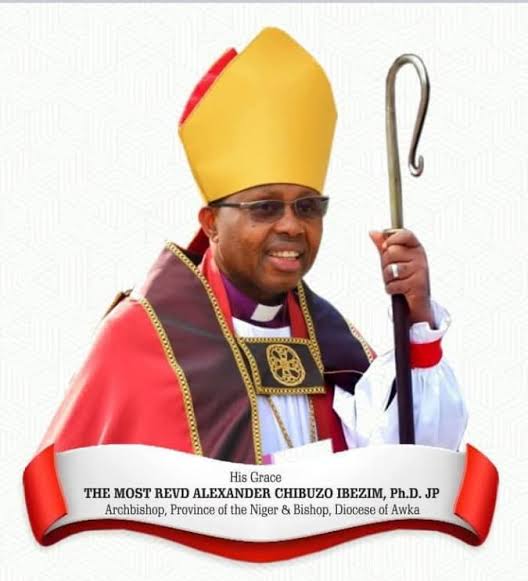
…Insists Archbishop remains in office, warns against interference by Ezeofor
By Tony Edike
The Diocesan Board of the Diocese of Awka, Anglican Communion, has rejected the six-month compulsory leave imposed on the Archbishop of the Province of the Niger and Bishop of Awka Diocese, Most Rev. Alexander Chibuzo Ibezim, by the Primate of the Church of Nigeria, Most Rev. Henry C. Ndukuba.
The board also rejected the appointment of Bishop Samuel C. Ezeofor as Supervising Bishop of Awka Diocese and Coordinating Bishop of the Province of the Niger, describing the decisions as unlawful, unjustified and contrary to the church’s governing provisions.
The resolutions were contained in a communiqué issued after an emergency meeting of the Diocesan Board held on Friday, October 16, 2026, at the Chapel of Divine Favour, Anglican Village, Ifite Awka, Anambra State.
The meeting deliberated on a letter dated October 13, 2026, issued by Ndukuba directing Ibezim to proceed on six months’ compulsory leave and appointing Ezeofor to oversee the diocese and province during the period.
The board argued that the Primate lacked the constitutional authority to compel Ibezim to proceed on leave or transfer his episcopal responsibilities to another bishop.
It maintained that neither the Constitution and Canons of the Church of Nigeria (Anglican Communion) 2020 nor the Constitution and Regulations of the Diocese of Awka 2023 empowered the Primate to take such action.
According to the communiqué, Section 29(1) of the church’s constitution, which the Primate reportedly cited in his letter, did not authorise the compulsory leave or the appointment of another bishop to assume Ibezim’s duties.
The board further argued that the decision violated Ibezim’s constitutional rights, including the presumption of innocence under Section 36(5) of the 1999 Constitution of Nigeria, as amended, and the right to freedom of thought, conscience and religion under Section 38(1).
Cites pending court cases
The board also faulted the Primate’s decision on the grounds that several cases involving Ibezim and allegations against him were pending before the High Court of Anambra State.
It listed three cases: Suit No. A/Misc. 446/2025, involving Ibezim and the Economic and Financial Crimes Commission; Suit No. A/Misc. 494/2026, involving Ibezim and the Inspector-General of Police and others; and Suit No. A/371/2026, involving Ibezim, Ndukuba and another defendant.
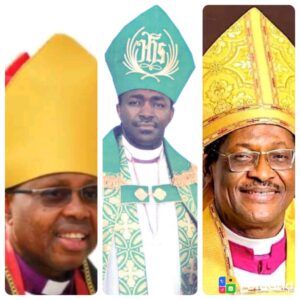
Archbishop Ibezim, Bishop Ezeofor and Primate Ndukuba
The board argued that the matters were sub judice and that the church authorities should refrain from taking actions capable of interfering with the issues before the court.
It further alleged that injunctions granted on September 9, 2025, against the EFCC and Prince Echezona Bonti Onuigbo were renewed by consent of the parties on October 14, 2025.
The communiqué also referred to pending motions seeking to restrain the Primate from issuing suspension letters or taking further steps that could affect Ibezim’s tenure as Archbishop of the Province of the Niger and Bishop of Awka Diocese.
The board maintained that the appointment of a supervising bishop while the legal proceedings remained unresolved amounted to an attempt to pre-empt the outcome of the cases.
Questions inquiry process
The Diocesan Board also challenged the explanation that Ibezim’s compulsory leave was intended to facilitate an impartial inquiry into the affairs of the diocese and promote peace and reconciliation.
It alleged that Ndukuba had previously constituted two panels to investigate allegations against Ibezim but had withheld their reports.
According to the communiqué, the first panel was established through a letter dated August 13, 2025, and headed by Justice Babashola Ogunade, while the second was constituted on June 17, 2026, under the leadership of Archbishop Blessing Enyindah.
The board argued that the failure to release and process the reports violated provisions of the Church of Nigeria’s Constitution and Canons, particularly Sections 75 and 76, which it said prescribe procedures for submitting, considering and ratifying the findings and recommendations of inquiry panels.
It maintained that the reports should be considered by the Episcopal Synod, with the relevant recommendations subjected to the prescribed approvals of the Standing Committee and General Synod.
Reaffirms confidence in Ibezim
Despite the allegations against Ibezim, the board expressed confidence in his leadership and insisted that he remained the duly recognised Bishop of Awka Diocese and Archbishop of the Province of the Niger.
It urged him to continue discharging his episcopal responsibilities, adding that the diocese remained peaceful, united and progressive.
The board also dismissed allegations of financial impropriety against the archbishop, insisting that no diocesan funds had been missing, stolen, misused or misappropriated by him.
It further claimed that neither of the two inquiry panels had indicted Ibezim for financial misconduct.
The board commended the archbishop for what it described as massive infrastructural development in the diocese and urged him not to be distracted by the controversy.
These assertions represent the position of the Diocesan Board as stated in the communiqué.
Warns Ezeofor, threatens withdrawal
The board warned Ezeofor against interfering in the affairs of Awka Diocese, urging him to concentrate on his responsibilities as Bishop of Aguata Diocese.
It cautioned that it would not accept any attempt to destabilise the diocese and threatened to seek legal remedies and involve law enforcement agencies if its warning was ignored.
The communiqué also directed all organs of Awka Diocese to remain loyal to Ibezim and continue their lawful activities, while rejecting what it described as interference or directives from Ezeofor.
It warned that members or diocesan organs that failed to comply with the directive could face appropriate sanctions.
In its strongest warning, the board threatened that Awka Diocese could withdraw from the Church of Nigeria (Anglican Communion) and continue under the Church of England if Ndukuba and Ezeofor persisted in what it described as unlawful interference in the diocese’s affairs.
The communiqué was signed by Sir B.E.I. Nwofor, SAN, Lord Chancellor of the Diocese of Awka; Ven. K.E.N. Chukwukamma, PhD, Synod Secretary; and Mr Eugene Chukwudi Okonkwo, Lay Synod Secretary.
The development marks a further escalation of the leadership dispute within the Anglican Church, with the Diocesan Board openly challenging the Primate’s directive and threatening a possible separation if the disagreement is not resolved.
The Primate and Bishop Ezeofor could not be reached for comments as of the time of filing this report. Their responses will be included in subsequent updates if made available.
Faith
BREAKING: Anglican Church Places Archbishop Ibezim on Six-Month Leave, Bars Him From Church Duties
Primate appoints Bishop Ezeofor to oversee Awka Diocese, Province of the Niger amid investigation
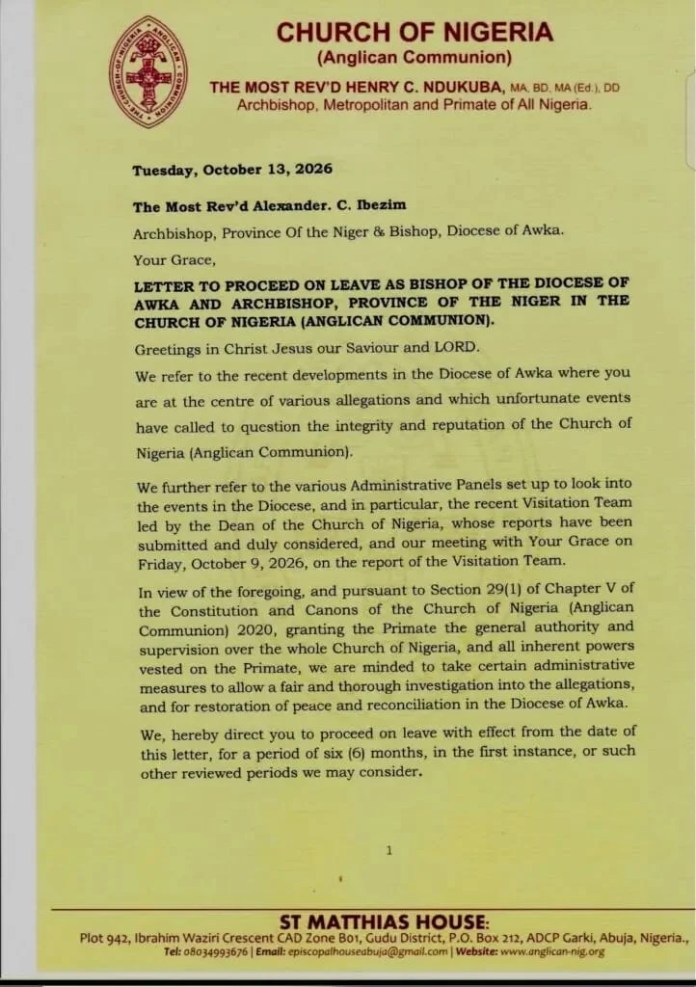
The Church of Nigeria (Anglican Communion) has directed the Archbishop of the Province of the Niger and Bishop of the Diocese of Awka, Most Rev. Alexander C. Ibezim, to proceed on six months’ leave with immediate effect amid investigations into allegations and recent developments within the diocese.
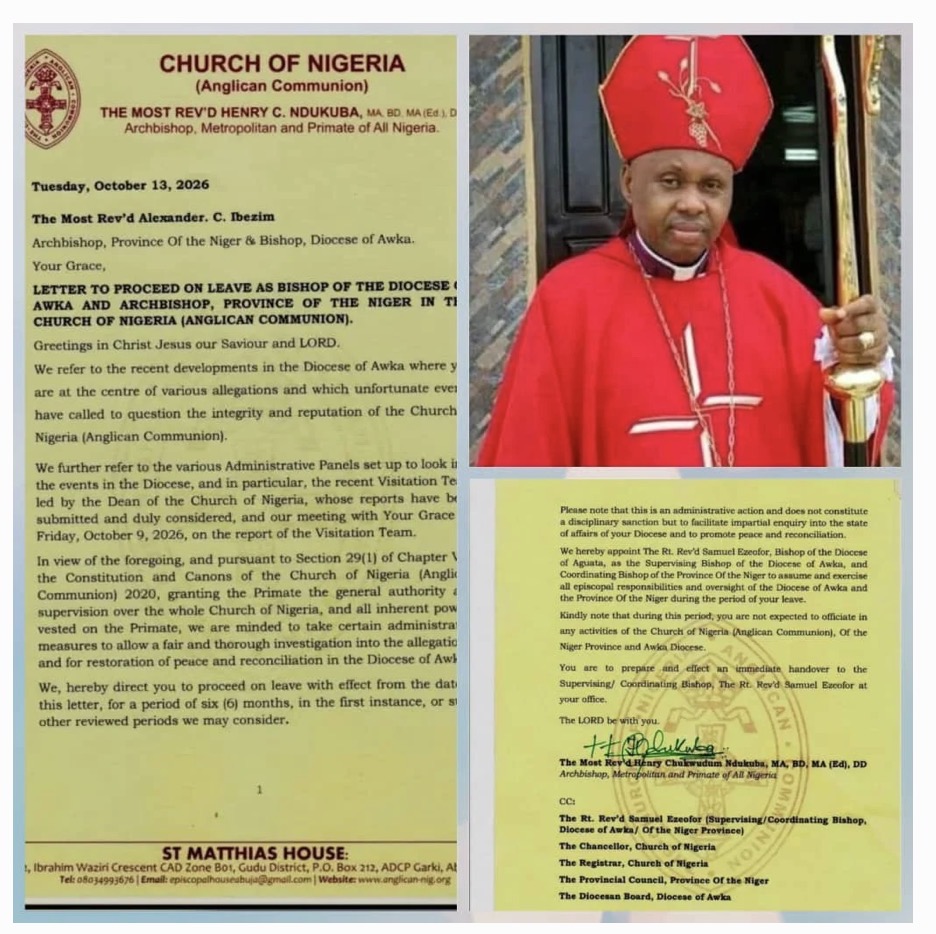
The Primate of the Church of Nigeria, Most Rev. Henry C. Ndukuba, announced the decision in a letter dated Tuesday, October 13, 2026, while appointing the Bishop of the Diocese of Aguata, Rt. Rev. Samuel Ezeofor, as Supervising Bishop of the Diocese of Awka and Coordinating Bishop of the Province of the Niger during Ibezim’s absence.
Screenshot
In the letter addressed to Ibezim, Ndukuba said the decision followed developments in the Diocese of Awka that had raised concerns about the integrity and reputation of the Church of Nigeria.
He referenced administrative investigations into the matter, particularly the report of a visitation team led by the Dean of the Church of Nigeria, which had been submitted and considered by the church leadership.
The Primate also cited a meeting with Ibezim on Friday, October 9, during which the visitation team’s report was discussed.
According to the letter, the directive was issued pursuant to Section 29(1) of Chapter V of the Constitution and Canons of the Church of Nigeria (Anglican Communion), 2020, which provides for the Primate’s general authority and supervisory powers over the church.
Ndukuba explained that the administrative measure was intended to facilitate a fair and thorough investigation, while creating an opportunity to restore peace and promote reconciliation within the Diocese of Awka.
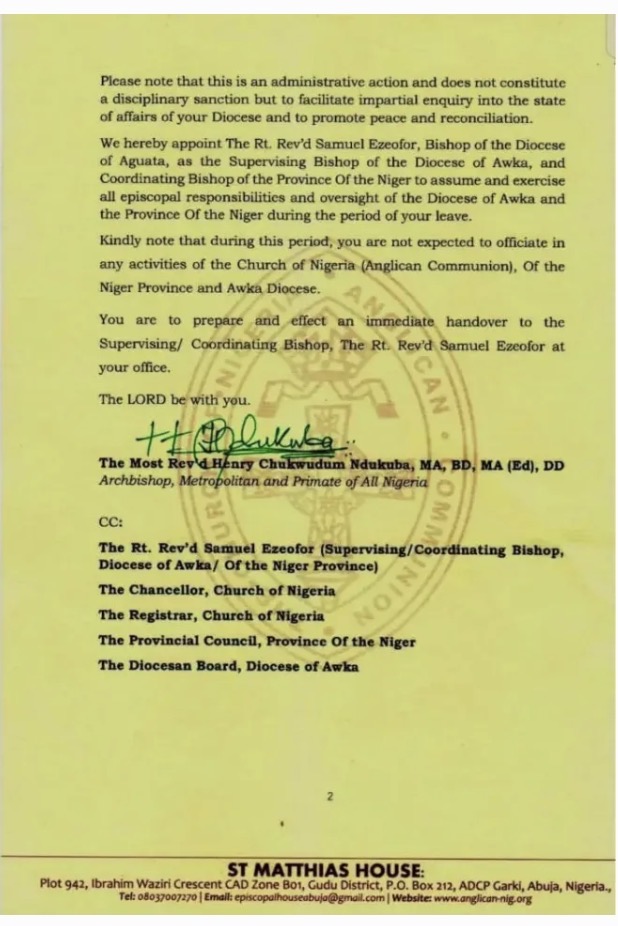
He stressed that the leave should not be interpreted as a disciplinary sanction but as an administrative arrangement designed to allow an impartial inquiry into the issues affecting the diocese.
The letter stated that the leave would last for an initial period of six months, subject to any revision the church leadership might consider necessary.
During this period, Ezeofor will assume episcopal responsibilities and oversee the affairs of both the Diocese of Awka and the Province of the Niger.
Ibezim was also directed not to officiate at any activities of the Church of Nigeria (Anglican Communion), the Province of the Niger or the Diocese of Awka throughout the period of his leave.
The Primate further instructed the archbishop to make immediate arrangements to hand over his responsibilities to Ezeofor at his office before departing.
Copies of the letter were sent to Ezeofor, the Chancellor and Registrar of the Church of Nigeria, the Provincial Council of the Province of the Niger and the Diocesan Board of the Diocese of Awka.
Background to the controversy
Although the letter did not disclose the specific allegations against Ibezim or provide details of the visitation team’s findings, reports have linked the controversy to allegations that the archbishop sold church lands valued at more than ₦2 billion without authorisation.
The allegation reportedly triggered a legal and ecclesiastical dispute, alongside speculation that the Economic and Financial Crimes Commission (EFCC) was seeking to arrest the archbishop.
The development followed a petition dated July 28 and submitted to the EFCC’s Enugu Zonal Directorate by Chief G. Tagbo (SAN) of Ike Ike Associates on behalf of Echezona Onuigbo, a member of St. Faith Cathedral, Awka.
However, an arrest was reportedly restrained by the Anambra State High Court sitting in Awka following an order granted by Justice F. I. Aniukwu in response to a motion ex parte dated September 4, 2025. The application was filed by Ibezim through his counsel, B. E. I. Nwofor (SAN).
The controversy also reportedly resulted in the removal of the Chancellor of the Diocese of Awka, Hon. Justice O. J. Okeke (retd.), by the archbishop.
The circumstances surrounding the allegations and the outcome of the church’s ongoing investigation remain unclear, as the Primate’s letter did not disclose the details of the findings or specify the allegations under investigation.
The six-month leave and the appointment of Ezeofor mark a significant administrative development in the leadership of the Diocese of Awka and the Province of the Niger as the church seeks to address the issues and restore stability.
The letter:
Screenshot

Twelve years after his ministry in Kenya, East African Italian-born Catholic priest Sandro Ferretto has married Sharon Jepng’ok, a Tugen woman from Baringo County.
According to Kenya Times, the couple exchanged vows in a traditional ceremony on 6 September at Seretion Village in Kasiela, a community where Mr Ferretto previously served as parish priest.
The event brought together relatives, local leaders, elders and friends of the bride, who witnessed the Koito ceremony, a significant Kalenjin custom centred on dowry negotiations and family blessings.
Ferretto’s ministry
Mr Ferretto, 55, began his priesthood in Italy before taking his ministry to Kenya, where he spent more than a decade working with local communities.
The Diocese of Padua ordained him as a priest, and he arrived in Kenya in 2008 to begin missionary service. He worked around Kasiela and Mochongoi under the Diocese of Nyahururu and became involved in pastoral outreach, youth programmes and community-based development efforts in Baringo.
He eventually returned to Italy in December 2020 with another missionary, Fr Mariano Dal Ponte.
In 2023, the priest assumed responsibility for a pastoral unit in Saletto, Borgo Veneto, in the Padua diocese. His duties covered eight churches in the area.
His tenure, however, lasted only several months. In December 2023, he celebrated a final Mass before stepping aside from the position to take time for reflection.
The decision reportedly caught some of his colleagues off guard because he gave them little notice.
The Diocese of Padua later acknowledged his withdrawal from pastoral duties, stressing that he continued to serve as a priest and had no connection to any controversy. The diocese described the decision as a requested period away from pastoral ministry.
During his break, Mr Ferretto was reportedly involved in volunteer work with a migrant support group in Padua.
Reunion and law
Mr Ferretto later returned to Kenya and reunited with Ms Jepng’ok, whom he met during his missionary work in Baringo.
Residents of the area widely knew him as “Father Sandro” after he spent more than a decade working with families, youth organisations and church congregations. Baringo is also Ms Jepng’ok’s home region.
Catholic canon law requires Latin Rite priests to observe celibacy and bars them from marrying while they remain in active ministry. The Church considers the commitment a lifelong obligation of the priesthood.
For a priest to marry, he must first be formally removed from the clerical state through a process approved by the Vatican. Known as laicisation, the process ends his status as a priest and normally includes a dispensation from the obligation of celibacy.
Only after receiving the necessary approval can a former priest marry. Without it, the marriage would contravene Catholic canon law and would not be recognised by the Church.
-
 News2 days ago
BREAKING: El-Rufai Tests Positive for Drug-Resistant Bacteria, Shows Signs of Possible Severe Infection—Report
-
News2 days ago
FG kicks off $100m Southeast gas pipeline project
-
News3 days ago
Ifeanyi Ubah’s Elder Sister, Fidelia Chigbogu, Dies Suddenly at 61
-
News3 days ago
Terrorists Abduct Sunday Igboho’s Iru Ekun Security Group Members in Kwara
-
News16 hours ago
Mbah Denies Alleged Order to Block Opposition Town Hall Meeting
-
News1 day ago
Governor Bago’s Convoy Accident Kills Four University Students, Driver
-
International23 hours ago
Spain Train Crash Kills at Least 64, Leaves 80 Injured
-
News3 days ago
Mbah Vows to Sign Bill Curbing Excessive Agency, Lawyers’ Fees in Enugu