International
Suspect killed after firing shots near White House security checkpoint in US, Secret Service says

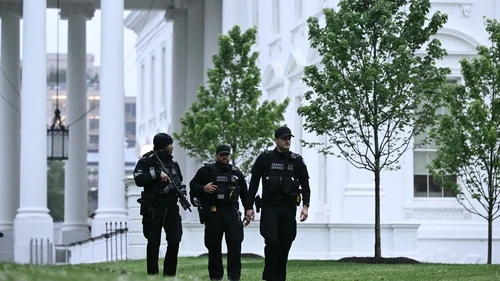
A man who opened fire Saturday near a White House security checkpoint is dead after being shot by officers who returned fire, the U.S. Secret Service said. It was the third incidence of gunfire in the vicinity of President Donald Trump in the past month.
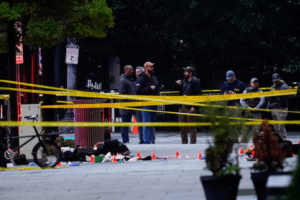
The law enforcement agency said in a statement posted on X that the man was in the area of 17th Street and Pennsylvania Avenue when he “pulled a weapon from his bag” shortly after 6 p.m. EDT and began firing. Secret Service officers returned fire and hit the suspect, who died at a hospital, the agency said.

The suspect was identified as 21-year-old Nasire Best, said a law enforcement official who spoke on the condition of anonymity because they were not authorized to discuss the investigation.
According to District of Columbia court records, Best was arrested in July 2025 after he attempted to enter a different White House checkpoint without authorization, didn’t heed officers’ commands to stop, “claimed he was Jesus Christ” and said he wanted to be arrested.

An initial hearing was held and a “Pretrial Stay Away Order” was issued, typically a measure ordering a defendant not to go near a person or area before a trial. A bench warrant was issued in August after a notice of “noncompliance” against Best, who did appear for a subsequent hearing.
Latest gunfire incident around Trump
It was the third time in the past month that shots were fired near the president after incidents at the White House Correspondents’ Association Dinner in April and near the Washington Monument earlier in May.
A bystander was also struck on Saturday, but a law enforcement official said it wasn’t clear whether that person was hit by the suspect’s initial bullets or those fired subsequently by officers.
Secret Service said none of its officers were injured, and that Trump — who was at the White House at the time — was not “impacted.” Trump originally was scheduled to spend the weekend at his New Jersey golf club but changed his plans on Friday to stay at the White House instead.
FBI Director Kash Patel said on social media that agency personnel were on the scene and “we will update the public as we’re able.”
Evidence of the shooting was visible on a sidewalk just outside the White House complex, where yellow crime scene tape snaked across the pavement and Secret Service officers placed dozens of orange evidence markers on the ground. Medical material, including what appeared to be purple surgical gloves and kits typically used by emergency medical personnel, were also seen.
Gunshots heard by journalists at the White House
Journalists working at the White House on Saturday evening reported hearing a series of gunshots and were told to seek shelter inside the press briefing room.
In a post shared on X, ABC News senior White House correspondent Selina Wang shared dramatic video of the moment she said she heard what “sounded like dozens of gunshots” and ducked for cover. Writing that she had been performing a routine task that White House reporters do daily — filming themselves on a cellphone for a social media post — Wang’s video shows her speaking for a few seconds about Trump’s statements earlier Saturday about a potential Iran deal.
As the sounds of gunfire are heard in the background, Wang’s eyes grow wider, and she ducks down in the media tent, which is among those situated in a line along the White House driveway where broadcasters film their reports. On X, Wang’s video had been shared thousands of times as of Saturday evening, and viewed at least 3 million times.
Shooting scene not far from a deadly incident last year
The shooting scene is within walking distance of where a gunman ambushed two members of the West Virginia National Guard last November.
U.S. Army Specialist Sarah Beckstrom, 20, died from the wounds she suffered in that shooting. Staff Sgt. Andrew Wolfe, then 24, was critically wounded. Rahmanullah Lakanwal has been charged in that incident.
The gunfire Saturday came nearly a month after what law enforcement authorities said was an attempted assassination of the president as he attended the annual White House Correspondents’ Association Dinner at a Washington hotel on April 25. Cole Tomas Allen, of Torrance, California, recently pleaded not guilty to charges that he attempted to kill Trump. Allen is accused of running through a security checkpoint inside the hotel and firing a shotgun at a Secret Service officer.
Following that scare, Secret Service officers shot a suspect they said had fired at officers near the Washington Monument, several blocks from the White House. Michael Marx, 45, of Midland, Texas, was charged in a complaint filed in U.S. District Court in connection with the May 4 shooting. A teenage bystander was wounded in that incident. AP













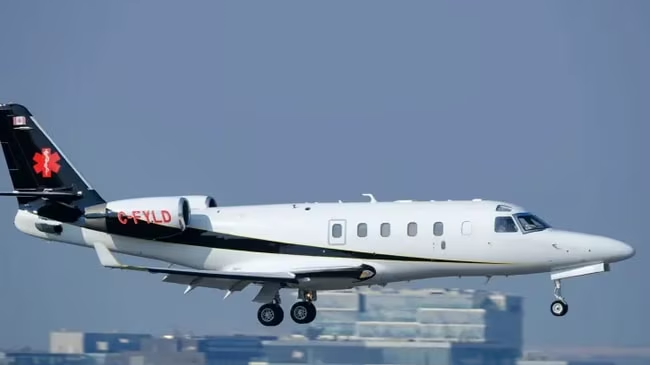
There are grave fears for the passengers of a private plane that suddenly vanished mid-flight, sparking a major search off the coast of the US.
US authorities say the Gulfstream G100 lost contact with air traffic control about 2am local time on Saturday (4pm Saturday AET) while flying from L.F. Wade International Airport in Bermuda to Boston Logan International Airport.
The US Coast Guard said the Federal Aviation Administration alerted it after contact was lost with the aircraft – which plummeted from 23,500 feet to 11,000 feet in just three minutes, according to FlightAware data.
“We are praying for a safe outcome,” a spokesperson for Latitude Air Ambulance, which operates the missing plane, told City News.
A search is now under way off Nantucket in the air and on water as crews work to locate the missing jet, the Coast Guard said. Data from FlightRadar24 showed a number of aircraft searching south of the island.
Six people are missing after a private jet vanished, sparking a major search off the coast of Nantucket in the US.
The plane was en route from Bermuda to Boston when it vanished.
“Air & surface crews have launched in search of the aircraft. Updates will be provided here as info becomes available,” the Coast Guard Northeast District said on X.
The plane was carrying out a medical evacuation in Bermuda – a British overseas territory in the north Atlantic Ocean, according to Clarence Togeretz, Director of Flight Operations at Latitude Air Ambulance.
“We always get rather concerned when our crew doesn’t report to us in a timely manner,” he told NBC News.
“But I will say that again, optimistically and positively, that doesn’t mean that the worst has happened.”
Seventeen people were killed when eight gunmen stormed a bar close to Johannesburg on Saturday evening, with 15 more injured.
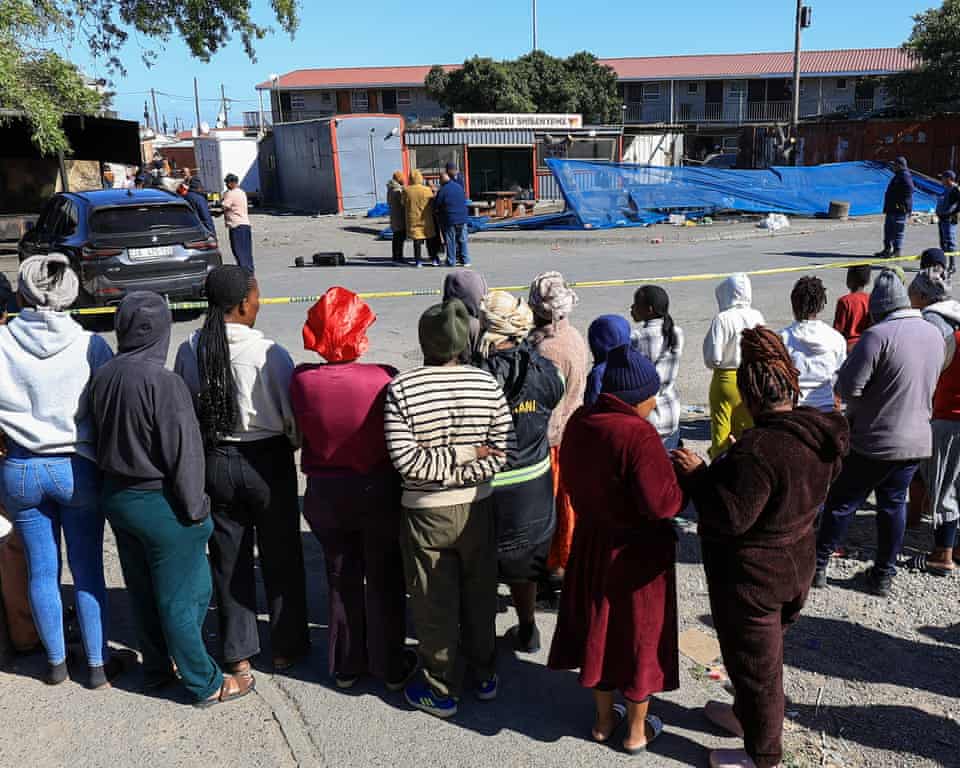
In a separate shooting in the early hours of Sunday morning, 10 people were killed outside an entertainment venue in a township near Cape Town and a further 11 were injured.
South Africa has one of the highest murder rates in the world and has struggled to contain gang-related gun violence in recent years. Police have not indicated a motive for either of the latest attacks.
In Johannesburg, gunmen opened fire on customers outside the bar before continuing the attack inside and torching two vehicles before fleeing.
Police said thirteen men and four women were killed.
Deputy provincial police commissioner Maj Gen Fred Kekana said the attack may have been a retaliation for an incident last month, in which one person was killed and another wounded, according to AFP news agency.
Speaking at the scene, he said police had clear pictures and in some cases names for the suspects.
In Cape Town, five victims died at the scene and a further five people died in hospital.
No arrests had been made in either case on Sunday morning.
The two mass shootings came days after 11 people were killed in the city of Duban when gunmen stormed a house in the KwaMakhutha township.

Illegal weapons are prevalent in South Africa and gun violence has been a persistent problem for decades, with about 60 murders recorded every day in the country of 62 million.
But a recent spate of mass shootings has raised fears that the problem is deepening, with violence often linked to turf wars between gangs engaged in drug trafficking and illegal mining.
In February, President Cyril Ramaphosa called organised crime “the most immediate threat to our democracy, our society and our economic development”.
Earlier this year the military was deployed alongside police in areas with the highest murder rates in an effort to reduce armed violence.
On Saturday a tenth woman’s body was found in Ekurhuleni, to the east of Johannesburg, with local police saying they were unable to rule out a serial killer operating in the area with similarities between the deaths. (BBC)
The United States has deported more than 25,000 people under secretive agreements with 35 countries to take migrants with no ties to those nations, according to an investigation published Monday.
Since US President Donald Trump took office in January 2025, Washington has been signing deals with developing countries to take migrants who cannot legally be sent home.
The investigation by Forbidden Stories found the administration has earmarked $410 million to be paid directly to the receiving countries, or to UN agencies to facilitate the returns.
At least 25,447 people had already been deported to third countries by August 31, 2026, according to data compiled by Forbidden Stories with a consortium of international journalists.
The vast majority — around 20,000 — were sent to Mexico, but the rest were dispersed to 27 other countries across Latin America, Africa, and the Pacific, and agreements have been finalised with seven more.
The deals vary, including over which nationalities can be deported and whether people with criminal records can be accepted.
An AFP investigation earlier this year found Washington is using visa bans and restrictions on African countries to strongarm them into accepting deportees.
Lawyers told AFP that deportees were being thrown into a “legal black hole”, held without charge in countries where they have no ties and few if any rights.
Forbidden Stories said 49 of Africa’s 54 countries had been approached about accepting third-country deportees.
A little-known State Department division called the Office of Remigration, created in May 2025, has handled most of the negotiations and payments, according to Forbidden Stories.
The office is headed by Christian Jove Ehrhardt, a 41-year-old diplomat who previously worked as a security officer.
The report details his visits to Cameroon, which signed a memorandum of understanding with the US in December on accepting deportees. A week later, it also signed a five-year health assistance programme worth nearly $400 million.
The following month, the State Department said it would provide a further $30 million to the UN Refugee Agency (UNHCR) in Cameroon to “facilitate the voluntary return of refugees and combat illegal immigration.”
The first plane carrying deportees arrived in Cameroon on January 14.
– Payments –
Other agreements have involved direct payments to governments.
Palau, a small Pacific island nation with a population of under 18,000, signed an agreement in December 2025 to accept up to 75 third-country nationals in return for $7.5 million.
However, only three people have so far been sent under the agreement.
In Eswatini, 32 people have arrived since July 2025 out of a possible 160 under an agreement worth more than $5 million. It has accepted deportees with criminal records, the investigation found.
Of the $410 million planned for the agreements, internal State Department records showed that $81 million was earmarked for signatory governments.
The rest was intended for aid organisations, including more than $178 million for the UN’s International Organisation for Migration, and $123 million for UNHCR.
The agencies have faced criticism over their involvement, although UNHCR told Forbidden Stories that it was not party to the bilateral agreements and that US funding was being used in line with its mandate to strengthen asylum systems.
An IOM spokesperson told Forbidden Stories that the agency’s decisions to accept funding rested “on a single question: whether our engagement will improve the lives of the migrants affected. In these instances, we believe strongly it does.”
-
 News3 days ago
Tragedy as RCCG pastor collapses, dies during sermon at funeral in Rivers
-
News3 days ago
Six missing as boat carrying 70 Benue mourners capsizes
-
Entertainment1 day ago
BREAKING: Temi Nkem wins BBNaija season 11
-
News1 day ago
NAF confirms ownership, launches rescue operation after aircraft crash in Ondo
-
News1 day ago
NAF aircraft crashed with 32 passengers, crew – Keyamo
-

 International2 days ago
Six people missing as plane vanishes from Bermuda to Boston
-
News22 hours ago
Bandits allegedly kidnap 18 Oyo students, kill driver
-
News2 days ago
Kidnappers torture 20 corps members, demand N5m each NYSC