News
Enugu Govt partners tech firm on training to tackle youth unemployment


Enugu State Governnent has partnered a tech firm, African Leadership Accelerator (ALX), to train youths on online tech skills to tackle unemployment and idleness.
The state government and ALX Africa had made it possible for all Enugu State youths to access free-of-charge training on Artificial Intelligence (AI) applicable to all field of human endeavours and jobs.

Speaking further on the partnership on Thursday in Enugu, the state Commissioner for Youths and Sports, Mr Lloyd Ekweremadu, said that the partnership was meant to up-skill and upgrade knowledge newly or already acquired by the youths in the state.
Ekweremadu said that the partnership and the benefit it would bring to the state “is part of the employment vision of Gov. Peter Mbah to reduce unemployment in the state by about 70 per cent by 2030”.


According to him, what we set out to achieve is to ensure employability of Enugu State youths both in locally and international labour market, which is highly competitive.
“His Excellence, Gov. Peter Mbah is keen on developing the capacity of youths and creating their capabilities for them to compete at the global world employment market.
“We intend to use technology, tech enhancement and development to drive this process and ensure youths in the state cover up the knowledge and employability gap,” he said.
Ekweremadu said that the state would start with AI training, which will be done for all youths free-of-charge and thereafter other system and software training/courses would be done online at a reduced cost.
He advised youth to take advantage of the trainig, adding the youth ministry was fashioning out ways to tackle the issue of getting a place within the metropolis where youths with challenge of not having power supply, internet connectivity, a laptop, tablets and android phones can participate in the training.
The Country General Manager of ALX Africa, Ms Ruby Igwe, said that the partnership on various tech training would bring modern skill sets closer to the people especially youths that needed tech skills for employment purpose and to create their own start-ups and be employers of labour.
Igwe said that the free-of-charge AI course training would be for youths between the ages of 18 and 35; while it would run for six weeks on online platform of ALX Africa.
She said that participants, who successful undergo the course, would be certified as well as have opportunities to participate in other online courses that would enhance their knowledge and reposition them to a vintage position in the global market and international mobility of labour.
“The curriculum for our courses especially the AI course is from a reputable US school and the same course is runned globally and even locally in some countries in Africa and one or two states in Nigeria. So, it is nothing short of internationally acceptable AI training.
“After the AI Course, other online courses, meant to equip youths with soft and international sellable online skills, will follow in partnership with the state government to ensure we carry hundreds of thousands of youths along and prepare them for the competitive future ahead,” she said.



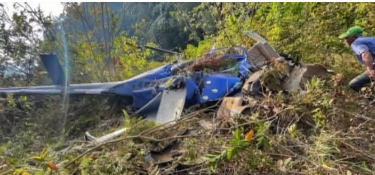
The Chief of the Air Staff (CAS), Air Marshal Sunday Kelvin Aneke, has expressed profound condolences to the families of the personnel and passengers who lost their lives following the accident involving Nigerian Air Force (NAF) ATR 42 aircraft, NAF 931, in the Igbokoda area of Ondo State.
The CAS described the incident as a deeply painful moment for the Nigerian Air Force and the nation, expressing heartfelt sympathies to the families, loved ones and colleagues of those who lost their lives. He assured the bereaved families of the Service’s full support during this difficult period.
NAF 931 had 25 persons on board, comprising five crew members and 20 passengers. The aircraft was on a routine mission from Benin to Lagos when the accident occurred. Search-and-rescue procedures were immediately activated, with response efforts conducted in coordination with relevant authorities to locate and account for all persons on board. No survivors have been found. The crew members were:
CREW
1. Squadron Leader MI Aburime (Flight Captain)
2. Squadron Leader AP Man-Ugwueje (Co-pilot)
3. Flight Lieutenant IS Bako (Co-pilot)
4. Warrant Officer Abubakar A (Aircraft Technician)
5. Corporal Uguru HC (Aircraft Technician)
PASSENGERS
6. Flight Lieutenant TL Lazarus
7. Flight Lieutenant M Akinloye
8. Flying Officer IM Adeshina
9. Master Warrant Officer Onwuka F
10. Master Warrant Officer Matini BA
11. Warrant Officer Nuhu FS
12. Flight Sergeant James RB
13. Flight Sergeant Mohammed AI
14. Sergeant Ani AE
15. Sergeant Izibenikien SI
16. Sergeant Alafuka C
17. Sergeant Mbadugha AN
18. Lance Corporal Ugwuba FC
19. Lance Corporal Eledan GE
20. Mrs Ezeh Nneka
21. Godstmine Tarabina
22. Joy Micheal
23. Sunday Micheal
24. Ukeme David
25. Gideon Omotola
The CAS has directed a comprehensive investigation to establish the circumstances surrounding the accident. The Nigerian Air Force will continue to provide timely and verified updates as the investigation progresses and urges the public to refrain from speculation and the circulation of unverified information, while respecting the privacy and dignity of the affected families. A condolence register has also been opened at Headquarters Nigerian Air Force, Abuja, for senior government officials, members of the diplomatic corps, heads of security agencies, and other well-wishers who may wish to pay their respects and convey messages of sympathy to the families of the deceased and the Nigerian Air Force.
Ehimen Ejodame
Air Commodore
Director of Public Relations and Information
Headquarters, Nigerian Air Force
6 October 2026

The political feud between the camp of former Anambra State Governor, Mr Peter Obi, and the administration of Governor Chukwuma Soludo has escalated dramatically following a sharp counterpoint from Obi’s Media Adviser, Mr Idris Zekeri Jnr., Spokesman, Peter Obi Media Reach (POMR).
Reacting to a publication emanating from the state’s ruling circle urging the Anambra electorate to reject Obi and the opposition, the media office dismissed the move with heavy scorn. Citing traditional Igbo philosophy—adighi ibua ayi ara (you do not join a mad person in the public square)—the camp maintained they chose silence over a full-scale exchange to avoid dignifying what they termed institutional absurdity.
Lifting the lid on internal dysfunction within the state’s leadership, Zekeri revealed that insiders in the administration had recently lamented that Governor Soludo spends half of executive council (EXCO) meetings obsessing over Peter Obi, treating his fixation on Obi as more vital than pressing state matters.
Adding a searing punchline, Zekeri remarked that if the governor’s obsession borders on clinical psychosis, stakeholders should promptly advise him to seek professional psychological aid rather than dragging the entire state into his mental fixations.
The statement lamented that as his obsession becomes magnified, the state is falling apart. Citing a recent meeting held in Port Harcourt, he pointed out that the National emergency agency explicitly noted that Anambra only truly had it good under Obi, managing disasters and public safety with utmost competence.
They were talking about the state’s preparedness for the recent flood that took lives in the state. “The only reason they gave to justify what the flood destroyed was that NIMET announced the impending flood, after they failed to follow the preemptive NINET prescribed.”
He recalled that as Governor, Obi uniquely engaged the UN-Habitat to formulate comprehensive master and structure plans for the state’s major cities, rigorously implementing them to the extent that by 2010, Onitsha was globally recognised among the fastest-growing cities in the world. Yet, rather than building on such visionary foundations, Soludo has completely abandoned these structural frameworks, choosing instead to focus his energy on petty political planning against Obi.
Zekeri further alleged that the state administration recently mobilised a cyber-army of over 500 internet trolls dedicated solely to attacking Peter Obi, with recruits supposedly promised the right to nominate cronies for state engagement, scaling the network up to 1,000 operatives based on hit-piece performance.
The Obi camp slammed the strategy as a gross misallocation of state resources, lamenting that public funds are being aggressively funnelled into digital vandalism while governance issues pile up.
Pre-empting what they described as a predictable scapegoating script, the media office stated they were putting the administration on formal record so officials could not tomorrow claim Peter Obi was the phantom distraction keeping them from working.
“Instead of obsessing over Obi, the governor should use those hours to tour Anambra and see how state funds are being wasted on roads that crumble while construction is still ongoing,” the statement fired.
Pointing to massive grassroots receptions—such as the large turnouts at the Nnewi Cathedral and the coronation of the Igwe of Adazi-Ani—the camp challenged the administration to read the political room, stressing that no amount of propaganda can erase the deep-seated bond between Ndigbo and Peter Obi.
Against this backdrop, Zekeri formally called on Anambra elders, religious leaders, traditional rulers, and key stakeholders to urgently call Governor Soludo to order, advising him to face the pressing issues of governance and stop self-destructing through needless distractions.
Tearing into the state’s economic scorecard, the media office contrasted Soludo’s administration with the benchmarks established during Obi’s tenure, highlighting independent indices like the Phillips Consulting State Performance Index, where Anambra has nosedived from 1st position during Obi’s era down to 27th position under the current watch.
The statement underscored that while Obi operated on a lean average federal allocation of about 3 billion monthly, Soludo now commands a combined allocation of roughly ₦25 billion monthly – meaning the current government receives in just two months what Obi managed in an entire year.
“Anambra people are aware that his Commissioner for Finance was his houseboy. Why would things not go wrong?”
The camp queried why higher institutions have not seen a single new building erected or positive intervention directed to schools since Obi left office, with recent NECO results showing the state slipping back down from previous historic highs.
Lamenting that the state is allegedly being branded one of the dirtiest in the country while ecological erosion ravages communities with zero effective combat, the statement concluded that when a leadership facing monumental challenges chooses obsession with an individual over governance, something is seriously wrong.

Suspected bandits have allegedly kidnapped 18 students from Oyo State travelling from Sokoto State to their hometowns in Oke-Ogun, after attacking their chartered bus and killing the driver, sources familiar with the incident have said.
The students, who were travelling from Gamji College of Health Technology, Sokoto, were reportedly intercepted by the assailants along the route to Oyo State within the past 48 hours.
The abductors were said to have moved the victims towards the Mokwa axis.
The development has raised fresh concerns over the safety of students travelling between states, particularly along routes where commuters have repeatedly faced attacks and abductions.
An Oke-Ogun youth leader, who spoke on condition of anonymity, confirmed the incident, clarifying that the victims were students of Gamji College of Health Technology and not Usmanu Danfodiyo University, Sokoto, as earlier reported.
“Sadly, the unfortunate incident is being confirmed by me because I’m from Oke-Ogun too, and our people have confirmed that it truly happened in the past 48 hours,” the youth leader said.
He explained that the students were travelling in a chartered bus from their institution in Sokoto to Oke-Ogun, with Igboho as their specific destination.
“But it wasn’t a bus conveying UDUS students. It was a bus taking students from Gamji College of Health Technology, Sokoto, to Oke-Ogun, Igboho to be precise,” he said.
According to him, the attackers killed the driver before taking the students away.
“The driver was killed and all the students were kidnapped. They have reached the Mokwa side,” he said.
The youth leader further disclosed that the driver’s remains had been buried.
“The driver was killed at the scene and his remains were buried on Saturday,” he said.
Other sources familiar with the incident said the number of abducted students could be as many as 18.
The sources said the students were travelling in a chartered bus arranged by their school to convey them to their respective hometowns in Oyo State when the vehicle was intercepted by the assailants.
They were reportedly taken away by the attackers after the driver was killed.
The latest incident comes barely days after 20 prospective National Youth Service Corps members were reportedly abducted by gunmen in Imo State.
The victims were travelling from Ibadan, Oyo State, to orientation camps in Abia and Akwa Ibom states when gunmen reportedly attacked their two buses along the Owerri-Onitsha Road in Umunoha, Mbaitoli Local Government Area of Imo State.
Efforts to obtain further information from the Oyo State Police Public Relations Officer, SP Olayinka Ayanlade, proved abortive, as he had not responded to messages sent to him as of the time of filing this report.
-
 News3 days ago
Tragedy as RCCG pastor collapses, dies during sermon at funeral in Rivers
-
Features3 days ago
Mbah Lists Projects Driving Enugu’s Revenue Growth, Says Less Than 13% Comes From Taxation
-
News3 days ago
Six missing as boat carrying 70 Benue mourners capsizes
-
Entertainment1 day ago
BREAKING: Temi Nkem wins BBNaija season 11
-
News20 hours ago
NAF confirms ownership, launches rescue operation after aircraft crash in Ondo
-
News3 days ago
IGP Disu deploys DIG, two CPs to rescue abducted NYSC members, passengers
-

 International2 days ago
Six people missing as plane vanishes from Bermuda to Boston
-
News19 hours ago
NAF aircraft crashed with 32 passengers, crew – Keyamo