Business
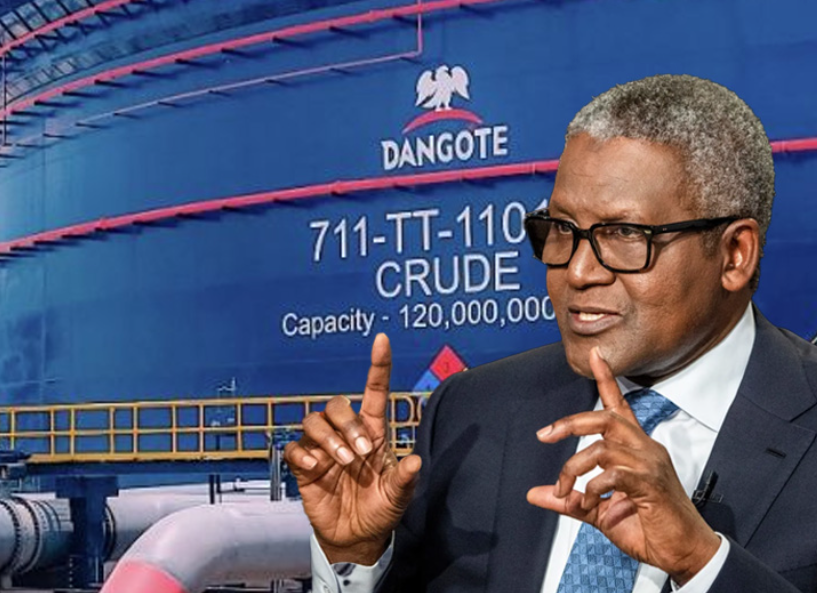
Dangote reduces fuel price by N100 as global crude slumps
The Dangote Refinery on Tuesday reduced its petrol gantry price by N100, from N1,175 to N1,075 per litre.
The move followed a slump in global oil prices, with Brent crude dropping to $89 per barrel from over $100 on Monday.
Officials of the refinery confirmed the development to newsmen, adding that diesel prices have also been reduced.
They stated that petrol supplied via coastal distribution channels will now sell for N1,050 per litre, reflecting a slight differential for marine logistics.
Similarly, diesel is now N1,430 per litre at the gantry, representing a N190 reduction from the earlier price of N1,620 per litre.

According to oilprice.com, Brent crude prices witnessed a dramatic reversal on Tuesday, plunging nearly 27 per cent from the previous day’s high of $119 per barrel to as low as $87 per barrel.
The Dangote Refinery reportedly blamed global crude volatility for the repeated price hikes, citing tensions arising from the US-Iran conflict.
Business
Dangote launches ₦500,000 reward program to encourage whistleblowing
•Says illegal goods on Dangote trucks to be confiscated
Dangote Industries Limited has intensified efforts to combat illegal haulage activities involving its trucks by unveiling a public whistleblowing initiative that offers a cash reward to individuals who provide credible information leading to the arrest of offenders or the interception of unauthorized goods and transportation of persons.
The company said the initiative, which will reward whistleblowers with N500,000.00 cash award, forms part of its broader commitment to protect the integrity of its logistics operations and eliminate the activities of unscrupulous individuals who illegally use Dangote-branded trucks to transport unauthorized goods.
In a statement issued in Lagos, the management urged members of the public to support the campaign by reporting any suspected cases of illegal haulage involving Dangote trucks, stressing that only specifically approved products are permitted to be transported by vehicles belonging to its various subsidiaries.

Dangote trucks
According to the company, Dangote Cement trucks are authorized to carry only cement, limestone, high-grade gypsum, coal and clinker, while Dangote Sugar Refinery trucks are restricted to the transportation of sugar products. Trucks belonging to NASCON Allied Industries are expected to carry Dangote Salt and DanQ Seasoning products, while Dangote Packaging vehicles are designated for bags and packaging materials.

Similarly, trucks operated by Dangote Petroleum Refinery and Petrochemicals are permitted to transport polypropylene products, while Dangote Fertiliser Limited vehicles are authorized for the haulage of urea fertilizer.
The company warned that any Dangote truck found transporting unauthorized goods would be treated as being involved in illegal haulage activities, adding that both the drivers and owners of such goods risk arrest, confiscation of the cargo and prosecution under applicable laws.
“Anyone with verifiable information that leads to the arrest of persons involved in illegal haulage activities or the recovery of unauthorized goods transported on Dangote trucks will receive a cash reward of Five Hundred Thousand Naira,” the company stated.
To aid investigations and enforcement efforts, the management of Dangote Group advised whistleblowers to provide detailed information when making reports. These include the truck type, registration plate number, cab number, location of the vehicle, description of the goods being transported, colour of the truck and photographs of the vehicle and cargo where possible.
The company has therefore established dedicated hotlines across its operations to receive reports relating to illegal haulage activities. Members of the public can report incidents involving trucks operating from the Obajana, Okpella and Gboko plants through certain dedicated telephone lines.
The Company stated that law enforcement agencies, including the Police, have been authorized to arrest any driver found using company trucks for unauthorized commercial haulage.
It reiterated its zero-tolerance stance against logistics-related fraud and called on the public to join hands with it in safeguarding legitimate business activities by exposing illegal operators.
Dangote Group emphasized that the initiative is designed not only to protect company assets and operations but also to strengthen transparency, accountability and compliance across its nationwide logistics network.
“Public cooperation remains critical in our efforts to eradicate illegal haulage activities. We encourage anyone with credible information to come forward and help us maintain the integrity of our transportation system,” the statement added.
The company reaffirmed that all reports would support ongoing efforts to protect the Dangote brand, promote lawful business practices and ensure that offenders are brought to justice.i
Business
Pipeline sale controversy deepens as expert warns of investor confidence risks
Fresh controversy has erupted over efforts to revive the sale of a 40 per cent stake in the Amukpe–Escravos Pipeline, with a governance expert warning that any attempt to resurrect a previously terminated transaction could damage investor confidence and raise fresh questions about transparency in Nigeria’s oil and gas sector.
Speaking on Channels Television on Thursday, June 11, 2026, Managing Director of Policy Management Consult Services, Jide Olatuyi, said concerns surrounding the transaction extend beyond commercial interests and strike at the heart of governance, transparency, and the credibility of Nigeria’s investment environment.
“The contract was terminated,” Olatuyi said. “What stakeholders are saying is that there is a need for a new competitive bidding process rather than attempting to revive a failed transaction.”
The controversy has intensified amid scrutiny of the asset’s valuation. The earlier transaction involving the 40 per cent stake was priced at approximately $243 million before collapsing over unmet contractual obligations. Independent assessments conducted in 2025 reportedly valued the same stake at between $544 million and $641 million.
The significant disparity between the earlier transaction price and the more recent valuations has fuelled calls for a fresh competitive bidding exercise to ensure that the asset reflects prevailing market conditions and delivers maximum value.

Rejecting suggestions that opposition to the proposed transaction is driven by sentiment or commercial rivalry, Olatuyi insisted that the debate centres on governance standards within the petroleum industry.
“I don’t think it is about sentiment at all,” he said. “It is about governance in the oil and gas sector.”
According to him, Nigeria’s challenge is no longer limited to attracting investors but also ensuring that investors have confidence in the integrity of the country’s commercial and regulatory processes.
“If you are not committed to transparency, it becomes a problem for investors,” he said. “If you cannot build trust and confidence in the sector, capital will go elsewhere.”
Olatuyi said several stakeholders, including project lenders such as Sterling Bank and AMCON, have advocated a transparent process that reflects current market realities and updated asset valuations.
The Amukpe–Escravos Pipeline, which has a transportation capacity of about 160,000 barrels per day and has maintained uptime above 95 per cent, remains one of Nigeria’s most strategic crude evacuation assets. The pipeline plays a critical role in transporting crude from inland production fields to export terminals in the Niger Delta.
Olatuyi urged authorities to ensure that any future transaction involving the asset is conducted through an open, transparent, and competitive process capable of inspiring investor confidence and safeguarding public value.
The debate comes at a time when the Federal Government is seeking to attract substantial investment into the energy sector and expand critical oil and gas infrastructure.
The eventual outcome of the Amukpe–Escravos Pipeline transaction could serve as a major test of Nigeria’s commitment to transparency, valuation discipline, and investor protection. As global competition for energy capital intensifies, governance standards may prove just as important as resource endowment in determining where investment flows.
Officials of the Nigerian Upstream Petroleum Regulatory Commission and members of the technical committee that supervised the original transaction did not respond to requests for comment as of press time.
Business
S/East companies shutting down over rising energy costs — MAN
The Manufacturers Association of Nigeria (MAN) has raised alarm over the worsening state of manufacturing activities in the South-East, warning that rising energy costs and poor access to finance are forcing many companies in the region to shut down.
Chairman of MAN for Anambra, Enugu and Ebonyi states, Lady Ada Chukwudozie, disclosed this during the MAN South-East Stakeholders’ Industry Conversation held in Awka, Anambra State.
The forum was convened to address concerns surrounding electricity regulation, billing transparency and declining industrial productivity across the region.
Chukwudozie said the few factories still operating were doing so at less than 30 per cent of installed capacity due to soaring electricity tariffs, high energy costs and limited access to credit facilities.
According to her, the harsh operating environment informed the decision to convene the stakeholders’ roundtable, stressing that the manufacturing sector remains critical to economic growth, industrialisation and job creation.

She warned that unless urgent measures are taken to address the challenges confronting manufacturers, industrial activities in the South-East could further deteriorate, with serious implications for employment and regional economic stability.
“The manufacturing sector cannot thrive in an environment of uncertainty,” she said.
She called for reforms in the power sector to be driven by transparency, accountability and measurable performance standards, including agreed electricity supply hours, actual delivery levels and compensation mechanisms where supply consistently falls below expectations.
Chukwudozie also urged regulatory authorities to strengthen oversight of electricity providers and improve power supply to industrial clusters across the South-East.
Stakeholders at the forum expressed concern that manufacturers were increasingly struggling to cope with escalating production costs, worsened by unreliable electricity supply and the rising cost of alternative energy sources.
They noted that without affordable and stable energy, many more companies could either scale down operations or shut down completely.
In his keynote address, former Chairman and Chief Executive Officer of the Nigerian Electricity Regulatory Commission, NERC, Dr. Sam Amadi, urged governments in the South-East to adopt deliberate policies aimed at prioritising electricity supply to industrial clusters.
Amadi also advocated pricing frameworks that would encourage manufacturers to expand production and invest in growth.
The stakeholders’ meeting brought together manufacturers, regulators and other industry players to explore practical solutions to revive industrial output and tackle persistent power challenges affecting businesses in the region.
-
News2 days agoAnambra Govt arrests woman over alleged illegal surgeries linked to complications and deaths, seals facility
-
News2 days agoNotorious bandit kingpin Kachalla Yellow shot dead by Hybrid forces
-
News3 days agoPeter Obi to Umahi: Become presidential candidate before challenging me to debate
-
News2 days ago27 killed as armed men launch fresh attacks on Benue, Plateau communities
-
News2 days agoSoldiers kill ISWAP cameraman, uncover foreign terrorist trainer, doctor in Borno forest
-
Uche Nnaji
Uche NnajiNews1 day agoEx-Minister Uche Nnaji arraigned over alleged certificate forgery, gets N20m bail
-
News2 days agoEnugu Police launch manhunt for Bus Driver, Conductor over rifle snatching, attempted murder
-
Business2 days agoDangote launches ₦500,000 reward program to encourage whistleblowing