International
Liberia’s notorious rebel-turned-senator Yommie Johnson dies at 72


Senator Prince Yommie Johnson, the leader of the erstwhile Independent National Patriotic Front of Liberia (INPFL), is dead.
Family sources confirmed that Senator Johnson collapsed in his bathroom during shower on Thursday morning and went into coma. He was later confirmed dead upon arrival at the Hope For Women Hospital in Paynesville.

He died at age 72.
The self-proclaimed Godfather of vote-rich Nimba County was instrumental in deciding the last few elections in Liberia.
Senator Johnson was last seen on November 25 when he honored the legacy of the late Gnassingbe Eyadema, former President of Togo, by naming his university’s auditorium after him.


AFP
Prince Johnson, seen here in 2008, had a key role in Liberia’s years of civil war
The event was attended by a diverse group of officials, including traditional leaders, legislators, and students, celebrating Eyadema’s contributions to goodwill and generosity.
In his remarks, Senator Johnson reflected on Eyadema’s significant role in fostering peace in Liberia and throughout West Africa, labeling him a “man of peace.”
Senator Johnson’s history with civil war
Johnson allied himself with Charles Taylor’s National Patriotic Front of Liberia (NPFL) rebel group when it launched the First Liberian Civil War in 1989 to overthrown President Samuel Doe. Due to a rift with Taylor, Johnson soon formed an NPFL splinter group, the Independent National Patriotic Front of Liberia (INPFL), which captured, tortured and executed Doe in 1990.
Following continued clashes with Taylor and the pro-Doe ULIMO group, the INPFL was disbanded and Johnson was forced into exile in Nigeria in 1992, where he converted to Christianity and reconciled with the Doe family.

Prince Yommie Johnson dies at 72
Johnson returned to Liberia in 2004 following the end of the Second Liberian Civil War and was elected to the Senate of Liberia in the 2005 Liberian general election. He founded a political party, the National Union for Democratic Progress (NUDP) in 2010, before being expelled from it in 2014.
He founded a new party, Movement for Democracy and Reconstruction (MDR) in 2016. He has since been re-elected to the Senate in 2014 and 2023. He was also an unsuccessful candidate for President in 2011 and 2017, respectively finishing in third and fourth place in the first round.
Johnson was born in Tapeta, Nimba County, in the east-central interior of the country, and was brought up by an uncle in the capital city of Monrovia. In 1971, while living in Monrovia, he joined the Liberian National Guard (LNG), which was transformed into the Armed Forces of Liberia (AFL) in the aftermath of Samuel Doe’s 1980 overthrow of President William R. Tolbert.
He rose to the rank of Lieutenant, receiving military training in both Liberia and the United States, where he was instructed in military police duties in South Carolina.
A stern, often draconian, disciplinarian, he served as aide-de-camp to General Thomas Quiwonkpa, the Commanding General of the Armed Forces of Liberia and accompanied him into exile in 1983, after Quiwonkpa was accused of plotting a coup against Doe.
Johnson, the Liberian warlord-turned-politician became infamous for the 1990 footage of him sipping beer while the-then president was tortured nearby.
As one of the key figures in the two civil wars between 1989 and 2003, the Truth and Reconciliation Commission said he should be prosecuted for war crimes, though he was never brought to trial.
But as a senator since 2005, he was highly influential in Liberian politics, backing the last three successful presidential candidates.
While some have celebrated his political role, others viewed him as a symbol of the country’s struggles with accountability.
“We see his death as a blow to many victims who were awaiting to see the senator to face justice given his role in the civil war,” human rights activist and campaigner for a special war crimes court Adama Dempster told the BBC.
An estimated 250,000 people died in the conflicts and many survivors from sexual assault and other attacks were left permanently scarred.
In a condolence message to his family, President Joseph Boakai – who Johnson supported in his presidential campaign last year – described him as “a figure who played a pivotal role in Liberia’s complex historical evolution and contributed to national discourse through his service in the Senate”.
Back in 1990, rebel soldiers from Johnson’s Independent National Patriotic Front of Liberia captured President Samuel Doe and were then, in front of their leader, filmed mutilating him – his ear was sliced off – before he was killed.
The warlord later expressed regret for what had happened, but, as quoted by the AFP news agency, justified his role in the war, saying he was defending “my country, my people, who were led to the slaughterhouse as if they were chickens and goats, by the Doe regime”.
He also said he had changed and had become a pastor in an evangelical church.
As a politician he was praised by his constituents in Nimba county for working to improve their lives.
But he also courted controversy.
In 2021 Johnson was sanctioned by the US for alleged involvement in so-called pay-for-play funding, where he would reportedly personally benefit from the distribution of government funding to various ministries.
He was also accused of selling votes for personal gain in several elections, leading to criticism from some of his allies.
But Wilfred Bangura, a former leading official in Johnson’s Movement for Democracy and Reconstruction, said “politically he was very weighty and strong” and that he only changed alliances once he saw people moving away from him.
While certainly revered and being mourned by many in his home county – where he was seen as a hero and liberator – elsewhere people feel he was not made to pay for the crimes committed during the civil war.



International
France braces for another weekend of protests as authorities launch massive security operation
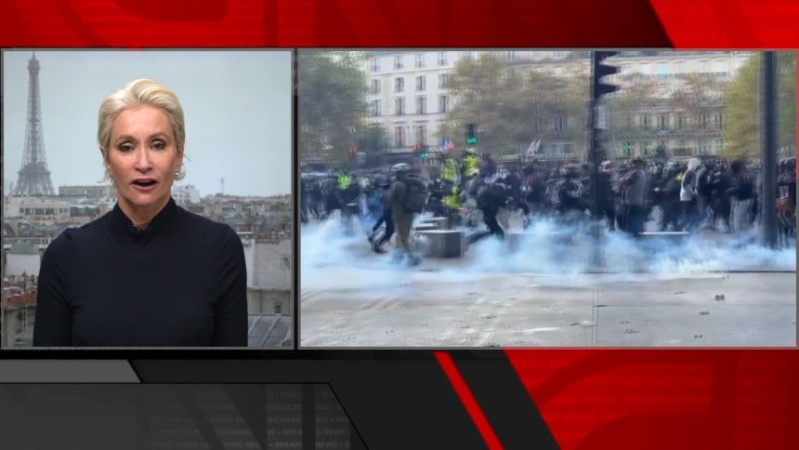
France is bracing for yet another wave of protests this weekend with authorities racing to prevent a repeat of the kind of violence and riots that hit the nation last week.
French authorities will be launching a massive security operation with some 70,000 police officers deployed across the country over the weekend, according to the interior ministry.
Specialist SWAT units, helicopters, armored vehicles, police dogs and water cannons will all be part of the operation. On top of that, the number of French army soldiers that normally patrol Paris as part of the country’s counter-terrorism measures will be increased to free the police from stationary guard duties.
Interior Minister Laurent Nuñez issued a stark warning on Friday to anyone looking for trouble, saying the government would be “uncompromising with those who engage in destruction.”
Last week’s violence followed weeks of protests over education, dismal job prospects and the cost of living. Initially peaceful and attended mostly by students, the demonstrations quickly turned into the worst wave of deadly, nationwide violence in years.
This week, curfews were imposed in some cities to help maintain calm.
Bracing for Saturday
A large demonstration has been called for Saturday afternoon in Paris and French media are expecting hundreds of thousands of people to attend.
The protest is organized by France’s main student union, UNEF, with one of the country’s biggest trade unions, CGT, announcing it would join. Other groups are expected to attend, including farmers, climate activists and the Yellow Vests, the movement that first emerged in 2018 during the protests over fuel costs.
While the protest in Paris has been authorized by the authorities, French President Emmanuel Macron on Thursday banned all non-trade union protests on Saturday as he seeks to control the civil unrest.
But the preparations go well beyond bans and police warnings, especially since last week’s riots sparked criticism of the authorities for not taking the threat seriously enough.
A police officer ties in place a perimeter tape near Chatelet – Les Halles to enforce a curfew, in central Paris on October 20.
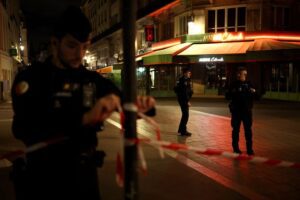
A police officer ties in place a perimeter tape near Chatelet – Les Halles to enforce a curfew, in central Paris on October 20.
Simon Wohlfahrt/AFP/Getty Images
The City of Paris announced earlier this week it was clearing public spaces of equipment and materials that could be used to cause damage, including barriers, bins, construction material and other items.
Many of the main tourist sites in the French capital, including world-famous museums like the Louvre, the Musée d’Orsay and the Musée de l’Orangerie will be closed on Saturday.
Art Basel finished the Paris version of its fair on Friday, two days earlier than scheduled. The Paris National Opera cancelled its performances on Saturday, citing the protests as the reason, and at least two dozen metro stations will also be closed for much of the day, according to Paris municipal authorities.
An NFL game between Pittsburgh Steelers and New Orleans Saints is set to take place at the Stade de France just outside of the capital on Sunday. While the match is scheduled to go ahead, a Steelers fan event in Paris was cancelled by the NFL.
During last weekend’s riots, at least two people died and multiple others suffered serious injuries, including two people who lost their hands. French Justice Minister Gérald Darmanin said some 2,700 people were held for questioning and 232 have been incarcerated in connection to the riots. (CNN)
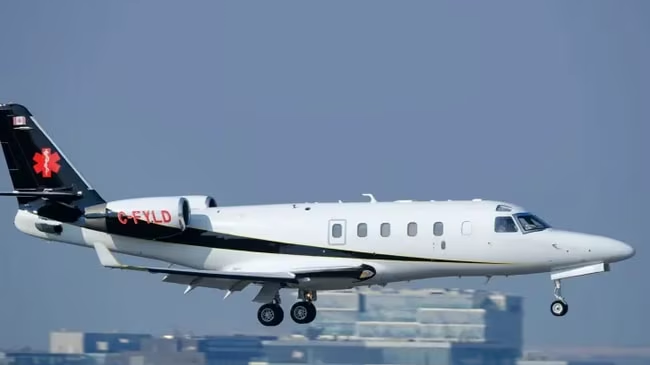
There are grave fears for the passengers of a private plane that suddenly vanished mid-flight, sparking a major search off the coast of the US.
US authorities say the Gulfstream G100 lost contact with air traffic control about 2am local time on Saturday (4pm Saturday AET) while flying from L.F. Wade International Airport in Bermuda to Boston Logan International Airport.
The US Coast Guard said the Federal Aviation Administration alerted it after contact was lost with the aircraft – which plummeted from 23,500 feet to 11,000 feet in just three minutes, according to FlightAware data.
“We are praying for a safe outcome,” a spokesperson for Latitude Air Ambulance, which operates the missing plane, told City News.
A search is now under way off Nantucket in the air and on water as crews work to locate the missing jet, the Coast Guard said. Data from FlightRadar24 showed a number of aircraft searching south of the island.
Six people are missing after a private jet vanished, sparking a major search off the coast of Nantucket in the US.
The plane was en route from Bermuda to Boston when it vanished.
“Air & surface crews have launched in search of the aircraft. Updates will be provided here as info becomes available,” the Coast Guard Northeast District said on X.
The plane was carrying out a medical evacuation in Bermuda – a British overseas territory in the north Atlantic Ocean, according to Clarence Togeretz, Director of Flight Operations at Latitude Air Ambulance.
“We always get rather concerned when our crew doesn’t report to us in a timely manner,” he told NBC News.
“But I will say that again, optimistically and positively, that doesn’t mean that the worst has happened.”
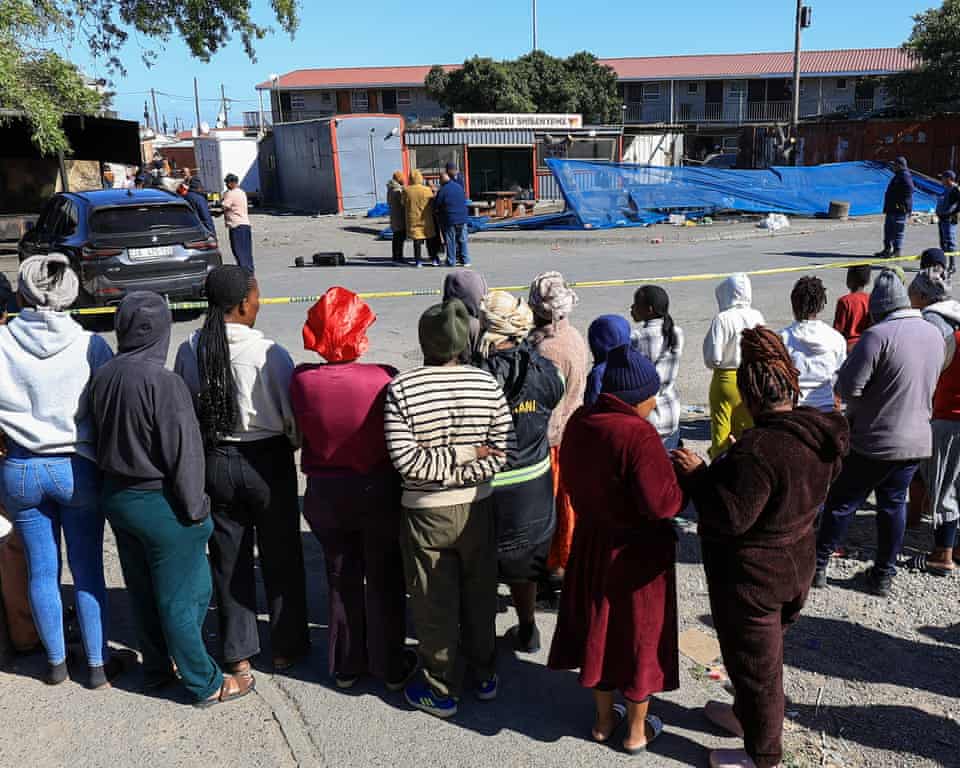
Seventeen people were killed when eight gunmen stormed a bar close to Johannesburg on Saturday evening, with 15 more injured.
In a separate shooting in the early hours of Sunday morning, 10 people were killed outside an entertainment venue in a township near Cape Town and a further 11 were injured.
South Africa has one of the highest murder rates in the world and has struggled to contain gang-related gun violence in recent years. Police have not indicated a motive for either of the latest attacks.
In Johannesburg, gunmen opened fire on customers outside the bar before continuing the attack inside and torching two vehicles before fleeing.
Police said thirteen men and four women were killed.
Deputy provincial police commissioner Maj Gen Fred Kekana said the attack may have been a retaliation for an incident last month, in which one person was killed and another wounded, according to AFP news agency.
Speaking at the scene, he said police had clear pictures and in some cases names for the suspects.
In Cape Town, five victims died at the scene and a further five people died in hospital.
No arrests had been made in either case on Sunday morning.
The two mass shootings came days after 11 people were killed in the city of Duban when gunmen stormed a house in the KwaMakhutha township.

Illegal weapons are prevalent in South Africa and gun violence has been a persistent problem for decades, with about 60 murders recorded every day in the country of 62 million.
But a recent spate of mass shootings has raised fears that the problem is deepening, with violence often linked to turf wars between gangs engaged in drug trafficking and illegal mining.
In February, President Cyril Ramaphosa called organised crime “the most immediate threat to our democracy, our society and our economic development”.
Earlier this year the military was deployed alongside police in areas with the highest murder rates in an effort to reduce armed violence.
On Saturday a tenth woman’s body was found in Ekurhuleni, to the east of Johannesburg, with local police saying they were unable to rule out a serial killer operating in the area with similarities between the deaths. (BBC)
-
 Features1 day ago
Mmesoma Umeorini: When Love Turns Deadly, and a Young Woman Pays With Her Life
-
Features1 day ago
Why Igbos Celebrate New Yam Festival Worldwide: The History, Cultural Significance and Lessons For The Younger Generation
-
News21 hours ago
Kogi Police Probe Alleged Murder-Suicide Involving Two Officers
-
News2 days ago
Mbah: Why We Built 268 Smart Green Schools Across Enugu State
-
News3 days ago
UBA Commences Contempt Proceedings Against WEMPCO Directors over Alleged Disobidence of Court Order
-
News3 days ago
Macron Postpones Planned Visit to Nigeria Until 2027
-
News3 days ago
Enugu CP Orders Probe into Death of Izuchukwu During Police Raid
-
News2 days ago
Anambra Police Arrest Suspect Over Murder of 23-Year-Old Woman in Uga