While we were going round the whole project sites to see what you are doing, a colleague asked a critical question: Where are you getting all the money you are using to do all this work within two years?
Actually, we don’t have to rely on third party funding to do what we’re doing. Since we came in, we’ve increased our internally generated revenue. When we came in, the highest we did as a state was about N25 billion in terms of our IGR, yearly. But this year’s IGR projection is about N600 billion. We’re likely going to achieve, if not exceed that figure. Sometimes, there is a misconception that we increase the tax rates and there are huge tax activities going on in Enugu. But that’s a misconception. There’s no such thing.
What we actually did was to expand the tax net. So, we brought in those who were not captured or who were not in the tax net into the tax net and we then also ensure that our processes are automated. So, where we, in the past, dealt with the collection through manual or through cash, we had to stop all that to ensure that payments are now made through an electronic or digital platform and they go straight into the government account. Largely, we are just plugging the leakages and expanding the tax net. We’ve been able to grow our tax rate to over 200 folds.

Therefore, you can actually do the calculus if you say that from N25 billion as of May 2023 we’re expecting N571 billion this year. It is about 2,000 per cent increase from where we were. So, that’s what it is.
Now, if we have a gap in our funding, we also could get a bridger and that bridger is what is referred to as an overdraft or a short term because we know we’re going to generate the revenue to clear it. But we haven’t done any long-term loan.
A major concern has to do with sustainability and institutionalising some of these things. How are you integrating them into your e-governance system?
It’s very key. We think that we need to build a very strong institution that would be stronger than the person at the driver’s seat. So, in a lot of what we’re doing, we’re focusing on how we sustain them. Whether it’s the Smart Green Schools initiative for example, how do we ensure that successive governments continue to fund it and that the infrastructure and the programmes we’ve initiated continue to live and deliver the desired impact? Beyond the brick and mortar, there are also quite a whole lot of soft issues like training and making sure you have a pipeline through which the programmes and the activities you do go through.
So, we’re very conscious of that. We’re strengthening the institutions by building the capacity of the civil servants, who obviously would continue to remain here; and we have a programme that ensures that all our civil servants have access to digital training, making sure that our processes are instituted. In fact, the e-governance thing that I mentioned to you is something that we have. We’ve over 111 MDAs in Enugu and they are all uploaded on our e-governance platform.
Even our financial manual is also something perhaps I need to speak to. We have a system here; a major part of our governance philosophy is transparency and accountability. Therefore, we have a system that whatever accrues to the government as revenue is seen and known by all. And it is not something anybody can alter. So, there is actually a digital tree to all that.When we came in, a lot of those things were done manually. But we had to digitise them. Even our financial report is something that you don’t have to wait till the end of the year to have. You get a monthly report of what accrued to the government as revenues, and what those funds have been spent on. So, you can actually do a trail and within a portal you can view all that. That’s part of what we believe that if we can build the capacity and strengthen these institutions, we can then sustain this.
On land banking, documents say you have created 300,000 hectares in land banks to be leased to large scale farmers and you are establishing 200 hectares of farm estates in all the 260 wards of the state. How will these 300,000 hectares of land bank be secured in such a way that the commercial farmers will have confidence that if any other governor comes in the future, it won’t be revoked. Is Enugu State totally giving the land away or it is, maybe, 51 per cent/49 per cent ownership?
The land bank is a programme designed for commercial farming. Beyond the farm estates we’re doing for small holder farmers across the 260 wards in the state, we also want to scale up production. So, we’re inviting those interested in investing in agriculture to come to Enugu; and we’ve quite a number of them.
In terms of the structure of the investment, it differs. For example, the company that we are working with on what used to be the United Palm Products Limited, which is now Enugu United Palm Products Limited, a company called Pragmatic Palms, we had a structure where the state took 40 per cent share and the investor has 60 per cent share in that business. It is a huge palm plantation of close to 10,000 hectares.

Enugu International Conference Centre
We also have a structure where the investor wants to go it all alone and then we just provide the land, give him the lease cost and then find a way we can help the investor de-risk the investment. Whether it’s the finance or the commercial aspect of the investment that may create problems, sometimes, we step in. Sometimes, we try to have our skin in the game so that it is then bankable. So, we have different strategies. I think at the last count, over 67,000 of that 300,000 have already been taken by investors; and we have quite a number of interests queuing up.
One is happy in how you put a lot of interest in education because a lot of governors run away from education, health and other critical human projects because the big contracts don’t come from there…
Again, the Smart Green School initiative is not something that is knee-jerk. If you looked at the manifesto during our campaign, we actually dealt with this. We refer to it as a cut-off point. We knew the challenges with our educational system and we felt it was something we needed to do differently. So, the cut-off point was designed to cut-off from that old system and to introduce a new learning system. And in order to do that, we also felt that the environment must be right, the infrastructure must also be right.
The reason was because we felt that the true wealth of any state or nation is not measured by the value of what they have beneath the soil. We may have had or we still do have huge quantities of coal and huge quantities of other solid minerals. But that will not be the right measure of our wealth. We believe strongly that the true measure of our wealth will be based on the quality of our human resources. We also recognise that the rest of the world will not wait for our children. We understand that the evolving skills in the 21st century require that we get our children ready and prepared for them to have a fighting chance.

Patrol vehicles procured by Mbsh administration to boost security
Take for example, it is projected that five years from now, AI is going to contribute $20 trillion to the global economy. So, the question you ask yourself is: How are we preparing our children to acquire the skills to be relevant in this new world order? Therefore, we felt that the best thing to do is get them at that very young age.
The Smart Green Schools initiative is designed to make sure that we get the index child at age three. That’s why we have provision for early child learning. So, at age three ,we provide the nursery one, nursery two, nursery three and then they are able to, beyond just even teaching them at that age, deal with their health profile because of where these children are and the level of education of their parents. We know a number of them may not have adequate medical records. So, we have in each Smart Green School, a clinic with a Registered Nurse. So, the first thing we do is to, of course, make sure that the child’s health is okay, they are not stunting, they are not wasting and that in terms of their vaccination or prophylaxis, that they are up to date. And where there is a deficiency, we step in to ensure that we regularise that and get them to be up to date.
 The idea is that these kids will be exposed to all the modern skills from a very young age, from elementary one to what we now refer to as a Lower Basic or Basic 1. You get them exposed to Robotics, to Artificial Intelligence, to Mechatronics, Virtual Reality, among others. So, if they are learning Biology, for example, they can actually visualise how the blood is going through the vein with the Virtual Reality. Most importantly is that we’re getting these kids to see their classroom beyond a place where they memorise or they repeat what they’ve been taught. We’re getting them to see their classroom as a creativity hub, a place where they have to solve compelling social problems. And of course, also find solutions to all the problems we have. They get into projects from that age. From elementary one, we teach them through practice and that’s the vision.
As somebody mentioned, some of these things we’re doing are not really so fashionable because the impact of some of these things may be felt long after we have left government. So, we’re looking at the future – 10, 20 years from now because this is essential. If we don’t get it right today, then we will not be able to have that reason for hope and for talking about the future.
Your vision for the state, how does it address the challenges of urban growths? Because once you start growing, you see people coming out from the communities into the cities. So, do you have provision for that? Especially, public utilities, transportation, while at the same time addressing infrastructural growths in the communities so that they are not left out.
Part of what we are experiencing in Enugu is actually the other way round where we have quite a lot of people from the urban migrating to the rural area and that is largely because the style of leadership we have here is all inclusive. We’re not leaving any parts of the state out. Our programmes, for example in education, is where the 260 electoral wards have a project of over a billion naira going on at the same time and that’s why somebody was telling me few days ago that Enugu had never experienced the amount of earth-moving equipment they’ve seen moved into in Enugu in the last two years. We don’t even have enough because people are coming here to work and we have to bring in the earth-moving equipment from other states to come here and work.
We‘ve also been told that in hiring your artisans, the labourers, Enugu is the most expensive state now. Essentially, you have activities going on across the states. You have in each ward major projects going on. Just as you are doing the Smart Green Schools, we’re also doing a Type 2 Primary Healthcare Centre in each of the 260 wards and we’re building the farm estates. So, they all require these earth-moving equipment. You have quite a lot of our young people, who are constructively and gainfully engaged. Instead of taking to criminality, you are then able to get them to generate revenues through constructive engagement.
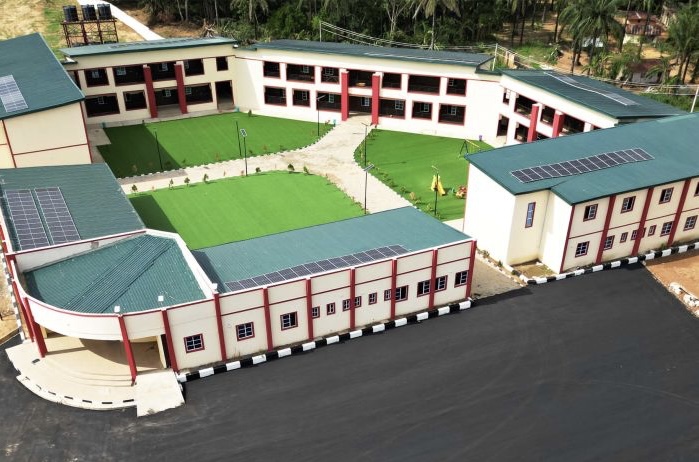
Enugu Smart School
Again, if we have an influx of people into the city, we realised also when we came in that the last master plan of Enugu was designed over 60 years ago around the 50s. Therefore, when we came in, we did a new master plan that expanded the city. We’re currently doing a brand new city, which is going to take about 300,000 households. That’s the capacity we’re actually planning for the future. If we’re going to grow this economy to $30 billion, you must be able to then provide access and provide the infrastructure. So, we’re already thinking ahead and providing this New Enugu City. There is no other like it in the country currently, because it’s going to be fully serviced. Your water, electricity, your sewage, your telecom, the fibre optics, internet access, the gas pipe are all going to be provided. You just go to your plot, you plug and play. You don’t need to go in there with your generator. There will be no such thing.
Of course, the roads are all designed with the weight of a modern city. If you look at the width of the primary road, it’s about 50 metres. The width of the of the secondary road is 33 metres and the tertiary road has a width of about 24 metres. So, it’s carefully planned, designed to be a modern and smart city. There is going to be a light rail. It is going to be on the right of ways. So, if you look at the media, it is designed to be quite sizable. That’s because we hope to have a light rail on it.
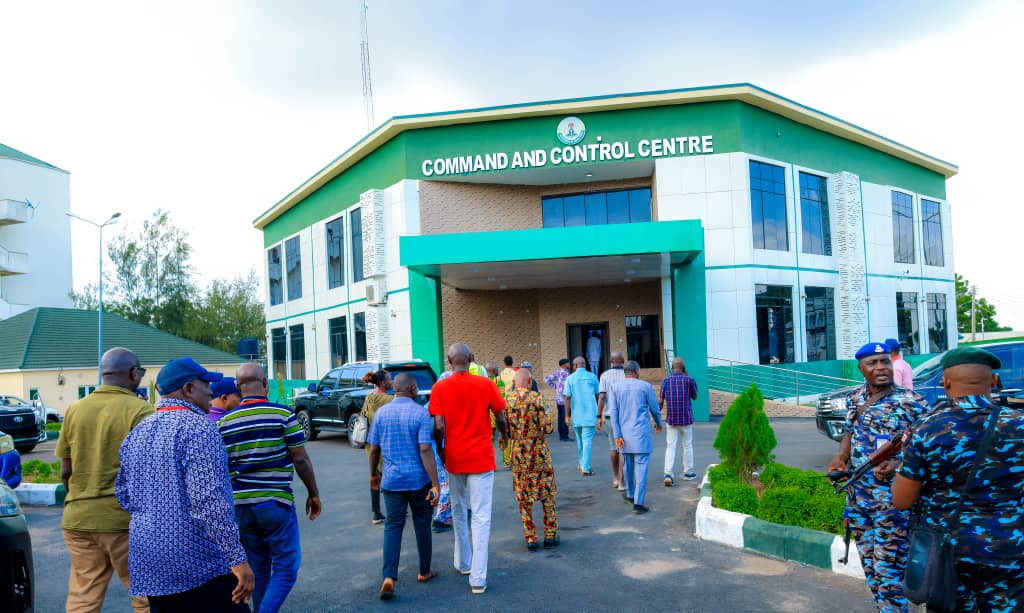
Some of us were here last year and we saw the Command and Control Centre project at its infancy. Today, the facility has been massively upgraded; we are all overwhelmed with the progress at the centre. The question is this: What is your plan for the local governments and the remote parts of Enugu State as far as covering the state with this kind of technology that you have displayed at the Command and Control Centre is concerned?
Part of what we did with the security system is to ensure that we don’t use satellites so that it’s not sensitive to weather. Therefore, when it’s raining, we’re not worried whether the cameras would work. They all use the fiber optic cable to all our cameras so that when it’s raining, we’re not we’re still seeing exactly what we’re seeing.
Now, what we’ve only just commissioned is the first phase. So, we’re now on the second phase. The second phase is designed to capture all the gateways, not just the known gateways. We are capturing all that and extending to all our communities. We do currently have coverage beyond the city.