International
Ten family members stranded after trekking to US border and denied asylum


The main room in the El Buen Samaritano shelter in Ciudad Juarez, a city along the US-Mexico border, is quiet for most of the day.
Rows of bunk beds stretch from wall to wall, each separated by thin curtains or hanging sheets. The mismatched mattresses are occupied by men, women, and children – all migrants who intended to reach the United States but haven’t completed their journey.

It’s the mid-morning of a cold Tuesday, most are resting or scrolling through their phones, the only noises in the room come from sporadic coughs, two children playing, and the subtle sounds from a video playing on a phone. The scene feels like a loop.
“Kids, guys, it’s almost lunchtime,” she yells as she gets up and puts on a coat. They’re indoors but the walls are penetrated by the winter cold.
“Everyone up, let’s get ready,” she says.

Her husband, her three kids, and five other relatives, all start getting ready enthusiastically. Soon after, a shelter worker announces the food is ready to be served.
“I’m hungry, finally!” her 9-year-old son Abel Jesus, says.
Polanco and the other nine members of her family are among thousands of asylum-seekers who were stopped in their tracks by US President Donald Trump’s January 20 decision to cancel all CBP One appointments for people seeking asylum from violence or persecution.
Their appointment had been set for January 21. Now, they are stranded in the shelter in Juarez with no money and full of uncertainty. From here, they can see across the border into the US – but they have no idea where to go now.
‘We laugh to keep from crying’
After lining up, the family – whose members range in age from 5 to 40 – head to the shelter’s dining hall. They sit together and occupy most of a communal table.
As soon as they sit, they seem to put all their problems aside and focus on one another, on talking and enjoying the warm meal. The day’s menu: chicken soup and a small dish of rice and beans with canned tuna.
“The most delicious soup does exist,” 9-year-old Abel Jesus says with his mouth half-full and soup dripping from the edge of his mouth.
“I heard appointments until January 30 will be reinstated,” Luis Alfonso Polanco, 30, says of a rumor that later proved to be untrue. “That’s what a friend in the US told me.”
On the other side of the table, his partner Yelitza Olivero talks to two other migrants from Ecuador and shares the rumor about the app with them.
At times, the family’s border chatter turns into laughter and jokes about one another.
“We try to make jokes about each other, it’s a way of distracting from the news we received on January 20, it was very sad,” Lucymar’s cousin, 18-year-old Estiven Castillo, says.
“The point is to support one another, so one makes a joke, and we laugh, and we try to make a nice moment, otherwise, if we just focus on our situation, we’d all get depressed, so we laugh to keep from crying,” Lucymar tells CNN.
Lucymar and her family say they fled the Venezuelan state of Lara due to political persecution from authoritarian President Nicolas Maduro’s government.
“We were part of an opposing political party,” she says. “My family, my parents, everyone there, and the government knew that, and we’d constantly be threatened.”
“I was set to receive a house from a program run by the government but after they found out who I voted for in prior elections, they took that benefit away from me,” she says holding back tears.
Prior to leaving Venezuela, both Lucymar and her brother, Luis Alfonso, worked in the beauty industry. “I was a barber in Venezuela, but things were so bad that at times I cut hair in exchange for food,” Luis Alfonso says.
Lucymar’s husband, Jesus Caruci, 40, worked as a mechanic, and Yelitza, who’s married to Luis Alfonso, worked in sales. The rest of the traveling family, all young adults or children, were in school before leaving the country.
Their journey began a little over two years ago. They spent a few months in neighboring Colombia to later trek through several countries. They crossed the treacherous Darien Gap safely – but were kidnapped by a cartel after arriving in southern Mexico.
“When we entered Tapachula, they were waiting for us,” Luis Alfonso recalls.
“They tricked us, they forced us into a vehicle and said they were taking us to a safe place (…) but they took us to a farm and held us there for six days.”
Luis Alfonso says the criminal group only released after they paid $900 – all that they were carrying.
“Ever since we’ve survived with some money our family has sent us or that we’ve had to borrow,” he says.
fter sobremesa, the family goes to the shelter’s patio to get some sun and continue to chat. They gather several plastic chairs that are spread out through the uneven and cracked shelter pavement and form a circle. The little kids decide to run around and play in an outdoor playset.
“I understand Trump,” says 19-year-old Beyker Sosa as the family stays quiet.
“There have been crimes done by illegal migrants, I understand the measures, they are meant to keep the country safe,” he adds. “But we aren’t criminals, I wish he (Trump) would have compassion, we are humans just like him.”
CNN asked the family if they ever considered entering the US illegally and in chorus, they all said “no.”
“We never considered entering illegally, we never want to hide from authorities, we wanted to be able to walk free,” Beyker says. “It’s very sad to have done things right, the legal way, only to have Trump shut the app down, but I guess God doesn’t want us there.”
The family says their smartphones and conversation are their only form of entertainment in the shelter. “We can’t even go out, we were warned that migrants are targeted in this area, so we just stay in, especially after already being kidnapped,” Lucymar says.
Still, with kids to entertain, snacks are a must. Luis Alfonso and Estiven go to a store around the corner to buy cookies and soda.
They rejoin the conversation and start passing around Oreos and a plastic cup with orange soda.
“Trump should clean up Venezuela, we are good people, but he should up take out the bad ones, especially those in the government, take them out, Trump, and then take our country and call it Venezuela of America,” Beyker jokes as he refers to Trump’s bid to rename the Gulf of Mexico to the Gulf of America.
Nearly two hours later, the family is back in the main room of the shelter with each settling into their beds again.
“This is all we do, we are either in our beds, on our phones, we wonder what could’ve been,” Lucymar says. (CNN)



International
France braces for another weekend of protests as authorities launch massive security operation
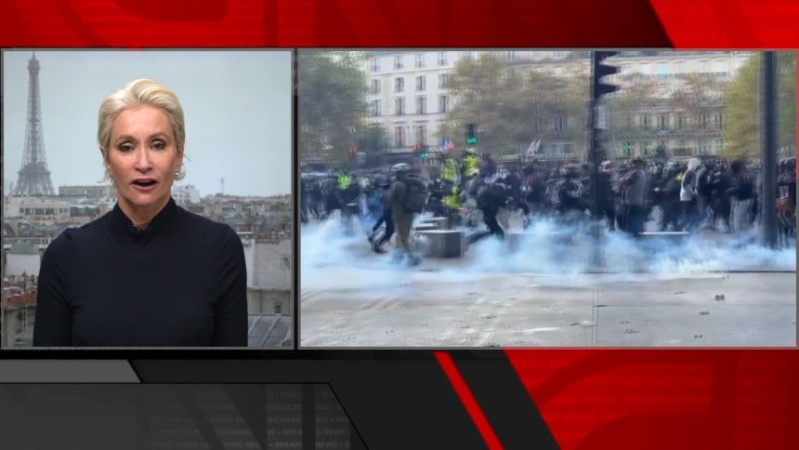
France is bracing for yet another wave of protests this weekend with authorities racing to prevent a repeat of the kind of violence and riots that hit the nation last week.
French authorities will be launching a massive security operation with some 70,000 police officers deployed across the country over the weekend, according to the interior ministry.
Specialist SWAT units, helicopters, armored vehicles, police dogs and water cannons will all be part of the operation. On top of that, the number of French army soldiers that normally patrol Paris as part of the country’s counter-terrorism measures will be increased to free the police from stationary guard duties.
Interior Minister Laurent Nuñez issued a stark warning on Friday to anyone looking for trouble, saying the government would be “uncompromising with those who engage in destruction.”
Last week’s violence followed weeks of protests over education, dismal job prospects and the cost of living. Initially peaceful and attended mostly by students, the demonstrations quickly turned into the worst wave of deadly, nationwide violence in years.
This week, curfews were imposed in some cities to help maintain calm.
Bracing for Saturday
A large demonstration has been called for Saturday afternoon in Paris and French media are expecting hundreds of thousands of people to attend.
The protest is organized by France’s main student union, UNEF, with one of the country’s biggest trade unions, CGT, announcing it would join. Other groups are expected to attend, including farmers, climate activists and the Yellow Vests, the movement that first emerged in 2018 during the protests over fuel costs.
While the protest in Paris has been authorized by the authorities, French President Emmanuel Macron on Thursday banned all non-trade union protests on Saturday as he seeks to control the civil unrest.
But the preparations go well beyond bans and police warnings, especially since last week’s riots sparked criticism of the authorities for not taking the threat seriously enough.
A police officer ties in place a perimeter tape near Chatelet – Les Halles to enforce a curfew, in central Paris on October 20.
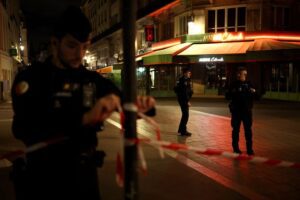
A police officer ties in place a perimeter tape near Chatelet – Les Halles to enforce a curfew, in central Paris on October 20.
Simon Wohlfahrt/AFP/Getty Images
The City of Paris announced earlier this week it was clearing public spaces of equipment and materials that could be used to cause damage, including barriers, bins, construction material and other items.
Many of the main tourist sites in the French capital, including world-famous museums like the Louvre, the Musée d’Orsay and the Musée de l’Orangerie will be closed on Saturday.
Art Basel finished the Paris version of its fair on Friday, two days earlier than scheduled. The Paris National Opera cancelled its performances on Saturday, citing the protests as the reason, and at least two dozen metro stations will also be closed for much of the day, according to Paris municipal authorities.
An NFL game between Pittsburgh Steelers and New Orleans Saints is set to take place at the Stade de France just outside of the capital on Sunday. While the match is scheduled to go ahead, a Steelers fan event in Paris was cancelled by the NFL.
During last weekend’s riots, at least two people died and multiple others suffered serious injuries, including two people who lost their hands. French Justice Minister Gérald Darmanin said some 2,700 people were held for questioning and 232 have been incarcerated in connection to the riots. (CNN)

There are grave fears for the passengers of a private plane that suddenly vanished mid-flight, sparking a major search off the coast of the US.
US authorities say the Gulfstream G100 lost contact with air traffic control about 2am local time on Saturday (4pm Saturday AET) while flying from L.F. Wade International Airport in Bermuda to Boston Logan International Airport.
The US Coast Guard said the Federal Aviation Administration alerted it after contact was lost with the aircraft – which plummeted from 23,500 feet to 11,000 feet in just three minutes, according to FlightAware data.
“We are praying for a safe outcome,” a spokesperson for Latitude Air Ambulance, which operates the missing plane, told City News.
A search is now under way off Nantucket in the air and on water as crews work to locate the missing jet, the Coast Guard said. Data from FlightRadar24 showed a number of aircraft searching south of the island.
Six people are missing after a private jet vanished, sparking a major search off the coast of Nantucket in the US.
The plane was en route from Bermuda to Boston when it vanished.
“Air & surface crews have launched in search of the aircraft. Updates will be provided here as info becomes available,” the Coast Guard Northeast District said on X.
The plane was carrying out a medical evacuation in Bermuda – a British overseas territory in the north Atlantic Ocean, according to Clarence Togeretz, Director of Flight Operations at Latitude Air Ambulance.
“We always get rather concerned when our crew doesn’t report to us in a timely manner,” he told NBC News.
“But I will say that again, optimistically and positively, that doesn’t mean that the worst has happened.”
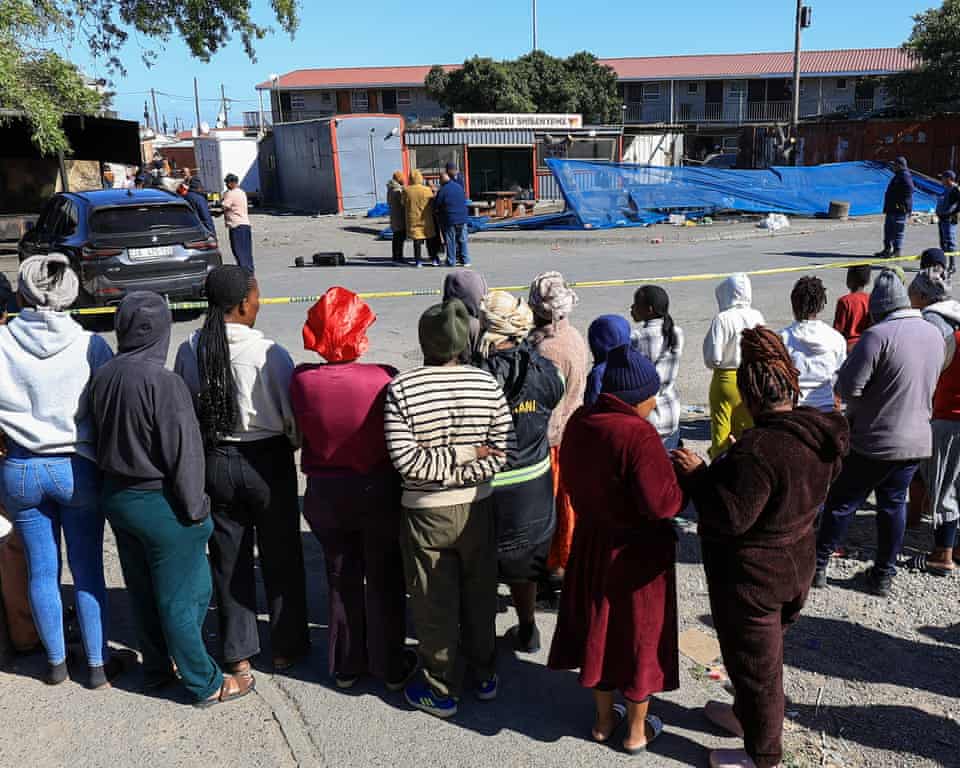
Seventeen people were killed when eight gunmen stormed a bar close to Johannesburg on Saturday evening, with 15 more injured.
In a separate shooting in the early hours of Sunday morning, 10 people were killed outside an entertainment venue in a township near Cape Town and a further 11 were injured.
South Africa has one of the highest murder rates in the world and has struggled to contain gang-related gun violence in recent years. Police have not indicated a motive for either of the latest attacks.
In Johannesburg, gunmen opened fire on customers outside the bar before continuing the attack inside and torching two vehicles before fleeing.
Police said thirteen men and four women were killed.
Deputy provincial police commissioner Maj Gen Fred Kekana said the attack may have been a retaliation for an incident last month, in which one person was killed and another wounded, according to AFP news agency.
Speaking at the scene, he said police had clear pictures and in some cases names for the suspects.
In Cape Town, five victims died at the scene and a further five people died in hospital.
No arrests had been made in either case on Sunday morning.
The two mass shootings came days after 11 people were killed in the city of Duban when gunmen stormed a house in the KwaMakhutha township.

Illegal weapons are prevalent in South Africa and gun violence has been a persistent problem for decades, with about 60 murders recorded every day in the country of 62 million.
But a recent spate of mass shootings has raised fears that the problem is deepening, with violence often linked to turf wars between gangs engaged in drug trafficking and illegal mining.
In February, President Cyril Ramaphosa called organised crime “the most immediate threat to our democracy, our society and our economic development”.
Earlier this year the military was deployed alongside police in areas with the highest murder rates in an effort to reduce armed violence.
On Saturday a tenth woman’s body was found in Ekurhuleni, to the east of Johannesburg, with local police saying they were unable to rule out a serial killer operating in the area with similarities between the deaths. (BBC)
-
 Features2 days ago
Mmesoma Umeorini: When Love Turns Deadly, and a Young Woman Pays With Her Life
-
Features2 days ago
Why Igbos Celebrate New Yam Festival Worldwide: The History, Cultural Significance and Lessons For The Younger Generation
-
News1 day ago
Kogi Police Probe Alleged Murder-Suicide Involving Two Officers
-
News11 hours ago
BREAKING: Tension as Video Shows Islamic Group Members Allegedly Calling for AK-47 to Kill Christians in Enugu, Jos
-
News3 days ago
Mbah: Why We Built 268 Smart Green Schools Across Enugu State
-
News1 day ago
NCDC Reports Two Suspected Ebola Cases as Contacts Rise to 53
-
News3 days ago
Anambra Police Arrest Suspect Over Murder of 23-Year-Old Woman in Uga
-
News1 day ago
Enugu Traders Pledge Support for Mbah’s Second Term, Cite Market Reforms