International
US Navy’s newest Supercarrier transited the Suez Canal, entered Red Sea

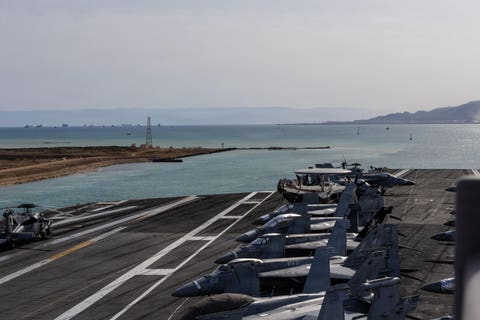
The United States Navy’s newest, largest and most capable nuclear-powered supercarrier entered the Red Sea on Friday after transiting the Suez Canal for the first time.
The USS Gerald R. Ford (CVN-78) is now officially operating in U.S. Central Command’s area of responsibility, even as it has been supporting the ongoing Operation Epic Fury from the eastern Mediterranean, where it arrived last month.

This marks the first deployment to the Middle East for CVN-78, and the furthest the aircraft carrier has traveled from the United States since it entered service with the U.S. Navy in July 2017.
During the warship’s previous extended deployment in 2023, USS Gerald R. Ford operated in the Mediterranean, with several of the escort ships in Carrier Strike Group 12 dispatched to the Red Sea to protect commercial shipping.
Then-U.S. Secretary of Defense Lloyd Austin directed CSG-12 to the region following the October 7 terrorist attacks on southern Israel to deter escalation, and to counter missiles and drones fired by the Iranian-backed Houthi militant group operating in Yemen.

Since the start of the current conflict with Iran, which began on February 28, the Houthis have expressed support for Tehran, yet have not resumed their attacks on shipping in the region.
Long deployment further extended
As of Saturday, USS Gerald R. Ford has been at sea for 255 days, exceeding the previous deployment that finally ended on January 17, 2024, after CVN-78 spent a total of 239 days away from her homeport of Norfolk, Virginia.
The current mission could stretch to 11 months, with the supercarrier unlikely to return home until May, Vice Chief of Naval Operations Admiral Jim Kilby told lawmakers on Wednesday.
“That extension will ultimately be about an 11-month deployment,” Kilby told the Senate Armed Services Committee’s subcommittee on readiness and management support, according to USNI News. “So there’ll be an impact on her return and the schedule for her maintenance availability so she’s ready to go again,” he added. “The good part about our public shipyards is they’re adjusting that schedule. They’re ready to bring our carrier back and maintain her.”
CVN-78 departed from Norfolk on June 24, 2025.
Even if the deployment is cut short, by mid-April, USS Gerald R. Ford will still have broken the post-Vietnam War record set by USS Abraham Lincoln (CVN-72) in 2019-2020 of 294 days at sea. By early May, CVN-78 could see a deployment as long as those during the Vietnam War, when U.S. Navy carriers spent 300 days or longer operating in the Gulf of Tonkin.
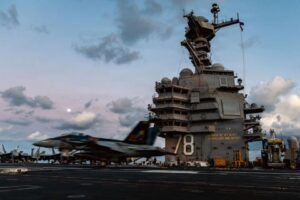
USS Gerald R. Ford Conducts Operations in Support of Operation Epic Fury
An F/A-18F Super Hornet aircraft, attached to Strike Fighter Squadron 213, lands on the flight deck of the world’s largest aircraft carrier, USS Gerald R. Ford (CVN 78), while operating in the Eastern Mediterranean Sea in support of Operation Epic Fury, March 2, 2026.
(U.S. NAVY PHOTO)
The conventionally-powered USS Midway (CVA-41) holds the record for 332 days at sea during its 1972-73 deployment. The extended, nearly year-long deployment supported operations during the conflict in Southeast Asia, including the intensified air campaigns against North Vietnam in 1972.
Keeping The Crew Fed
Even as nuclear-powered warships have unlimited range and endurance, the crew still needs to eat, and the aircraft need fuel. However, the U.S. Navy has that covered.
“The carrier and its crew can be resupplied by air and logistics ships so that it can remain at sea for a very long time.
This is combat, and the crew is ready to execute the mission,” explained Brent Sadler, senior research fellow for Naval Warfare and Advanced Technology in the Allison Center for National Security at the Heritage Foundation.
He added that CVN-78’s extended deployment was largely unavoidable.
“We have too few of these ships for a major war,” said Sadler.
Wear And Tear On The Ship, And On The Crew
The downside of such a lengthy deployment is that it is certain to take a toll on the supercarrier, which will require an extended post-deployment maintenance period. Even as Kirby said the shipyards will adjust as needed, the extended time at sea may impact planned upgrades for the carrier.
“Another area for consideration is the limited capabilities to conduct maintenance on the aircraft stationed on the Ford, as well as the vessel itself,” said Lewis Galvin, lead Americas analyst at private intelligence firm Sibylline.
Any mishaps will further complicate matters.
“Repairs are possible while on deployment, but extensive damage will likely have to be addressed post-deployment,” Galvin noted.
However, it isn’t just the wear and tear on the ship that is a concern. The record-setting deployment may impact the personnel onboard.
“Crew morale and fatigue are the primary concerns at the moment,” Galvin said in an email, noting that the USS Gerald R. Ford was initially scheduled to end its deployment in early March.
“Several problems on aircraft carriers have been reported in recent years,” warned Galvin. “In 2022, the crash of an F-35C on the USS Carl Vinson was attributed to pilot workload and decision-making under pressure. In 2016, an E-2C Hawkeye was damaged on the USS Dwight D. Eisenhower, with a subsequent investigation citing procedural mistakes. This risk is elevated if deployments are protracted.” (Forbes)















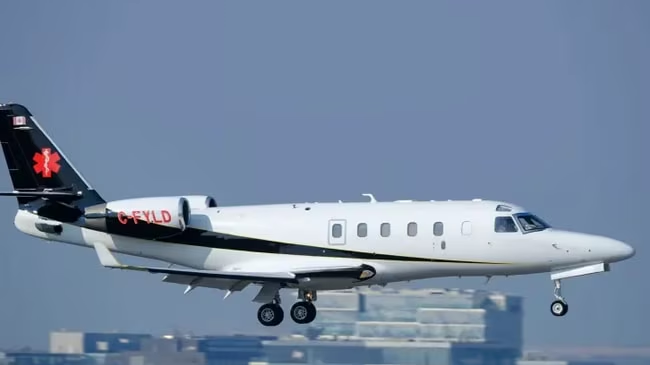
There are grave fears for the passengers of a private plane that suddenly vanished mid-flight, sparking a major search off the coast of the US.
US authorities say the Gulfstream G100 lost contact with air traffic control about 2am local time on Saturday (4pm Saturday AET) while flying from L.F. Wade International Airport in Bermuda to Boston Logan International Airport.
The US Coast Guard said the Federal Aviation Administration alerted it after contact was lost with the aircraft – which plummeted from 23,500 feet to 11,000 feet in just three minutes, according to FlightAware data.
“We are praying for a safe outcome,” a spokesperson for Latitude Air Ambulance, which operates the missing plane, told City News.
A search is now under way off Nantucket in the air and on water as crews work to locate the missing jet, the Coast Guard said. Data from FlightRadar24 showed a number of aircraft searching south of the island.
Six people are missing after a private jet vanished, sparking a major search off the coast of Nantucket in the US.
The plane was en route from Bermuda to Boston when it vanished.
“Air & surface crews have launched in search of the aircraft. Updates will be provided here as info becomes available,” the Coast Guard Northeast District said on X.
The plane was carrying out a medical evacuation in Bermuda – a British overseas territory in the north Atlantic Ocean, according to Clarence Togeretz, Director of Flight Operations at Latitude Air Ambulance.
“We always get rather concerned when our crew doesn’t report to us in a timely manner,” he told NBC News.
“But I will say that again, optimistically and positively, that doesn’t mean that the worst has happened.”
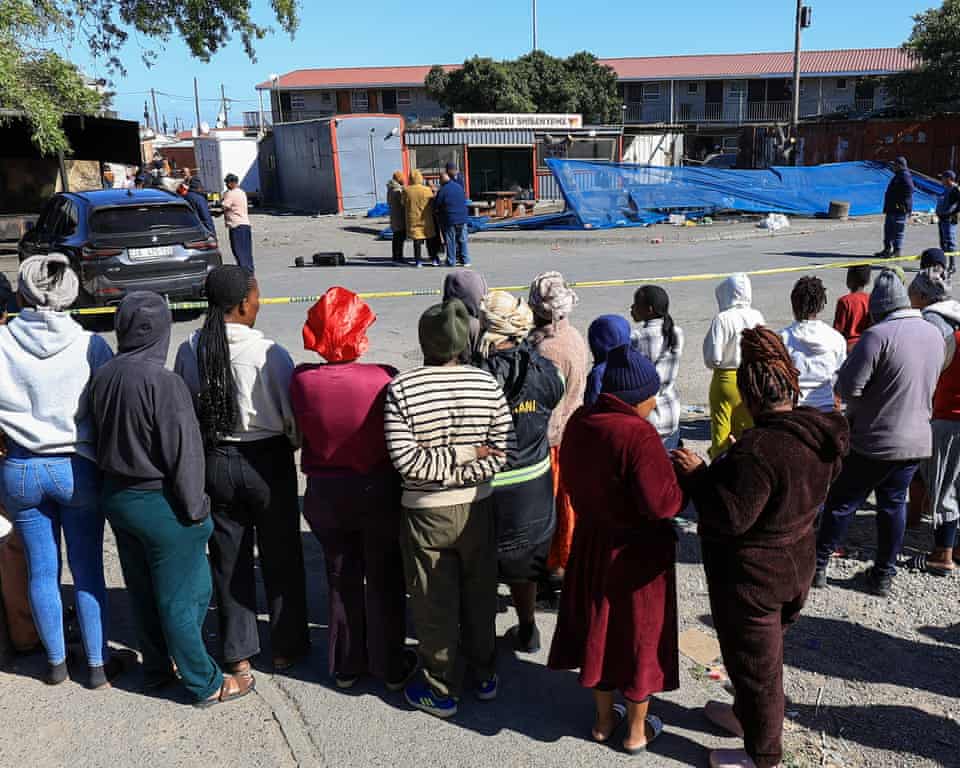
Seventeen people were killed when eight gunmen stormed a bar close to Johannesburg on Saturday evening, with 15 more injured.
In a separate shooting in the early hours of Sunday morning, 10 people were killed outside an entertainment venue in a township near Cape Town and a further 11 were injured.
South Africa has one of the highest murder rates in the world and has struggled to contain gang-related gun violence in recent years. Police have not indicated a motive for either of the latest attacks.
In Johannesburg, gunmen opened fire on customers outside the bar before continuing the attack inside and torching two vehicles before fleeing.
Police said thirteen men and four women were killed.
Deputy provincial police commissioner Maj Gen Fred Kekana said the attack may have been a retaliation for an incident last month, in which one person was killed and another wounded, according to AFP news agency.
Speaking at the scene, he said police had clear pictures and in some cases names for the suspects.
In Cape Town, five victims died at the scene and a further five people died in hospital.
No arrests had been made in either case on Sunday morning.
The two mass shootings came days after 11 people were killed in the city of Duban when gunmen stormed a house in the KwaMakhutha township.

Illegal weapons are prevalent in South Africa and gun violence has been a persistent problem for decades, with about 60 murders recorded every day in the country of 62 million.
But a recent spate of mass shootings has raised fears that the problem is deepening, with violence often linked to turf wars between gangs engaged in drug trafficking and illegal mining.
In February, President Cyril Ramaphosa called organised crime “the most immediate threat to our democracy, our society and our economic development”.
Earlier this year the military was deployed alongside police in areas with the highest murder rates in an effort to reduce armed violence.
On Saturday a tenth woman’s body was found in Ekurhuleni, to the east of Johannesburg, with local police saying they were unable to rule out a serial killer operating in the area with similarities between the deaths. (BBC)

The United States has deported more than 25,000 people under secretive agreements with 35 countries to take migrants with no ties to those nations, according to an investigation published Monday.
Since US President Donald Trump took office in January 2025, Washington has been signing deals with developing countries to take migrants who cannot legally be sent home.
The investigation by Forbidden Stories found the administration has earmarked $410 million to be paid directly to the receiving countries, or to UN agencies to facilitate the returns.
At least 25,447 people had already been deported to third countries by August 31, 2026, according to data compiled by Forbidden Stories with a consortium of international journalists.
The vast majority — around 20,000 — were sent to Mexico, but the rest were dispersed to 27 other countries across Latin America, Africa, and the Pacific, and agreements have been finalised with seven more.
The deals vary, including over which nationalities can be deported and whether people with criminal records can be accepted.
An AFP investigation earlier this year found Washington is using visa bans and restrictions on African countries to strongarm them into accepting deportees.
Lawyers told AFP that deportees were being thrown into a “legal black hole”, held without charge in countries where they have no ties and few if any rights.
Forbidden Stories said 49 of Africa’s 54 countries had been approached about accepting third-country deportees.
A little-known State Department division called the Office of Remigration, created in May 2025, has handled most of the negotiations and payments, according to Forbidden Stories.
The office is headed by Christian Jove Ehrhardt, a 41-year-old diplomat who previously worked as a security officer.
The report details his visits to Cameroon, which signed a memorandum of understanding with the US in December on accepting deportees. A week later, it also signed a five-year health assistance programme worth nearly $400 million.
The following month, the State Department said it would provide a further $30 million to the UN Refugee Agency (UNHCR) in Cameroon to “facilitate the voluntary return of refugees and combat illegal immigration.”
The first plane carrying deportees arrived in Cameroon on January 14.
– Payments –
Other agreements have involved direct payments to governments.
Palau, a small Pacific island nation with a population of under 18,000, signed an agreement in December 2025 to accept up to 75 third-country nationals in return for $7.5 million.
However, only three people have so far been sent under the agreement.
In Eswatini, 32 people have arrived since July 2025 out of a possible 160 under an agreement worth more than $5 million. It has accepted deportees with criminal records, the investigation found.
Of the $410 million planned for the agreements, internal State Department records showed that $81 million was earmarked for signatory governments.
The rest was intended for aid organisations, including more than $178 million for the UN’s International Organisation for Migration, and $123 million for UNHCR.
The agencies have faced criticism over their involvement, although UNHCR told Forbidden Stories that it was not party to the bilateral agreements and that US funding was being used in line with its mandate to strengthen asylum systems.
An IOM spokesperson told Forbidden Stories that the agency’s decisions to accept funding rested “on a single question: whether our engagement will improve the lives of the migrants affected. In these instances, we believe strongly it does.”
-
 News2 days ago
Why UK varsities are cancelling Nigerians’ admission — Report
-
News1 day ago
2027: Enugu Accuses Opposition of Plotting to Import Armed Thugs, Bandits
-
News3 days ago
US asks American business executives to be wary of insecurity, corruption, detention risk in Nigeria
-
News2 days ago
Alleged Magistrate Court Order To Arrest Araraume, Okorocha Is Fake, Non-Existent — Imo First Group
-
News2 days ago
2027: Over 30,000 Enugu Teachers Endorse Mbah, Tinubu, List Welfare, Increased Education Funding
-
News2 days ago
Benue APC Delegation Involved in Ghastly Accident En Route to Rally
-
News2 days ago
Why men with braids, tattoos were banned from mosque, Ogun Chief Imam clarifies
-
News2 days ago
Man stabs wife in Anambra community, kills himself with poison