Connect with us

News

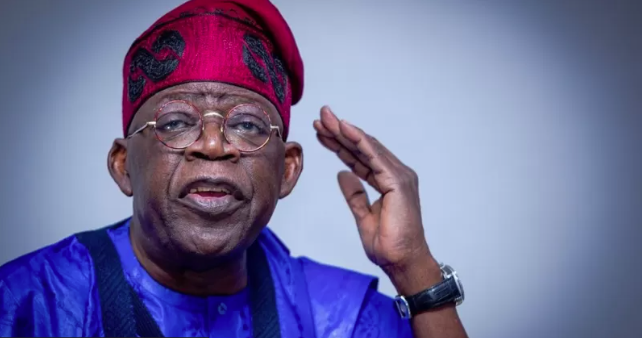
No one is above the law under my administration – Tinubu

Published

on

Why we increased price of petrol — President Tinubu
President Bola Tinubu
Spread the love

…as EFCC records 7,000 convictions, recovers N500bn in two years

President Bola Tinubu has declared that his administration cannot be accused of protecting any individual or group from legal consequences on account of political affiliation, or obstructing crime investigation and prosecution by the authorities, as the government has neither shield laws nor engages in concealment of people’s involvement in crime.

Tinubu said a Nigeria corruption-free was possible if everyone committed to doing the right thing in their respective spheres of influence.

He charged the judiciary to remain steadfast, impartial, and incorruptible in dispensing justice.

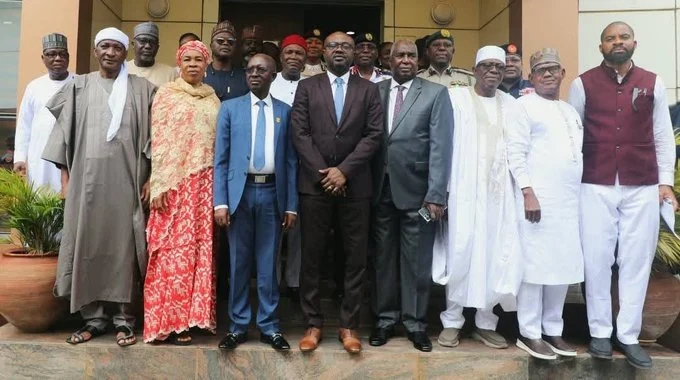
The president spoke on Monday in Abuja while declaring open the Economic and Financial Crimes Commission (EFCC) and National Judicial Institute (NJI) Workshop for Justices and Judges.

He warned that the breakdown of any society began when those entrusted with interpreting its laws became compromised.

Tinubu said his administration was committed to improving the welfare and working conditions of judicial officers, stating that recent remuneration reviews are part of a broader effort to strengthen judicial independence.

Maduka College Advert

The president, who was represented by Vice President Kashim Shettima, said the moral foundation of the Nigerian nation rested on the integrity of its judicial system.

“We draw our moral distinction as a people from the judiciary, and we owe it the reverence and autonomy to remain the last sanctuary of our collective conscience,” he said.

The president addressed growing public concerns about delayed adjudication in high-profile corruption cases while cybercrime matters were resolved more swiftly.

He said, “The theme of this year’s workshop, ‘Enhancing Justice in the Fight Against Economic and Financial Crimes,’ will resonate among many in this audience, coming at a time when conversation in the fight against corruption evokes anger over delayed adjudication of high-profile matters while cases involving cybercrime masterminds are determined with dispatch.

“There is also a certain level of consternation over decisions of courts in serious corruption matters that engender feelings that society is being left with the wrong end of the stick.”

Defending his administration’s non-interference in matters of the court and fight against graft, he stated, “There is no person or group who can accuse this administration of shielding political actors on account of their affiliation to this government or the political party. We have allowed both the judiciary and the anti-graft agencies to exercise their constitutional and statutory powers.”

Tinubu highlighted achievements in the anti-corruption drive, revealing that EFCC “has recorded over 7,000 convictions in the first two years of my administration and recovered assets in excess of N500 billion.”

He added that the recovered proceeds were being channelled into social investment programmes, including the Students Loan and Consumer Credit Schemes.

Addressing the technological challenges facing the judiciary, Tinubu observed the evolution from simple email evidence to complex block-chain analysis in financial crime cases.

“How does one do justice in a cryptocurrency fraud case except one is grounded in such matters? Learning and relearning is no longer a buzz phrase but an essential undertaking for continued relevance in this digital age,” he said.

The president reminded judicial officers that corruption affected everyone equally, saying, “Your vantage position on the Bench does not insulate you from the consequences of corruption. There are no special roads, hospitals, or communities for judges.

“A Nigeria free of corruption is possible if we all commit to doing what is right in our respective spheres of influence.”

Chief Justice of Nigeria (CJN) and Chairman of Board of Governors of the National Judicial Institute (NJI), Justice Kudirat Kekere-Ekun, maintained that the decisions of judicial officers had a profound impact on the growth and stability of Nigeria.

Kekere-Ekun charged judicial officers to be deliberate in applying the relevant constitutional tools at their disposal while exercising firm control over proceedings.

She emphasised that the strength of the judiciary lay in the trust reposed in judges by the Nigerian people, urging them to ensure that justice is neither delayed nor partial.

Senate President Godswill Akpabio, represented by Senate Chief Whip, Mohammed Monguno, stressed that while corruption was an enemy of the state, the fight against it required action from the legislature, a vigilant citizenry, and a courageous judiciary.

Akpabio assured that the National Assembly would continue to play its part in equipping law enforcement agencies to combat crime so that corruption would find no place to hide in Nigeria.

Administrator of the NJI, B.A. Adejumo, stated that the gathering had become a significant milestone over the years in the quest to fight corruption, adding that “no nation can develop without tackling corruption.”

Chairman of EFCC, Ola Olukoyede (SAN), disclosed that the landmark decision of the Supreme Court, which upheld the commission’s anti-corruption mandate, had further strengthened anti-corruption institutions.

“The record of 4,111 convictions and humongous asset recoveries could not have been achieved by a lazy or ineffective judiciary,” Olukoyede added.

In a related development, Tinubu approved the construction of a new auditorium for the Nigerian Law School, Abuja Campus, to enhance legal education infrastructure nationwide.

Minister of the Federal Capital Territory (FCT), Nyesom Wike, disclosed the approval on Monday during the flag-off ceremony of a 600-capacity student hostel at the Law School campus in Bwari, Abuja.

Wike stated that the president approved the new project after he expressed concerns over limited space in the existing auditorium following a private discussion.

He said, “When I told Mr. President that the current auditorium may not accommodate all students once the new hostels are ready, he immediately directed me to ensure that another auditorium is built.

“This shows that when issues are properly presented to the right authority, a responsive leader, like Mr. President, will always act swiftly.”

Wike added that the project also demonstrated the Tinubu administration’s resolve to enhance legal education and improve students’ learning environment.

He lauded the Attorney General of the Federation and Minister of Justice, Lateef Fagbemi (SAN), for reforming the justice sector and for his role in initiating the ongoing digitisation of the FCT High Courts.

Wike stated he would ensure that the hostel was completed within 12 months, without delays or contract variations.

Earlier, Fagbemi expressed gratitude to Tinubu and Wike for their unprecedented interventions in legal education, describing the projects as a true reflection of the Renewed Hope Agenda in action.

He said, “It is an understatement to say I am happy, I am elated. This marks the fourth major intervention for the Law School and Council of Legal Education under this administration. What we are seeing today is real leadership that delivers results.”

The justice minister also praised Wike for his enduring contributions to the Nigerian Law School, recalling his part in the building of what has been described as the best law school campuses in Yenagoa and Port Harcourt.

“From staff quarters to student hostels, every intervention has made teaching and learning easier. This is what true service and responsible governance look like,” he said.

Director-General of the Nigerian Law School, Professor Isa Hayatu Chiroma, SAN, thanked Tinubu for approving the project and the FCT minister for his sustained support for legal education.


News

Democracy Day address: Terror financiers will pay dearly, says Tinubu

Published

on

Rising cost of living: We’re almost on the way to Venezuela – PDP Govs
President Bola Ahmed Tinubu
Spread the love

…issues ultimatum to bandits, kidnappers,  their sponsors to surrender or…

President Bola Tinubu has vowed that no mercy will be shown to terror purveyors who enable the killing and kidnapping of innocent Nigerians.

He also issued an ultimatum to bandits, kidnappers and sponsors of terrorism to surrender or face the full force of the Nigerian state, disclosing that his administration had already neutralised over 13,000 terrorists in the past year alone.

Tinubu gave the warning in his national address delivered on the occasion of the country’s 27th consecutive Democracy Day celebration, his fourth as President since 2023.

According to him, although terror-related deaths had declined by 81 per cent since 2015, Friday’s Democracy Day celebration was subdued by the continued captivity of schoolchildren abducted in Oyo and Borno states.

He declared, “To bandits, kidnappers, and sponsors of terror: Surrender or face the full force of the Nigerian State.

“These windows of surrender will not remain open forever. No mercy will be shown to those who trade in the blood of Nigerians.”

Maduka College Advert

The Nigerian leader said his administration had moved beyond training with allies to precision operations on the ground.

“We have moved from training with our allies, the United States, France and other European countries, to precision targeting.

“In Arege, Borno State, we degraded ISWAP’s command centre.

Terror-related deaths are down by 81 per cent since 2015.

“Over 13,000 terrorists have been neutralised in the past year,” he stated.

Tinubu added that despite the neutralisation of terrorists, the door of rehabilitation remained open alongside the door of force.

“Over 124,000 fighters and dependents have laid down their arms since 2023 through Operation Safe Corridor,” he said.

The N5.41tn security allocation in the 2026 budget, Tinubu said, was a statement of national will to crush the current wave of terrorism, which has raged since 2009.

Beyond the budget, he said his administration had approved the recruitment of more than 50,000 new police officers and thousands of military recruits, which, he revealed, was designed to address the persistent gap between the number of security personnel and the security demands of over 230 million Nigerians.

Tinubu acknowledged that even as the country celebrates 27 years of steady democracy, this year’s festive spirit of Democracy Day was weighed down by the continued hostage situation involving school children and teachers kidnapped in Oyo and Borno states, which has now entered its fourth week.

“Though this year’s mood is dampened by the abduction of our children in Oyo and Borno, we remain hopeful for their safe return. Democracy without security is a mirage.

“That is why this administration declared a security emergency and approved the recruitment of more than 50,000 new police officers and thousands of military recruits.

“Our 2026 budget commits N5.41tn, our largest ever, to defence and security. Our administration is ever ready to do much more to secure our people,” he stated.

He called for national unity in the face of the security challenge, rejecting ethnic or religious framing of criminality and urging Nigerians to do the same.

“At a time like this, let us not assign blame or point fingers. Crime has no ethnicity.

“We must stand united and be assured that the enemies of our nation shall soon be history.

“We will triumph over terror and continue to build a more prosperous nation,” he declared.

On the intermittent power crisis of the past three years, the President explained the scale of the challenge he inherited and his response so far.

He said by 2023, the sector was “characterised by chronic generation shortfalls, an unreliable gas supply, and transmission infrastructure so fragile that it could not evacuate available power. Distribution companies were burdened by massive losses and a metering deficit of over four million.

“The result was a sector that generated less than the 13,500 megawatts installed capacity, a sector that transmitted less than it generated, distributed less than it transmitted, and collected revenue far below what it needed to sustain itself,” he added.

Tinubu said in response, he signed the Electricity Act, granting states authority to generate, transmit and distribute power, authorised the Presidential Power Sector Task Force to raise a N4tn bond to settle verified legacy debts, and directed the Rural Electrification Agency, supported by the World Bank and the African Development Bank, to deploy off-grid and mini-grid power to underserved communities, universities, markets and hospitals.

He explained, “To address the problems besetting the sector, I signed the Electricity Act, which grants states authority to generate, transmit, and distribute power.

“The Presidential Power Sector Task Force is working hard to reduce the metering deficit. It has also been authorised to raise N4tn bond to settle verified legacy debts.

“The Rural Electrification Agency, supported by the World Bank and the African Development Bank, has deployed off-grid and mini-grid power to underserved communities, universities, markets, and hospitals.

“Electricity is a democratic dividend we owe every Nigerian. We intend to deliver it.”

On the broader economy, Tinubu said federation revenues had risen, providing states and local governments with more resources, fiscal transparency had improved, and investor confidence had returned across agriculture, energy, manufacturing, technology, mining, transportation and the creative industries.

He said non-oil exports grew by 21 per cent last year, over 1,000 small and medium enterprises had been certified for export, and the National Agricultural Development Fund was deploying 10,000 tractors over five years.

However, he acknowledged that hardship persists.

“Yet, many Nigerians still face economic hardship. We remain focused on reducing inflation, expanding food production, creating jobs, improving living standards, rebuilding confidence in our economy, and creating conditions for sustainable prosperity.

“We are moving from uncertainty to stability. The next phase is about accelerating growth and ensuring the benefits are felt in every home, every community, and every region. We believe that Democracy must be felt in the pocket,” he stated.

Continue Reading

News

FULL TEXT: Tinubu’s 2026 Democracy Day speech ‎

Published

on

President Bola Ahmed Tinubu
Spread the love

Today, we celebrate not only democracy but also the enduring Nigerian spirit. For 27 unbroken years, since May 29, 1999, Nigerians have chosen their leaders through the ballot, witnessed peaceful transitions of power, and resolved disagreements in courtrooms and legislative chambers—not through violence. We have experienced the longest stretch of civilian rule in our history. Our democracy is not perfect, but it is ours, and we must continue to defend and strengthen it.

‎In the coming days, Ekiti and Osun States will hold elections. I urge INEC, security agencies, and all parties to ensure these polls are peaceful and credible. Democracy fails when citizens doubt the process. To our National Assembly, Judiciary, the Press, and Civil Society: you are the guardrails of our republic. Criticise me, disagree with me, but never stop believing in Nigeria.

‎To our young people: Nigeria is your home and your future. Build here, code here, work here, and vote here. Every great nation was built by those who stayed to solve problems, not by those who abandoned ship.

‎To our armed forces, police, and intelligence services: Nigeria salutes your sacrifice. To our traditional rulers, faith leaders, and community heads: thank you for your support of peace and reconciliation. The government cannot do it alone.

‎Today, we honour the resilience of Nigerians who refused to surrender their faith in freedom, and the courage of those who stood firm against intimidation. We pay tribute to patriots who endured persecution, imprisonment, exile, and even death so that future generations could enjoy democracy. I salute labour leaders, journalists, activists, students, women, professionals, political leaders, and soldiers—both those who have passed and those still with us—for their patriotic contributions.

‎Though this year’s mood is dampened by the abduction of our children in Oyo and Borno, we remain hopeful for their safe return. Democracy without security is a mirage. That is why this administration declared a security emergency and approved the recruitment of more than 50,000 new police officers and thousands of military recruits. Our 2026 budget commits N5.41 trillion—our largest ever—to defence and security. Our administration is ever ready to do much more to secure our people.

‎We have moved from training with our allies, the United States, France and other European countries, to precision targeting. In Arege, Borno State, we degraded ISWAP’s command centre. Terror-related deaths are down by 81% since 2015. Over 13,000 terrorists have been neutralised in the past year. But we also keep the door of surrender open. Over 124,000 fighters and dependents have laid down their arms since 2023 through Operation Safe Corridor.


‎To bandits, kidnappers, and sponsors of terror: Surrender or face the full force of the Nigerian State. These windows of surrender will not remain open forever. No mercy will be shown to those who trade in the blood of Nigerians.

‎At a time like this, let us not assign blame or point fingers. Crime has no ethnicity. We must stand united and be assured that the enemies of our nation shall soon be history. We will triumph over terror and continue to build a more prosperous nation.

‎June 12 occupies a sacred place in our national memory. It represents more than an election; it is a defining chapter in our story. We remember Chief M.K.O. Abiola, who won a pan-Nigerian mandate transcending ethnicity and religion. We remember Alhaja Kudirat Abiola.

‎We also remember Chief Gani Fawehinmi, Chief Bola Ige, Chief Alfred Rewane, Pa Abraham Adesanya, Chief Anthony Enahoro, Alhaji Balarabe Musa, Commodore Dan Suleiman, Dr Beko Ransome-Kuti, Frank Kokori, Arthur Nwankwo, Chima Ubani, Shehu Musa Yar’Adua, and the many other heroes and heroines of democracy whose sacrifices helped secure the freedoms we enjoy today.

‎As beneficiaries of their struggle, we have a duty to strengthen and deepen the democratic institutions for which they fought. The greatest tribute we can pay is to build a Nigeria where freedom is protected, justice is upheld, opportunity is expanded, and government is accountable.

‎June 12, 1993, revealed the possibility of a true Nigerian nation. The heroes of June 12 secured political freedom. Our challenge is to secure economic freedom. Democracy must be felt in the quality of people’s lives—in opportunities for youth, in prosperous farmers, successful entrepreneurs, and the dignity of our workers.


‎The reforms we are undertaking were not chosen for ease, but for necessity. Three years ago, our public finances were under severe strain, investment was discouraged, and economic uncertainty threatened our future. We chose to act, embracing reforms to advance Nigeria’s economic freedom.

‎Since 2023, our reforms have restored stability and credibility to economic management. Federation revenues have risen, providing states and local governments with more resources for infrastructure, education, healthcare, and security. Fiscal transparency has improved, leakage has been reduced, and public funds are better directed to national priorities. Investor confidence has returned, with investments in agriculture, energy, manufacturing, technology, mining, transportation, and the creative industries growing.

‎Domestic refining capacity has increased, strengthening energy security and reducing our reliance on imported petroleum products.

‎By 2023, when we came on board, the electricity sector was characterised by chronic generation shortfalls, an unreliable gas supply, and transmission infrastructure so fragile that it could not evacuate available power. Distribution companies were burdened by massive losses and a metering deficit of over four million. Worst of all, the value chain was drowning in legacy debt. The result was a sector that generated less than the 13,500 Megawatts installed capacity, a sector that transmitted less than it generated, distributed less than it transmitted and collected revenue far below what it needed to sustain itself.

‎To address the problems besetting the sector, I signed the Electricity Act, which grants states authority to generate, transmit, and distribute power. The Presidential Power Sector Task Force is working hard to reduce the metering deficit. It has also been authorised to raise N4 trillion bond to settle verified legacy debts. The Rural Electrification Agency, supported by the World Bank and the African Development Bank, has deployed off-grid and mini-grid power to underserved communities, universities, markets, and hospitals. Electricity is a democratic dividend we owe every Nigerian. We intend to deliver it.

‎Across the country, infrastructure projects are connecting producers to markets and creating opportunities for enterprise and employment. The National Agricultural Development Fund is deploying 10,000 tractors over five years. Over 1,000 SMEs have been certified for export. Non-oil exports grew by 21% last year.

‎Yet, many Nigerians still face economic hardship. We remain focused on reducing inflation, expanding food production, creating jobs, improving living standards, rebuilding confidence in our economy, and creating conditions for sustainable prosperity.

‎We are moving from uncertainty to stability. The next phase is about accelerating growth and ensuring the benefits are felt in every home, every community, and every region. We believe that Democracy must be felt in the pocket.

Maduka College Advert

‎Recognising that democracy is undermined when people do not feel its impact, my administration has sought financial autonomy for our 774 local councils. A fundamental challenge to our nation’s advancement has been ineffective local government administration. The insecurity we are addressing is partly due to the collapse of grassroots governance. The Renewed Hope Agenda is about ensuring that all Nigerians benefit from governance.

‎Every generation has a defining responsibility. The generation of our founding fathers secured independence—the generation of June 12 secured democracy. Our generation must secure prosperity.

‎Let us move forward together—rejecting division, cynicism, and despair; embracing unity, hope, and confidence. Let us build a Nigeria united by a common purpose, strengthened by diversity, where justice is accessible, liberty is secure, and opportunity is abundant.

‎Among the architects of modern democratic Nigeria, we honour General Shehu Musa Yar’Adua for his vision of national partnership. In recognition of his contributions, the Federal Government has approved the revitalisation and renaming of the completed Institute of Petroleum Studies, Kaduna, as the General Shehu Musa Yar’Adua University of Geological Sciences and Engineering Technology.

‎I am also pleased to announce national awards to the following Nigerians, who suffered persecution, endured indignities, exile, incarceration, and, at times, solitary confinement, so that we have democracy today.

‎Barrister Ayoka Lawani

‎Tunde Fagbenle

‎Oladele Alake

‎Olatunji Bello

‎Louis Odion

‎Segun Babatope

‎Sam Omatseye

‎Sir Ademola Osinubi

‎Bola Bolawole

‎Lade Bonuola

‎Femi Kusa

‎Debo Adeniran

‎Chief Ayo Opadokun

‎Chief Ralph Obiora

‎Ose Osayande

‎Barrister Osa Director

‎Prof. Sylvester Odion-Akhaine

‎Dr Arthur Nwankwo (Posthumous)

‎Dr Osagie Obayuwana

‎Dr Joe Okei-Odumakin

‎Barrister Titus Mann

‎Joe Igbokwe

‎Richard Akinnola

‎Ben Charles-Obi (Posthumous)

‎George Mbah

‎Dr Niran Malaolu

‎Major-General Ishola Williams (rtd)

‎Femi Aborisade

‎Jenkins Alumona

‎Gbemiga Ogunleye

‎Muyiwa Adekeye

‎Babajide Kolade-Otitoju

‎Ike Okonta

‎We also recognise the soldier-democrats of the June 12 struggle:

‎Major General MA Garba

‎Brigadier General Lawal Jaafaru Isa

‎Col Umar Farouk Ahmed;

‎Col Sambo Dasuki;

‎Col Lawan Gwadabe;

‎Brigadier Jonathan Ndam Temlong

‎Col Musa Shehu;

‎Major General Chris Eze;

‎Major General Harris Dzarma;

‎Col Isa Jibrin;

‎Maj. General Joseph Oshanupin;

‎Col Olusegun Oloruntoba, Olugbede of Gbede Kingdom)

‎Lieutenant Colonel Happy Kefas Bulus

‎Col J Okai;

‎Col Emmanuel Ndubueze;

‎Lt Col Yakubu Muazu

‎Brigadier Yahaya Abubakar, the Current Etsu Nupe, who is already the holder of the CFR title.

‎The honours list will be released in the next few days.

‎Fellow Nigerians, 27 years ago, many doubted democracy would survive here because of our diversity. Today, our diversity sustains our democracy. The road ahead is steep. But June 12 reminds us: Nigerians do not break. We bend, we bleed, but we do not break.

‎Let us renew our covenant: That the labours of our heroes past shall never be in vain, and that government of the people, by the people, for the people, shall not perish from this land.

‎May God bless the heroes of our democracy. May God bless the Federal Republic of Nigeria. May God continue to bless us all.

‎Happy Democracy Day.

‎BOLA AHMED TINUBU, GCFR

‎President and Commander-in-Chief of the Armed Forces, Federal Republic of Nigeria

Continue Reading

News

Mild drama as policemen, court bailiff storm Nwobodo’s Amechi Country home over Investor’s lawsuit

Published

on

Father remanded in prison for alleged sexual assault of 7-year-old daughter
Spread the love

There was a mild drama in Amechi Awkunanaw, the native home of the former Governor of old Anambra State, Chief Jim Nwobodo, on Thursday morning as they tried to serve a court process.

A team from the Magistrate Court Enugu South, backed by a team of armed police officers, arrived to serve a court summons on the elder statesman’s wife, Patricia Nwobodo.

The dramatic encounter highlights an escalating legal dispute involving a prominent investor, Chief Basil Kenechukwu Ogbuanu.

​The operation follows several failed attempts by court officials to deliver the legal documents to Patricia Nwobodo through regular administrative means.

Frustrated by the inability to effect service, High Court authorities took the unusual step of requesting a formidable security escort. The move was deemed necessary to ensure the safety of the court bailiff and to guarantee that judicial orders could be carried out at the high-profile country home.

​The roots of the confrontation stem from a bitter legal battle between Mrs. Patricia Nwobodo and Chief Basil Kenechukwu Ogbuanu, a well-known investor in the region.

Maduka College Advert

The civil matter follows the recent collapse of a criminal charge that had previously been brought against Ogbuanu at the instance of the Nwobodos. Following his clearance by the courts, Ogbuanu initiated the current legal action, claiming the initial criminal prosecution was a product of pure malice and falsehood.

​Seeking redress for what he describes as a calculated attempt to damage his reputation and investment interests, Ogbuanu filed the suit to hold Mrs. Nwobodo accountable.

However, the progression of the case stalled due to the court’s repeated inability to officially serve her with the originating processes. This procedural bottleneck ultimately forced the Enugu State High Court to employ more assertive measures on Thursday.

​The security convoy arrived at the main gates of the Nwobodo country home in Amechi Awkunanaw at exactly 8:47 AM, taking household staff and local residents by surprise.

The scale of the security deployment signaled how seriously the judiciary viewed the persistent evasion of court processes.

​With the perimeter of the property secured, a small group consisting of the court bailiff, a female police officer, and an accompanying policeman stepped forward. They entered the main building of the estate to locate Mrs. Nwobodo and execute the court’s directive. Outside, the remaining heavily armed officers maintained a strict cordon, keeping an eye on the developing situation.

​For nearly two hours, an anxious silence hung over the Amechi community as the team remained inside the Nwobodo residence. Journalists who had trailed the security convoy observed the developments from a safe distance outside the gates.

The prolonged duration of the exercise inside the house heightened speculation among onlookers that the team was encountering significant resistance.

​When the bailiff and the two officers finally emerged just about 11:09AM, the mood outside visibly shifted. Observers noted that the expressions on the faces of the court official and the police personnels were tense and strained as it was alleged that the police team received orders from the State Command Headquarters to immediately vacate the premises of Jim Nwobodo. No immediate official statement was issued by the team as they made their way back to their waiting vehicles.

​Adding to the tension, journalists monitoring the area noticed a man loitering near the perimeter of the property who was making urgent phone calls.

The individual, whose ties to the household could not be immediately confirmed, appeared to be monitoring the movements of the court officials. His body language suggested a rapidly changing security situation on the ground.

​As journalists drew closer to understand what was happening, they overheard the individual calling for what appeared to be immediate security reinforcement or a “backup.”

​Fearing they might be caught in an ensuing clash, the journalists covering the event made a swift decision to leave the vicinity immediately. The media corps evacuated the Amechi Awkunanaw axis to avoid further trouble, leaving the final minutes of the standoff unrecorded. The hasty retreat left the journalists unable to verify the ultimate outcome of the two-hour operation.

​Consequently, it remains unconfirmed whether Mrs. Nwobodo was successfully served with the court papers or if the bailiff had to retreat without success.

Furthermore, journalists could not ascertain if the court intended for a personal delivery or if the operation was an attempt at substituted service, such as pasting the documents on the property.

The coming days at the Enugu State High Court will likely reveal whether the dramatic intervention succeeded in moving the investor’s lawsuit forward.

Continue Reading

Trending

Maduka College Advert