International
Mass burials in Nepal as death toll from flash floods exceeds 1,000


KATHMANDU, Nepal (AP) — Rescue teams with search dogs continued to look through mud, rocks and debris on the Nepal -China border Tuesday for thousands of people missing a week after the catastrophic flash floods that tore through Himalayan communities and left more than 1,000 dead.
As police in Kathmandu buried dozens of bodies in multiple trenches, Nepal’s disaster agency said 1,003 deaths had been counted there, with 3,916 people missing, including 583 foreign nationals. China reported 16 deaths and 546 missing, including 261 foreigners, as of Sunday.

The scale of the Aug. 26 disaster is hampering rescue efforts, with landslides, destroyed roads and widespread damage cutting off remote areas.
Crews faced challenging conditions as they searched unstable terrain and piles of debris, raising fears the death toll could rise as rescuers reach isolated communities.
Race to reach missing hydropower workers

Rescuers are racing to reach hundreds of workers believed to be trapped inside tunnels at hydropower projects in Nepal damaged by the floods. About 900 workers are missing from 12 projects, with roughly 500 believed to be trapped in tunnels, according to local authorities.
Brig. Gen. Raja Ram Basnet, Nepal’s army spokesperson, said teams assisted by foreign experts were working at several hydropower projects. Images released by the army showed rescue teams entering debris-filled tunnels and wading through mud and water in the search for signs of life.
On the Chinese side, rescue crews scoured areas hit by mudslides, particularly around the Gyirong Port border crossing, which was destroyed.
Some rescuers, aided by search dogs, searched gaps among rocks and debris for signs of life. Other teams used heavy machinery to clear a major highway leading to Gyirong Port, hoping to clear the way for equipment, personnel and supplies to reach the disaster zone, according to China’s state-run Global Times newspaper.
Mass burials of unidentified bodies in Kathmandu
In Kathmandu, police worked in heavy rain on Tuesday to bury dozens of bodies in multiple trenches next to a forested area.
Barbed wire was erected around the site, while blue numbered markers identified the graves of people whose names were not yet known.
Authorities in Nepal have been burying bodies in temporary graves until they can be identified. They are preserving DNA samples, photographing distinguishing facial features and recording other identifying details.
Each body is assigned a reference number to help families identify and claim the remains later.
Sign up for Morning Wire: Our flagship newsletter breaks down the biggest headlines of the day.
Relief operations expanded to stranded communities
At least 11,814 people have been rescued so far, according to Nepalese authorities. Emergency crews used helicopters and other aircraft to reach stranded communities in areas where roads and bridges have been destroyed by the flooding and landslides.
Efforts are being stepped up to provide assistance to survivors in areas where roads and other transportation routes had been damaged or cut off.
China’s Foreign Ministry spokesperson, Guo Jiakun, said a second batch of relief supplies was being sent to Nepal, including drones, DNA testing and water purification equipment. Chinese DNA testing experts will also help Nepal identify bodies, he said.
Bimal Sharma, a helicopter pilot who has been flying rescue and relief missions, said he was shocked to see the devastation in Timure, a border town close to Tibet that he has known for years.
“It felt like I was flying over an entirely different landscape,” said Sharma, adding that he has had little opportunity to speak with the people he rescued. “I can see the pain in their eyes. It’s heartbreaking,” he said.
Glacial collapse in the Himalayas
The disaster began in the Himalayas when a glacial collapse sent large amounts of rock, ice and meltwater into valleys below, triggering powerful floods downstream.
Scientists studying satellite imagery said the collapse appears to have involved the failure of bedrock beneath a glacier in the Himalayan region. The rockfall was powerful enough to register as a magnitude 5.2 seismic event.
The resulting surge of water and debris entered rivers that flow through valleys in Tibet and Nepal, causing them to rise rapidly. Floodwaters swept away homes, buildings, roads and bridges and carried mud and rocks downstream.
Nepal’s Prime Minister Balendra Shah said that the disaster highlighted the need for action to combat climate change.
“This incident has indicated that the risks we face in the Himalayan region are increasing with climate change,” Shah said in a social media post Monday night. “Therefore, this region must be alert, and at the same time, it is time for us to strongly raise the issue of disasters caused by climate change before the international community.”
Saaliq reported from New Delhi. Associated Press journalists Victoria Milko in Kathmandu, Nepal, E. Eduardo Castillo in Beijing, Kanis Leung in Hong Kong and Aijaz Hussain in New Delhi contributed to this report.



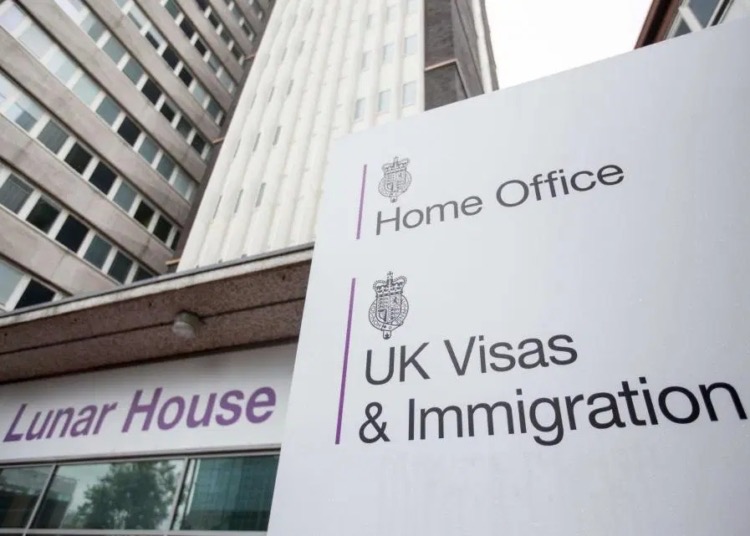
The United Kingdom (UK) has announced plans to retain the two-year post-study work visa for international graduates of selected universities, partially reversing an earlier decision to reduce the duration of the scheme.
Under the revised policy, graduates of universities with strong immigration compliance records and positive employment outcomes will continue to qualify for a two-year Graduate visa, while other international graduates will be eligible for an 18-month visa from January 2027.
The UK government disclosed the change in its 2026 Budget, although it has yet to publish the list of qualifying universities or explain the criteria institutions must meet to retain the two-year visa option.
The policy introduces a two-tier system under which the university an international student attends could determine how long they can remain in Britain after completing their studies.
“The government will also increase the duration of the Graduate visa to two years for graduates from high compliance universities where there are strong labour market outcomes,” the Budget document stated.
The development follows an earlier government announcement to reduce the standard Graduate visa duration from two years to 18 months for international students completing bachelor’s and master’s degree programmes, effective January 1, 2027.
However, international graduates who complete doctoral programmes will continue to qualify for a three-year Graduate visa.
The revised policy means that Nigerian students and other international students planning to study in the UK may need to consider their chosen university’s eligibility under the new criteria when making decisions about their education and post-study employment opportunities.
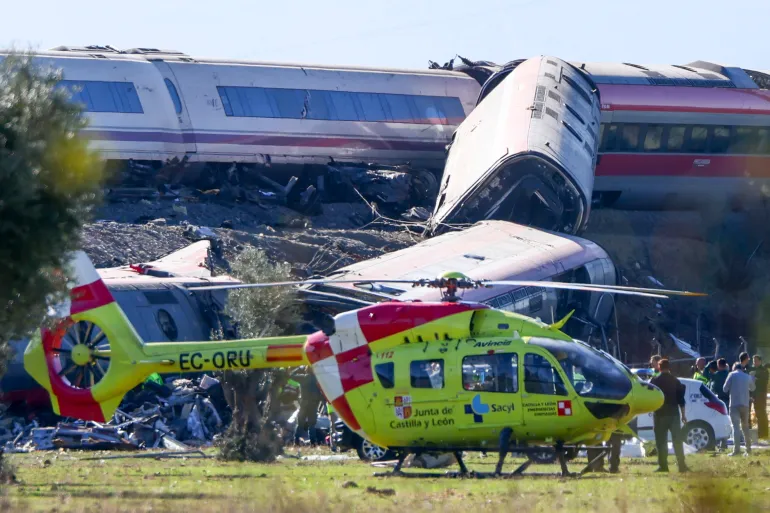
At least 64 people have been killed and about 80 others injured after two high-speed trains collided in central Spain, according to regional authorities.
The accident occurred early Wednesday near Urda in Toledo province, south of Madrid, along the high-speed railway line connecting the Spanish capital with Seville.
The head of the Castilla-La Mancha regional government, Emiliano García-Page, said about 50 of the injured were in serious condition, while 15 others were critically injured. He warned that some of the most seriously injured victims might not survive.
Spain’s Health Minister, Mónica García, said the injured were being transported to several hospitals across the region for treatment.
The collision involved a Renfe-operated AVE high-speed train travelling from Madrid to Seville and another train operated by private railway company Iryo.
Esther Padilla, a spokeswoman for the Castilla-La Mancha regional government, told Spanish public broadcaster TVE that both trains were travelling in the same direction when one struck the rear of the other, which had stopped.
The impact caused carriages to derail, with two carriages of the Iryo train reportedly plunging down an embankment.
Authorities said 397 passengers were aboard the Renfe train, while 147 were travelling on the Iryo train, bringing the total number of passengers involved to 544.
Signalling System Failure Under Investigation
Spain’s Transport Minister, Óscar Puente, said a failure of the railway’s signalling and control system preceded the accident.
Puente explained at a press conference that the LZB train control system went down at about 8:30 a.m. along a 63-kilometre stretch of railway, affecting six trains, although he said the exact number remained uncertain.
Following the failure, control was transferred to the Atocha control post, where a decision was made to allow the Renfe train to resume its journey.
“The decision to resume traffic without the system having been restored corresponds to the control centre,” Puente said, describing the circumstances as “inexplicable”.
Emergency workers were concentrating on rescuing survivors and recovering bodies from the most severely damaged carriages.
More than 200 members of Spain’s Military Emergencies Unit were deployed to the crash site, while local authorities mobilised food and other essential supplies for those affected.
Footage circulating on social media showed wreckage scattered along a slope, with rescue workers and members of the public gathered around the damaged train.
High-Speed Rail Services Suspended
Spain’s railway infrastructure operator, ADIF, suspended high-speed rail services between Madrid and the southern region of Andalusia following the collision.
The disruption resulted in delays and cancellations, with passengers waiting at railway stations, including Sevilla Santa Justa station.
The Civil Guard also deployed a disaster investigation team to the scene to assist with the investigation into the circumstances surrounding the crash.
Madrid Mayor José Luis Martínez-Almeida said the capital was sending emergency medical teams and firefighters to support rescue operations.
Government, European Leaders React
Spanish Prime Minister Pedro Sánchez said he was shocked by the tragedy and was in contact with Transport Minister Puente and Castilla-La Mancha regional leader García-Page as emergency crews continued their work.
“Shocked by the serious train accident in Toledo. My affection, solidarity, and support to all the victims and their families,” Sánchez said in a post on X.
European Commission President Ursula von der Leyen also expressed her condolences to the victims and their families.
“Today, Europe mourns with you,” she said.
French President Emmanuel Macron expressed solidarity with Spain, saying his thoughts were with the victims, their families, the injured and the emergency workers responding to the disaster.
The crash comes nine months after another accident involving high-speed trains operated by the same companies on the same railway line reportedly killed 46 people.
Journalist Graham Keeley, speaking to Al Jazeera from Spain, said the latest tragedy had come at a difficult time for the Spanish government, with an election expected in just over a month.
He noted that following the January accident, the government had promised to conduct safety checks across the country’s railway network.
The investigation is expected to examine the signalling failure, the decision to resume train movements and the sequence of events that led to the collision.
International
France braces for another weekend of protests as authorities launch massive security operation
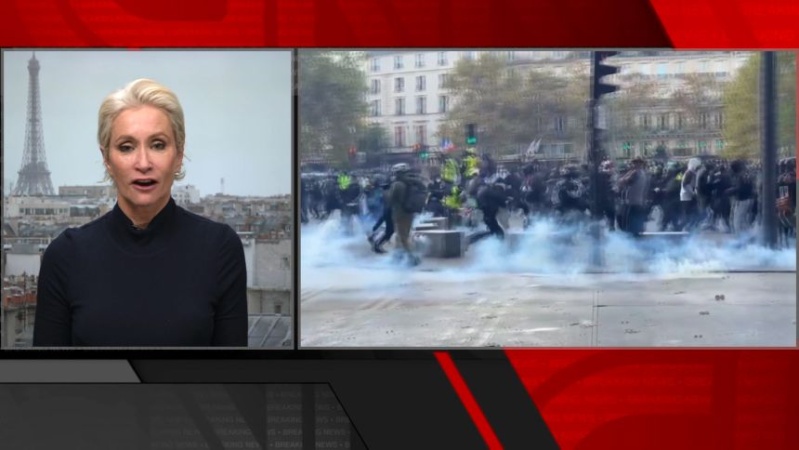
France is bracing for yet another wave of protests this weekend with authorities racing to prevent a repeat of the kind of violence and riots that hit the nation last week.
French authorities will be launching a massive security operation with some 70,000 police officers deployed across the country over the weekend, according to the interior ministry.
Specialist SWAT units, helicopters, armored vehicles, police dogs and water cannons will all be part of the operation. On top of that, the number of French army soldiers that normally patrol Paris as part of the country’s counter-terrorism measures will be increased to free the police from stationary guard duties.
Interior Minister Laurent Nuñez issued a stark warning on Friday to anyone looking for trouble, saying the government would be “uncompromising with those who engage in destruction.”
Last week’s violence followed weeks of protests over education, dismal job prospects and the cost of living. Initially peaceful and attended mostly by students, the demonstrations quickly turned into the worst wave of deadly, nationwide violence in years.
This week, curfews were imposed in some cities to help maintain calm.
Bracing for Saturday
A large demonstration has been called for Saturday afternoon in Paris and French media are expecting hundreds of thousands of people to attend.
The protest is organized by France’s main student union, UNEF, with one of the country’s biggest trade unions, CGT, announcing it would join. Other groups are expected to attend, including farmers, climate activists and the Yellow Vests, the movement that first emerged in 2018 during the protests over fuel costs.
While the protest in Paris has been authorized by the authorities, French President Emmanuel Macron on Thursday banned all non-trade union protests on Saturday as he seeks to control the civil unrest.
But the preparations go well beyond bans and police warnings, especially since last week’s riots sparked criticism of the authorities for not taking the threat seriously enough.
A police officer ties in place a perimeter tape near Chatelet – Les Halles to enforce a curfew, in central Paris on October 20.
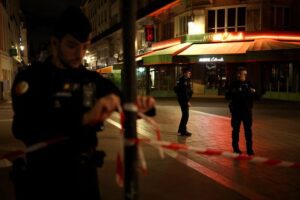
A police officer ties in place a perimeter tape near Chatelet – Les Halles to enforce a curfew, in central Paris on October 20.
Simon Wohlfahrt/AFP/Getty Images
The City of Paris announced earlier this week it was clearing public spaces of equipment and materials that could be used to cause damage, including barriers, bins, construction material and other items.
Many of the main tourist sites in the French capital, including world-famous museums like the Louvre, the Musée d’Orsay and the Musée de l’Orangerie will be closed on Saturday.
Art Basel finished the Paris version of its fair on Friday, two days earlier than scheduled. The Paris National Opera cancelled its performances on Saturday, citing the protests as the reason, and at least two dozen metro stations will also be closed for much of the day, according to Paris municipal authorities.
An NFL game between Pittsburgh Steelers and New Orleans Saints is set to take place at the Stade de France just outside of the capital on Sunday. While the match is scheduled to go ahead, a Steelers fan event in Paris was cancelled by the NFL.
During last weekend’s riots, at least two people died and multiple others suffered serious injuries, including two people who lost their hands. French Justice Minister Gérald Darmanin said some 2,700 people were held for questioning and 232 have been incarcerated in connection to the riots. (CNN)
-
 News1 day ago
BREAKING: Court Nullifies Atiku’s ADC Presidential Ticket, Removes David Mark-Led Leadership
-
News2 days ago
Presidency Reacts as NDC Opens Up on Peter Obi’s Health Challenge
-
News10 hours ago
PSC Appoints Fidelis Ogarabe Enugu Police Commissioner, Deploys Three Others
-
News2 days ago
‘19 Years of Waiting!’ Enugu Pensioner Breaks Down in Joy as Mbah Pays Long-Overdue Gratuity [VIDEO]
-
News2 days ago
Enugu Air to Begin Lagos–London Flights in December – Official
-
Politics2 days ago
2027: APC Flags Off Enugu Campaign in Nsukka, Vows to Deliver Mbah, Tinubu, other Candidates
-
News2 days ago
Trump Blames Republican Candidates for Midterm Election Losses
-
News3 days ago
NBS: Enugu Records Lowest Tax Revenue-to-IGR Ratio in 2025