Business
MainPower rolls out mass MAP prepaid metering programme in Enugu


The MainPower Electricity Distribution Limited (MEDL) says it will roll out mass prepaid meters via mobile Meter Asset Provider (MAP) Metering Programme across its network in Enugu State.
The Head, Corporate Communications, MEDL, Mr Emeka Ezeh, in a statement on Monday in Enugu, noted that the MAP metering programme was meant to fast-track metering process for unmetered customers in the state.

Eze said that the mass metering initiative, which would kick off on Wednesday, July 30, 2025, with its Abakpa and Ogui Districts, offers customers the opportunity to get metered within 72 hours.
He said that the Mobile MAP Metering Programme aligns with the company’s commitment to bridging the existing metering gap, improving transparency in billing and empowering customers with more control over their electricity consumption.
According to him, the programme will be conducted in phases across various district offices, ensuring that all unmetered customers have access to quick and convenient metering options.

Ezeh said that the Disco had urged customers in the selected districts to take advantage of the opportunity.
He emphasised that accurate metering empowers users to take full control of their energy consumption and eliminates billing disputes.
“Customers who are interested in the programme are required to visit the designated locations with a copy of their electricity bill and a valid means of identification,” he said.
He also said that the approved meter prices ranged from N137,062.50 for a Single-Phase meter to N227,900.00 for a Three-Phase meter, and the costs which are subject to monthly review are inclusive of 7.5 per cent VAT.
Ezeh noted that payment for meters during the programme would be with Debit Cards (ATM Cards) only, as cash transactions will not be accepted.
He assured customers that there were no extra or hidden charges involved in the process other than the payment for the meter.
The spokesman said, “Customers are encouraged to report any form of extortion by using its established whistle blowing line (08146026678).
“The company encouraged unmetered customers within the specified districts to take advantage of this metering programme to get metered faster.”
Ezeh said that while this special mobile metering exercise is ongoing, the regular MAP metering process remains available.
“Customers who are unable to participate in the mobile programme can still walk into any of the company’s district offices or visit the official website to apply for a meter through the standard application process.
“Our goal is to ensure more of our customers are metered and are able to manage their energy consumption,” Ezeh added.



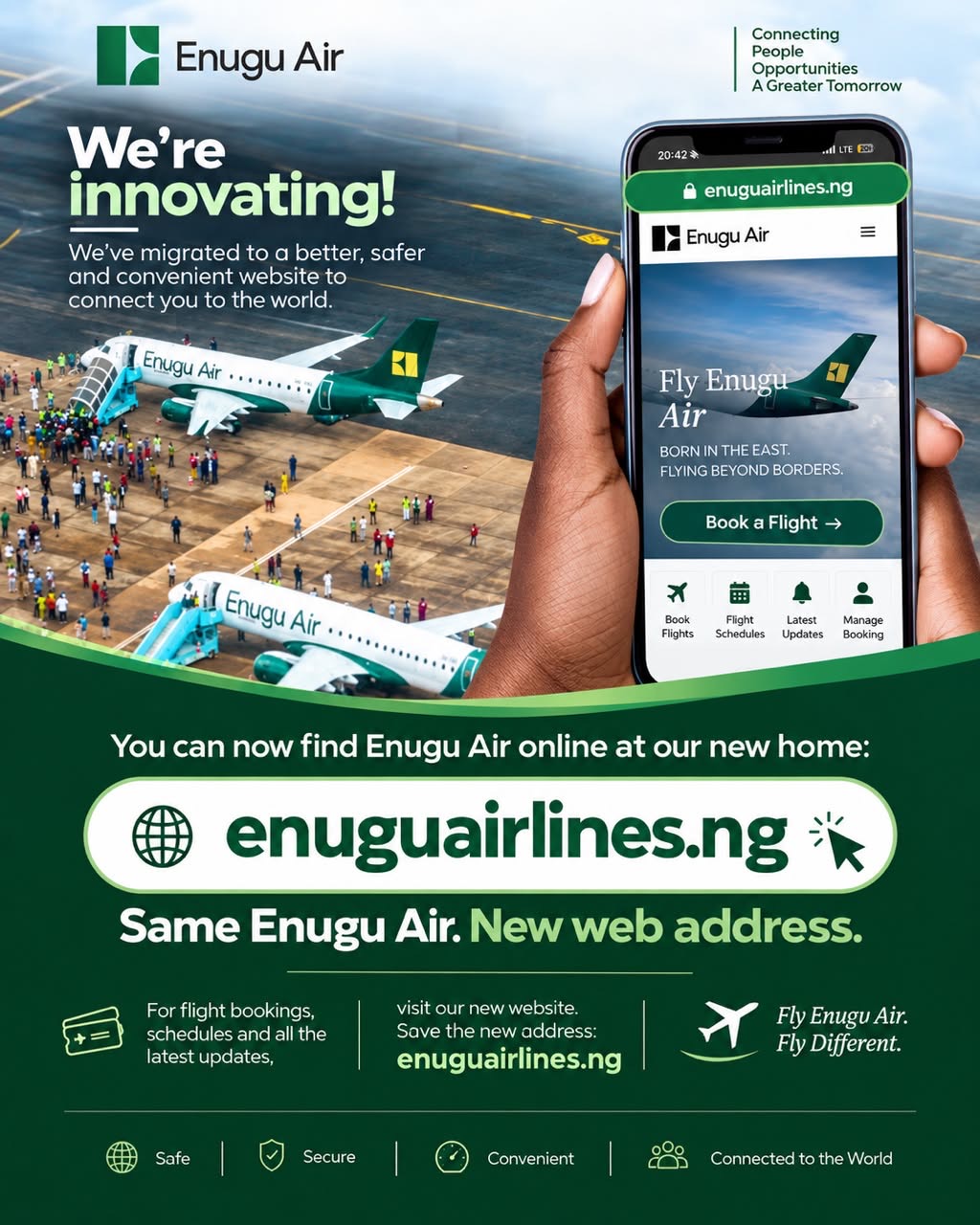
…moves online services to www.enuguairlines.ng
Enugu Air has announced the launch of its new official website, enuguairlines.ng, as part of efforts to provide passengers and customers with a better, safer and more convenient digital experience.
The airline said the migration to the new website is designed to improve how passengers connect with Enugu Air and access its services online, including flight bookings, schedules and the latest updates.
Announcing the development, the airline said: “We’ve moved! We’re innovating! We’ve migrated to a better, safer and convenient website to connect you to the world.”
Passengers can now access Enugu Air’s online services through its new web address, enuguairlines.ng, which the airline described as its new digital home.
The airline urged passengers and prospective travellers to save the new web address and use it for flight bookings, checking schedules and obtaining the latest information about its operations.
“Same Enugu Air. New web address,” the airline stated, emphasising that the change represents an improvement in its digital platform while retaining the Enugu Air brand and services.
The airline further encouraged customers to visit, www.enuguairlines.ng for all flight-related information and online services.
It further stated that the old website, enuguairlines•com has been discarded and no longer in use.
Nigerians consumed a record 8.51 million terabytes of data in the first half of 2026, underscoring the country’s accelerating shift toward a digital-first economy.
Data from the Nigerian Communications Commission (NCC) confirmed this. Specifically, in January, consumption was 1.385 million terabytes; February, 1.260 million terabytes and March, 1.422 million terabytes.
In April, consumption was 1.414 million terabytes. It climbed to 1.504 million terabytes in May and 1.532 million terabytes in June.
In 2025 alone, Nigerians consumed over 13.2 million terabytes of data, a 35 per cent increase from 2024, reflecting how connectivity has become essential for daily life.
The surge in consumption was driven largely by the twin giants of the telecom sector, MTN Nigeria and Airtel Nigeria, whose half-year reports revealed data services have firmly overtaken voice as the primary revenue stream.
According to industry figures, average monthly data usage per subscriber rose sharply, reflecting the growing reliance on mobile broadband for work, entertainment, and commerce.
Streaming platforms, social media, fintech apps, and remote work tools have all contributed to the spike in demand.
MTN Nigeria reported that its 55.7 million active data subscribers consumed an average of 14.8 gigabytes per month, representing a 15.2 per cent increase year-on-year. Overall, MTN’s data traffic surged by 25.8 per cent across its network in the period.
This translated into a massive N1.70 trillion in data revenue, a 38.4 per cent jump compared to the same period in 2025. Data now accounts for more than half of MTN’s total service revenue, dwarfing its voice earnings of N993.5 billion, which grew at a modest 12 per cent.
Airtel Nigeria also posted strong numbers, recording N691 billion in data revenue ($507 million). While Airtel’s voice services contributed to a combined N1.42 trillion in voice earnings alongside MTN, the clear trend is that data has become the dominant driver of growth.
Together, MTN and Airtel generated N2.4 trillion from data services in H1 2026, cementing their role as the backbone of Nigeria’s digital economy.
MTN invested N620.5 billion in capital expenditure during the period, focusing on expanding 4G coverage, scaling 5G rollout, and strengthening fibre infrastructure. The company’s aggressive push into next-generation networks is aimed at meeting the surging demand for high-speed connectivity.
Airtel, meanwhile, faced challenges with fibre cuts and vandalism, forcing reinvestments to stabilize its network. The operator is blending 5G expansion with satellite partnerships to extend coverage into rural and semi-urban areas, where demand for reliable Internet is rising.
Despite these investments, many consumers continue to express dissatisfaction with service quality. Complaints of slow speeds, unstable connections, and high costs remain widespread, highlighting the gap between consumption growth and infrastructure capacity.
The NCC has repeatedly urged operators to deepen investments in fibre, towers, and spectrum to sustain the country’s digital transformation. Analysts note that the sector is undergoing a structural shift from voice-first to data-led growth, with internet connectivity now central to economic activity.
Industry experts predict that Nigeria’s data consumption will continue to rise exponentially as smartphone penetration increases and more services migrate online. The rollout of 5G is expected to further accelerate usage, enabling innovations in fintech, e-commerce, healthtech, and entertainment.
The consumption of 8.51 million terabytes in H1 2026 marks a historic high for Nigeria’s telecom industry. It reflects not only the appetite of a digitally hungry population but also the broader transformation of the economy.
With MTN and Airtel leading the charge, the challenge now lies in improving service quality, expanding infrastructure, and ensuring affordable access for millions of Nigerians. As data becomes the lifeblood of communication and commerce, the telecom sector’s ability to keep pace with demand will determine how effectively Nigeria harnesses the opportunities of the digital age.
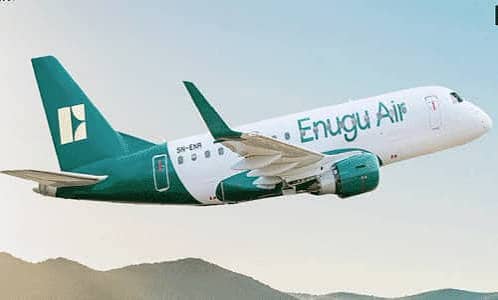
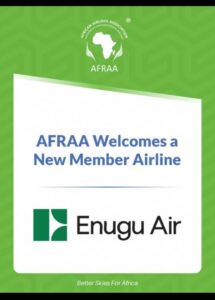
The African Airlines Association (AFRAA) has admitted Enugu Air as Member, extending the Association’s membership base in Nigeria’s fast-growing domestic aviation market and reaffirming AFRAA’s commitment to supporting the continued development of African carriers across the continent.
This was announced by AFRAA in Nairobi on Wednesday, making Enugu Air the 50th Member of the association, joining the AFRAA airline fraternity, collectively representing more than 85 per cent of total international traffic carried by African airlines.
Speaking on the occasion, AFRAA Secretary General, Mr. Abdérahmane Berthé, said, “We are delighted to welcome Enugu Air into the AFRAA fraternity.
“As a state-backed carrier serving Nigeria’s rapidly expanding domestic market, Enugu Air represents the kind of homegrown investment that is vital to building resilient air connectivity across our continent.
“We look forward to supporting the airline through the IOSA certification process and to its continued growth within the AFRAA membership, as we work together to advance the cause of unified African skies.”
Reacting to the development, the CEO of Enugu, Capt Tolu Ita, described the admission into AFRAA as a major milestone in the airline’s short history.
“We are honoured to join the AFRAA fraternity. This membership underscores Enugu Air’s commitment to safe, reliable, and affordable air travel for Nigerians while contributing to the vision of a unified African aviation market.
“We look forward to collaborating with fellow AFRAA members and leveraging the association’s support as we grow our network and pursue IOSA certification,” Tolu stated.
Founded on July 7, 2025, Enugu Air commenced commercial operations with a fleet of Embraer E170/E190/E195 aircraft.
The airline, which has its headquarters in Enugu and operates from the Akanu Ibiam International Airport, currently serves nine domestic destinations including Enugu, Abuja, Lagos, Port Harcourt, Kano and Benin City.
As part of the airline’s growth strategy, Enugu Air plans to expand further across Nigeria and, in subsequent phases, to launch regional and international routes across Africa, Europe, and beyond.
As part of its growth strategy, Enugu Air plans to expand further across Nigeria and, in subsequent phases, to launch regional and international routes across Africa, Europe, and beyond.
The admission of Enugu Air aligns with AFRAA’s strategic priorities and strengthens the voice of the association. Nigeria, as Africa’s most populous nation and one of its fastest-growing economies, remains central to the realization of a truly integrated African aviation market.
Meanwhile, founded in Accra, Ghana, in April 1968, and headquartered in Nairobi, Kenya, AFRAA’s mission is to promote, serve African Airlines and champion Africa’s aviation industry.
The association envisions a sustainable, interconnected and affordable air transport industry in Africa, where African airlines become key players and drivers of African economic development.
AFRAA membership cuts across the entire continent and includes all the major intercontinental African operators.
The association’s members represent over 85% of total international traffic carried by African airlines.
-
 Politics18 hours ago
WHEN PRIVACY BECOMES CONTENT: The Dangerous Normalisation of Leaked Private Conversations
-
Editorial3 days ago
Why Nigerian Graduates and Youths Are Jobless — and Increasingly Vulnerable to Crime and Other Vices
-
News1 day ago
BREAKING: Gov Mbah appoints 101 new aides
-
News2 days ago
Former Kogi Gov, Ibrahim Idris, dies in UK at 77
-
News2 days ago
NDLEA intercepts N3.4bn drugs, arrests fake police officer
-
News11 hours ago
UK excludes Nigerian, Ghanaian-trained teachers from teaching qualification list
-
Politics3 days ago
NDC disowns purported OK Movement PCC, moves to sanction John Ugulu
-
News2 days ago
Woman allegedly kills husband over plans to marry second wife