

News
Israel-Iran War: Stranded Nigerians in underground shelters, cry out for help

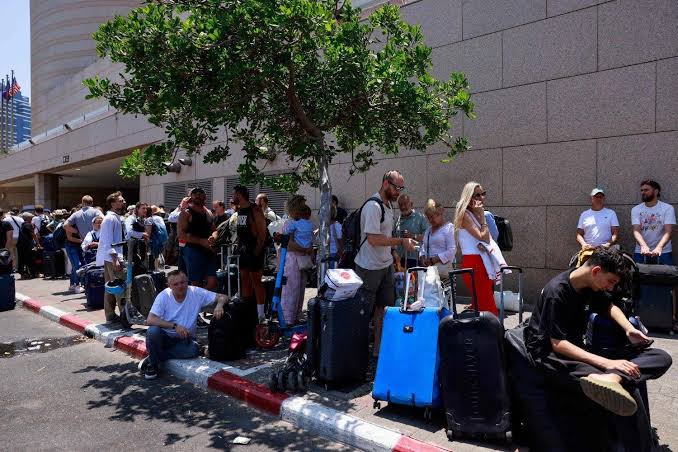
Nigerians caught in the hostilities between Israel and Iran have called for help from underground shelters amid heavy exchange of missiles between the two countries.
Those who spoke to Saturday PUNCH slammed the Nigerian government for not doing enough, adding that other countries had started evacuating their citizens.

Meanwhile, the Federal Government said it was awaiting border clearance to rescue over 1,000 Nigerians in the warring countries.
Rising casualties
According to reports, no fewer than 264 people, including 70 women and children, have died in the two countries since the war started.

The war began last Friday when Israel launched Operation Rising Lion, with guided missiles and air raids pounding suspected Iranian nuclear and military sites, including air-defence installations, as well as residential areas in eastern Tehran, notably the Shahrak-e-Mahallati neighbourhood, home to senior IRGC commanders, and targets in Tabriz and other cities.
High-ranking Iranian military figures, including General Mohammad Bagheri and IRGC commander Hossein Salami, were among those killed in the Israeli offensive.
In a statement, Tehran described the strikes from Israel as ‘the most direct act of war’ in decades of covert hostilities.
In a retaliatory response on 13 June 2025, Iran launched a large-scale missile barrage, firing over 100 ballistic missiles at Israeli cities, including Tel Aviv, where the Nigerian embassy is located.
Checks by Saturday PUNCH revealed that most Nigerians living in Israel are based in Tel Aviv and Jerusalem.
Sources confirmed that nearly all economic, social, and religious activities have been suspended in major Israeli cities.
Nigerians recount ordeal
In separate interviews with Saturday PUNCH, some Nigerians living in major Israeli cities recounted their ordeals.
A Nigerian in Tel Aviv, Ekene Abaka, said since the onslaught began, members of the Nigerian community in the city had joined other foreigners to take cover in underground shelters provided by the Israeli military, pending an opportunity to escape the country.
‘We are in an Israeli bomb shelter and I can’t answer calls right now’, Abaka said in a hasty Facebook message to Saturday PUNCH.
A software engineer living in Jerusalem, who spoke on condition of anonymity, said Nigerians in Tel Aviv and Jerusalem had been scrambling for the past few days since the face-off between the two nations started.
The source, who also claimed to be speaking from a bomb shelter, said though many Israelis had died, no casualties had been recorded among Nigerians so far.
He lamented that the Nigerian embassy had closed all official and diplomatic activities without supporting distressed Nigerians in the country.
‘Most of the areas where Nigerians live in Israel are in Tel Aviv. As a matter of fact, that is the main area where most of the missiles are going. I live in Jerusalem.
‘There are about three families in Jerusalem from Nigeria, but the majority of Nigerians live in Tel Aviv. We are on the run.
‘The Nigerian embassy is situated in Tel Aviv. It has shut down. It’s not doing anything about the issue at the moment. We ran into a bomb shelter to protect ourselves from missiles coming from Iran’, he added.
Meanwhile, in a video shared on Tuesday by Travels Vlog, a Facebook page documenting the daily experiences of Nigerians in Israel and other parts of the Middle East, some Nigerians were seen scrambling into a bomb shelter after the Israeli government sounded the security alarm, warning of incoming Iranian missiles.
‘Everybody is running helter-skelter now. I didn’t grab my water. Oh! Those are the missiles there. They have fallen now’, one of them cried out in fear.
But as they approached one of the shelters, they found it locked.
‘Oh! It’s closed. Why did they lock this place? Let’s go, there is another one over there. We can’t stay here. This place is not safe’, another voice urged as the group rushed off in search of an open shelter under the night sky.
When they finally reached a covered spot, they sat on the ground, visibly shaken, waiting as the blaring alarm slowly faded and the missiles vanished from sight.
The Travels Vlog host, identified as one Solomon, explained in a live video on Wednesday that people were informed about incoming Iranian missiles through a text message from the government.
‘There are missiles coming in, but 10 minutes before they hit, the Israeli government detects them and sends us a direct message to immediately leave our homes and run to the shelter. A few minutes afterwards, the security siren starts blaring, and that’s when panic sets in’, he said.
Countries move to evacuate citizens
The situation in the Middle East has prompted governments around the world to evacuate their nationals from both Iran and Israel, where airspace closures and missile fire have made civilian travel dangerous or impossible.
No fewer than 12 countries, including the Czech Republic, Slovakia, Germany, Greece, and Bulgaria, have contacted their citizens in the warring nations and repatriated hundreds by air, sea, and road.
Many evacuees crossed land borders on foot before boarding repatriation flights from neighbouring countries.
Agence France-Presse reported on Thursday that the Czech Republic and Slovakia flew home 181 people on government planes, while Greece returned home 105 of its citizens plus a number of foreign nationals via Egypt.
The United States announced plans on Wednesday to evacuate Americans by air and sea, while China evacuated more than 1,600 citizens from Iran and several hundred more from Israel.
In a statement on Tuesday night, the Federal Ministry of Foreign Affairs revealed that the Nigerian Embassies in Israel and Tehran (Iran) were actively reaching out to affected citizens and coordinating efforts to ensure their safe return.
As of Thursday night, the Federal Government had yet to evacuate any Nigerian trapped in the countries.
A woman, identified as Hope Omobeauty, during Solomon’s Vlog podcast, said some of her people had been trying to leave Israel but had found no way.
‘I have people in Israel who are trying to leave, but there is no way’, she said.
Collapse of businesses
The Israeli government has shut down all activities until at least Sunday at 8 pm, further worsening conditions for Nigerians in the country.
Israel announced that all educational institutions, including kindergartens, daycare centres, schools, special education programmes, summer camps, youth organisations, and higher education facilities, had been closed.
Speaking about this, the engineer told Saturday PUNCH that the closures had negatively affected the livelihoods of Nigerians.
He lamented the ‘indifference and insensitivity’ of the Nigerian embassy to their predicament.
‘In Israel, rent is paid every month. At workplaces, you’re paid per hour. But all business activities have been shut down, so there is no income for anyone at the moment. We are scared because we don’t even know how we will pay our next rent or feed our children’, he said.
‘There is an announcement that everything will reopen on Sunday, schools, markets, and places of worship, but it is not guaranteed. It all depends on how Iran continues the war, whether they will carry on with the bombardment or not. We don’t sleep at night because that’s when the missiles fall.
‘What the officials at the Nigerian embassy do is perform their formal obligations, grant visas and handle diplomatic or travel assignments. They don’t engage in the welfare of Nigerians. If anything happens, you are on your own. They don’t do anything to help Nigerian citizens here’.
FG awaits border clearance
Meanwhile, nearly 1,000 Nigerians stranded in Iran have remained in limbo, as the Federal Government awaits final border clearance from Armenia to begin their evacuation.
According to the spokesperson for the Ministry of Foreign Affairs, Kimiebi Ebienfa, the Nigerian Embassy in Tehran has completed logistical arrangements to move citizens to Armenia, the nearest border country, where they are to be airlifted home from the capital, Yerevan.
He told Saturday PUNCH that embassy officials were in close talks with Armenian authorities to finalise the movement of evacuees across the Iran-Armenia border.
While bus transport has been secured, approval from Armenia to allow Nigerians to cross the border is still pending.
‘The Charge d’Affaires of the Embassy met officials of the Ministry of Foreign Affairs in Armenia, which is the nearest border, to discuss modalities of moving stranded Nigerians via buses to Yerevan, while waiting to be airlifted to Nigeria.
‘The Embassy has also advised Nigerians to stay away from demonstrations, remain in safe areas, and stay glued to their phones for evacuation messages once arrangements are concluded.
‘At the moment, the Embassy has concluded arrangements with bus companies to hire buses that will convey us all to the transit country, Yerevan, Armenia. However, we are awaiting permission from the transit country before moving from locations already earmarked for evacuation’, Ebienfa said.
He said to prevent complications at the crossing, the embassy was coordinating with Iran’s Ministry of Foreign Affairs by submitting updated lists of evacuees, including personal details.
‘This is to ensure a smooth passage through the border and avoid any bottlenecks.
‘All hands are on deck to get permission, including for transit and final airlifting to Abuja from Yerevan, Armenia’, he stated.














Suspected bandits have abducted 29 women and a male child during attacks on four communities in Mariga Local Government Area of Niger State, with 11 of the female victims reportedly escaping from captivity.
The affected communities are Kwimo, Kalgo, Kakaki and Mabona.
The latest development was disclosed in an operational update by the Nigeria Police Force covering security operations across several states between October 27 and 28, 2026.
According to the report, the 11 women escaped from their abductors’ hideout following sustained tactical pressure from police operatives.
Security personnel are continuing efforts to secure the release of the remaining victims and apprehend those responsible for the abduction. The State Criminal Investigation Department in Minna is investigating the incident.
A resident, Mohammed Ibrahim, said a joint security team led by operatives of the Bangi Police Division immediately launched a pursuit of the attackers after the incident.
He said the security operatives tracked the assailants, leading to efforts to rescue the abducted residents.
The Police Public Relations Officer of the Niger State Command, SP Wasiu Abiodun, also confirmed the attack and the ensuing security operation.
Mariga Local Government Area has experienced repeated attacks and kidnappings in recent months, raising concerns over the safety of residents, particularly those in rural communities.
In September, suspected bandits abducted dozens of farmers, most of them women, while they were harvesting groundnuts in the area. The police confirmed that more than 20 people were abducted, while the local government chairman put the figure at 47.
The recurring attacks have heightened concerns about the security of farming communities and the impact of kidnappings on residents’ livelihoods.
As of the latest available report, efforts were ongoing to rescue the remaining victims of the latest abduction.
The status of the male child and the exact number of victims still in captivity had not been independently established in the reports reviewed.
The Trade Union Congress of Nigeria (TUC) has rejected the Federal Government’s proposed N70,000 wage award, demanding an increase in the monthly salary of the lowest-paid worker to N300,000 to cushion the effects of rising living costs.
The congress described temporary wage allowances as inadequate to address the economic hardship facing Nigerian workers, urging the government to implement a permanent salary review and honour outstanding agreements with organised labour.
The position was contained in a statement issued on Wednesday by the TUC President, Festus Osifo, and Secretary-General, N.A. Toro, following a National Administrative Council meeting held in Abuja on October 8, 2026.
The congress said it had written to the Federal Government through the Office of the Secretary to the Government of the Federation, demanding an immediate review of workers’ salaries in response to rising food prices, transportation costs, healthcare expenses and other essential needs.
According to the TUC, the government does not need to wait for negotiations on the national minimum wage before reviewing workers’ salaries, arguing that there is no legal ceiling on how much employers can pay.
It proposed raising the monthly salary of the lowest-paid worker from N70,000 to N300,000, with corresponding adjustments across other salary grades.
The congress also expressed concern over the implementation of the 2023 wage award, alleging that the arrangement had not benefited workers consistently across the country.
It said some workers were still owed one or two months’ payments, while others had yet to receive the allowance. Some beneficiaries, it added, experienced irregular payments and were repeatedly forced to demand their entitlements.
The TUC further claimed that more than 80 per cent of states and workers in the informal sector had not benefited from any form of wage award.
It questioned the rationale for introducing another temporary relief measure when outstanding obligations under the previous arrangement remained unsettled.
The congress maintained that ongoing negotiations on a new national minimum wage should not prevent the government from implementing urgent salary increases for workers grappling with mounting economic pressures.
Beyond salary adjustments, the TUC called on federal, state and local governments to introduce practical measures to reduce the cost of essential goods and services, ensure prompt payment of salaries and pensions, protect jobs and address exploitative labour practices.
TUC Accuses FG of Breaching Health Workers’ Agreement
The congress also accused the Federal Government of failing to implement an agreement with the Joint Health Sector Unions (JOHESU) on adjustments to the Consolidated Health Salary Structure (CONHESS).
According to the TUC, representatives of organised labour, JOHESU leaders and government officials reached an agreement during conciliation talks at the Federal Ministry of Labour and Employment.
The government delegation included the Minister of Labour and Employment, Dr Muhammad Maigari Dingyadi; the Coordinating Minister of Health and Social Welfare, Prof. Muhammad Ali Pate; and the then Minister of Finance and Coordinating Minister of the Economy, Wale Edun.
The congress said JOHESU suspended its industrial action in good faith following the agreement but alleged that the government had failed to fulfil its commitments seven months later.
It described the delay in implementing the CONHESS adjustment as a breach of the agreement, warning that failure to honour commitments could undermine confidence in collective bargaining.
The TUC consequently demanded the immediate implementation of the salary adjustment, a clear timetable for execution, adequate budgetary provisions and consultations with the relevant unions to resolve outstanding issues.
It also pledged to support affected health workers and pursue lawful measures to compel the government to honour the agreement.
The congress said it was awaiting the outcome of its scheduled meeting with the Federal Government before deciding on its next course of action. It did not announce an immediate nationwide strike.
Nigeria’s national minimum wage was increased from N30,000 to N70,000 monthly in July 2024 after President Bola Tinubu signed the new minimum wage law following negotiations with organised labour.
However, the increase has not ended calls for broader salary reviews and additional measures to protect workers’ purchasing power amid rising living costs.
The TUC maintained that Nigerian workers needed lasting improvements in their earnings rather than temporary relief measures, stressing that government agreements must be honoured and workers’ welfare prioritised.

Four students of the Federal University of Technology, Minna, and a driver attached to the Niger State Government House have died in a road accident involving a vehicle in the convoy of Governor Mohammed Bago.
The accident occurred on Monday at Gidan Kwanu, near Minna, when a Toyota Hilux conveying the Director-General of the Government House, Mr Dauda Chikuba, collided head-on with a vehicle carrying five students of the university.
According to a report by The PUNCH, four of the five students died on the spot, alongside the driver of the Government House vehicle.
The newspaper reported that the governor’s convoy was returning to Minna, while the vehicle conveying the students was travelling towards Bida when the crash occurred.
Eyewitnesses said the governor and his entourage were returning from a condolence visit to the Etsu Nupe and Chairman of the Niger State Council of Traditional Rulers, Alhaji Yahaya Abubakar, following the death of the Sagi Nupe, Hajia Aisha.
One of the eyewitnesses described the incident as a head-on collision and alleged that the convoy was travelling at high speed when the crash occurred.
“It was a head-on collision. We learnt that the convoy was at high speed when the accident occurred. It was a terrible accident,” the eyewitness was quoted as saying.
The eyewitness added that Chikuba was immediately rushed to a hospital for treatment, while the bodies of the deceased students and the driver were evacuated to an undisclosed destination.
The spokesperson for the Niger State Police Command, Superintendent of Police Wasiu Abiodun, confirmed the incident, saying the police had commenced an investigation.
“The accident occurred this morning, and we are investigating it,” Abiodun was quoted as saying by The PUNCH on Wednesday.
-
 News2 days ago
BREAKING: Tension as Video Shows Islamic Group Members Allegedly Calling for AK-47 to Kill Christians in Enugu, Jos
-
News1 day ago
BREAKING: El-Rufai Tests Positive for Drug-Resistant Bacteria, Shows Signs of Possible Severe Infection—Report
-
News2 days ago
Ifeanyi Ubah’s Elder Sister, Fidelia Chigbogu, Dies Suddenly at 61
-
News17 hours ago
FG kicks off $100m Southeast gas pipeline project
-
News2 days ago
Terrorists Abduct Sunday Igboho’s Iru Ekun Security Group Members in Kwara
-
News2 days ago
Apologise to Igbos: Senator Umeh Challenges Gowon to Write Book on Civil War
-
News3 days ago
Ngozi Okonjo-Iweala loses mother
-
News2 days ago
Mbah Vows to Sign Bill Curbing Excessive Agency, Lawyers’ Fees in Enugu