News
Over billing: Enugu Electricity Regulatory Commission orders MainPower to refund over 20,000 customers


In exercise of its regulatory powers, the Enugu State Electricity Regulatory Commission, EERC, has ordered MainPower Electricity Distribution Company, formerly Enugu Electricity Distribution Company, EEDC, to refund over 20,000 estimated customers over “wrongful billing” by the company.
This was contained in a public notice issued by EERC on Monday where the Commission said that its order was consequent upon many complaints by MainPower’s customers against the firm’s overbilling.

“Pursuant to Section 35 of the Enugu State Electricity Law 2023 and other extant rules, this is to inform customers in Enugu State that the Commission has issued an Order to MainPower to refund the affected customers the overbilled units for energy consumed in April 2025,” EERC notice reads.
It said the list of the affected customers have been published on the Commission’s website, www.eerc.en.gov.ng/order, and advised affected customers of MainPower, who are not refunded at the expiration of the timeframe for the refund to contact the Commission via email at info@eerc.en.gov.ng or call 09122642755 for the Commission’s necessary action.

Meanwhile, the order signed by the Chairman of EERC, Chijioke Okonkwo, and the Commissioner in charge of Market Operations, Barr. Reuben Okoye, gave MainPower till July 2025 billing cycle at most to refund the customers, failing which it would pay a fine of N500,000 for each day that it fails to comply with the order in line with the extant law of the Enugu State Electricity Law, 2023.
According to the Commission, it started tracking the estimate billing practices of MainPower from October 2024 when it assumed full regulatory control in Enugu State from the Nigerian Electricity Regulatory Commission, NERC, and raised the issues with the firm in a letter dated 16th December, which it said MainPower failed to adequately address in their response dated 14th January 2025.
EERC added that in another letter dated 4th April 2025, it further called MainPower’s attention to its continuous estimated billing violations from October 2024 to February 2025 and demanded a significant improvement in the next two billing cycles failing which it would be constrained to commence enforcement action.
“The Commission, in its letter to MainPower dated 6th May 2025 called MainPower’s attention to the suspiciously striking similarity between MainPower’s estimated billing reports in February and March 2025; and gave MainPower 14 days from the date of receipt of the letter to provide an explanation, if any.
“The 14 days given to MainPower to respond to the Commission’s letter dated 6th May 2025, expired on 23rd May 2025 without any response from MainPower.
“The Commission recently reviewed MainPower’s April 2025 estimated report, and observed that the degree of violation of the caps on estimated billing by MainPower had further deteriorated from the 24 percent observed in February and March 2025, to 34 percent in April, 2025,” EERC stated.
The Commission, therefore, said it had “established that MainPower is in deliberate breach of the Commission’s stipulations in the terms and conditions of MainPower’s Interim Licence with respect to the capping of estimated billing.”
Consequently, it ordered that MainPower refunds the equivalent amount of the April 2025 over-bill to the affected customers.
“MainPower shall refund the over-bill to the affected customers within the June 2025 billing cycle, but not later than the July 2025 billing cycle.
“Where MainPower fails or neglects to comply with this Order, the Commission shall invoke its powers under section 32 (5) of the Enugu State Electricity Law 2023, which authorises the Commission to impose a fine not exceeding Five Hundred Thousand Naira (N500,000.00) for each day that MainPower may be in default of compliance with this Order,” the order concluded.










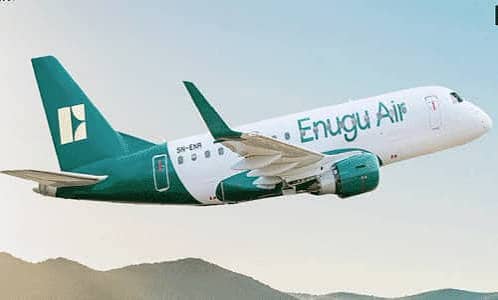
The African Airlines Association (AFRAA) has admitted Enugu Air as Member, extending the Association’s membership base in Nigeria’s fast-growing domestic aviation market and reaffirming AFRAA’s commitment to supporting the continued development of African carriers across the continent.
This was announced by AFRAA in Nairobi on Wednesday, making Enugu Air the 50th Member of the association, joining the AFRAA airline fraternity, collectively representing more than 85 per cent of total international traffic carried by African airlines.
Speaking on the occasion, AFRAA Secretary General, Mr. Abdérahmane Berthé, said, “We are delighted to welcome Enugu Air into the AFRAA fraternity.
“As a state-backed carrier serving Nigeria’s rapidly expanding domestic market, Enugu Air represents the kind of homegrown investment that is vital to building resilient air connectivity across our continent.
“We look forward to supporting the airline through the IOSA certification process and to its continued growth within the AFRAA membership, as we work together to advance the cause of unified African skies.”
Reacting to the development, the CEO of Enugu, Capt Tolu Ita, described the admission into AFRAA as a major milestone in the airline’s short history.
“We are honoured to join the AFRAA fraternity. This membership underscores Enugu Air’s commitment to safe, reliable, and affordable air travel for Nigerians while contributing to the vision of a unified African aviation market.
“We look forward to collaborating with fellow AFRAA members and leveraging the association’s support as we grow our network and pursue IOSA certification,” Tolu stated.
Founded on July 7, 2025, Enugu Air commenced commercial operations with a fleet of Embraer E170/E190/E195 aircraft.
The airline, which has its headquarters in Enugu and operates from the Akanu Ibiam International Airport, currently serves nine domestic destinations including Enugu, Abuja, Lagos, Port Harcourt, Kano and Benin City.
As part of the airline’s growth strategy, Enugu Air plans to expand further across Nigeria and, in subsequent phases, to launch regional and international routes across Africa, Europe, and beyond.
As part of its growth strategy, Enugu Air plans to expand further across Nigeria and, in subsequent phases, to launch regional and international routes across Africa, Europe, and beyond.
The admission of Enugu Air aligns with AFRAA’s strategic priorities and strengthens the voice of the association. Nigeria, as Africa’s most populous nation and one of its fastest-growing economies, remains central to the realization of a truly integrated African aviation market.
Meanwhile, founded in Accra, Ghana, in April 1968, and headquartered in Nairobi, Kenya, AFRAA’s mission is to promote, serve African Airlines and champion Africa’s aviation industry.
The association envisions a sustainable, interconnected and affordable air transport industry in Africa, where African airlines become key players and drivers of African economic development.
AFRAA membership cuts across the entire continent and includes all the major intercontinental African operators.
The association’s members represent over 85% of total international traffic carried by African airlines.

Ondo State Governor, Lucky Aiyedatiwa, has approved a fresh round of appointments involving a commissioner, three Special Advisers and 1,000 other aides.
The appointments comprise 90 Senior Special Assistants and 910 Special Assistants, with the governor saying the move is intended to reinforce his administration and improve its reach across the state.
Erelu Taibat Yemi Oloruntoba, from Akoko North-West Local Government Area, has been nominated as Commissioner for Special Duties. Her nomination has been transmitted to the state House of Assembly for consideration and confirmation.
The governor also appointed Hon. Abimbola Fajolu as Special Adviser on Environment, Chief Ade Adeniyi as Special Adviser on Rural and Community Development, and Mr Muyiwa Ogunyemi as Special Adviser on Transport.
Among those named as Senior Special Assistants are Erelu Toyin Ogungbure, Women Mobilisation (South); Bidemi Obayangbon, Forestry; Gboluge Olufunmi Alex, Community Engagement (South); Hon. Akin Adeniyi, Community Engagement (Central); and Obayan Theophilus Ayodeji, Community Engagement (North).
Others include Kelvin Solomon, Students Affairs; Adeolu Iwakun, Volunteer Services; Samson Job Bazuaye, Oil and Gas; Fade Ojamomi, Youth Empowerment and Job Creation; Sam Adepoju, Public Engagement; and Alhaji Samad Orijeminiyi, Scholarship.
Also appointed are Victor Omodara, Grassroots Mobilisation; Abayomi Adefolalu, Photography; and Alhaji Abdukadiri Adenoyi, Prince Nzuoma Egbulefu and Alhaji Garba Goni, all for Non-Indigenes.

About 40 people are suspected to have lost their lives after a boat carrying farmers to their rice farms capsized in Gorau town, Goronyo Local Government Area of Sokoto State.
The incident occurred while the victims were crossing a stream to access their farms.
An eyewitness said more than 70 people were on the boat when it capsized shortly after taking off.
The village head was among those on board but he was reportedly rescued.
“So far, we have recovered about 40 bodies, while six people, including the village head, were rescued,” a local journalist who was at the scene, Sharhabilu Yahuza Kiliya, told our reporter.
According to him, the victims comprised farm owners and labourers who had been engaged to harvest rice.
“The canoe capsized shortly after take-off. Rescue operations are still ongoing, with local divers searching for those still missing and recovering bodies,” he said. (Daily Trust)
-
 News1 day ago
BREAKING: Gunmen attack Adeleke’s convoy in Osogbo shortly after receiving Certificate of Return
-
International2 days ago
Canada invites 1,000 candidates to apply for permanent residence
-
Uncategorized2 days ago
2027: Obi unfolds agenda as campaigns begin
-
News1 day ago
Lagos shuts churches over noise pollution
-
News1 day ago
Two shot as police attempt to arrest suspects in Anambra
-
News2 days ago
Why I won’t apologise to Okpebholo — Davido
-
News2 days ago
Even if Tinubu appoints Seyi as INEC chairman, he’ll be defeated in 2027 — Dalung
-
News2 days ago
Access Bank asks court to recover N1.3bn stolen by Yahoo Boys