News
Rivers: FG deploys 10,000 troops against vandals as opposition, NLC protest


The Federal Government has deployed 10,000 Nigeria Security and Civil Defence Corps personnel to curb further attacks on oil pipelines against the backdrop of the blasts at oil installations in Rivers State between Sunday and Tuesday.
The NSCDC spokesperson, Afolabi Babawale, confirmed the deployment of anti-vandal operatives on Wednesday, stating that the operatives were tasked with protecting critical infrastructure and preventing pipeline vandalism, particularly in the Niger Delta.

“The NSCDC hereby warns against destruction and vandalism of critical national assets and infrastructure across the Niger Delta as over 10,000 operatives have been deployed to collaborate with other security agencies to provide adequate peace and security of lives and property,” Babawale said.

This came as the opposition lawmakers and Organised Labour protested the imposition of emergency rule in Rivers State by President Bola Tinubu.

Tinubu in a national broadcast on Tuesday announced the suspension of Governor Siminalayi Fubara, his deputy, Prof Ngozi Odu and the state assembly members.
He also nominated Vice Admiral Ibok-Ette Ibas (retd.) as the state’s sole administrator.
Ibas, who was sworn in at the Aso Villa on Wednesday, will administer the state for an initial period of six months.
Before the declaration of the emergency rule, the political atmosphere in the state was charged, leading to three explosions within two days.
The explosions followed threats by Ijaw groups against the push to impeach Fubara, as they vowed to disrupt oil production and cripple the economy if lawmakers removed the governor.
On Monday, the Martin Amaewhule-led Assembly, loyal to former governor Nyesom Wike, listed 19 infractions committed by Fubara in a misconduct notice, setting the stage for his impeachment.
Before the notice was served on both the governor and his deputy, there was an explosion on Sunday at the Trans Niger Pipeline in Aluu, in the Ikwerre Local Government Area of the state.
Security agents on Wednesday recovered a corpse at the scene of the explosion, while a suspect was arrested in connection with the blast.
An official said the suspect was arrested following credible intelligence from Pipeline Infrastructure Nigeria Limited’s covert team operating in Aluu.
The PINL staff member, who gave his name simply as Ebikeme, said, “On Sunday the 16th day of March 2025, there was a blast on the TNP Pipeline Right of Way in Aluu – Zone 5 and a suspected vandal was found dead at the site of the incident from the effects of the blast.
“Upon further investigation, a suspected vandal was apprehended in connection with the incident. The suspect is currently in the custody of the Nigeria Police while further investigation is being carried out to nab all the perpetrators.”
Speaking on the deployment of 10,000 armed personnel of the NSCDC to curb pipeline vandalism, Babawale said the commands nationwide are on high alert to protect the nation’s vital assets, particularly in the Niger Delta.
Babawale stated, “The Nigeria Security and Civil Defence Corps has a statutory mandate as the lead agency in the protection of critical national assets and infrastructure.
“In this regard, the corps across the federation have placed the commands and formations on red alert to forestall all acts of economic sabotage, pipeline vandalism and destruction of government utilities.
“However, it is a notable fact that no security agency has the monopoly of strategies in tackling crime and criminalities, hence the NSCDC is working in collaboration with other sister security agencies in the protection of lives and property.”
More soldiers deployed
On Wednesday,Governor Fubara moved out of the Government House in Port Harcourt.
The governor’s destination could not be confirmed. It was unclear if he retired to his private residence in Port Harcourt or his hometown in Opobo.
However, more soldiers were seen in patrol vans trooping into the Government House.
One of our correspondents observed three Armoured Personnel Carriers at the entrance of the building.
Also, the movement of persons and vehicles into the Government House was being subjected to heavy security scrutiny.
An aide to Fubara who pleaded anonymity told our correspondent that the soldiers were occupying the Government House.
He stated, “As I speak with you, more soldiers are entering the Government House. This afternoon, over 15 came in. They are believed to be an advanced team of the Sole Administrator who is still expected to resume duties. This evening, some more soldiers came in.”
The aide could not account for his principal’s whereabouts as of the time of filing this report.
N’Assembly debates today
The National Assembly has slated today to debate the legality of the emergency rule declared in Rivers State by the President.
The Senate and House of Representatives shifted the debate to today amidst a groundswell of opposition to the decision.
On Wednesday, House spokesman, Akin Rotimi, announced that the President had transmitted a letter to the National Assembly on the Rivers State crisis, saying that it would be read on the floor.
That was, however, not to be.
There was an earlier indication that the plenary could be rowdy when two female lawmakers, Blessing Amadi (PDP, Rivers) and Marie Ebikake (PDP, Bayelsa) traded uncomplimentary words over the constitutionality or otherwise of the President’s decision to suspend democratic structures in the state.
It took the intervention of some members to restore order in the hallowed chamber, even as Ebonyi lawmaker, Kama Nkemkanma, was seen banging a table, claiming that, “Nothing will happen here today.”
Some legislators were seen conversing in low tones over the development in the South-South state as they awaited the commencement of plenary.
Following the approval of the votes and proceedings of the previous legislative day, the Deputy Speaker, Benjamin Kalu, who presided over plenary in the absence of the Speaker, Tajudeen Abbas, called for the submission of petitions, an indication that the letter from the President would not be read.
However, after taking petitions and motions of urgent public importance, the charged atmosphere became calm as it was evident that the issue of emergency rule in Rivers State would not come up for mention.
The deputy spokesman of the House, Phillip Agbese (APC, Benue), said the House would only make its decision known after Mr President’s letter has been read and debated by members on the floor of the Green Chamber.
He noted, “The letter from the President has not been debated and the parliament has not taken any decision. There is nothing we can do about it for now until it is debated.
“For us as a parliament, it is still the same way that Nigerians have seen it on the pages of newspapers even though the leadership of the parliament was invited. But officially, Mr Speaker has not communicated that to the floor.”
At least 73 senators and 240 members of the House must vote in support of the emergency rule at the sittings of the lawmakers today.
Ibas sworn in
Tinubu, on Wednesday, swore in the sole administrator for Rivers State.
The AGF, Fagbemi; Chief of Staff to the President, Femi Gbajabiamila; Principal Private Secretary to the President, Hakeem Muri-Okunola and the Special Adviser to the President on Information and Strategy, Mr Bayo Onanuga and others witnessed the short ceremony at the State House, Abuja.
Born on September 27, 1960, Ibas was commissioned as a sub-lieutenant in the Nigerian Navy in 1983 and held various command positions until President Muhammadu Buhari appointed him the Chief of Naval Staff in August 2015.
He was retired when Buhari replaced his service chiefs in 2021.
After retirement from service, Buhari appointed him the Nigerian High Commissioner to Ghana, where he served between 2021 and 2023.
Speaking with State House correspondents, Ibas pledged to prioritise peace, security, and stability in the state.
He stressed the need to restore law and order as the foundation for any meaningful governance and development in the state.
“First of all, I think we know the circumstances that led to where we are here,” he said, denoting the events that led to his appointment.
Ibas said the primary mandate of his administration was to work with all stakeholders to ensure stability.
“Mr President made it very clear in his broadcast. If the main issue is that of maintaining law and order in the state, I think for any meaningful activities to take place in Rivers State, that is the utmost task,” he stated.
The retired naval chief affirmed that his administration would collaborate with relevant authorities and the people of Rivers State to restore peace and ensure effective governance.
‘Presidential declaration unconstitutional’
The anger over the suspension of democratic structures in Rivers State continued to grow on Wednesday, with the opposition and Labour kicking against the decision.
The Peoples Democratic Party has berated President Tinubu and insisted that Fubara remained the Governor of Rivers State despite the declaration of a state of emergency and his suspension by the President.
The PDP National Publicity Secretary, Debo Ologunagba, speaking at a press conference in Abuja on Wednesday, stated that the Nigerian Constitution does not grant President Tinubu the authority to declare a state of emergency or suspend a governor.
Ologunagba stated, “What President Tinubu is attempting to do is to suspend the 1999 Constitution, overturn a democratic government and foist an undemocratic regime in Nigeria in gross violation of Sections 1 (2), 14(2)(a), 180, 217(2)(b) (c) and 305 (2) of the Constitution of the Federal Republic of Nigeria, 1999 (as amended).
“Section 180 of the 1999 Constitution is clear on the tenure of a state governor, which is prescribed as four years commencing from the date of the swearing-in. The only means provided for in the Constitution for the abridgment of the tenure of a governor is death, resignation, incapacitation or impeachment and not by suspension by the President.”
The PDP urged the National Assembly to exercise its legislative authority to address this constitutional violation.
Ologunagba emphasised the importance of maintaining calm and reiterated its unwavering support for Governor Fubara and the people of Rivers State.
On his part, PDP South-South Caretaker Committee Chairman, Emma Ogidi, accused President Tinubu of focusing solely on Fubara while overlooking the involvement of Minister of the Federal Capital Territory, Wike, in escalating the Rivers crisis.
He stated, “Mr President, all through his speech, he blamed the governor for everything, but what happens to the chief investigator? No mention was made of the FCT Minister, his own minister, who we all know is the chief investigator.
“He has had several press briefings, has assaulted elders, has assaulted the Ijaw nation. Only last Saturday, he went to Abulama. He went with a contingent of soldiers, saying he was being honoured. A minister, going about with a contingent of soldiers.
“So when the thing was announced on Tuesday, we were not surprised because he has found a loose cannon.A man who has no respect for authorities, who believes in his own self. That’s why he’s doing what he’s doing. It’s unfortunate for us that our President has not brought him to book.”
He accused the President and the ruling party of working to capture River State.
Also, a former Bayelsa State Governor, Seriake Dickson, faulted Tinubu’s action, describing it as a ‘power grab.’
The senator representing Bayelsa West also vowed to mobilise his colleagues to ensure that the President doesn’t get the needed support to validate his action in Rivers.
Dickson disclosed this in an interview with selected journalists in Abuja.
He said, “It is unconstitutional. Most people see this as a power grab. Is there a constitutional provision mandating the president to declare a state of emergency? Yes, but you’ve got to scrutinise it and see whether it comes under that general provision. Even when you come to that conclusion, does that justify the removal of elected officials? No!
“You can’t talk about anything emergency unless you have a minimum of 73 senators sitting and 240 members of the House of Representatives present. And you must do that in two days. Otherwise, everything goes back to square one. So you see, I don’t know the kind of advice the President has.
“I’m not in a position to speculate about the numbers. The leadership knows best, but mine is to be available and network with my colleagues. Those of us who don’t believe in it are quite large in number. I am talking about senior ranking members who, in the protection of democratic rights created by the constitution, will say no to it.”
Also, the lawmaker representing Ideato North/Ideato South Federal Constituency of Imo State, Ikenga Ugochinyere at the National Assembly, likened Tinubu’s emergency declaration in Rivers as akin to asking the military to take over an elected government.
He said, “The governor should head to the courts. I am not going to speak for him, but some of us believe this should also be tested in court; it should also be resisted. Even with a gun to my head, I will not vote in support of that. Where does this leave us as lawmakers?”
NLC, TUC tackle FG
Weighing in, the Nigeria Labour Congress and the Trade Union Congress of Nigeria strongly condemned the emergency rule, describing it as “an assault on democracy.”
In a joint statement on Wednesday, the NLC President, Joe Ajaero, and his TUC counterpart, Festus Osifo, denounced the President’s action as “hasty and unconstitutional,” violating Section 305 of the 1999 Constitution.
“This reckless move should deeply concern every reasonable governor and citizen who believes in the rule of law,” the statement read.
“No democratic society can thrive where elected leaders are arbitrarily removed at the whims of the President,” it added.
The labour unions argued that the suspension or removal of the governor, deputy governor, and the state House of Assembly members was unlawful and set a dangerous precedent, eroding constitutional governance and threatening the autonomy of subnational governments.
“We demand the immediate reversal of this unconstitutional state of emergency in the interest of democracy, economic stability, and the welfare of Nigerian workers.
“Nigeria’s democracy must not be sacrificed on the altar of political expediency,” the unions warned.
CSOs fault Tinubu
The Country Director of Amnesty International Nigeria, Isa Sanusi, described the development as “a setback for the rule of law,” noting that the authorities must ensure that the situation did not become a reason to deprive the people of their rights.
“The Nigerian authorities must uphold human rights in Rivers State and ensure that the emergency does not become a cause or reason to deprive people of their rights.
“The suspension of democratic institutions is a setback for the rule of law. There must be safeguards for people’s rights,” he said.
Similarly, the National Coordinator of the Human Rights Writers Association of Nigeria, Emmanuel Onwubiko, rejected Fubara’s suspension, likening the development to the military coups that occurred in Niger, Burkina Faso, and Mali.
“This unconstitutional takeover of another branch of government in Rivers State under Governor Siminalayi Fubara by an elected civilian President and his grotesque, nebulous and sham decision to bring back a retired Naval Chief to exercise the same powers of an elected governor is a calculated attempt to establish a dictatorship,” Onwubiko said in a statement.
The Coalition of Northern Groups, in a statement signed by its National Coordinator, Jamilu Charanchi, cautioned the President to tread carefully.
“Instead of allowing Wike’s rhetoric to dictate policy, Tinubu should focus on fostering unity and addressing the underlying grievances that fuel discontent.
“By doing so, he can reinforce his leadership while mitigating the risk of exacerbating tensions,” the group noted.









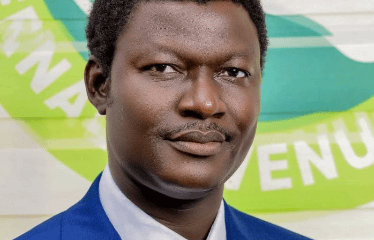




Tension enveloped the headquarters of The Fountain of Life Church in Ilupeju, Lagos, on Sunday following the deployment of heavily armed police officers to the premises amid an escalating leadership crisis involving Senior Pastor Jimmy Odukoya and some members of the church’s Board of Trustees.
The presence of the armed policemen reportedly created an atmosphere of uncertainty among worshippers, with questions arising over who would preside over the church’s regular Sunday service.
The development comes against the backdrop of a deepening disagreement between Odukoya and a faction of the church’s trustees over his continued leadership of the ministry, founded by his late father, Pastor Taiwo Odukoya.
The dispute has reportedly degenerated into a legal battle, with both sides seeking judicial intervention over the leadership, control and administration of the church.
In the latest twist, Jimmy Odukoya approached the Federal High Court in Lagos on Friday, challenging his reported removal as senior pastor and questioning the legality of decisions allegedly taken by some members of the Board of Trustees.
The suit was instituted by Odukoya alongside the Incorporated Trustees of The Fountain of Life Church, with his sister, Tolu Odukoya, and seven other church leaders listed as defendants.
Those named in the suit include Pastors Rotimi Okpaise, Tobi Enuha, Gbenga Onabanjo, Fred Ohiani and Akin Osinbajo, as well as Biodun Balogun and Biodun Awosika.
Among the issues submitted for the court’s determination is the validity of meetings allegedly held by some members of the Board of Trustees on January 22, February 28 and November 16, 2026, and the resolutions purportedly adopted at the meetings.
Odukoya is also seeking the court’s interpretation of whether the trustees have the constitutional authority to remove him as senior pastor without complying with the procedures prescribed by the church’s governing constitution.
The leadership tussle has raised questions about the future direction, governance and administration of the prominent Lagos-based ministry, as the legal battle between the contending parties continues.
As of press time, The Advocate could not independently establish whether the church’s Sunday service held as scheduled. The police authorities had also yet to publicly explain the reason for the deployment of armed officers to the church premises.
• Critics question legality of arming local security operatives, warn against possible political misuse ahead of polls
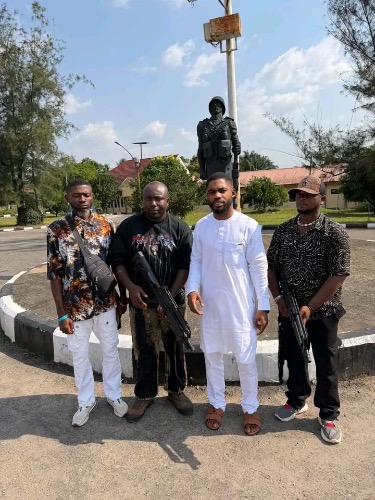
The inauguration of more than 200 personnel of a community-based security outfit, known as Neighbourhood Watch, by the Chairman of Ohaozara Local Government Area of Ebonyi State, Engr. Osborne Umahi, has sparked controversy amid concerns over its legality, composition and possible political implications ahead of the 2027 general elections.
The development has generated mixed reactions, with residents and social commentators questioning the authority of a local government council to establish and arm a security outfit, particularly as preparations for the 2027 elections gather momentum.
The personnel were inaugurated on Friday at the council headquarters in Obiozara.
Osborne is the son of the Minister of Works and former Governor of Ebonyi State, David Umahi.
Speaking at the ceremony, the council chairman said the initiative was designed to strengthen grassroots security, protect lives and property, and complement the efforts of conventional security agencies, particularly during the Christmas and New Year festivities.
He charged the newly inaugurated personnel to discharge their duties with discipline, commitment and professionalism, warning them against any conduct capable of undermining public confidence in the outfit.
Umahi stressed the importance of respecting the rule of law and maintaining effective collaboration with established security agencies to ensure the safety of communities across the local government area.
He also assured the personnel of his administration’s commitment to their welfare, provision of a conducive working environment and necessary operational infrastructure.
The chairman subsequently announced Mr Amos Eze of Umunaga Ward as the Leader and Commander of the Neighbourhood Watch.
According to him, the outfit, comprising more than 200 personnel, would work alongside existing security institutions to promote peace and protect residents, businesses and property throughout Ohaozara.
However, the initiative has attracted criticism from social commentators, who have raised questions about the legal basis for its establishment, the training of its personnel, the nature of weapons reportedly issued to them and the possibility of political interference.
A social critic, Mr Nwoba Chika Nwoba, criticised the development in a social media post, questioning the constitutional authority of a local government council to establish and arm such a security outfit.
He wrote: “This is not a good beginning. Does a local government have the constitutional authority to establish a security outfit and arm them, moreover as election is two months away?”
Nwoba further expressed fears that the outfit could be deployed to intimidate political opponents and undermine the credibility of the 2027 general elections.
He also alleged that the personnel could be used for partisan political activities, although no evidence was presented to substantiate the allegation.
Another social media commentator, Mr Idaga, questioned the type of firearms reportedly issued to the operatives, arguing that personnel without adequate and coordinated security training should not be allowed to handle sophisticated weapons.
“My interest is the type of guns those guys are armed with. People without coordinated security training have no business being armed with the type shown in this optic,” he wrote.
Similarly, another commentator, Mr Kelvin, expressed concern over the implications of arming civilians, drawing a connection between the development and the ongoing national debate over the establishment of state police.
He argued that if civilians could be equipped with sophisticated firearms without adequate training and oversight, the introduction of state police could present additional security challenges.
The controversy has renewed calls for clarification on the legal framework governing the establishment, recruitment, training, supervision and arming of community-based security outfits, as well as their operational relationship with conventional security agencies.
With the 2027 general elections approaching, concerns are also mounting over the need to ensure that local security initiatives are not turned into instruments of political intimidation or partisan interests.
Stakeholders are therefore expected to demand greater transparency and accountability from the authorities, particularly regarding the weapons, operational guidelines and oversight mechanisms governing the newly inaugurated outfit.
News
South-East Policy and Impact Conference to chart pathway from economic reforms to regional prosperity
• Policymakers, investors, business leaders and development stakeholders to converge in Enugu on November 26
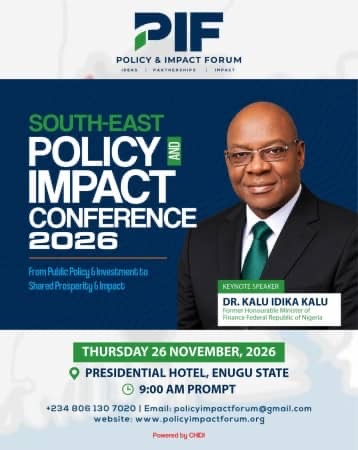
The Policy and Impact Forum (PIF) will convene the South-East Policy and Impact Conference 2026 on Thursday, November 26, at the Presidential Hotel, Enugu, bringing together policymakers, business leaders, investors, professionals, academics and development stakeholders to examine how economic reforms, public investments and emerging opportunities can translate into shared prosperity across the South-East.
The conference, themed “From Policy and Investment to Shared Prosperity and Impact,” will provide a platform for constructive dialogue on the policies, investments and partnerships required to accelerate economic transformation, strengthen enterprises, create jobs and improve livelihoods across the region.
The gathering comes at a time when Nigeria is implementing significant economic reforms aimed at addressing longstanding structural challenges, improving economic stability and creating a more sustainable environment for investment and growth. Participants will examine the implications of these reforms for the South-East and identify practical ways for the region to position itself to benefit from emerging opportunities.
“The real test of economic reforms and public investments is their impact on people’s lives. We must ask how policies translate into opportunities for businesses, jobs for our young people, stronger institutions and prosperity for our communities. This conference provides an opportunity to have those conversations and identify practical pathways to action,” said Agwu Amogu, Executive Director of the Policy and Impact Forum.
The programme will feature a keynote address by Dr. Kalu Idika Kalu on economic transformation and the future of South-East Nigeria, alongside a presentation by Professor Okey Ikechukwu on the Federal Investments and Development Scorecard, 2023–2026. The Governor of Enugu State is also expected to deliver a special address.
A high-level panel discussion will explore how public policies, government investments and private capital can drive inclusive economic growth and measurable development outcomes.
Discussions will cover infrastructure and connectivity, agriculture and value chains, manufacturing, MSMEs, trade and export, investment mobilisation, public-private partnerships, education, skills development, research and innovation.
The conference will also feature an interactive stakeholder session designed to bring government, businesses, investors, professional bodies, community leaders, civil society, young people and other stakeholders into a practical conversation about regional priorities and opportunities. The organisers expect the engagement to generate actionable recommendations, partnership opportunities and priority actions for sustained development across the five South-East states.
“Our objective is to move beyond policy conversations and investment announcements to focus on implementation, collaboration and results. We want participants to leave with a clearer understanding of the opportunities before the region and with practical ideas, relationships and commitments that can contribute to inclusive growth and shared prosperity,” Amogu added.
The Policy and Impact Forum is a platform for constructive policy dialogue, public engagement, accountability and development-oriented conversations. It brings together government, business, academia, civil society and other stakeholders to examine policies, investments and programmes and identify practical pathways towards sustainable development and measurable impact.
-
 News3 days ago
BREAKING: Enugu Billionaire, Ferotex Boss Festus Oshaba-Onuh Feared Dead in Road Accident
-
News2 days ago
Gunmen Machete Football Legend Segun Odegbami in Abeokuta Home Attack
-
News3 days ago
Festus Onu’s Death: Enugu APC Campaign Council Suspends Activities
-
News3 days ago
Anambra Billboard Saga: Onyima Challenges Soludo Govt to Cite Law Behind Umeh’s Billboard Removal
-
News2 days ago
2027: Obi Urges Nigerians to ‘Sacrifice One Day for Nigeria to Be Good Again’
-
News3 days ago
EFCC Arraigns Socialite Over Alleged ₦603.4m NNPC Appointment Scam
-
Editorial2 days ago
FAKE DRUGS: Nigeria’s Deadly Trade in Human Lives Must End
-
News3 days ago
Rev Chidi Okorafor Emerges New Assemblies of God General Superintendent