Politics
2027: Atiku, Peter Obi, Fayemi, el-Rufai launch coalition against Tinubu


…urge NASS, Nigerians to resist River’s state of emergency
Former Vice President, Atiku Abubakar, the Presidential Candidate of the Labour Party (LP) in the 2023 elections, Mr Peter Obi and the immediate past Governor of Kaduna State have kick-started a movement aimed at ending President Bola Tinubu’s rule come 2027.
This was confirmed by Atiku who read the text of a Press Conference addressed by a cross-section of leaders and political stakeholders from across the country, in Abuja, on Thursday.

Atiku in response to a question whether the gathering was to kick start a coalition to oust Tinubu in 2007, the former Vice President said “Yes.”
Earlier, while addressing the press conference, Atiku and his partners called on Nigerians especially members of the National Assembly to reject President Bola Tinubu’s unconstitutional declaration of a state of emergency in Rivers State.
Atiku said, “We have come together to address the dangerous and unconstitutional actions taken by President Bola Ahmed Tinubu, GCFR, on March 18, 2025-to wit, the declaration of a State of Emergency in Rivers State and the illegal suspension of the democratically elected Governor, Deputy Governor, and the State House of Assembly.

“This action is not only unlawful but also a clear subversion of democracy and imposition of autocratic federal control over a duly elected state government.
“We strongly condemn this development and call on all Nigerians of good conscience to resist this brazen assault on the constitution of our country and the institutions of our democracy.
“Mr President’s illegal and unconstitutional proclamation was presumably driven by the protracted insidious political crisis in Rivers State, which culminated in the recent ruling of the Supreme Court.
“Naturally, we expected all parties to the dispute to follow laid-down procedures, and in good faith, to promptly implement the judgment of the highest court of the land.
“We note that despite provocative statements and belligerent attitude of his opponents, Governor Fubara had demonstrated goodwill and appeared disposed to the implementation of the ruling of the Supreme Court.
“However, rather than rise above the fray, the president yielded to petty favouritism and betrayed the oath that he solemnly swore to before God and man, which was to ‘do right to all manner of people, according to law, without fear or favour, affection or ill-will.”
“If president Tinubu had conveniently disguised his true intentions in the past, his broadcast to the nation on 18th March 2025 betrayed his bias and fell far below the standard of comportment expected from his exalted office.”
Listing areas of Constitutional breaches by the President, the former Vice President said, “Illegal Removal of a Governor and State Assembly
“Without any doubts, the Nigerian Constitution does not empower the President to remove an elected Governor, Deputy Governor, or State Assembly under any circumstances.
“The procedure for removing a Governor is clearly outlined in Section 188 of the Constitution of the Federal Republic of Nigeria 1999 (as amended) through an impeachment process initiated by the State House of Assembly-not by presidential proclamation or arbitrary pronouncement.
“Misuse of Section 305 on State of Emergency:
“Section 305 of the Constitution allows the President to declare a State of Emergency only in extreme cases where public safety, national security, or Nigeria’s sovereignty is at serious risk.
“However, it does not grant him the power to suspend elected officials or to demolish democratic structures as he has brazenly done.
“Furthermore, Section 305(1) states that any proclamation of emergency is subject to the provisions of the Constitution-meaning it cannot override the tenure and removal procedures of a Governor.
“Failure to Meet Constitutional Requirements for Emergency Rule
“The conditions under Section 305(3) for declaring a state of emergency include: War or external aggression, Breakdown of public order and safety, Natural disasters or any other grave emergency threatening Nigeria’s corporate existence.”
He further said, “None of these conditions exist in current circumstances in Rivers State. There is no war, no widespread violence, and no breakdown of law and order warranting emergency declaration.
“Failure to Follow Due Process: Even if an emergency declaration were valid (which it is not), it would still require a two-thirds majority approval of all members of the National Assembly-that is, at least, 72 Senators and 240 members of the House of Representatives. If this approval is not secured, the proclamation must automatically cease to have effect.
“Alternative Legal Avenues Were Ignored
“If the issue was the dysfunction of the Rivers State House of Assembly, the President could have encouraged the National Assembly to intervene under Section 11 of the Constitution.
“However, even under such an intervention, the Governor and Deputy Governor cannot be removed by any arm of government except through constitutional means, as the proviso to S. 11(4) clearly provides.
A Manufactured Crisis for Political Control
“This State of Emergency declaration is not about security-it is about power grabbing and control. The disagreements within Rivers State stem from the defection of 27 Assembly members from the PDP to the APC, their loss of seats under constitutional provisions, and the subsequent political manoeuvring to undermine the Governor’s mandate.
“Rather than allowing the law to take its course, the federal government has engineered a crisis to justify this obviously premeditated and brazenly cynical unconstitutional action.
“We find the federal government’s excuse of pipeline vandalism quite untenable and even laughable.
“The security of national infrastructure falls squarely under the responsibilities of federal security agencies and privately contracted security firms.
“ If this issue has to do with breach of security in whatever form, the question that should naturally be asked are: Who controls the police, the military, and the DSS? The Governor or the President?
“Our Demand and Call to Action
Immediate Reversal: We call on President Bola Ahmed Tinubu to immediately revoke this unconstitutional proclamation and reinstate the elected Governor, Deputy Governor, and State Assembly of Rivers State.
“National Assembly’s Rejection: We call on patriotic Senators and Representatives to vote against this illegal action when it comes before them for approval. The National Assembly must stand on the right side of history and not allow itself to be used to legitimise an unconstitutional power grab.
“ Judicial Intervention: We urge the judiciary to act swiftly in striking down this proclamation, as it sets a dangerous precedent that could be used to arbitrarily remove any Governor in the future.
“Nigerians Must Defend Democracy: We call on all civil society organisations, political groups, and Nigerians of good conscience to stand firm in the defence of this democracy that we have all toiled to build.
“Rivers State is not a conquered territory, and Nigeria is not a dictatorship requiring the replacement of an elected governor with a military administrator.
“We recall that even when a previous administration had declared a state of emergency in parts of the country bedevilled by insurgency and acts of terrorism, the governors of the concerned states were not removed from office as this administration has done. This action, by President Tinubu therefore represents a new low for our country.”
Going down memory lane, Atiku said, “The historical unrest in the Niger Delta should not be forgotten so soon.
“Past administrations had made great efforts and sacrifices to restore peace and stability to the Niger Delta, which is critical to the economic health and stability of Nigeria itself.
“This federal government should not manufacture political crises that could disrupt the fragile stability and return the country to the past that we have all prayed to leave behind for good.
“We must never allow personal political interests and the desire to hold on to power at all costs to throw the country into unavoidable chaos through brazen subversion of the principles of federalism, democracy, and constitutional governance. This is not just about Rivers State it is about the future of Nigeria’s democracy.”
Other opposition leaders present at the ongoing press conference include, Labour Party’s 2023 presidential candidate, Peter Obi, who is represented by Yunusa Tanko, former Secretary to the Government of the Federation, Babachir Lawal, former Kaduna State Governor, Nasir El-Rufai, National Secretary of the Coalition of United Political Parties, Peter Ahmeh, and Convenor of the Alternative, Segun Showunmi, among others.
Among those whose apologies were announced are former governors Rotimi Amaechi (Rivers), Kayode Fayemi (Ekiti), and the immediate past National Chairman of the All Progressives Congress, Abdullahi Adamu, among others.









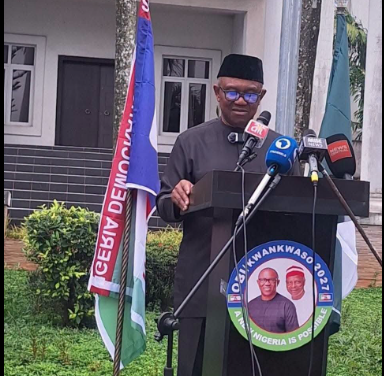
Presidential candidate of the Nigeria Democratic Congress (NDC), Peter Obi, has said Nigeria must move from an economy driven by consumption and imports to one built around production, investment and job creation.
Obi made the declaration on Friday while outlining his economic agenda for the 2027 presidential election, saying the country had the resources, population and entrepreneurial capacity required to build a more productive economy.
He said the key question for any government should be whether Nigerians were actually becoming better off.
“Are Nigerians better off than they were four years ago? Can they afford food, education, and healthcare? Can businesses produce, expand, and create jobs?” Obi asked.
He said his administration, if elected, would place agriculture, manufacturing, agro-processing, technology, construction, energy, creative industries and services at the centre of economic development.
According to him, Nigeria must “produce more of what we consume, process more of what we produce, and compete more effectively in global markets.”
Obi said his economic plan would include improving agricultural productivity through better security for farming communities, irrigation, rural roads, storage facilities, finance and market access.
He also promised to strengthen manufacturing and agro-processing to enable Nigeria to export more finished products and derive greater value from its natural resources.
The former Anambra State governor said government must also create conditions that allow entrepreneurs to invest, employ workers and expand without unnecessary regulatory and infrastructure barriers.
He stressed that public finances would be managed with greater discipline, insisting that government spending must have clear purposes and measurable results.
“Every naira should have a clear purpose, and major public investments should have measurable outcomes,” he said.
Obi also identified Nigeria’s large and growing young population as an economic opportunity rather than a burden, saying government must invest in education, technical training and human capital to enable young Nigerians to contribute productively to the economy.
He said the country’s economic objective should not simply be growth in statistical terms, but an economy capable of producing more, creating jobs, generating wealth and improving living standards.
“The goal is not growth for its own sake, but an economy that produces more, employs more people, creates wealth, and improves living standards,” he said.
Obi, who is campaigning alongside former Kano State governor Rabiu Kwankwaso, said their different governing experiences had led them to a common conclusion that Nigeria must invest in its people and manage public resources responsibly.
He urged voters to examine the records and proposals of all presidential candidates as the 2027 campaign progresses.
MY ADDRESS TO MARK THE COMMENCEMENT OF THE 2027 PRESIDENTIAL AND NATIONAL ASSEMBLY CAMPAIGNS
21 August 2026
Dear Compatriots,
Members of the Press,
Distinguished ladies and gentlemen,
Wednesday, 19 August 2026, marked the official start of the campaign period for the 2027 Presidential and National Assembly elections.
There is no doubt that this is a defining moment for our democracy. This moment gives Nigerians the opportunity to assess the records, ideas, and plans of those seeking their mandate to lead their country at a time of grave uncertainty in our rapidly changing world.
I consider myself quite privileged to be one of those seeking your mandate to deal with these challenges facing our country.
I enter this contest with one firm conviction: Nigeria can work, and Nigeria must work.
Nigeria faces several serious challenges. Some of them are indeed of existential proportions.
According to the IMF, 63%, or over 140 million Nigerians, live at or below the national poverty line, while humanitarian agencies estimate that 35 million people will need food assistance during the 2026 lean season. About 3.6 million Nigerians remain internally displaced, largely because of conflict and insecurity. Each year, millions of young people enter the labour market, yet too many struggle to find productive opportunities. Weak infrastructure, unreliable power, insecurity, and the excessive cost of doing business continue to burden households and constrain enterprise.
These are more than statistics. They reflect the daily realities of Nigerian families, farmers, workers, students, and businesses.
Yet I do not believe Nigeria lacks the ability to overcome these challenges. We have the people, resources, market, talent, and enterprise. What we must do now is turn these strengths into security, productivity, and shared prosperity.
LEADERSHIP MUST DELIVER RESULTS
My successful private-sector experience, studies in institutions of repute on policy and business matters, and my service as Governor of Anambra State have shaped my understanding of public leadership. Government must manage resources responsibly, set clear priorities, and measure the outcomes of its decisions. Public office is not a reward; it is a responsibility to the people.
In Anambra, I prioritised the foundations of long-term development: education, healthcare, infrastructure, fiscal discipline, and institutional capacity. I do not present that record as perfect, but as an experience from which Nigerians can draw their own conclusions.
Senator Rabiu Musa Kwankwaso brings a different but complementary governing experience.
As Governor of Kano State, he focused strongly on education, technical training, scholarships, infrastructure, and human-capital development. His administration’s investments in education and skills showed an understanding that the people are a state’s most important long-term resource.
Our experiences are different, but our conclusion is the same: Nigeria must invest in its people and manage public resources with discipline.
BUILDING AN ECONOMY THAT WORKS
Nigeria needs more than reactive reforms. We must focus on the questions that matter:
Are Nigerians better off than they were four years ago? Can they afford food, education, and healthcare? Can businesses produce, expand, and create jobs? Can young people find productive work? Can farmers work safely and get their produce to market?
These are the measures that matter.
With your mandate, our economic agenda will put production, investment, enterprise, and human capital at the centre of how we lead.
We will raise agricultural productivity by securing farming communities, expanding irrigation, improving rural roads and storage, and linking farmers to finance and markets. We will also strengthen manufacturing and agro-processing so Nigeria can export more finished goods and capture greater value from its resources.
We will create a business environment where entrepreneurs can invest, hire, and grow without unnecessary regulatory or infrastructure barriers.
And we will manage public finances responsibly. Every naira should have a clear purpose, and major public investments should have measurable outcomes.
The goal is not growth for its own sake, but an economy that produces more, employs more people, creates wealth, and improves living standards.
SECURITY IS THE FOUNDATION
No nation can prosper when its people cannot live, farm, travel, or do business safely. Insecurity has displaced millions of Nigerians and continues to disrupt agriculture, education, trade, and investment. Our response must therefore be comprehensive.
We must improve intelligence gathering and coordination among security agencies, strengthen policing and border management, and make better use of technology. We must also support lawful community-based systems that identify threats early and enable effective responses.
The imperative of decentralising security management, but with strong systems of coordination between the levels, is critical to our plans.
Security policy must also address the conditions that make vulnerable young people susceptible to criminal recruitment. Farmers cannot produce food if they cannot reach their farms safely. Children lose the chance to learn when they cannot attend school safely. Businesses cannot create jobs when they cannot move goods securely.
FROM CONSUMPTION TO PRODUCTION
Nigeria, with a population now above two hundred million and projected to continue growing rapidly, has one of Africa’s largest domestic markets and labour forces. That is an opportunity we must seize to turn the future of our country around.
Nigeria cannot import its way to prosperity. We will produce more of what we consume, process more of what we produce, and compete more effectively in global markets.
We will deploy our experiences in public funds management, the private sector, and the civil service to turn our population into productive human capital, our natural resources into value-added industries, and our domestic market into an engine for investment and enterprise.
Agriculture, manufacturing, technology, construction, energy, creative industries, and services all have important roles to play. Nigeria does not lack opportunities; what it needs are the systems that enable its people to turn those opportunities into prosperity.
OUR YOUNG PEOPLE ARE OUR GREATEST ASSET
I reject the idea that Nigeria’s young population represents a burden. It represents an enormous opportunity, but only if we prepare young Nigerians to participate productively in the economy.
We will improve basic education, strengthen universities, and expand technical and vocational training. Nigeria needs doctors, engineers, scientists, and lawyers, as well as technicians, mechanics, builders, nurses, farmers, programmers, manufacturers, artisans, and entrepreneurs. Our goal is to secure a high demographic dividend from our youth bulge.
HEALTH IS HUMAN CAPITAL
A productive economy requires a healthy population, yet Nigeria’s health indicators remain deeply concerning. According to available data, Nigeria’s primary healthcare system is very poor, with infant and maternal mortality among the worst globally. We will strengthen healthcare, improve maternal and child health, expand access to essential medicines, and equip healthcare workers to serve effectively.
EVERY REGION MUST BECOME PRODUCTIVE AND PROSPER
Nigeria’s diversity is an economic strength. Each region has distinct assets, and national policy must unlock those assets while connecting them to one productive economy.
The North-West can expand agriculture, livestock, irrigation, agro-processing, and manufacturing while strengthening education and security.
The North-East can speed up reconstruction, restore livelihoods, and expand agriculture, education, enterprise, and regional trade.
The North-Central can strengthen food production and processing while developing its mineral resources responsibly.
The South-West can build on its strengths in manufacturing, technology, finance, trade, and the creative economy.
The South-East can expand its entrepreneurial and industrial strength through better infrastructure, stronger connectivity, and greater access to investment.
The South-South can derive greater value from oil and gas while expanding maritime services, fisheries, agriculture, and other productive sectors, supported by stronger environmental protection.
The Federal Capital Territory must demonstrate what efficient urban planning, transportation, housing, sanitation, security, and public services can achieve.
Every region must produce. Every region must contribute. Every region must benefit.
A DIFFERENT STANDARD OF GOVERNANCE
Sustainable development requires more than reactive reform. Reform is not the goal; better lives are. The World Bank’s April 2026 Nigeria Development Update makes clear that Nigeria’s challenge is to turn economic reform and stabilisation into improved livelihoods, stronger human capital, wider opportunities, and inclusive growth. We will pursue practical reforms that deliver lasting results, combining fiscal discipline with productive investment, as Senator Kwankwaso and I have demonstrated.
We will cut wasteful spending while protecting investments that create jobs and expand productive capacity. We will raise public revenue without stifling businesses and invest in education, healthcare, security, and infrastructure because they are foundations for future prosperity, not costs to defer. We will also build institutions that endure beyond any single administration. That is the standard by which every government should be judged.
Fellow Nigerians,
The campaign period gives every citizen an opportunity to join the national conversation. I urge Nigerians to examine each candidate’s record and proposals, ask tough questions, and demand evidence behind every promise.
We should debate ideas without hatred, compete without violence, and disagree without weakening the bonds that unite us. When Nigerians make their choice, that choice must be respected.
Democracy does not end on election day. Citizens must continue to demand transparency, accountability, and results from those entrusted with the mandate to govern.
Nigeria’s challenges are real, but so are its opportunities. We have the people, resources, enterprise, and creativity to build a safer, more productive country. Our task is to turn these possibilities into results. We have the credentials, experience, and record to collaborate with Nigerians on this transformative journey.
Our journey will be harder if we do not unite as one people and one nation. A united Nigeria, guided by shared purpose and a commitment to fairness, justice, and equity, will make transformation easier, strengthen our institutions, and help us hold our leaders accountable.
Finally, the 2027 election must be guided by capacity, competence, compassion, character, and commitment. Our campaign will focus on the urgent concerns of Nigerians and not on ethnicity or religion. Nigerians must reject and disregard any campaign driven by propaganda, ethnicity, religion, elitism, or cronyism.
As my team and I travel across the country, we will listen to Nigerians, understand their needs and concerns, and assure them that we have the competence, character, and compassion to lead and reset Nigeria for the benefit of all.
Nigerians deserve leaders who will engage them, listen to their concerns, and present clear solutions to unite the country, defeat insecurity, pull people out of poverty, drastically reduce hunger and the number of out-of-school children, improve education and healthcare, and build growth that serves everyone, especially the most vulnerable. Every candidate must be willing to present their credentials, defend their records, and subject their vision to open scrutiny.
No candidate should hide behind the high walls of power, send proxies or surrogates to the hustings, and expect Nigerians to entrust them with the leadership of the country. Every candidate seeking the presidency must have the courage to come before the people, answer their questions, defend their records, and subject their vision to public scrutiny.
True leadership requires presence and empathy. No one can lead from the front without standing with communities across Nigeria devastated by banditry, criminality, terrorism, and flooding. You cannot truly lead people you are unwilling to visit, listen to, and understand.
Today, I make this clear commitment: my running mate and I will take our message directly to Nigerians. We will listen to them, understand their concerns, and engage them openly. We will not delegate this duty to proxies. We will answer questions, defend our record and character, and present our plan to rebuild Nigeria. Any presidential candidate who lacks the resolve to travel across the country, meet the people, and respond to their questions lacks the capacity to govern it.
I commit to commencing the journey of resetting Nigeria by uniting it, securing it on the path of economic and inclusive growth, and moving our country from consumption to production.
A New Nigeria is possible.
God Almighty bless Nigeria. -PO

Ahead of the 2027 general elections, the National Chairman of the All Progressives Congress (APC), Prof. Nentawe Yilwatda, has apologised to aggrieved members over perceived wrongs during the party’s internal primaries, saying the National Working Committee (NWC) takes responsibility for such actions.
Yilwatda, who made the disclosure on Thursday in Ibadan during the launch of the APC governorship candidate campaign office in Ibadan, appealed to members who felt hurt, injured, prevented or excluded in any form to forgive the party and remain united ahead of the 2027 general elections.
He said the responsibility extended beyond Oyo State, stressing that the committee that conducted the party’s primaries was constituted by the national leadership and therefore, any mistake committed by it amounted to a mistake by the party.
“This is not for Oyo State alone. Anywhere anybody made a mistake in a state, it is our mistake because the committee was set up by us and they are representing us.
“If anybody is hurt, if anybody is injured, if anybody is prevented or excluded in any form or the other, we take responsibility. On TV, before Nigerians, we take responsibility of all that has happened. I appeal to everybody that we are sorry,” he said.
The APC national chairman urged members at polling units, wards and local government areas across the country to regard the matter as an internal family affair.
Yilwatda assured that the party was taking Oyo State seriously because of its strategic importance and large voting population, second only to Lagos.
Speaking, the APC governorship candidate in Oyo State, Senator Sharafadeen Alli, commended the party’s National Chairman, Prof. Nentawe Yilwatda, for fulfilling his promises to the state within two days.
Alli expressed appreciation to Yilwatda for honouring the invitation to meet with governorship aspirants and stakeholders, saying the achievements recorded within the period surpassed what the stakeholders had been able to accomplish.
He said the promises made when the national chairman invited the aspirants had now been fulfilled.
“We cannot thank you enough for what you have come to do. What you have achieved successfully in two days, we have not been able to accomplish,” Alli said.
He assured the national chairman that the party in Oyo would continue to do the needful.
Earlier, mammoth crowd of members and supporters of the All Progressives Congress (APC) gathered in Ibadan on Thursday as the party’s national chairman, Professor Nentawe Yilwatda, officially inaugurated the party’s governorship campaign office in Dandaru, along the Total Garden-Mokola Road, Ibadan.
The inauguration formed part of activities marking the APC National Chairman’s two-day official visit to Oyo State, which commenced on Wednesday, August 19, 2026.
Party members from across the 33 local government areas of the state converged on the venue to witness the official inauguration of the campaign office and welcome the national chairman.
The campaign office will serve as the secretariat of the APC governorship candidate in Oyo State, Senator Sharafadeen Alli.
-
 Entertainment2 days ago
Dolly Parton, Queen of Country Music, dies at 80
-
News1 day ago
Tension mounts as bandits kill brother of Tinubu’s minister
-
News2 days ago
NFIU uncovers how terrorist financiers use women’s bank accounts, crowdfunding in operations
-
News11 hours ago
BREAKING: NLC General Secretary, Ugboaja, is dead
-
News2 days ago
Motorists trapped in Benin-Agbor-Asaba gridlock for days, Umahi inspects road
-
News2 days ago
Police detain officers accused of N40,000 extortion in Abuja
-
News1 day ago
GOCOP mourns former President Dotun Oladipo
-
News18 hours ago
Enugu Govt Refutes Report of Sale of Assets at ESBS, Water Corporation, Stadium, Lagos Liaison Office