News
Food inflation hits 60.88% despite FG $3.3bn agric loan

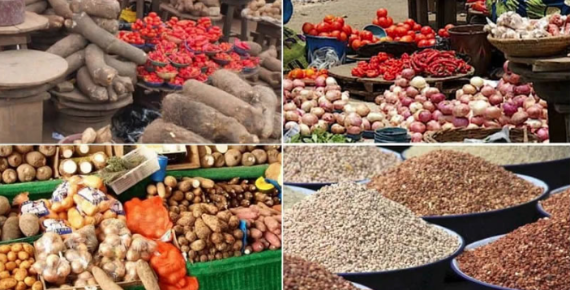
Despite securing multilateral loans amounting to $3.334bn (N5.178tn) and attracting over $4.3bn investments to boost food production, the cost of essential staple food items skyrocketed by 60.88 per cent under the leadership of President Bola Tinubu.
When Tinubu assumed office in May 2023, food inflation was 24.82 per cent. It jumped to about 40 per cent in November 2024. This is based on data from the National Bureau of Statistics.

This is occurring as Nigerians are increasingly struggling to afford basic food items, with many households finding it difficult to make ends meet due to the sharp rise in prices.
This stark increase in food prices stands in contrast to the government’s ambitious efforts to address food security and agricultural development, raising concerns about the effectiveness of current economic policies, the impact of inflation, and the challenges in translating financial support into tangible relief for Nigerians.
Upon assumption of office in May last year, President Tinubu promised to prioritise food availability and security, stressing that the government would cultivate about 500,000 hectares of farmlands to combat hunger in the country.

“I am well aware that for some time now, the conversations and debates have centred on the rising cost of living, high inflation, which is now above 28 per cent, and the unacceptable high under-employment rate.
“To ensure constant food supply, security, and affordability, we will step up our plan to cultivate 500,000 hectares of farmlands across the country to grow maize, rice, wheat, millet, and other staple crops”, Tinubu stated in his new year address amidst other commitments.
However, the spiral increase in transportation costs occasioned by the removal of fuel subsidies, massive devaluation of the naira, and ravaging insecurity have fuelled a rapid increase in the price of all food commodities over 19 months.
Data obtained from the Consumer Price Index report released by the National Bureau of Statistics between May 2023, when Tinubu assumed office, and November 2024 showed that for 14 consecutive months, Nigerians spent increasingly more money each time they visited the market to buy food items.
A breakdown showed that food inflation increased from 24.82 per cent in May 2023 to 25.25 per cent in June, 26.98 per cent in July, 29.34 per cent in August, 30.64 per cent in September, 31.52 per cent in October, 32.84 per cent in November and 33.93 in December 2023.
By January 2024, the price of food items increased to 35.41 per cent and surged further to 37.92 per cent in February, 40.01 per cent in March, 40.53 per cent in April, 40.66 per cent in May, 40.87 in June, before witnessing a drop to 39.53 per cent in July and 37.52 per cent in August due to the harvest season.
In September, the cost of food increased again to 37.77 per cent, 39.16 per cent in October, and 39.93 per cent in November, which is almost 40 per cent.
Despite the challenging situation, checks by our correspondent revealed that the government secured loans totalling $3.334bn, an equivalent of N5.178tn from the World Bank and the African Development Bank under President Tinubu’s administration to enhance agricultural production, adopt innovative farming techniques, and increase food sufficiency for Nigerians.
Analysis showed that $500m was approved by the World Bank for the Livestock Productivity and Resilience Support Project to boost livestock production and food security nationwide.
The Board of the World Bank Group approved a $500m loan to Nigeria last week Friday (December 13, 2024) to boost rural access and agricultural marketing in the country.
According to information obtained from the Washington-based institution, the loan is for the Rural Access and Agricultural Marketing Project—Scale Up.
It is designed to bridge the gap between rural communities and the broader marketplace, facilitating smoother access to agricultural markets, schools, and hospitals and promoting social cohesion among rural populations.
Similarly, the AfDB under the leadership of President Akinwumi Adesina has approved a loan facility worth $2.2bn in capital mobilisation for its transformative Special Agro-Industrial Processing Zones in Nigeria.
He said phase two is set to revolutionize Nigeria’s agricultural sector by creating agro-industrial hubs that drive productivity, enhance food security, raise living standards, and create jobs.
The programme will be implemented in states including Cross River, Imo, Ogun, Oyo, Kaduna, Kwara, Kano, and the Federal Capital Territory and will expand to an additional 24 States in Nigeria in the next three years.
In an interview with PUNCH, Adeshina said its agricultural initiatives would yield about five million metric tons of wheat, rice, cassava, and this year for the country.
Also, a loan of $134m was approved for seeds and grain production in the country in November this year.
A statement by the agriculture ministry said the fund will support farmers across the country to increase production of key staple crops, thereby improving national food security.
“The Federal Government has secured a loan facility of $134m from the African Development Bank to help farmers boost seeds and grain production in the country,” the statement read.
The government through the Ministry of Agriculture and Food Security also secured a private-sector investment commitment worth $4.3bn to advance private-sector development in fertiliser production, hybrid seed technology, and agricultural finance.
The partnership with the Fundação Getulio Vargas of Brazil will support one agribusiness in Nigeria’s 774 Local Government Areas with technical and financial resources over the next five years.
The surge in food costs underscores the complexities of managing an economy where external financial assistance and investments have yet to stabilize the market or alleviate the burden on citizens.
Stakeholders wondered the effect of the loans which are to yield expected results and drive down the cost of food items.
Analysts worry
Experts expressed skepticism about the effectiveness of the billions of naira borrowed by the Tinubu administration as agricultural loans.
The loans, intended to reduce food prices, have raised questions about their implementation and potential impact.
Associate Professor Unekwuojo Onuche of the University of Africa, Bayelsa, suggested that subsidizing farmers might not be feasible due to the large number of farmers in the country. Instead, he proposed an alternative approach:
“You increase supply so that supply increases and demand remains fairly stable. Prices will be forced to come down,” he stated.
However, he cautioned that the agricultural sector has a significant time lag, typically ranging from six months to one year, before the effects of investments become apparent.
“The fact that I have just injected the money into the sector today does not mean that farmers will begin to use it today. Farmers will need time to plan and finish up what they are doing before they start,” Onuche explained.
He also highlighted the challenge of rising fuel prices, which can offset the benefits of increased food production.
“If you are giving farmers money to expand their businesses and you are increasing the cost of production, increasing the prices of oil, and that price is touching on every other thing, I don’t think you can succeed in keeping the prices of farm outputs down by simply increasing it,” he said.
Onuche emphasized the need for a coordinated approach to addressing the complex issues affecting the agricultural sector.
“It is not a haphazard and a fire brigade approach to issues. You want to increase the prices of food by increasing production and at the same time you are increasing prices of fuel. What are we saying?” he added.
An agricultural economist at the University of Agriculture, Abeokuta, Ogun State, Tobi Awolope pointed out additional challenges in the implementation of agricultural interventions.
“Various interventions have failed because the targeted small-holder farmers are not reached. Moreover, issues around supply chain and logistics resulting from the hike in fuel price is another main reason why interventions have zero or marginal effect on food prices,” she said.
Awolope emphasised the need for transparency in allocating and selecting beneficiaries for interventions.
“In allocating and drawing out beneficiaries for interventions, there should be full transparency, ensuring that farmers who are the main players in the agri-food system are reached and not just anybody,” she said.
She also advocated for government action to reduce the cost of fuel to ease mobility challenges in the agricultural supply chain.
“Government should also subsidize the price of fuel to reduce the cost of mobility of food commodities,” Awolope suggested.
Both experts agree that without addressing these structural and logistical issues, the desired impact of agricultural loans on food prices will remain elusive. (PUNCH)









President Bola Tinubu has ordered the suspension of three permanent secretaries over the discovery of another fake agency operating within the Office of the Secretary to the Government of the Federation.
The affected PS are M.S. Danjuma, Nadungu Gagare, and Richard P. Pheelangwah.
The President also ordered the arrest of one George Buchi Nwabueze.
Chairman of the Independent Corrupt Practices and Other Related Offences Commission, Dr Musa Aliyu, SAN, disclosed this to State House correspondents on Friday after briefing the President for the second time in two days, following an earlier meeting on Thursday.The
Aliyu said the newly uncovered fake office, operating under the name “National Brands Development and Made-in-Nigeria Special Project Office,” had been illegally allocated office space within the premises of the OSGF, contrary to extant laws and without presidential authorisation.
He said the discovery emerged in the course of the commission’s broader investigation, as earlier directed by the President.
The ICPC boss identified the promoter of the fake office as one George Nwabueze, who was said to be operating under multiple aliases.
“The fake agency office, National Brands Development and Made in Nigeria Special Project Office, was promoted by one George Buchi Nwabueze, with active suspected collaborators in the Office of the Secretary to the Government of the Federation, contrary to extant laws and without authorisation of the President of the Federal Republic of Nigeria.
“The promoter was discovered to also operate under four other variations of his name: George Nathan, George Nathan Nwabueze, Honourable George Buchi Nwabueze, Prince George Buchi Nwabueze and George Nwabueze,” Aliyu said.
He revealed that the ICPC had engaged the OSGF to ascertain vital information relating to the fake office under investigation, and had comprehensively briefed the President on the new developments.
“I have briefed Mr President comprehensively on these new developments. ICPC will continue with its investigations accordingly,” he said.
Aliyu said following the discovery, “Mr President has directed as follows: the immediate arrest of Prince George Buchi Nwabueze; the immediate suspension of the following permanent secretaries; M.S. Danjuma, Nadungu Gagare, and Richard P. Pheelangwah,” he said.
Friday’s development is the latest in a scandal that began with the exposure of the fictitious Presidential Foreign Intervention Promotion Council, whose self-styled Director-General, Adeniyi Adeyemi, is currently facing prosecution on charges of forgery and impersonation.
The ICPC’s interim report, submitted to the President on August 6 after a 30-day investigation, had earlier disclosed the existence of two other fictitious bodies, the FCT Investment Promotion Agency and the Foreign Investment Promotion Agency and Public-Private Partnership.
The National Brands Development and Made-in-Nigeria Special Project Office is the fourth fake agency uncovered after the PFIFC scandal since early April.

Tension and grief have enveloped the political community in Enugu State following the suspected murder of the African Democratic Congress (ADC) Chairman in Udenu Local Government Area, Chisimdiri Emmanuel Ngwu.
Ngwu, said to be one of the longest-serving members of the ADC in the state, was reportedly found dead in the early hours of Wednesday, August 19, 2026, in circumstances suspected to be suspicious.
A family source, who spoke to our correspondent, said Ngwu left the house shortly after waking up on Wednesday morning but never returned alive.
“He woke up early in the morning on Wednesday and walked out and that was the last we heard of him,” the source said.
According to the source, the family became worried after discovering that Ngwu was missing, before his lifeless body was later found outside the compound.
“When we woke up, we didn’t see him only to discover his lifeless body in front of our compound. We saw scratches on his neck which was twisted backwards,” the source added.
The circumstances surrounding his death have continued to generate concern among family members, friends and political associates.
Meanwhile, two persons have reportedly been arrested in connection with the incident.
However, their identities and the circumstances surrounding their arrest were not immediately disclosed as of press time.
The development has reportedly sent shock waves through the ADC in Udenu and the wider political community in the state, with calls for a thorough investigation into the circumstances surrounding Ngwu’s death.
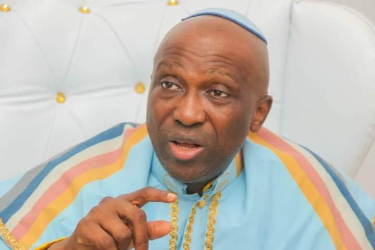
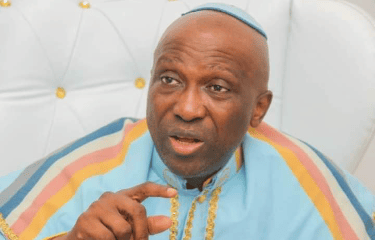
Leader of INRI Evangelical Spiritual Church, Primate Elijah Ayodele has claimed that President Bola Tinubu will relocate the capital of Nigeria to Lagos if he is declared the winner of the 2027 general elections.
Primate Ayodele made this statement in a video posted on X.
President Tinubu is seeking re-election under the platform of the ruling All Progressives Congress, APC.
Speaking about Tinubu’s re-election, the cleric said, “Lagos architecture will change. You may not see this one very seriously, but if Tinubu wins the second time, the capital of Nigeria will be relocated to Lagos.
“When this happens, the capital can be in Epe or Lekki or anywhere at all in Lagos.”
-
 News2 days ago
BREAKING: Gunmen attack Adeleke’s convoy in Osogbo shortly after receiving Certificate of Return
-
International3 days ago
Canada invites 1,000 candidates to apply for permanent residence
-
Uncategorized3 days ago
2027: Obi unfolds agenda as campaigns begin
-
News2 days ago
Lagos shuts churches over noise pollution
-
News2 days ago
Two shot as police attempt to arrest suspects in Anambra
-
News3 days ago
Even if Tinubu appoints Seyi as INEC chairman, he’ll be defeated in 2027 — Dalung
-
News3 days ago
Why I won’t apologise to Okpebholo — Davido
-
News3 days ago
Access Bank asks court to recover N1.3bn stolen by Yahoo Boys