INTRODUCTION:
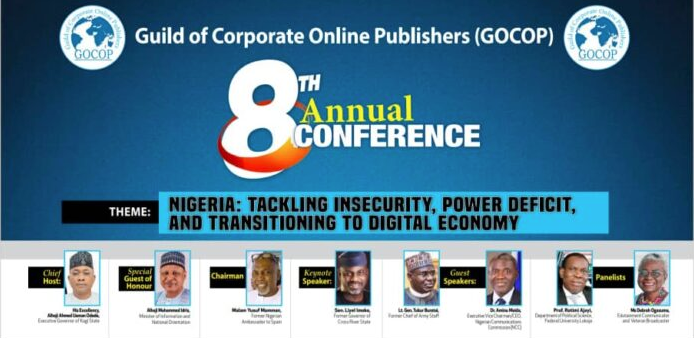
The Guild of Corporate Online Publishers (GOCOP) held its 8th annual conference from October 2nd to 3rd, 2024, at Reverton Hotel in Lokoja, Kogi State. His Excellency, the Governor of Kogi State, Usman Ododo, was the Chief Host.

The conference was attended by over 100 members of the Guild and dozens of invited guests from across the country.
The conference with the theme: “Nigeria: Tackling Insecurity, Power Deficit, And Transitioning To Digital Economy” was chaired by a former Nigerian Ambassador to Spain, Ambassador Mamman Yusuf, with a former Governor of Cross River State, Senator Liyel Imoke, as the Keynote Speaker.
A former Chief of Army Staff, Lt. Gen. Tukur Buratai and the Executive Vice Chairman/Chief Executive Officer, Nigerian Communications Commission, (NCC), Dr. Aminu Maida, were Guest Speakers.

On the panel of discussants were: Prof. Rotimi Ajayi of the Department of Political Science, Federal University Lokoja and Ms Debrah Ogazuma, Edutainment Communicator and Veteran Broadcaster.
DAY ONE:
The morning session of Day One of the two-day event featured a capacity building programme on how members of GOCOP could improve on the visibility of their websites and how to generate revenue to survive the harsh business environment.
The resource persons were sourced from within members of the Guild. President Emeritus Dotun Oladipo, Publisher of THE EAGLE ONLINE, made a presentation on ‘Website Optimization’, emphasizing the need for members to ensure that their websites are on Google News.
Dr. Max Amuchie, Publisher of SUNDIATA POST, spoke on ‘Maximising Advertising Opportunities’, dwelling on the various revenue options available to online publishers.
The third presentation was made by Mr. Olumide Iyanda, Publisher of QED.NG, on ‘Leveraging Digital Marketing: Strategies for Online Publishers’.
He enjoined publishers to explore online platforms and technologies to promote their news stories and engage with audiences on the various digital platforms like Twitter (X handle), WhatsApp, TikTok, Instagram and Facebook.
The Annual General Meeting (AGM) of GOCOP was also held in the afternoon during which GOCOP President Maureen Chigbo, presented a report on the State of GOCOP.
She highlighted key events that happened during the year under review like: employment of an Administrative Officer to man the GOCOP secretariat, various support packages that members benefited from through sponsored content and advertorials.
Ms Chigbo informed the congress that GOCOP is now a member of the National Media Complaints Commission (Media Ombudsman) which means our members are now under close watch.
CORPORATE SOCIAL RESPONSIBILITY (CSR):
In pursuit of our Corporate Social Responsibility (CSR), GOCOP President led members on a visit to two orphanage homes – Margaret Garba Ohiani Orphanage/Less Privileged Home and Rehoboth Children’s Homes, in Lokoja, during which various food items were donated.
On Day Two, after the successful hosting of the 2024 Conference, GOCOP issued the following communiqué, focusing on the three areas of the theme – Insecurity, Power Deficit and Digital Economy:
INSECURITY:
Since Nigeria returned to democracy 25 years ago, we have been experiencing security challenges ranging from Boko Haram insurgency, banditry, kidnapping, separatists agitations to Niger Delta militancy.
These security challenges have no doubt impacted negatively on the Nigerian economy
thus, causing economic hardships on the citizens.
The Conference notes that poverty and high unemployment rate which is close to about 40% today are major factors contributing to insecurity across the country.
It notes weak governance, inconsistent government policies and widespread corruption in the security forces as factors leading to compromising efforts in tackling insecurity effectively.
The Conference acknowledges the federal government’s efforts in significantly degrading the Boko Haram insurgency through the use of technology and intelligence, and notes however, that insurgent attacks have continued unabated, especially in the north-east region.
The Conference therefore, calls for decentralization of security by granting state governments greater control over local security forces so as to improve regional responses to insecurity.
It further advocates the urgent need to strengthen our local security architecture through Community Policing, which will no doubt improve intelligence gathering, foster trust between security forces and communities, and ensure a more proactive response to local threats.
The Conference stresses the need for increased funding for Security Agencies, while emphasizing the need to reduce corruption in the procurement process so as to ensure judicious use of available resources.
To address the root causes of banditry, kidnapping, and farmer-herder conflicts, the government should implement development initiatives targeting rural poverty and job creation.
The Conference opines that tackling insecurity effectively depends largely on political will and the right leaders that will see corruption as evil and confront it frontally.
It therefore charges members of GOCOP to take interest in interrogating the governance process that will ensure that committed and sincere leaders emerge to pilot the affairs of the country.
The Conference realizes that there is a corollary relationship between poverty and insecurity. Hence, it calls for specific economic empowerment programs targeting the
youths such as entrepreneurship training, and access to financing for small and medium enterprises, SMEs.
POWER DEFICIT:
In Nigeria, electricity supply remains one of the most significant constraints to economic growth despite several power reforms that have been introduced since 1999 by successive governments.
The Conference laments that despite huge resources that have been expended on electricity generation and distribution, Nigeria can only manage to deliver 4,000 to 5,000 megawatts.
It notes that Nigeria’s per capita electricity consumption which is around 150 to 200 kWh per year, is too low compared to other African countries and only reflects challenges in electricity access, infrastructure, and supply.
On the way forward in addressing Nigeria’s power deficit, the Conference enjoins conscious efforts aimed at diversifying generation capacity through investment that guarantees expansion of the gas pipeline network, to ensure more stable gas supply to power plants.
The Conference identifies the need to diversify Nigeria’s energy mix by increasing the share of renewable energy sources like solar, wind, and small hydropower projects that could provide electricity to areas that are not well-served by the grid.
It observes that the current transmission system is not working hence, calls for the unbundling of the Transmission Company of Nigeria to allow greater private sector involvement in the transmission network.
The Conference advises the government to encourage more private sector investment in the power sector by creating a more stable and predictable regulatory environment to attract long-term investments.
It notes that this is achievable if the government could stick to agreed contracts, reduce political interference, and ensure a transparent regulatory process.
TRANSITIONING TO DIGITAL ECONOMY:
The significant gains recorded through liberalization of the telecommunications sector in 2001 notwithstanding, Nigeria still lags behind in digital infrastructure, digital literacy, and the adoption of digital technologies in government and business processes.
The Conference notes that transitioning to a Digital Economy remains a major challenge for the country due to inadequate broadband penetration and unreliable internet services.
It observes further that despite the fact that Nigeria boasts a young and dynamic population, digital literacy remains low, limiting the ability of the workforce to participate in the global digital economy.
The Conference agrees that Nigeria’s transition to a digital economy holds immense potential for transforming its economic landscape, creating jobs, and driving inclusive growth.
Therefore, to fast-track this transition, the Conference calls on the government to prioritize infrastructure development, digital literacy, favourable regulations, and indigenous innovation.
It also advises that the government should address challenges such as poor internet access, regulatory uncertainty, and cybersecurity risks, noting that opportunities in fintech, e-commerce, agritech, and digital services present significant growth potential for Nigeria.
The Conference lauds GOCOP for promoting responsible online publishing devoid of fake news, and urges its members to continue to discharge their responsibilities with patriotism.
GOCOP also charges its members to key into the various digital platforms like YouTube, TikTok, Twitter, Instagram and Facebook to promote their products or services and engage more with their audiences.
GOCOP thanks the Executive Governor of Kogi State, Alhaji Usman Ododo, members of the State Executive Council and the good people of the state for providing the necessary facilities that made the hosting of the 8th annual conference of the Guild a huge success.
GOCOP reiterates its commitment to continue to promote ethical and professional journalism, foster collaboration as well as advocate for the interests of online publishers in Nigeria.
Ms. Maureen Chigbo, GOCOP President
Olumide Iyanda, GOCOP Dep. Gen. Sec