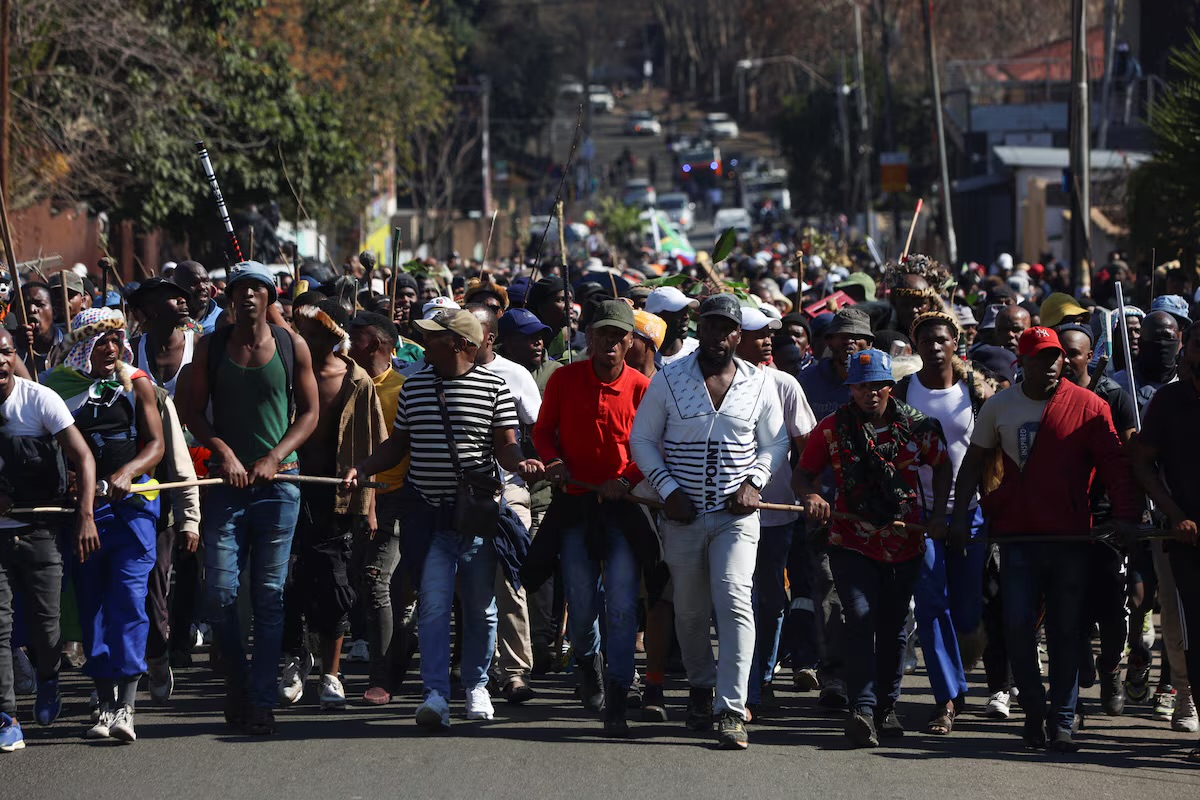
/10] Anti-immigrant marchers walk through the streets of Johannesburg on the day of an unofficial deadline set by anti-immigrant groups for all undocumented migrants to leave, in Johannesburg, South Africa, June 30. REUTERS/Oupa Nkosi Purchase Licensing Rights
Thousands of people marched Tuesday in cities across South Africa to demand the departure of undocumented foreign nationals after a weeks-long campaign that has sent thousands fleeing and claimed four lives.
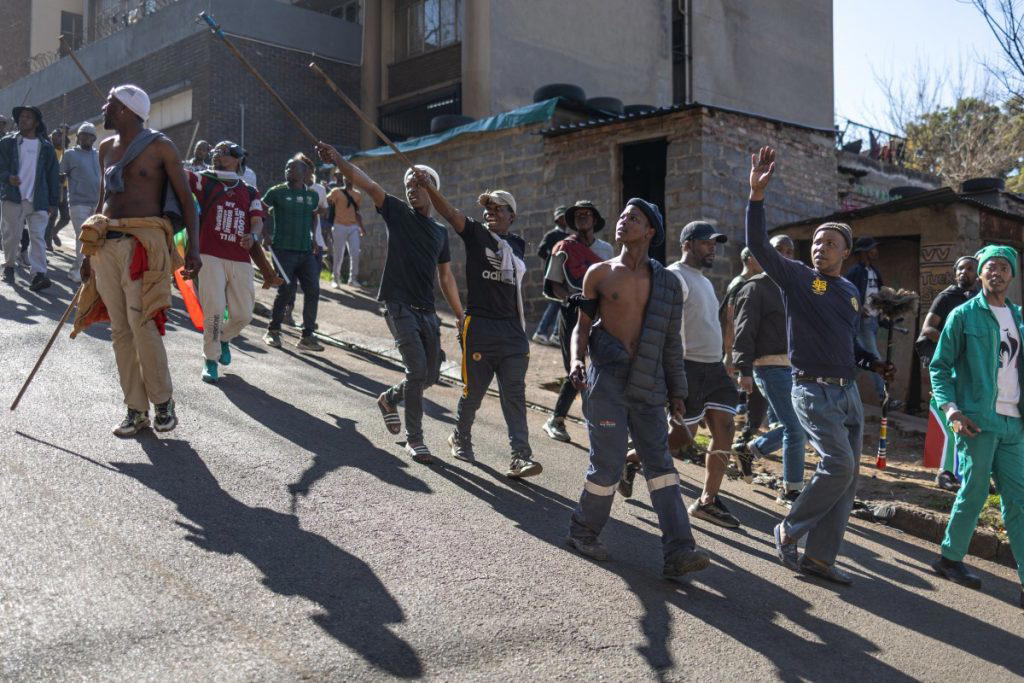
Protesters gesture towards people they believe to be undocumented foreign nationals while marching during a demonstration by the “March and March” and Operation Dudula movements marking an unofficial deadline set by citizen-led groups for undocumented foreign nationals to leave South Africa, in Johannesburg, on June 30, 2026. Thousands of demonstrators massed across South African cities on June 30, 2026, venting anger at undocumented foreign nationals as police mounted a major operation to head off looting and xenophobic violence that has claimed four lives. The nationwide protests cap weeks of demonstrations called by a loose coalition of minor political parties and small citizen-led vigilante groups, which set an unofficial June 30 deadline for foreigners without residency papers to leave. (Photo by EMMANUEL CROSET / AFP)
Police were out in force for the nationwide protests which capped a campaign of demonstrations led by citizen-led vigilante groups that set an unofficial June 30 deadline for foreigners without papers to leave.
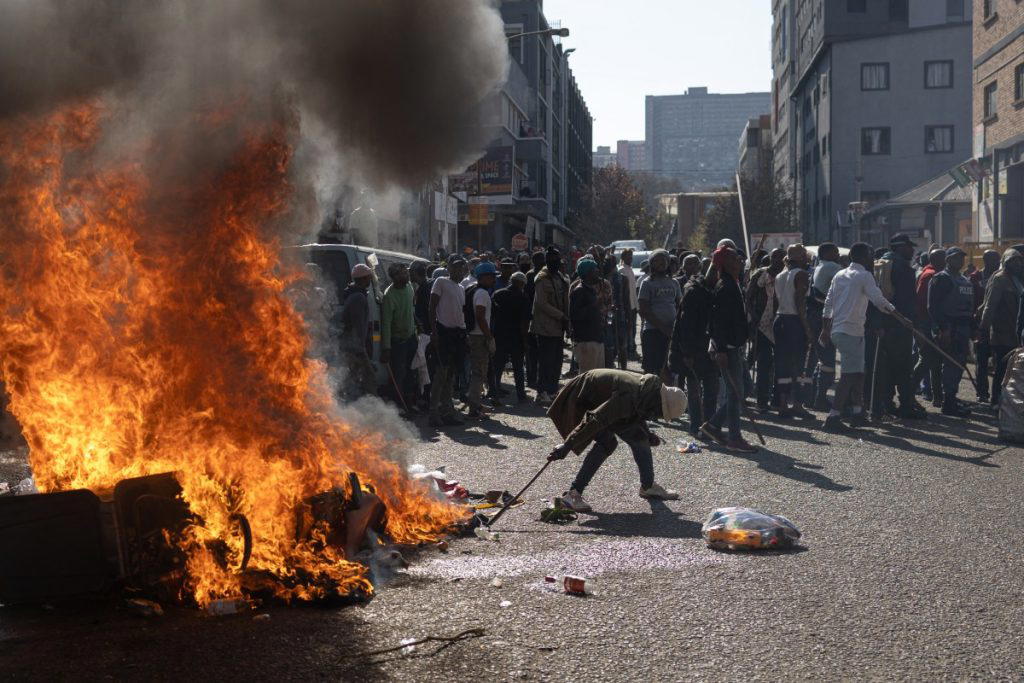
There were isolated reports of looting, stone-throwing and confrontation, including near Johannesburg where security forces escorted a handful of foreign nationals away from a mob brandishing large sticks.
Crowds of demonstrators moved through the centre of the city, South Africa’s financial capital, where most shops were shuttered, workers stayed home, and transport hubs were quiet.
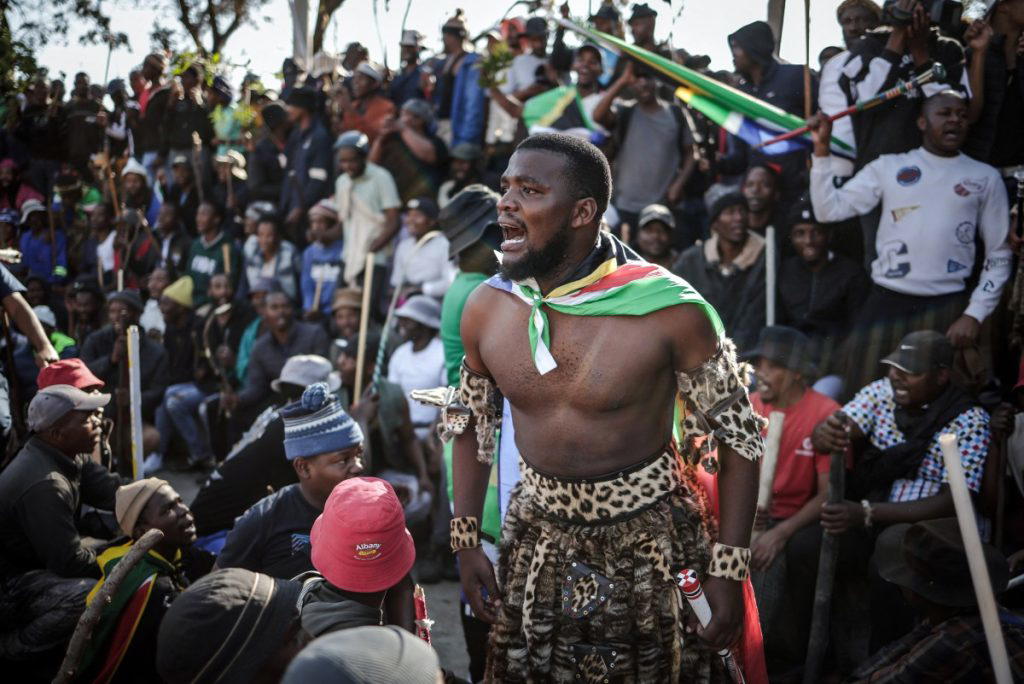
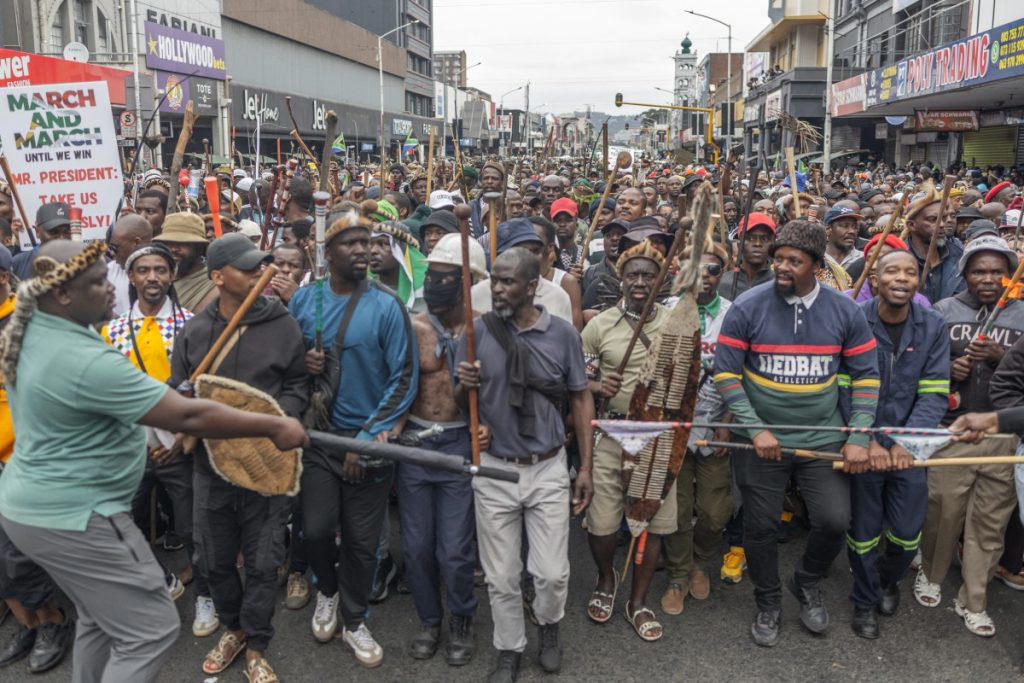
Protesters, some wearing traditional Zulu attire, chant slogans as they gather during a demonstration by the “March and March” and Operation Dudula movements marking an unofficial deadline set by citizen-led groups for undocumented foreign nationals to leave South Africa, in Johannesburg, on June 30, 2026. South African police deployed to head off unrest and protests on June 30, 2026, the unofficial deadline set by anti-immigrant groups for undocumented foreign nationals to leave that has already pushed thousands to flee. Officers were out in force to prevent violence and looting by the xenophobic groups, while hundreds of foreign nationals took refuge in several cities, urgently seeking help to leave. (Photo by EMMANUEL CROSET / AFP)
They waved flags and placards, watched by police in bulletproof jackets and riot helmets.
In the southeastern city of Durban, the Zulu heartland, protesters turned out in traditional warrior attire, carrying spears, whips and shields and some draped in leopard skins.
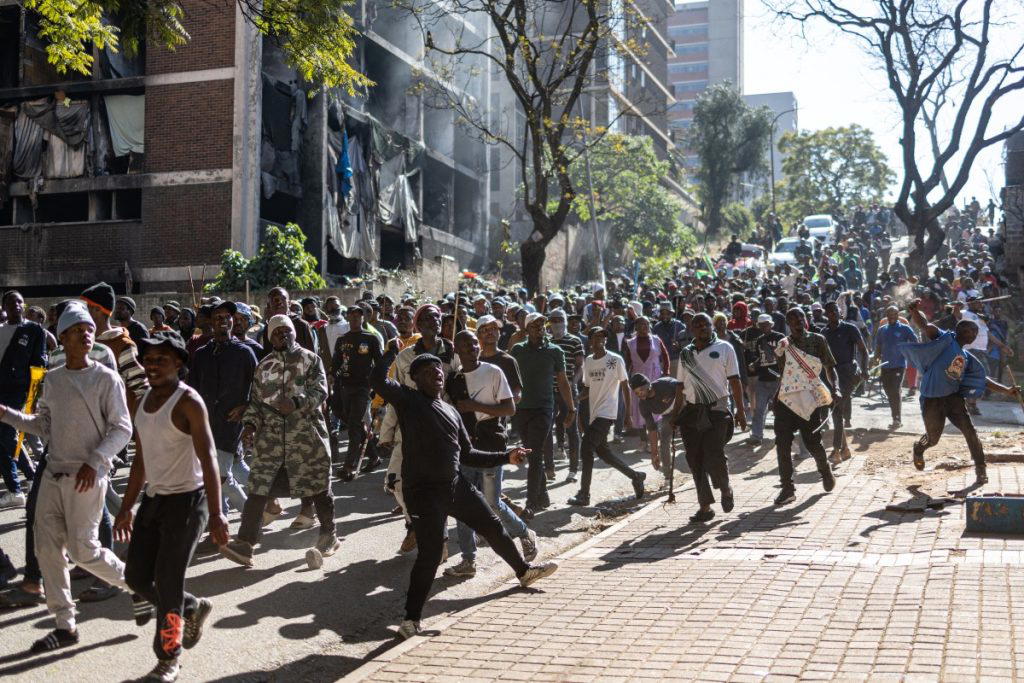
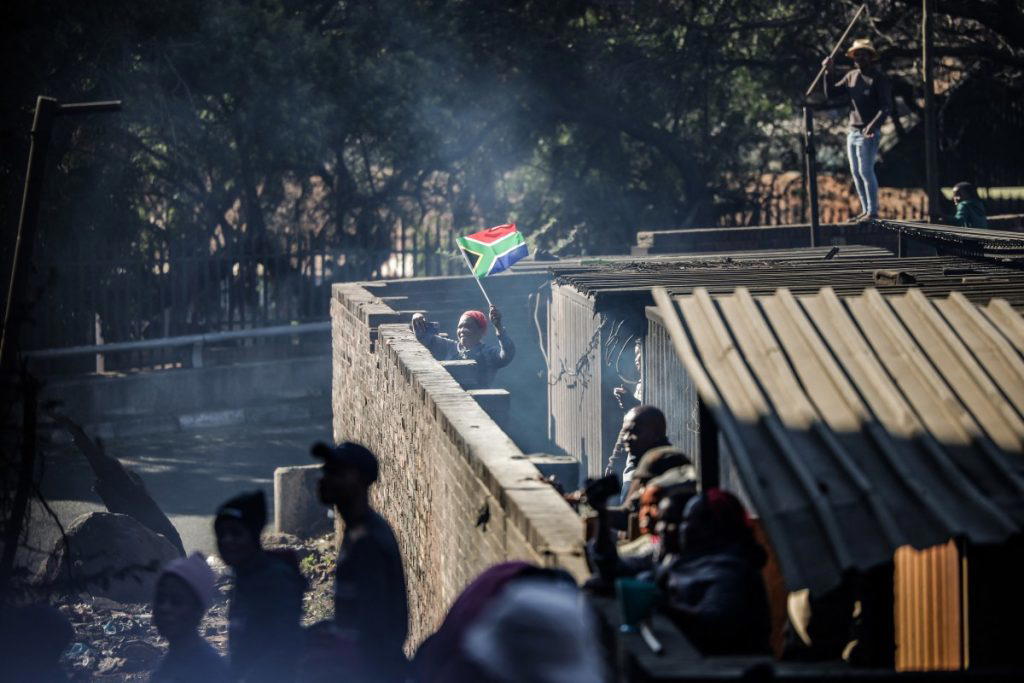
Protesters throw rocks at a building while marching with others during a demonstration by the “March and March” and Operation Dudula movements marking an unofficial deadline set by citizen-led groups for undocumented foreign nationals to leave South Africa, in Johannesburg, on June 30, 2026. Thousands of demonstrators massed across South African cities on June 30, 2026, venting anger at undocumented foreign nationals as police mounted a major operation to head off looting and xenophobic violence that has claimed four lives. The nationwide protests cap weeks of demonstrations called by a loose coalition of minor political parties and small citizen-led vigilante groups, which set an unofficial June 30 deadline for foreigners without residency papers to leave. (Photo by EMMANUEL CROSET / AFP)A resident waves a South African flag in support as protesters march during a demonstration by the “March and March” and Operation Dudula movements marking an unofficial deadline set by citizen-led groups for undocumented foreign nationals to leave South Africa, in Johannesburg, on June 30, 2026. Thousands of demonstrators massed across South African cities on June 30, 2026, venting anger at undocumented foreign nationals as police mounted a major operation to head off looting and xenophobic violence that has claimed four lives. The nationwide protests cap weeks of demonstrations called by a loose coalition of minor political parties and small citizen-led vigilante groups, which set an unofficial June 30 deadline for foreigners without residency papers to leave. (Photo by EMMANUEL CROSET / AFP)
Demonstrator Brightness Gumbi, 48, said she was frustrated at not being able to afford to rent a premises for her business while foreign nationals were able to run shops.
Members of the Zulu regiment known as the Amabutho chant slogans as they march during a demonstration by the “March and March” movement marking an unofficial deadline set by citizen-led groups for undocumented foreign nationals to leave South Africa, in Durban, on June 30, 2026. Thousands of demonstrators massed across South African cities on June 30, 2026, venting anger at undocumented foreign nationals as police mounted a major operation to head off looting and xenophobic violence that has claimed four lives. The nationwide protests cap weeks of demonstrations called by a loose coalition of minor political parties and small citizen-led vigilante groups, which set an unofficial June 30 deadline for foreigners without residency papers to leave. (Photo by RAJESH JANTILAL / AFP)
“The illegal foreigners manage to pay it because they sell drugs to our people,” she told AFP. “I hope through these demonstrations our president will hear our cries and enforce stricter laws.”
Protesters gather outside a building they believe is occupied by undocumented foreign nationals during a demonstration by the “March and March” and Operation Dudula movements marking an unofficial deadline set by citizen-led groups for undocumented foreign nationals to leave South Africa, in Johannesburg, on June 30, 2026. Thousands of demonstrators massed across South African cities on June 30, 2026, venting anger at undocumented foreign nationals as police mounted a major operation to head off looting and xenophobic violence that has claimed four lives. The nationwide protests cap weeks of demonstrations called by a loose coalition of minor political parties and small citizen-led vigilante groups, which set an unofficial June 30 deadline for foreigners without residency papers to leave. (Photo by EMMANUEL CROSET / AFP)
In tourist magnet Cape Town, only about 100 people joined a march through the city centre, passing a counterprotest against Afrophobia and xenophobia.
– ‘Mass deportation’-
One of the continent’s wealthiest countries, South Africa is a magnet for migrant labour while grappling with an unemployment rate above 30 percent, high crime and a breakdown in services in many areas.
Groups mobilising against illegal immigrants say they take jobs and services from locals, claims that analysts say is unfairly scapegoating foreign nationals for government failures.
“South Africans have been replaced by illegal foreigners, increasing unemployment,” the leader of the anti-immigrant March and March group, Jacinta Ngobese-Zuma, told a crowd in Durban.
“We want mass deportation,” she said. “For the next six months we want the government to get rid of the people who have not left.”
At least two Mozambicans, an Ethiopian and a Malawian have been killed in the latest outburst of anti-immigrant violence, according to police.
Several African governments — including Nigeria, Malawi, Ghana, Zimbabwe and Mozambique — have organised voluntary repatriation flights and buses for their citizens.
South Africa has seen previous flare-up of violence targeting undocumented foreign nationals, but this is the first time governments have simultaneously organised repatriations.
More than 25,000 people had been processed for departure in recent weeks, authorities said Monday.
– ‘I’m scared’ –
As the protests unfolded in several cities, hundreds of migrants — mostly Malawians and Zimbabweans — gathered in Cape Town, Johannesburg and other centres, waiting for assistance to go home.
Some said their landlords had evicted them or their employers had fired them, fearing fines from officials or attacks by vigilante groups.
“The people in South Africa, they don’t want us here. I’m scared,” said a 23-year-old Zimbabwean woman, who asked to remain anonymous, where around 2,000 people were waiting for buses.
Only a few dozen Malawians remained at a site in Durban from where several thousand had been bused out in recent days, either taken back to their country or to a processing site near the border with Zimbabwe.
“I thought I could stay on but neighbours warned us last night,” 32-year-old Adam John told AFP. “I felt that it is better to try and get home while I still can.”
– ‘Weaponised’ –
Concerned about a repeat of unrest five years ago when around 350 people were killed in days of looting and riots, the government put in place a massive security deployment for Tuesday’s mobilisation.
President Cyril Ramaphosa announced stepped-up government plans to combat illegal immigration and called on traditional leaders to use their “standing to calm tensions”.
Coming ahead of local government elections in November, the anti-migrant push has been “politically weaponised”, labour analyst Dale McKinley said.
Previous anti-foreigner riots in South Africa have proved deadly. In 2008, violence left 62 people dead.
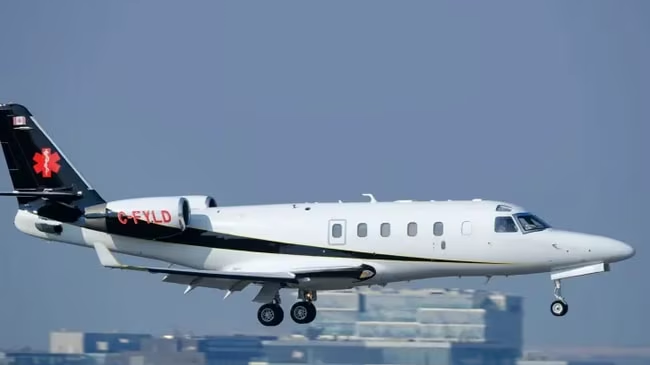
Six people are missing after a private jet vanished, sparking a major search off the coast of Nantucket in the US. Picture: X
Spread the love
There are grave fears for the passengers of a private plane that suddenly vanished mid-flight, sparking a major search off the coast of the US.
Six people are missing after a private jet vanished en route from Bermuda to Boston, sparking a major search off the coast of Nantucket in the US.
US authorities say the Gulfstream G100 lost contact with air traffic control about 2am local time on Saturday (4pm Saturday AET) while flying from L.F. Wade International Airport in Bermuda to Boston Logan International Airport.
The US Coast Guard said the Federal Aviation Administration alerted it after contact was lost with the aircraft – which plummeted from 23,500 feet to 11,000 feet in just three minutes, according to FlightAware data.
“We are praying for a safe outcome,” a spokesperson for Latitude Air Ambulance, which operates the missing plane, told City News.
A search is now under way off Nantucket in the air and on water as crews work to locate the missing jet, the Coast Guard said. Data from FlightRadar24 showed a number of aircraft searching south of the island.
Six people are missing after a private jet vanished, sparking a major search off the coast of Nantucket in the US.
The plane was en route from Bermuda to Boston when it vanished.
“Air & surface crews have launched in search of the aircraft. Updates will be provided here as info becomes available,” the Coast Guard Northeast District said on X.
The plane was carrying out a medical evacuation in Bermuda – a British overseas territory in the north Atlantic Ocean, according to Clarence Togeretz, Director of Flight Operations at Latitude Air Ambulance.
“We always get rather concerned when our crew doesn’t report to us in a timely manner,” he told NBC News.
“But I will say that again, optimistically and positively, that doesn’t mean that the worst has happened.”
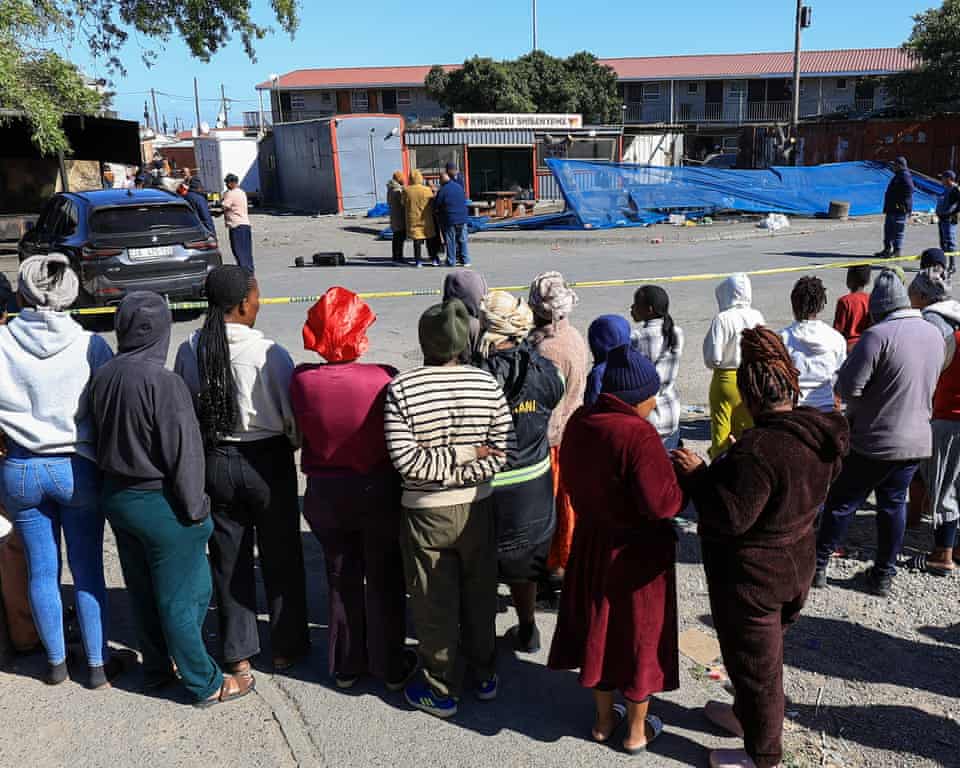
People gather at the store in Lwandle, near Cape Town, where 10 people were killed. Photograph: Esa Alexander/Reuters
Spread the love
Twenty-seven people have been killed in two mass shootings hours apart in South Africa, the latest gun violence to hit the country.
Seventeen people were killed when eight gunmen stormed a bar close to Johannesburg on Saturday evening, with 15 more injured.
In a separate shooting in the early hours of Sunday morning, 10 people were killed outside an entertainment venue in a township near Cape Town and a further 11 were injured.
South Africa has one of the highest murder rates in the world and has struggled to contain gang-related gun violence in recent years. Police have not indicated a motive for either of the latest attacks.
In Johannesburg, gunmen opened fire on customers outside the bar before continuing the attack inside and torching two vehicles before fleeing.
Police said thirteen men and four women were killed.
Deputy provincial police commissioner Maj Gen Fred Kekana said the attack may have been a retaliation for an incident last month, in which one person was killed and another wounded, according to AFP news agency.
Speaking at the scene, he said police had clear pictures and in some cases names for the suspects.
In Cape Town, five victims died at the scene and a further five people died in hospital.
No arrests had been made in either case on Sunday morning.
The two mass shootings came days after 11 people were killed in the city of Duban when gunmen stormed a house in the KwaMakhutha township.
Armed security forces were deployed to the scene of a mass shooting in Cape Town on Sunday morning
Illegal weapons are prevalent in South Africa and gun violence has been a persistent problem for decades, with about 60 murders recorded every day in the country of 62 million.
But a recent spate of mass shootings has raised fears that the problem is deepening, with violence often linked to turf wars between gangs engaged in drug trafficking and illegal mining.
In February, President Cyril Ramaphosa called organised crime “the most immediate threat to our democracy, our society and our economic development”.
On Saturday a tenth woman’s body was found in Ekurhuleni, to the east of Johannesburg, with local police saying they were unable to rule out a serial killer operating in the area with similarities between the deaths. (BBC)
The United States has deported more than 25,000 people under secretive agreements with 35 countries to take migrants with no ties to those nations, according to an investigation published Monday.
Since US President Donald Trump took office in January 2025, Washington has been signing deals with developing countries to take migrants who cannot legally be sent home.
The investigation by Forbidden Stories found the administration has earmarked $410 million to be paid directly to the receiving countries, or to UN agencies to facilitate the returns.
At least 25,447 people had already been deported to third countries by August 31, 2026, according to data compiled by Forbidden Stories with a consortium of international journalists.
The vast majority — around 20,000 — were sent to Mexico, but the rest were dispersed to 27 other countries across Latin America, Africa, and the Pacific, and agreements have been finalised with seven more.
The deals vary, including over which nationalities can be deported and whether people with criminal records can be accepted.
An AFP investigation earlier this year found Washington is using visa bans and restrictions on African countries to strongarm them into accepting deportees.
Lawyers told AFP that deportees were being thrown into a “legal black hole”, held without charge in countries where they have no ties and few if any rights.
Forbidden Stories said 49 of Africa’s 54 countries had been approached about accepting third-country deportees.
A little-known State Department division called the Office of Remigration, created in May 2025, has handled most of the negotiations and payments, according to Forbidden Stories.
The office is headed by Christian Jove Ehrhardt, a 41-year-old diplomat who previously worked as a security officer.
The report details his visits to Cameroon, which signed a memorandum of understanding with the US in December on accepting deportees. A week later, it also signed a five-year health assistance programme worth nearly $400 million.
The following month, the State Department said it would provide a further $30 million to the UN Refugee Agency (UNHCR) in Cameroon to “facilitate the voluntary return of refugees and combat illegal immigration.”
The first plane carrying deportees arrived in Cameroon on January 14.
– Payments –
Other agreements have involved direct payments to governments.
Palau, a small Pacific island nation with a population of under 18,000, signed an agreement in December 2025 to accept up to 75 third-country nationals in return for $7.5 million.
However, only three people have so far been sent under the agreement.
In Eswatini, 32 people have arrived since July 2025 out of a possible 160 under an agreement worth more than $5 million. It has accepted deportees with criminal records, the investigation found.
Of the $410 million planned for the agreements, internal State Department records showed that $81 million was earmarked for signatory governments.
The rest was intended for aid organisations, including more than $178 million for the UN’s International Organisation for Migration, and $123 million for UNHCR.
The agencies have faced criticism over their involvement, although UNHCR told Forbidden Stories that it was not party to the bilateral agreements and that US funding was being used in line with its mandate to strengthen asylum systems.
An IOM spokesperson told Forbidden Stories that the agency’s decisions to accept funding rested “on a single question: whether our engagement will improve the lives of the migrants affected. In these instances, we believe strongly it does.”