“If you look at Obasanjo’s past, you see that he has been very fair, more than fair, to the Igbos. He went to campaign for the Igbo party presidential candidates at Onitsha.”
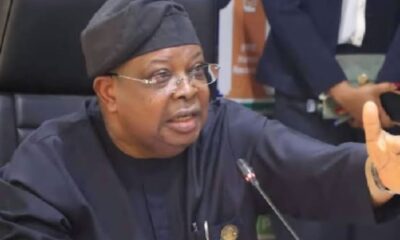
Chief (Dr) Sunday Adekunle Majekodunmi, the current Aare Ona Kakanfo of Egba-land and the Otun Ba’asegun of Egba-land has spoken on sacred subjects that border on life, medicine, politics and nationhood as he celebrates his 90th birthday tomorrow, Monday, March 18.
Majekodunmi, who is a former Chief Medical Officer to the General Officer Commanding (GOC), TY Danjuma, bares it all, in a chat with Daily Independent leaving no topic too controversial as he weighs in on the current state of the nation and his hopes for life after death.
Tell us about your early life.
I was born on March 18, 1934 at Ijebu-Ode because my father was working with UAC; he was selling motor parts and that is where he met my mother. I spent many years in Ijebu-Ode before I moved to Abeokuta where I spent my early years. I attended a missionary school in Ikereku area, and after secondary school I went to Oke-Ona United School (OUS) at Ibereke, Abeokuta. I was in the school till 1947 December. When I was young, I moved with a bad gang and we won’t go to school. Ogun River was close to the school, and before exams, we would visit a Babalawo (herbalist) to give us voodoo that would help us remember the answer in the examination hall and he would give us a handkerchief to wipe our faces and we honestly believed him then.
Unfortunately, I was only being promoted on trial each year. One of my big cousins, who was a teacher in the school, was the one who exposed me at home and told my family that I was not reading rather, it was voodoo that I was depending on.
That was how I found myself in Ibadan Boys High School in 1948. When there was no ‘babalawo’ anymore, I started studying. During the first year leaving certificate examination in 1951, I came first and because I was doing well, my father got me a school where I will have my secondary education in the United Kingdom (UK), because we were under colonial rule.
I did not take any Unity School exam; if I had taken, I would have come first again.
While my father was planning on taking me abroad to study, one of his aunts ‘Iya Ibadan’ visited and he told her of his plan for me and the woman said to her younger brother, that, if you want to send Sunday (that is my name) abroad to study, you must include in his baggage, a woman or a girl because women will not allow him to study well and that put an end to my ambition to go overseas. I ended up in Lagos Boys High School in 1952 where I spent one year.
In 1956, I finished my school leaving certificate and was employed at Adeoyo Hospital in Ibadan as a clerk. My father used to tell everybody that his son was going to be a medical doctor.
I got to the UK on December 2, 1957, during winter. At that time, you could only go overseas officially through Western Region. It was part of what Baba Awolowo did for us, and I was met at Liverpool by a representative of Western Region.
When I was in Nigeria, I was working with the Ministry of Health, so they took me to a health center in the South of England.
While I was in the UK, there was nobody to supervise me, we were just moving from one dancing hall to another. So, I moved to London to finish all my papers for O’ level. I heard about Coventry Technical College, which is now a university and I saw some of the boys there who were my classmates, not in the same school, but from different schools. So, I prepared for my GCE.

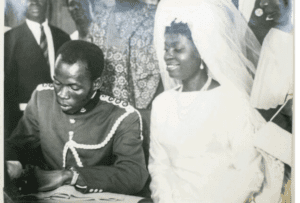
• Chief (Dr) Sunday Adekunle Majekodunmi, during his wedding
By 1960, I passed my subjects, so by October 1, I was already in the University of Glasgow. I stayed in Glasgow for six years to do medicine. I completed it on June 1, 1966.
In 1963, I was passing out blood in my urine after my second Masters in Bachelor (MB), and they thought it was schistosomiasis. It’s a disease that we get when you go to swim in the Ogun River, which I did a lot.
They discovered that I had congenital disease of the bladder, which I was born with it. They call it cystitis cystica.
I heard the professor tell the registrar that it’s not curable.
They said I had 10 to 15 years plus or minus in the medical field. What it means is that I can only live 10 to 15 years. When they finished talking, I didn’t wait for a prescription because it was not curable, so I went back to Glasgow. I don’t want to tell you what I did then, I mean, for someone who was waiting to die.
Every weekend, we must have a party at number 42, Buckley Street, Glasgow.
From there, I did my house job, surgery in Glasgow, and then medicine in Leeds in England. In my final year, I had a girlfriend, a white girl, Jennifer. She came to do midwifery. I got her pregnant and she gave birth to my first son. Even though we were never married, she was really my first wife. I returned home to Nigeria on July 28, 1967.
You have a vivid memory, how are you able to stay sharp even at your age?
I ascribe it to a good life. I don’t get involved in something I cannot handle. I have been careless in the past, nobody’s perfect. I also believe in destiny; if God says you are going to reach one place, you will get there. I mean, I didn’t know that I would even reach this my present age because of what they told me in the theater, that I have 10 to 15 years, plus or minus. So, every year, I celebrate my birthday. My wife used to ask me why, and I tell her I don’t know, I just feel like I’m someone that was told he will die and is still alive today.
I joined the Army in April 1968, I came home the same month in the middle of the war, and University Teaching Hospital Ibadan (UCH) paid for my ticket, Jennifer and our son, Mark.
When I got home, my mother said I must not marry the white girl. Along the line I met my Nigerian wife whom my mother approved of, and we got married on April 7, 1969.
How did you join the Nigerian Army?
Remember I told you that I was sent to Lagos to assist with the war effort. They used to bring casualties from the war front, and we helped in removing their bullets. That was during the Civil War.
By January 1,1968, I was already in Lagos at the Military Hospital, Yaba. I was their first Commandant.
When I saw the way the war was going, with Ojukwu promising to have breakfast in Lagos. I said, ‘over my dead body’.
So, I joined the Army by April 26, 1968. I was commissioned as a Captain. I was shipped to 44, Military Hospital, Kaduna as a General Duty Medical Officer (GDMO).
After staying there till the war finished in the first week of October 1970, I went to the UK to do a postgraduate in Preventive Health Medicine. I spent two years there. My wife also got a scholarship at LUTH, so she joined me there. She’s a professor of ophthalmology.
We came back home together, and while she went back to LUTH, I went back to the Army because we were both on scholarship.
When I got to Lagos headquarters, they shipped me to 3D. It used to be 3 Marine Commando but now, 3 Armored Division as the Chief Medical Officer to the General Officer Commanding (GOC), TY Danjuma as the CO 3 Field Ambulance in Port-Harcourt before we moved to Jos in 1975.
Tell us about serving in the Nigerian Army; the good and the bad.
What I will say about the Nigerian Army is that not all the people that were killed were guilty of mutiny or coup plotting, some of them were just unfortunate to be there at the wrong time. I remember the case of a young officer. He was a night duty officer who went to submit a report but he was unfortunate to be in the room where the coup plotters were just coming from. They saw him and said he was among them.
Nonetheless, the army is a nice place, you just have to be content with your life. Don’t get involved with stealing. There was one Major Yaya, who was a Kano boy under my command at the Military Hospital. He was a lousy officer, who didn’t watch what he said. He was in a Nigerian plane from Ghana with other officers and he was naive enough to say he dreamt that there was a coup and Ibrahim Babangida (IBB), who was always afraid of his own shadow, got wind of it from his boys. So, when they came to arrest Yaya, I said, the only weapon he had was the one he signed for at the hospital armory where we kept ammunition, so, he couldn’t have been planning a coup. Why would he? He was in the Pharmacy Department. I wanted to go and pleaded on his behalf, but one of the officers asked me to be careful and that I should not take part, because they had made up their mind on what to do with Yaya.
But I still wrote something nice, because I knew he was naive. However, they didn’t kill him, they just retired him. So, what I’m saying is that somebody should be careful about what he says and where he says it at any given time.
Are there any memorable events that come to mind?
Oh yes. It was about T.Y. Danjuma in 1973. I was allotted a plot of land in Surulere by the LSDPC, through my mother-in-law for just about N4,000, in Bode Thomas. Honestly, I didn’t have a penny to my name as a young officer then, so I approached one of the senior officers. I was going to die within 10 or 15 years, so I was not thinking of tomorrow. I approached Major General Bajowa and I told him I needed N4,000. I had so many things I could use that were not in the record, that were given to us during the war effort. Bajowa said I should not go to that area. He told me to write a letter to T.Y. Danjuma who was my boss, but he warned me that if he wasn’t in good mood, I should not submit my application for a loan. We have what we called welfare vote, we called it ration cash allowance, that was not auditable.
But some officers like Abacha will not buy the idea. That was why I decided to retire, when Abacha was going to be made the Chief of Army Staff. I said I can’t work with him.
So, I watched Danjuma, because I have to brief him virtually every day on what is happening in the division. I had my application in my pocket and entered his office, saluted him and when I saw that he was in a good mood, I said, sir, I have a problem. I asked for 10,000 from the welfare, and when he read the letter, he said, ah! And approved N10,000. I thanked him and went to the paymaster who said there was no money that time. He gave me only N5,000, which I sent to my wife in Lagos so that she can pay for the land.
I will never forget that about Danjuma unlike Abacha. There was a time I was sent from Lagos as an assistant director of Army health to Mokola barracks where there was a suspected waterborne disease, Cholera before it was confirmed. The children in the barracks were dying from dehydration. So when I got to the barracks, I took some samples and it was confirmed that the children were dying of dehydration and electrolytes imbalance. I realised that they do not have pipe-borne water, they were drinking from a river behind the barracks. I knew we needed to buy some drugs, so I asked the paymaster if there was money to purchase the vaccine for cholera and he said yes. So instead of going to Lagos to get the vaccines, I went to give Abacha the report of my findings and asked him to give his Chief Medical Officer money to purchase the drug. I was careful not to mention the name of the paymaster who told me they had money to purchase the drug, else he would have removed him.
You need to hear what he said; he was unlike TY Danjuma. If he was in that situation, he would be the one to even ask you about what to do to cure the sickness. I could not work with him. It was six months before my retirement in 1998. I got a hint that he was going to become the Chief of Army Commander. I decided to retire because I can’t work with him.
Would it be right to say that you retired from the Nigeria Army because of the inhuman nature of Abacha?
That was what capped it all. Despite how tough Obasanjo was, he did not joke with anything that had to do with welfare, same as TY Danjuma, Abacha was the only different one among them. I was not asking for personal money but money to treat his people. He insisted that if I did not move to Lagos to get the vaccine, he would put me on house arrest.
I had to rush to Lagos to get the drugs and have it sent to his barracks.
At some points, Obasanjo and Abacha led the nation. What is your opinion on their leadership roles in Nigeria?
Obasanjo was a fine officer. It was Abacha that sent Obasanjo to Yola Prison, but it served him right because he was the one that promoted him citing balancing being an Hausa man. All his report after training has always been that he was not grade-able.
Abacha shouldn’t even have gotten beyond the rank of a Major. He was trained on lots of things abroad, but this officer was said not to be grade-able.
Abacha and IBB did not like opposition, but I like Obasanjo for always saying what’s on his mind. He criticises appropriately.
Meanwhile, Obasanjo comes from a very poor family. He never liked us the Yoruba people that were in the army. You cannot say this is what Obasanjo did for us because he sorts of antagonised us.
There was this police officer who was a DPO at Lafenwa that had an affair with Obasanjo’s mother. But at that time, the Igbos didn’t intermarry with Yoruba. He was posted out. After she had the child, his adopted father now adopted him (Obasanjo). Obasanjo’s biological father was an Igbo man from Onitsha and from a royal family for that matter.
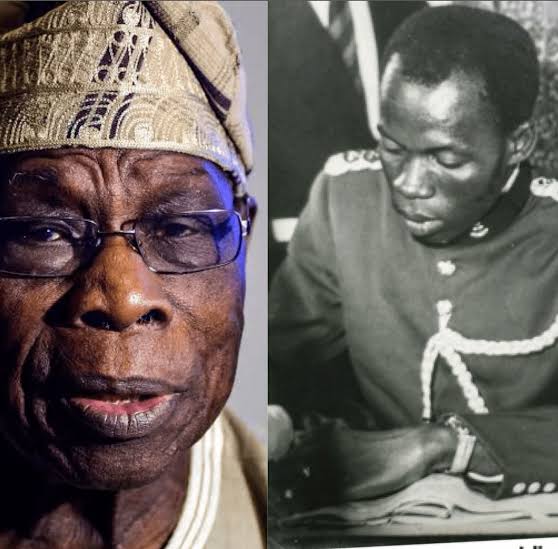
If you see the picture of Obasanjo and the ex DPO of Lafenwa, you will see that they look alike.
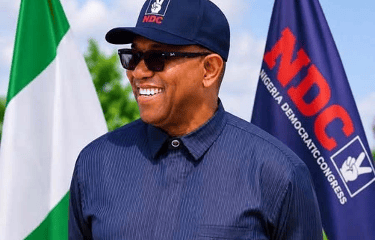
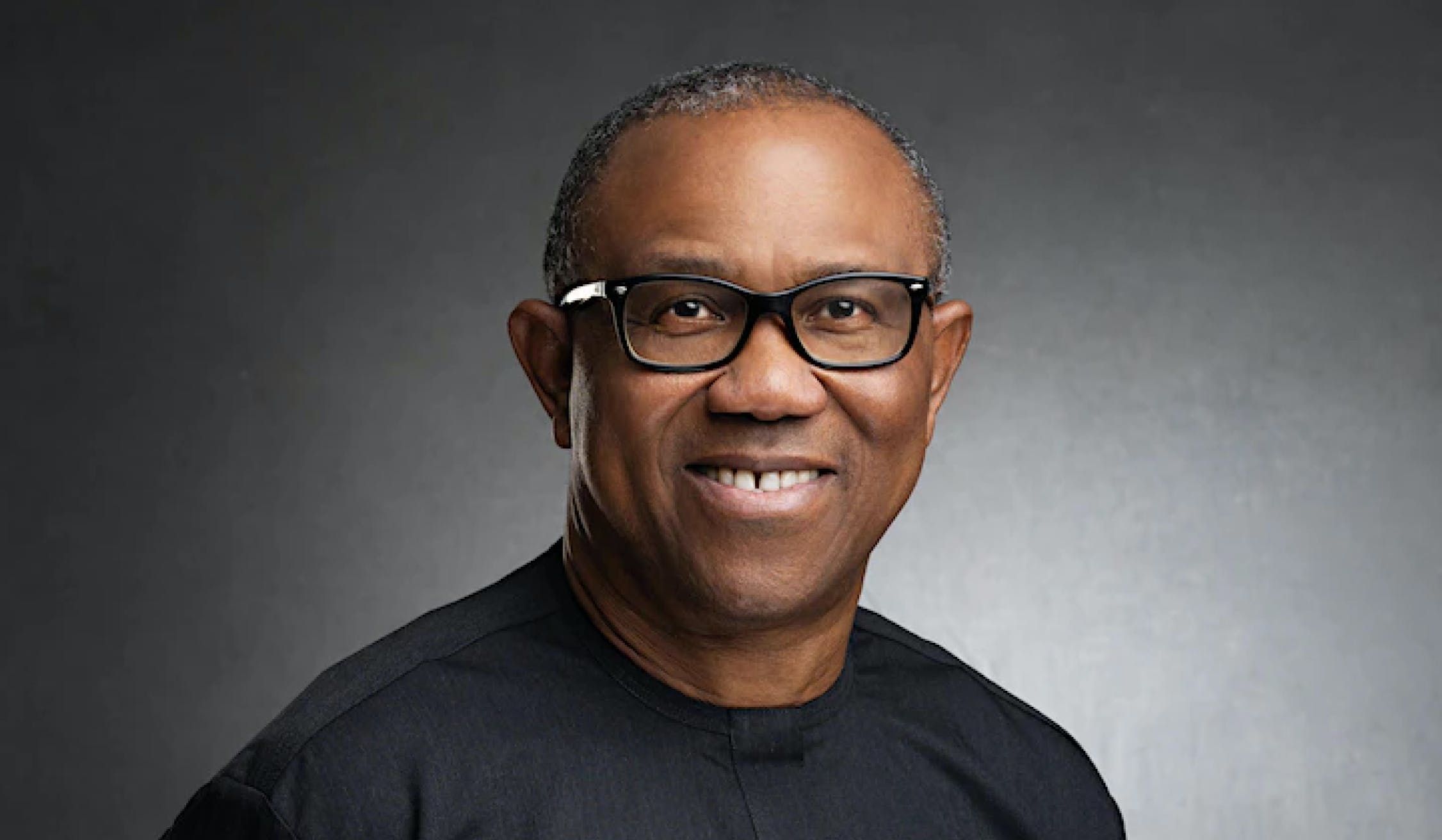
When they ask him, he doesn’t talk about it. You see some Igbo people like a former governor had once referred to Obasanjo as his cousin because he’s from there. Obasanjo left Yoruba people to Igbo land to go and campaign for Peter Obi at Onitsha.
If you look at Obasanjo’s past, you see that he has been very fair, more than fair, to the Igbos. He went to campaign for the Igbo party presidential candidates at Onitsha.
He has so many things that we know that he doesn’t like to be reminded of. When he was joining the Army it was the DPO that gave him the backing and a good recommendation. That’s how he left when he passed his GC in Form 5 and he got into the army.
But when you are talking about brave officers, you are thinking of TY Danjuma.
Abacha was the greatest problem Nigeria ever had. Remember I said earlier that it was Obasanjo that promoted him to Lieutenant Colonel because they said he was not grade-able.
Abacha was also a good coup planner. You will see him on the television accusing the civilian government of neglecting medical care, yet he didn’t do better when he was there. He was a very wicked officer. He has a team of killer squad headed by Al-Mustafa. Whatever Al-Mustafa is saying, he’s just telling lies. Many people left the country through the escape route via Cotonou.
Abacha and IBB were not tolerant, and I think Abacha was probably the most dangerous of them all.
So since the day he said that he was going to lock me up because I asked for welfare vote money to buy a vaccine for the cholera that was raging in Mokola Barracks and he refused, I knew I could not work with him.
So when I knew he was going to become the chief of army, I said, no, I can’t work with him.
Despite all Obasanjo did for Abacha, he was the one that sent him to prison.
As I said, Abacha couldn’t tolerate opposition. You know he was not lettered as such, but he knew Obasanjo could finish him internationally because he travels a lot and he’s more educated and the world will believe whatever he says.
So Obasanjo was criticising him and he didn’t like that. In fact, Obasanjo was lucky that they didn’t kill him like some people that they killed with the vaccine, the one that has no cure. Obasanjo, apart from his small, small problem, is not a wicked officer. But when he stands by something, he works it down. (Excerpts from Daily Independent)