News
767 Nigeria’s Manufacturing Companies shut down, 335 became distressed in 2023 – MAN

The Manufacturers Association of Nigeria has said that 767 manufacturers shut down operations while 335 became distressed in 2023.
This came against the backdrop of exchange rate volatility, rising inflation and other economic challenges that have worsened the investment climate.

MAN stated this in a statement issued yesterday by Director-General, Mr. Segun Ajayi-Kadir, titled, “MAN Expresses Grave Concerns over the Expatriate Employment Levy.” It strongly condemned the recently introduced Expatriate Employment Levy by the Federal Government.
The association said it was struck with disbelief, seeing that the levy runs contrary to President Bola Tinubu’s Renewed Hope Agenda and the kernel of his Fiscal Policy and Tax Reform initiative.
It warned that the EEL would certainly ruin the confidence President Bola Ahmed Tinubu was striving to build among domestic and foreign investors.

It described the latest levy as “punitive levy,” which was already “being perceived as a punishment imposed on investors for daring to invest in Nigeria and on indigenous companies for employing needed foreign nationals”.
The statement said EEL “is potentially an albatross to the realisation of Mr. President’s private sector led economy aspirations and would certainly ruin the trust and confidence he is striving hard to build among domestic and foreign private investors”.
Ajayi-Kadir added, “The imposition of EEL poses potential impact on the manufacturing sector and the economy at large.
“This will in turn mark an unwarranted and unprecedented addition to the cost of doing business in Nigeria, especially to manufacturers.
“The policy will surely undermine the administration’s determination to position Nigeria as an attractive global investment destination and may engender a cold welcome in Mr. President’s future foreign investment promotions endeavours, as well as undermine Nigeria’s efforts at becoming a hub for shared services centre and business process outsourcing.”
According to the statement, “The manufacturing sector is already beset with multidimensional challenges. In year 2023, 335 manufacturing companies became distressed and 767 shut down.
“The capacity utilisation in the sector has declined to 56 per cent; interest rate is effectively above 30 per cent; foreign exchange to import raw materials and production machine inventory of unsold finished products has increased to N350 billion and the real growth dropped to 2.4 per cent.
“Expatriates in Nigeria currently pay more than $2000 for CERPAC. The sector cannot afford another disincentive to increased investment and portfolio expansion.”
MAN stated that the levy would deter multinational companies from investing in Nigeria and setting up their regional headquarters in the country.
“Also, the levy will make Nigeria a more expensive location for global expertise that international companies require for their operations,” it stated.
“Overall, we risk slowing down knowledge and skills transfer to Nigerians and undermining a key avenue for the country to move up the technology ladder,” MAN added.
The manufacturers’ association was equally worried that the imposition of such a levy, which could have far-reaching implications for the country’s economy and potentially exert pressure on Nigeria’s currency, was introduced through a handbook, rather than a law enacted by the National Assembly.
MAN warned, “This levy may expose the federal government to a plethora of lawsuits that will distract government from the task of salvaging the current dire situation of our economy.
“Additionally, we already have laws that were promulgated to achieve the exact purpose for which the EEL was introduced. They include the Local Content Act, which guarantees the jobs of Nigerians, and the Immigration Act, which prescribes the primacy of consideration for Nigerians and imposes appropriate quota in the engagement of expatriate.
“Therefore, the EEL would amount to duplication and burdensome addition.”
MAN also expressed concern that EEL would contradict Nigeria’s international trade agreements and the obligations contained therein.
It stated, “For instance, Nigeria is a signatory to the African Continental Free Trade Area (AfCFTA) agreement. One of the pillars of the AfCFTA is the free movement of skilled labour across the continent, which is complemented by non-discriminatory measures against fellow Africans.
“Quite importantly, this could trigger retaliatory measures against Nigerians working across Africa and other nations of the world; frustrate regional integration efforts and portray Nigeria as a spoiler among her peers.”
The association, therefore, asked the president to give due consideration to its arguments and direct that the implementation of EEL be discontinued.
According to MAN, discontinuing the policy would be in the overall interest of the country’s economy and is urgently needed to reassure domestic and foreign investors of Nigeria’s commitment to an investment friendly environment and ease of doing business.
“Additionally, Mr. President should direct the Nigeria Immigration Service to refrain from enforcing compliance with the policy,” MAN said.
Ajayi-Kadir stated that while MAN fully supported policies aimed at promoting quality job opportunities for Nigerians, it would urge the president to consider the wider negative effect of EEL.
He stated, “A more effective and sustainable approach is for government to intentionally improve on its human capital development and incentivise companies to invest in developing local talent without compromising Nigeria’s ability to attract Foreign Direct Investment (FDI).
“MAN advises that it is extremely important that government institutionalise stakeholders’ consultations and engagement before important policies that could have far-reaching implications for our economy are made.
“This will allow for constructive input from the business community, who are able to support government initiatives and are the most impacted by the outcomes.”











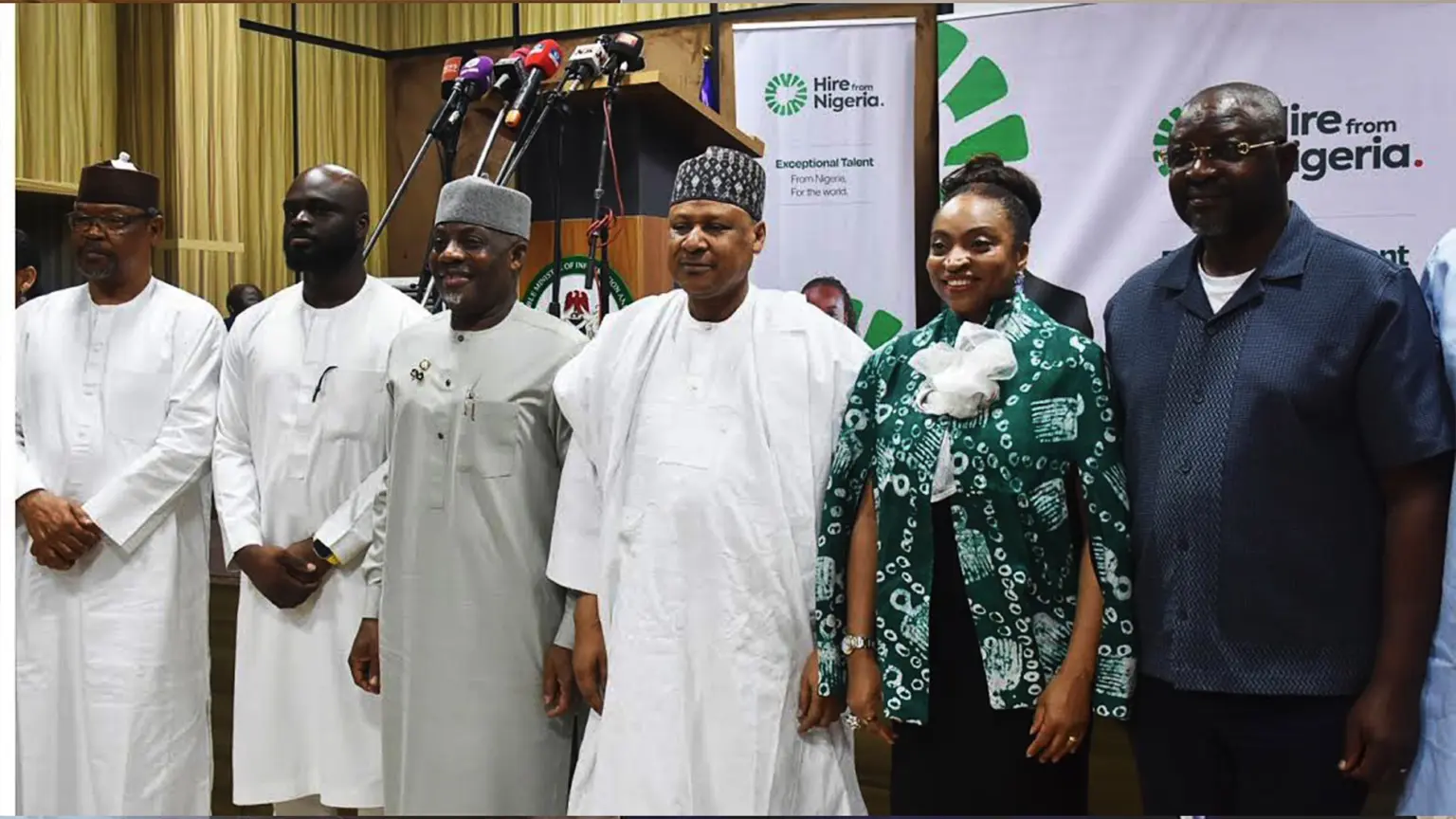
The federal government has launched the “Hire from Nigeria” campaign to connect Nigerian professionals with international employers and position the country as a global hub for skilled talent and digitally delivered services.
Mohammed Idris, minister of information and national orientation, launched the initiative in Abuja on Monday.
Idris said Nigeria could increasingly earn from the skills and services of its citizens without requiring them to relocate abroad.
He said the global economy had evolved to allow knowledge, skills, creativity and professional services to cross borders digitally, adding that Nigeria’s youthful population and growing pool of skilled workers put the country in a position to benefit from the trend.
“The future of Nigeria’s economy will increasingly be driven by the talent, creativity, skills and productivity of our people. Nigeria is ready to compete on the global stage. Nigerian talent is ready to work. And the world should look to Nigeria,” the minister said.
Idris added that the campaign brings together the ministries of industry, trade and investment; education; the National Talent Export Programme (NATEP); iDICE; and private-sector partners to connect Nigerian talent with global demand.
He also said the information ministry would use its communication platforms and partnerships to promote Nigerian professionals and businesses internationally.
“A young Nigerian does not have to leave the country to participate in the global economy. With the right skills, infrastructure, professional standards, and access to markets, Nigerians can live and work and earn here at home, while providing valuable services to clients and employers worldwide,” he added.
The minister said the initiative is aligned with President Bola Tinubu’s Renewed Hope Agenda and the government’s target of creating one million export-linked jobs.
On her part, Olajumoke Dan-Okayi, senior special assistant on strategic communications and NATEP to the minister of industry, trade and investment, said the campaign was designed to address barriers preventing Nigerian professionals from accessing international opportunities.
She said the challenge was not a shortage of talent but the difficulty of making Nigerian professionals visible and trusted by global employers.
“It’s not the talent, it’s not the ambition. It’s discoverability, trust and global access,” Dan-Okayi said.
She said the campaign would focus on making Nigeria easier for international clients to discover, Nigerian talent easier to trust and professionals easier to hire.
Jumoke Oduwole, minister of industry, trade and investment, described the initiative as more than a communications campaign, saying it was designed to turn Nigeria’s demographic advantage into jobs, exports and investment.
“Hiring from Nigeria is not an act of goodwill. It is a sound commercial decision that delivers capability, innovation, competitiveness, and value,” Oduwole said.
The minister added the government would take the campaign to the global stage during the 81st United Nations General Assembly.
FG TARGETS GLOBAL DEMAND FOR NIGERIAN SKILLS
Maruf Tunji Alausa, minister of education, said his ministry would strengthen the talent pipeline through curriculum reforms, technical and vocational education, digital skills development and industry-focused training.
“Wherever in the world, whoever in the world wants to hire, we want Nigerians to be trained, certified, and ready for the hire,” Alausa said.
Joel Ogunsola, founder and president of Tech4Dev, said the campaign would help connect Nigeria’s large pool of skilled workers with international demand.
“Nigeria has the talent, the world has the demand. Our job is to bring the two together.”
The federal government said the campaign would connect Nigerian professionals, service providers and businesses with global employers, outsourcing companies, investors and international markets.
PHOTO CAPTION:
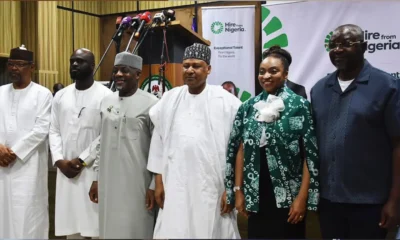
Director-General of Nigerian Television Authority (NTA), Salihu Dembos (left); President, Tech4Dev, Joel Ogunsola; Minister of Education, Dr Tunji Alausa; Minister of Information and National Orientation, Mohammed Idris; Minister of Industry, Trade and Investment, Dr Jumoke Oduwole, and Special Adviser to the President on Media and Public Communications, Sunday Dare, during a briefing on the inauguration ‘Hire from Nigeria’ campaign in Abuja, on Monday.
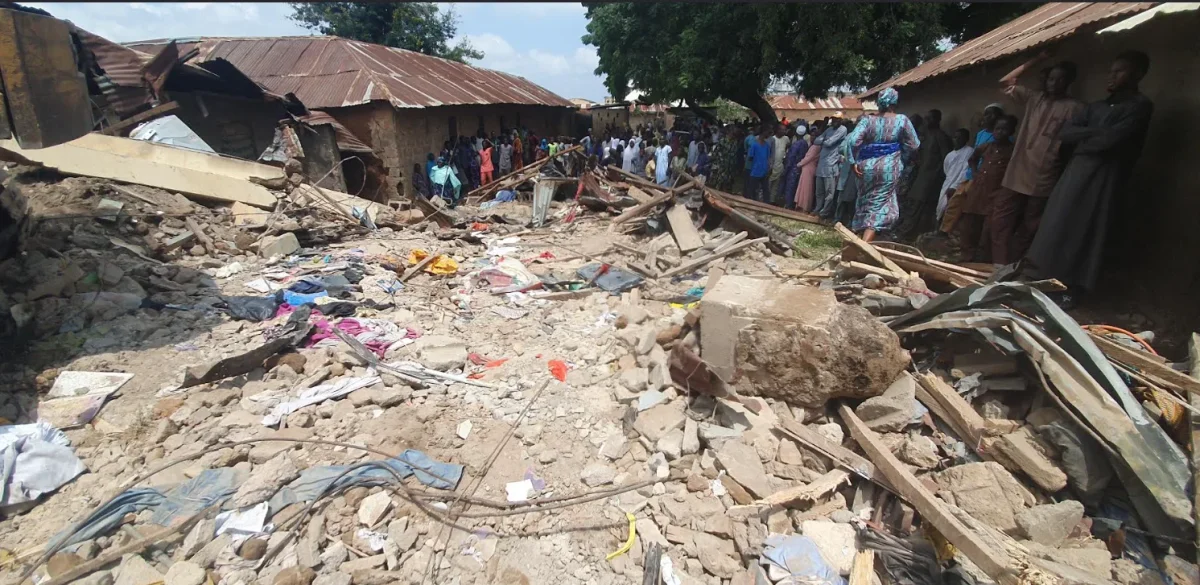
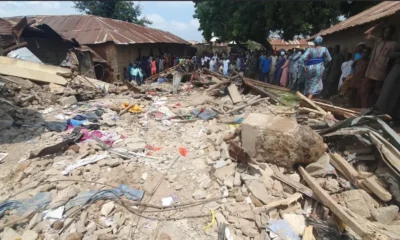
Four members of the same family have been confirmed dead after a three-storey building collapsed at Popo Giwa, Ilorin, Kwara State, on Tuesday morning.
The PUNCH gathered that the incident occurred around 5am at No. 41 Popo Giwa Street, beside Gogoro Mosque, with eight members of the family initially trapped beneath the rubble.
Speaking with our correspondent during the rescue operation, an eyewitness, Abdulganiy Musa, said the father of the family was a serving soldier, while the mother worked as a casual staff member at the Michael Imoudu National Institute for Labour Studies, Ilorin.
Musa said rescue workers were engaged in efforts to evacuate the victims trapped under the collapsed structure.
A child identified as Firdaus, the second-to-last born of the family, was among those rescued alive from the rubble as emergency responders intensified the operation.
An excavator was later deployed to the scene to assist rescuers in removing the debris and gaining access to the remaining trapped victims.
Findings by The PUNCH showed that several emergency and security agencies were involved in the rescue operation, with ambulances deployed to evacuate survivors for medical attention.
Representing Governor AbdulRahman AbdulRazaq at the scene, the Commissioner for Education and Human Capital Development, Lawal Olohungbebe, described the incident as unfortunate and condoled with the victims’ families.
“The rescue mission began immediately after the collapse and to the Grace of God, some were rescued but unfortunately, we have to take it as this,” he said.
Olohungbebe stressed the importance of accessible roads in residential areas, saying the access route to the building contributed to the ease with which emergency responders were able to reach the scene.
“One of the things that made it very easy for us to rescue the few people we were able to rescue is the access route,” he said.
He urged residents and developers to respect building and town-planning regulations, particularly the need to maintain access roads to residential areas.
The commissioner commended the Ministries of Health and Environment, the Council for the Regulation of Engineering in Nigeria, SEMA, the National Emergency Management Agency, Fire Service, Civil Defence, the Red Cross and other responders for their swift intervention.
The Kwara State Fire Service subsequently confirmed that four people died while four others were rescued alive.
The Public Relations Officer of the Kwara State Fire Service, Hassan Adekunle, disclosed this while speaking at the scene of the incident.
“We have recovered four people dead and rescued four people alive,” he said.
Adekunle said the agency received a distress call at about 5am reporting that a building had collapsed and people were trapped underneath.
“We immediately mobilised to the scene and commenced rescue operation. This kind of situation is not something the fire service can handle alone,” he said.
He added that officials of the Hospitals Management Board, the Nigeria Security and Civil Defence Corps and other emergency agencies joined the rescue operation.
The fire service spokesman said the cause of the collapse would be determined after a proper assessment of the structure.
“We are only here to ascertain the actual cause of this collapse and rescue the trapped victims. As at when due, we will communicate to the media about our findings,” he said.
Adekunle said if the assessment warranted demolition, the relevant authorities would take appropriate action, while occupants would be advised accordingly if the structures were found to be safe.
He commiserated with the families of the victims and urged residents to report unusual signs in their buildings or evacuate immediately when they noticed anything that could indicate danger.
The Kwara State Emergency Management Agency also confirmed the death of four people and the rescue of four others.
The SEMA Secretary, Magaji Saadudeen, said eight people were trapped in the building, adding that the rescued victims and bodies of the deceased had been taken to hospital.
“The rescued persons are receiving treatment presently,” Saadudeen said.
Speaking on the structure, the Kwara State Commissioner of Police, Ojo Adekimi, said it was a three-storey building and that the portion that collapsed was the boys’ quarters.
“It was a three-storey building that collapsed. Our findings showed that the boys’ quarter of the building that collapsed.
Information gathered revealed that eight people were trapped in the building,” he said.
Adekimi said the rescued victims had been taken to hospital while the bodies of those who died were also evacuated.
“For now, the situation is under control. We will examine the remaining building and see how people can be secured. But for now, we have evacuated everybody from the main building,” he said.
The police commissioner said residents should pay attention to warning signs such as leakages and other structural defects in buildings.
The Chairman of Ilorin West Local Government Area, AbdulRahman Babatunde Ladan, who monitored the rescue operation, also commended the emergency agencies and residents for their prompt response.
Ladan said about six to seven ambulances were deployed to the scene to support the evacuation of victims for medical attention.
He urged residents to report structural defects promptly and evacuate buildings whenever they noticed signs of possible collapse.
“Whenever you discover something like this, please escalate it. Get to the point of evacuating yourself and your family members from that building. Life is the priority,” he said.
The council chairman also advised prospective developers to use quality materials and engage qualified professionals to supervise construction, stressing that adherence to building standards was essential to preventing structural failures. (PUNCH)

Governor Babajide Sanwo-Olu of Lagos State, on Thursday, will deliver the 7th yearly lecture of Freedom Online newspaper.
Theme of the event, which holds in Ikeja, Lagos, is “2027 Elections, Economy, Security and Nigeria’s Future”.
Former Information Minister, Alhaji Lai Mohammed, is the Chairman of the event while former Governor of Ogun State, who is currently representing Ogun East District in the Senate, Senator Gbenga Daniel, is the Special Guest of Honour.
According to a statement by the Managing Director/Editor-in-Chief of the newspaper, Gabriel Akinadewo, other eminent Nigerians will grace the epoch-making event.
President of the Nigerian Guild of Editors (NGE) and Editor of Vanguard, Eze Anaba, is the Chief Host.
-
 News3 days ago
Married father of two exposed for posing as Catholic priest
-
Entertainment3 days ago
Dolly Parton: The Coat of Many Colors She Left for the World
-
News1 day ago
Ex-Bayelsa Gov, Timipre Sylva dumps APC, gives reasons
-
News2 days ago
‘Nigeria is burning’ — Atiku tackles Tinubu over three-week European vacation
-
News13 hours ago
EFCC sacks over 40 staff for corruption, prosecutes 5 others
-
News2 days ago
Despite fuel subsidy removal, FG struggles to implement budgets, experts lament
-
News2 days ago
Inferno razes Abuja building materials market, destroys goods worth millions
-
News2 days ago
Why Tinubu embarked on three-week Europe vacation — Presidency