Connect with us

Politics

Dismiss Atiku’s appeal, it’s abuse of court process, Tinubu tells Supreme Court

Published

on

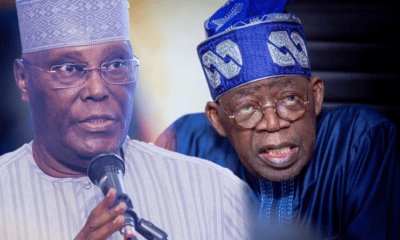
President Tinubu and Atiku Abubakar
Spread the love
President Bola Tinubu has asked the Supreme Court to dismiss the appeal filed by candidate of the Peoples Democratic Party (PDP) in the February 25 presidential election, Atiku Abubakar against his declaration as president.

Tinubu predicated his request on the grounds that Atiku’s appeal seeking to overturn the judgment of the presidential election tribunal, which affirmed his victory at the presidential poll, was lacking in merit and an abuse of court process.

The Independent National Electoral Commission (INEC) had on March 1, declared Tinubu of the All Progressives Congress (APC), winner of the presidential poll, having been convinced that he won a majority of the lawful votes cast at the presidential election.

Dissatisfied, Atiku on March 21, lodged his petition at the tribunal, seeking amongst others, the nullification of Tinubu’s election over alleged irregularities, malpractices, and non-compliance with electoral laws amongst others.

But, the tribunal in its unanimous judgment delivered on September 6, upheld the declaration of Tinubu as winner of the presidential poll.

Maduka College Advert

The five member panel, led by Justice Haruna Tsammani, pointed out that Atiku’s petition failed to prove allegations contained therein and subsequently dismissed the petition for lacking in merit.

Still not satisfied, Atiku on September 18, asked the apex court to set aside the judgment of the tribunal for being perverse in arriving at the conclusion that he did not prove his case.
He predicated his appeal upon 35 grounds upon which he is asking the Supreme Court to set aside the judgment of the tribunal.

He has also brought in fresh and additional evidence to prove that Tinubu ought not to be on the ballot in the first place on the grounds that he forged his Chicago State University (CSU) certificate he submitted to INEC in aid of his qualification for the presidential election.
Relying on Section 137 of the Constitution, Atiku also urged the apex court to sack Tinubu for lying on oath, regarding his academic qualification.

However, in response to the appeal marked SC/CV/935/2023; with petition number: CA/PEPC/05/2023, Tinubu through his team of lawyers led by Chief Wole Olanipekun, SAN, argued that from the “clear position of the law”, Atiku and his party in their joint appeal have not, “demonstrated any reason why this Honourable Court should disturb any of the findings of the lower court, which, with all modesty are rooted in law and perfect demonstration of scholarship.”

Tinubu, in his response, challenged the competence of the grounds of appeal contained in Atiku’s Notice of Appeal, as well as the issues formulated in the appellants’ brief.

He raised seven issues for determination by the apex court, which included, having regard to the appellants’ pleadings before the lower court, vis-a-vis the provisions of paragraphs 4(1)(d)(2) and 16(1)(a) of the First Schedule to the Electoral Act, 2022 and Order 13 Rule 4 of the Federal High Court (Civil Procedure) Rules, 2019, coupled with consistent judicial authorities on the fundamental nature of pleadings, whether the lower court did not rightly strike out offensive paragraphs of the petition and petitioners’ reply to the respondents’ respective replies?

“In view of the clear provisions of section 285(5) of the Constitution of the Federal Republic of Nigeria, 1999 (as amended), section 132(7) of the Electoral Act, 2022, paragraph 4(5) of the First Schedule to the Electoral Act, 2022 and the settled line of judicial authorities on the subject, whether the lower court did not rightly strike out the witness statements on oath and expunge the evidence of PW 12, PW 13, PW 14, PW 15, PW 16, PW17, PW18, PW19, PW2 I , PW23, PW24, PW25, PW26 and PW27?

“Was the lower court not right when it upheld the respondents’ objection to the admissibility of the documents tendered by the appellants and struck out the said documents?“Considering the clear provision of Section 135 of the Electoral Act, the pleadings and the reliefs sought by the petitioners/appellants as well as the admissible evidence before the lower court, whether the lower court was not right in dismissing the appellants’ petition?

“In view of the circumstances of the petition before the lower court, the terse evidence adduced by the appellants and the state of the law on the respective subjects, whether the lower court could rightly be accused of bias by the appellants?” he asked.

On issue one, Tinubu claimed that by all extant relevant laws, INEC has/had the prerogative of determining the mode and manner for the transmission of election results and the lower court was perfectly in order when it so held.

Atiku, had in his petition, alleged substantial non-compliance because INEC failed to transmit election results to the IREV in real time, adding that failure to do so automatically nullified the result of the election.

“The lower court, in deciding the issue, took a painstaking consideration of the binding judgment of the Federal High Court, per Nwite, J., in FHC/ABJ/CS/1454/2022-Labour Party v. Independent National Electoral Commission, delivered on January 23, 2023, which was tendered before it and admitted as Exhibit.”

Tinubu stated that all the provisions of the regulations created the alternative between electronic transmission and transfer, with the use of the article “or”.

On issue two, which bordered on a candidate securing 25% votes in the Federal Capital Territory (FCT) before being declared winner, Tinubu submitted that the wordings of sections 134 and 299 of the Constitution were clear and urged the apex court to hold that “any election where the electorate exercise their plebiscite, there is neither a ‘royal’ ballot nor ‘royal’ voter.

“It added “that residents of the FCT do not have any special voting right over residents of any other state of the federation, in a manner similar to the concept of preferential shareholding in Company Law. We, therefore, urge the court to resolve this issue in favour of the respondent and against the appellant.”

On issues three to five, which bordered on the striking out of certain paragraphs as well as witnesses’ statement of the petitioners/ appellants, Tinubu said the tribunal was right in holding that the affected paragraphs were offensive and should be removed.

“We, accordingly, urge this Honourable Court to affirm the decision of the lower court, while dismissing this appeal in its entirety, as same is lacking in merit and bona fide.

“We cannot draw the curtain on this brief, without drawing the Supreme Court’s attention to another hypocritical relief being claimed by the appellants in their petition, and more particularly, that in their supplication before the Supreme Court, they are asking that their reliefs be granted.

“The alternative relief (e) put forth by the appellants at the lower court reads thus: ‘An Order directing the 1’ Respondent to conduct a second election (run-off) between the 1’ Petitioner and the 2’ Respondent.’
“Undoubtedly, this relief has exposed the pretentious attitude of the appellants, both at prosecuting their case at the lower court and before this Honourable Court.

“Here are the same set of appellants alleging non-qualification of the respondent, via the backdoor, that is, through their reply, on the one hand, and on the other hand, praying this Honourable Court to nullify the presidential election of February 25, 2023, and direct a second election between the 1st petitioner and the respondent.

“The logical conclusion from this approbative and reprobative posture of the appellants is that deep down in their hearts, they are convinced that the respondent won the election, but have decided to embark on this voyage of abuse of court processes.

“Lastly, may we draw the attention of the Supreme Court to the fact that at the lower court, this set of appellants did not ask for any relief that could inure to the benefit of the appellants in their final written address, as all issues formulated by them and prayers also sought by them before the lower court were targeted at the respondent, without any one of those reliefs designed for their benefit.

“May we quickly refer the court to the 4 issues formulated for determination in their final written address at page 6974 (vol. 9) of the record, and the concluding part of the address in paragraph 6.01 (a), (b), (c) and (d) on pages 7004¬7005 (vol. 9) of the record.

“Everything put together or summarised, this appeal is a further demonstration of the abusive nature to which the appellants have subjected court processes. The Supreme Court is urged to dismiss it.” (Arise News)


Politics

Tinubu, APC governors move to resolve campaign list crisis

Published

on

Spread the love

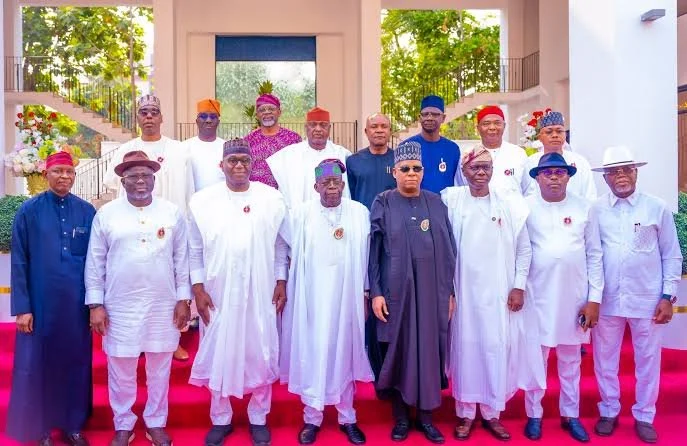
President Bola Tinubu on Thursday held closed door talks with governors elected on the platform of the All Progressives Congress, otherwise known as the Progressives Governors‘ Forum, at the Aso Rock Presidential Villa, Abuja.

Thursday’s meeting is the latest in a back-to-back series of engagements with governors and top chieftains of the party at Aso Rock to resolve the crisis trailing the controversial Presidential Campaign Council list released by the party last Saturday, August 23, 2026.

The governors marched to the President’s office shortly before 4:00pm on Thursday, after emerging from a separate session of the National Economic Council chaired by Vice President Kashim Shettima.

The consultations, which began since Wednesday, were aimed at reviewing and reworking the PCC list which has continued to generate controversy since its release.

The ruling party had faced severe backlash over the inclusion of some controversial party chieftains, particularly those currently facing corruption charges.

Maduka College Advert

It was also alleged that some key sections of the party were not carried along in the drafting of the PCC list.

Multiple party sources, who spoke with The PUNCH on Thursday, said the meeting, which initially held from around 4pm to 11pm on Wednesday, could not be concluded.

Consequently, the meeting continued on Thursday after the regular NEC meeting.

As of press time on Thursday, The PUNCH could not confirm the extent of the changes made to the list.

However, sources close to the APC governors and party heavyweights said the list had been reviewed.

One of the sources said the initial list had been deleted from the party’s X handle and that a new list would be posted as soon as the President approves the deliberations at the meeting and the proposed changes.

“The list is part of the main agenda of the meeting. You can notice that the other controversial list has been deleted from the Twitter handle of the party,” a top source close to the APC governors said.

Also speaking on the list, another top party chieftain said, “Can you believe that the party was not carried along in the formation of the list? The President’s Special Adviser on Political Matters and a few persons in the Presidency came up with the list.

“You can see the backlash that has trailed it. The President is handling the matter, and it is believed that some changes will be made after the two-day meeting.”

Meanwhile, further findings by our correspondent showed that the party would double down on social intervention programmes ahead of the January 2027 poll.

It was learnt that this was part of the ruling party’s plan to reach out to Nigerians and ameliorate the suffering of the masses.

The APC had recently released the complete membership list of its 2027 Presidential Campaign Council.

As earlier reported, President Bola Tinubu will chair the council, with Vice President Kashim Shettima and APC National Chairman, Professor Nentawe Yilwatda, serving as vice chairmen I and II respectively. Senator Abdulaziz Yari was named Director-General, while Imo State Governor, Hope Uzodimma, will serve as Secretary.

The expanded list, numbering 223 entries, adds directorates covering finance, extractive industries, education, manufacturing and MSMEs, support group coordination, faith-based mobilisation, protocol, labour union relations, special duties, stakeholders’ mobilisation, community support, digital operations, grassroots engagement, and welfare.

Following series of controversies that trailed the list, the Special Adviser to the President on Media and Public Communication, Sunday Dare, said later that adjustments would made to the list where necessary.

Dare said the list remained valid because the campaign structure was not yet complete, with several subcommittees still to be constituted.

“As it is with every other list, there’s a room for subcommittees. Those subcommittees have not been formed, and so many other names will come into that subcommittee,” he said.

Dare also referred to a statement issued by the APC, insisting that the party had not withdrawn the list.

“But of course, there will be adjustments. The list is not cast in stone, just like every other list,” he added.

Asked whether the expected changes amounted to a review of the council, Dare drew a distinction between the two terms, saying the changes would only be made where necessary.

“Not a review, just adjustments where necessary,” he said.

Explaining the distinction, Dare said a review would amount to a broader overhaul of the existing structure.

“Review is wholesale, this is not wholesale,” Dare said.

He added that the planned subcommittees would provide room for more party members and political stakeholders to be accommodated within the campaign structure. (PUNCH)

Continue Reading

Politics

Nigeria must move from consumption to production, Peter Obi unveils vision

Published

on

NDC Presidential candidate, Peter Obi
Spread the love

Presidential candidate of the Nigeria Democratic Congress (NDC), Peter Obi, has said Nigeria must move from an economy driven by consumption and imports to one built around production, investment and job creation.

Obi made the declaration on Friday while outlining his economic agenda for the 2027 presidential election, saying the country had the resources, population and entrepreneurial capacity required to build a more productive economy.

He said the key question for any government should be whether Nigerians were actually becoming better off.

“Are Nigerians better off than they were four years ago? Can they afford food, education, and healthcare? Can businesses produce, expand, and create jobs?” Obi asked.

He said his administration, if elected, would place agriculture, manufacturing, agro-processing, technology, construction, energy, creative industries and services at the centre of economic development.

Maduka College Advert

According to him, Nigeria must “produce more of what we consume, process more of what we produce, and compete more effectively in global markets.”

Obi said his economic plan would include improving agricultural productivity through better security for farming communities, irrigation, rural roads, storage facilities, finance and market access.

He also promised to strengthen manufacturing and agro-processing to enable Nigeria to export more finished products and derive greater value from its natural resources.

The former Anambra State governor said government must also create conditions that allow entrepreneurs to invest, employ workers and expand without unnecessary regulatory and infrastructure barriers.

He stressed that public finances would be managed with greater discipline, insisting that government spending must have clear purposes and measurable results.

“Every naira should have a clear purpose, and major public investments should have measurable outcomes,” he said.

Obi also identified Nigeria’s large and growing young population as an economic opportunity rather than a burden, saying government must invest in education, technical training and human capital to enable young Nigerians to contribute productively to the economy.

He said the country’s economic objective should not simply be growth in statistical terms, but an economy capable of producing more, creating jobs, generating wealth and improving living standards.

“The goal is not growth for its own sake, but an economy that produces more, employs more people, creates wealth, and improves living standards,” he said.

Obi, who is campaigning alongside former Kano State governor Rabiu Kwankwaso, said their different governing experiences had led them to a common conclusion that Nigeria must invest in its people and manage public resources responsibly.

He urged voters to examine the records and proposals of all presidential candidates as the 2027 campaign progresses.

Continue Reading

News

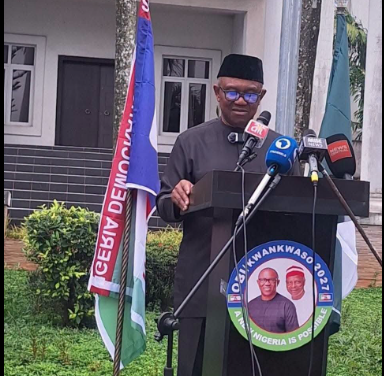
FULL SPEECH: Peter Obi launches 2027 Campaign

Published

on

Peter Obi
Spread the love

MY ADDRESS TO MARK THE COMMENCEMENT OF THE 2027 PRESIDENTIAL AND NATIONAL ASSEMBLY CAMPAIGNS

21 August 2026

Dear Compatriots,
Members of the Press,

Distinguished ladies and gentlemen,

Wednesday, 19 August 2026, marked the official start of the campaign period for the 2027 Presidential and National Assembly elections.

Maduka College Advert

There is no doubt that this is a defining moment for our democracy. This moment gives Nigerians the opportunity to assess the records, ideas, and plans of those seeking their mandate to lead their country at a time of grave uncertainty in our rapidly changing world.

I consider myself quite privileged to be one of those seeking your mandate to deal with these challenges facing our country.

I enter this contest with one firm conviction: Nigeria can work, and Nigeria must work.

Nigeria faces several serious challenges. Some of them are indeed of existential proportions.

According to the IMF, 63%, or over 140 million Nigerians, live at or below the national poverty line, while humanitarian agencies estimate that 35 million people will need food assistance during the 2026 lean season. About 3.6 million Nigerians remain internally displaced, largely because of conflict and insecurity. Each year, millions of young people enter the labour market, yet too many struggle to find productive opportunities. Weak infrastructure, unreliable power, insecurity, and the excessive cost of doing business continue to burden households and constrain enterprise.

These are more than statistics. They reflect the daily realities of Nigerian families, farmers, workers, students, and businesses.

Yet I do not believe Nigeria lacks the ability to overcome these challenges. We have the people, resources, market, talent, and enterprise. What we must do now is turn these strengths into security, productivity, and shared prosperity.

LEADERSHIP MUST DELIVER RESULTS

My successful private-sector experience, studies in institutions of repute on policy and business matters, and my service as Governor of Anambra State have shaped my understanding of public leadership. Government must manage resources responsibly, set clear priorities, and measure the outcomes of its decisions. Public office is not a reward; it is a responsibility to the people.

In Anambra, I prioritised the foundations of long-term development: education, healthcare, infrastructure, fiscal discipline, and institutional capacity. I do not present that record as perfect, but as an experience from which Nigerians can draw their own conclusions.

Senator Rabiu Musa Kwankwaso brings a different but complementary governing experience.

As Governor of Kano State, he focused strongly on education, technical training, scholarships, infrastructure, and human-capital development. His administration’s investments in education and skills showed an understanding that the people are a state’s most important long-term resource.

Our experiences are different, but our conclusion is the same: Nigeria must invest in its people and manage public resources with discipline.

BUILDING AN ECONOMY THAT WORKS

Nigeria needs more than reactive reforms. We must focus on the questions that matter:

Are Nigerians better off than they were four years ago? Can they afford food, education, and healthcare? Can businesses produce, expand, and create jobs? Can young people find productive work? Can farmers work safely and get their produce to market?

These are the measures that matter.

With your mandate, our economic agenda will put production, investment, enterprise, and human capital at the centre of how we lead.

We will raise agricultural productivity by securing farming communities, expanding irrigation, improving rural roads and storage, and linking farmers to finance and markets. We will also strengthen manufacturing and agro-processing so Nigeria can export more finished goods and capture greater value from its resources.

We will create a business environment where entrepreneurs can invest, hire, and grow without unnecessary regulatory or infrastructure barriers.

And we will manage public finances responsibly. Every naira should have a clear purpose, and major public investments should have measurable outcomes.

The goal is not growth for its own sake, but an economy that produces more, employs more people, creates wealth, and improves living standards.

SECURITY IS THE FOUNDATION

No nation can prosper when its people cannot live, farm, travel, or do business safely. Insecurity has displaced millions of Nigerians and continues to disrupt agriculture, education, trade, and investment. Our response must therefore be comprehensive.

We must improve intelligence gathering and coordination among security agencies, strengthen policing and border management, and make better use of technology. We must also support lawful community-based systems that identify threats early and enable effective responses.

The imperative of decentralising security management, but with strong systems of coordination between the levels, is critical to our plans.

Security policy must also address the conditions that make vulnerable young people susceptible to criminal recruitment. Farmers cannot produce food if they cannot reach their farms safely. Children lose the chance to learn when they cannot attend school safely. Businesses cannot create jobs when they cannot move goods securely.

FROM CONSUMPTION TO PRODUCTION

Nigeria, with a population now above two hundred million and projected to continue growing rapidly, has one of Africa’s largest domestic markets and labour forces. That is an opportunity we must seize to turn the future of our country around.

Nigeria cannot import its way to prosperity. We will produce more of what we consume, process more of what we produce, and compete more effectively in global markets.

We will deploy our experiences in public funds management, the private sector, and the civil service to turn our population into productive human capital, our natural resources into value-added industries, and our domestic market into an engine for investment and enterprise.

Agriculture, manufacturing, technology, construction, energy, creative industries, and services all have important roles to play. Nigeria does not lack opportunities; what it needs are the systems that enable its people to turn those opportunities into prosperity.

OUR YOUNG PEOPLE ARE OUR GREATEST ASSET

I reject the idea that Nigeria’s young population represents a burden. It represents an enormous opportunity, but only if we prepare young Nigerians to participate productively in the economy.

We will improve basic education, strengthen universities, and expand technical and vocational training. Nigeria needs doctors, engineers, scientists, and lawyers, as well as technicians, mechanics, builders, nurses, farmers, programmers, manufacturers, artisans, and entrepreneurs. Our goal is to secure a high demographic dividend from our youth bulge.

HEALTH IS HUMAN CAPITAL

A productive economy requires a healthy population, yet Nigeria’s health indicators remain deeply concerning. According to available data, Nigeria’s primary healthcare system is very poor, with infant and maternal mortality among the worst globally. We will strengthen healthcare, improve maternal and child health, expand access to essential medicines, and equip healthcare workers to serve effectively.

EVERY REGION MUST BECOME PRODUCTIVE AND PROSPER

Nigeria’s diversity is an economic strength. Each region has distinct assets, and national policy must unlock those assets while connecting them to one productive economy.

The North-West can expand agriculture, livestock, irrigation, agro-processing, and manufacturing while strengthening education and security.

The North-East can speed up reconstruction, restore livelihoods, and expand agriculture, education, enterprise, and regional trade.

The North-Central can strengthen food production and processing while developing its mineral resources responsibly.

The South-West can build on its strengths in manufacturing, technology, finance, trade, and the creative economy.

The South-East can expand its entrepreneurial and industrial strength through better infrastructure, stronger connectivity, and greater access to investment.

The South-South can derive greater value from oil and gas while expanding maritime services, fisheries, agriculture, and other productive sectors, supported by stronger environmental protection.

The Federal Capital Territory must demonstrate what efficient urban planning, transportation, housing, sanitation, security, and public services can achieve.

Every region must produce. Every region must contribute. Every region must benefit.

A DIFFERENT STANDARD OF GOVERNANCE

Sustainable development requires more than reactive reform. Reform is not the goal; better lives are. The World Bank’s April 2026 Nigeria Development Update makes clear that Nigeria’s challenge is to turn economic reform and stabilisation into improved livelihoods, stronger human capital, wider opportunities, and inclusive growth. We will pursue practical reforms that deliver lasting results, combining fiscal discipline with productive investment, as Senator Kwankwaso and I have demonstrated.

We will cut wasteful spending while protecting investments that create jobs and expand productive capacity. We will raise public revenue without stifling businesses and invest in education, healthcare, security, and infrastructure because they are foundations for future prosperity, not costs to defer. We will also build institutions that endure beyond any single administration. That is the standard by which every government should be judged.

Fellow Nigerians,

The campaign period gives every citizen an opportunity to join the national conversation. I urge Nigerians to examine each candidate’s record and proposals, ask tough questions, and demand evidence behind every promise.

We should debate ideas without hatred, compete without violence, and disagree without weakening the bonds that unite us. When Nigerians make their choice, that choice must be respected.

Democracy does not end on election day. Citizens must continue to demand transparency, accountability, and results from those entrusted with the mandate to govern.

Nigeria’s challenges are real, but so are its opportunities. We have the people, resources, enterprise, and creativity to build a safer, more productive country. Our task is to turn these possibilities into results. We have the credentials, experience, and record to collaborate with Nigerians on this transformative journey.

Our journey will be harder if we do not unite as one people and one nation. A united Nigeria, guided by shared purpose and a commitment to fairness, justice, and equity, will make transformation easier, strengthen our institutions, and help us hold our leaders accountable.

Finally, the 2027 election must be guided by capacity, competence, compassion, character, and commitment. Our campaign will focus on the urgent concerns of Nigerians and not on ethnicity or religion. Nigerians must reject and disregard any campaign driven by propaganda, ethnicity, religion, elitism, or cronyism.

As my team and I travel across the country, we will listen to Nigerians, understand their needs and concerns, and assure them that we have the competence, character, and compassion to lead and reset Nigeria for the benefit of all.

Nigerians deserve leaders who will engage them, listen to their concerns, and present clear solutions to unite the country, defeat insecurity, pull people out of poverty, drastically reduce hunger and the number of out-of-school children, improve education and healthcare, and build growth that serves everyone, especially the most vulnerable. Every candidate must be willing to present their credentials, defend their records, and subject their vision to open scrutiny.

No candidate should hide behind the high walls of power, send proxies or surrogates to the hustings, and expect Nigerians to entrust them with the leadership of the country. Every candidate seeking the presidency must have the courage to come before the people, answer their questions, defend their records, and subject their vision to public scrutiny.

True leadership requires presence and empathy. No one can lead from the front without standing with communities across Nigeria devastated by banditry, criminality, terrorism, and flooding. You cannot truly lead people you are unwilling to visit, listen to, and understand.

Today, I make this clear commitment: my running mate and I will take our message directly to Nigerians. We will listen to them, understand their concerns, and engage them openly. We will not delegate this duty to proxies. We will answer questions, defend our record and character, and present our plan to rebuild Nigeria. Any presidential candidate who lacks the resolve to travel across the country, meet the people, and respond to their questions lacks the capacity to govern it.

I commit to commencing the journey of resetting Nigeria by uniting it, securing it on the path of economic and inclusive growth, and moving our country from consumption to production.

A New Nigeria is possible.

God Almighty bless Nigeria. -PO

Continue Reading

Trending

Maduka College Advert