Connect with us

News

Tinubu set to appoint ex-secretary, Olanipekun Olukoyede, as EFCC chair

Published

on

Tinubu seeks Senate’s approval for $7.8 Billion, €100 Million Borrowing Plan
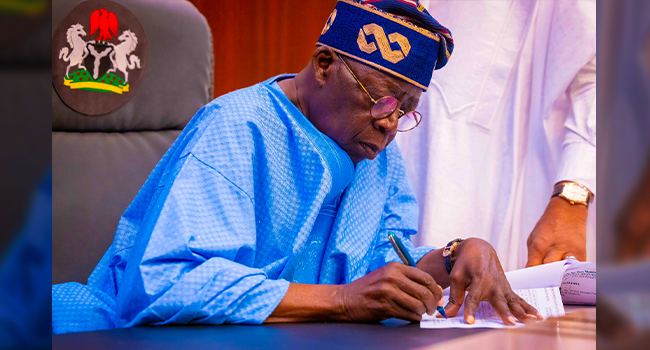
President Bola Tinubu
Spread the love

The candidate being considered for the EFCC job by Mr Tinubu is a lawyer, who served as secretary of the anti-graft agency for two years during the reign of Ibrahim Magu as the acting chair of the commission.

Barring any last-minute change of plan, President Bola Tinubu is set to appoint Olanipekun Olukoyede as the substantive chairperson of the Economic and Financial Crimes Commission (EFCC), a move that is bound to set off controversy over the candidate’s qualification for the job.

Mr Olukoyede, a lawyer, had served as secretary of the anti-graft agency for two years during the reign of Ibrahim Magu as the acting chair of the commission. He, along with Mr Magu, was suspended from office by President Muhammadu Buhari in 2020 and was never recalled.

Before his secretary role, Mr Olukoyede had served as Mr Magu’s chief of staff.

“President Tinubu has chosen Olanipekun Olukoyede for appointment as substantive chairman of the EFCC,” a top presidency source familiar with the development but not permitted to discuss it ahead of the official announcement, told PREMIUM TIMES.

Also confirming the development, another source hinted that Mr Olukoyede’s appointment, which requires Senate confirmation, would be made public “very soon”.

President Tinubu, in June this year, suspended Abdulrasheed Bawa as EFCC chair, and in his place, appointed Abdulkarim Chukkol, then director of operations, in an acting capacity.

Maduka College Advert

Mr Bawa’s suspension, anchored on “weighty allegations of abuse of office levelled against him” followed a conventional pattern of unceremonious removal of past EFCC bosses

This newspaper had chronicled how leadership succession at the two-decade-old EFCC had been steeped in controversies concerning allegations of fraud.

For four months now, Mr Bawa has been in detention at the State Security Service (SSS) after he honoured the agency’s invitation for interrogation regarding the corruption allegation.

There are speculations that Mr Bawa has agreed to officially resign from office.

Who is Olanipekun Olukoyede?

Mr Olukoyede, who hails from Ekiti State, South-west Nigeria, was born in Ikere-Ekiti on 14 October 1969. He will therefore clock 54 on 14 October.

Former President Muhammadu Buhari nominated Mr Olukoyede as Secretary to EFCC in 2018.

Subsequently, the Nigerian Senate confirmed his appointment in November 2018, to replace Emmanuel Aremo, whose five-year tenure ended in July of 2018.

But, Mr Olukoyede’s confirmation as EFCC scribe came with controversy, as a senator, Isa Misau accused the Chairman of the Senate Committee on Anti-Corruption and Financial Crimes, Chukwuka Utazi, of sidelining some members of the committee in preparing the committee’s report which cleared Mr Olukoyede for the job.

He had worked as a lawyer at the law firm of former Vice President Yemi Osinbajo before he clinched the EFCC job.

Mr Olukoyede is a seasoned lawyer with expertise in compliance management, corporate intelligence and fraud management.

He is a certified fraud examiner who has led investigations and civil litigation of fraud and financial crimes in International development projects.

He equally specialises in anti-corruption research and analysis, corporate and business intelligence gathering and processing.

He is a member of the Fraud Advisory Panel (UK), and also a member, of the Federal Government Technical Committee on the Repositioning of the Nigerian Financial Intelligence Unit.

Controversy: Is Mr Olukoyede qualified to head the EFCC

If Mr Olukoyede’s nomination sails through, he will be the first Nigerian from the South of the country to lead the anti-corruption agency.

From the pioneer chair of the EFCC, Nuhu Ribadu who is now the National Security Adviser (NSA) to President Tinubu, to Farida Waziri, Ibrahim Lamorde, and Abdulrasheed Bawa, all substantive chairpersons of the commission, and even acting chairpersons, have always been from the Northern region.

However, there are concerns that Mr Olukoyede, who is being considered for the job and touted to likely break the trend of having northerners as the chair of the commission, may not be qualified for the job. There are statutory requirements for the appointment of the EFCC boss which Mr Olukoyede may not meet.

Section 2(3) of the EFCC Act, 2005, stipulates that a chairman of the commission “must be a serving or retired member of any government security or law enforcement agency not below the rank of Assistant Commissioner of Police or equivalent; possess not less than 15 years experience.”

Mr Olukoyede, who has played more administrative roles in EFCC for less than a decade, cannot be said to have attained 15 years of cognate experience, especially when he has never worked in the mainstream law enforcement operations of the commission or any related agency.

Mr Tinubu, who has been criticised for his administration’s lukewarmness towards the fight against corruption, is set to attract more rebukes if he eventually announces Mr Olukoyede with doubtful background qualification to lead Nigeria’s flagship anti-corruption agency. (PREMIUM TIMES)


News

Anambra introduces new burial law, bans presentation of cows, goats as condolence gifts

Published

on

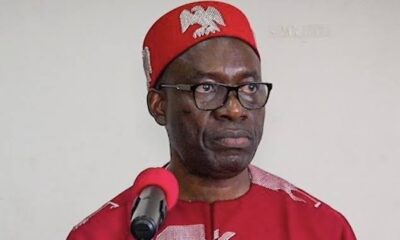
Governor Charles Soludo of Anambra State
Spread the love

• Public display of caskets, dancing with caskets, others abolished

The Anambra State Government has introduced strict new legislation regulating funeral rites, effectively outlawing midweek burials and banning the presentation of items such as cows, goats and other expensive gifts during condolence visits.

The law, enacted by the Anambra State House of Assembly, is aimed at regulating burial and funeral ceremony activities in the state.

According to the law obtained by our correspondent on Monday, the state described the move as a major step towards curbing extravagant funeral practices that have long placed heavy financial burdens on bereaved families.

The regulations are also aimed at boosting economic productivity, reducing extravagant spending and stopping prolonged, lavish funeral activities from disrupting working days.

Under the legislation, “No person shall give to the deceased person’s family, as a condolence gift, any item exceeding money, one jar of palm wine, one carton of beer and one crate of soft drinks.

“All burial and funeral ceremonies are now restricted to Saturdays only. Midweek (Monday to Friday) burials are prohibited. All burial ceremonies must be completed within one day.”

Maduka College Advert

The burial law also contains far-reaching provisions aimed at reducing ostentatious funeral ceremonies across the state, stating that offenders are liable to a fine of ₦100,000, or six months’ imprisonment, or both.

By the law, the common practice of presenting cows, goats, bags of rice and other expensive items at funerals and condolence visits is banned.

The law is intended to remove financial burden and pressure on bereaved families and to curb oppressive practices during burials.

It states, “All burial ceremonies must be completed within one day, while wake-keep ceremonies have been abolished entirely.

“Vigil masses, services of songs and related religious activities must end by 9pm, and no food, drinks, live bands or cultural entertainment may be provided during such events.

“The law also prohibits the erection of billboards, banners and posters of deceased persons anywhere in the state.

“Only directional signs leading to burial venues are permitted, and they cannot be displayed earlier than seven days before the burial date.

“Public display of caskets for advertisement or sale is barred, and dancing with caskets is prohibited.

“Undertakers are limited to six persons during funeral activities.

“Corpses are not to remain in mortuaries beyond two months from the date of death.

“Any corpse kept longer risks being classified as a ‘rejected corpse’ and may be buried in government-designated burial grounds to be established in every community.”

The legislation also seeks to limit excessive spending by making food and drinks optional for guests and banning the sharing of souvenirs during funerals.

“Second funeral rites are prohibited except in legacy-related cases.

“The wearing of uniform attire, popularly known as ‘aso ebi’, is restricted to immediate family members, church groups, ‘umunna’, ‘umuada’ and ‘iyom di’, where applicable.

“To enforce compliance, the state will establish monitoring and implementation committees in various communities to oversee the registration of deaths, approve burial ceremonies and monitor adherence to the law.

“Traditional youth practices deemed disruptive have also been outlawed, including public display of photographs of the deceased, destruction of crops or household property, and unauthorised use of firearms during burials,” it added.

The government’s latest move is aimed at restoring order to burial ceremonies and easing the financial burden on families.

The law also warns against the blocking of roads and streets during burial ceremonies.

Continue Reading

News

Yahaya Bello disqualified from APC Senatorial primaries

Published

on

Follow AGF’s advice, submit to EFCC – Group tells Yahaya Bello
Yahaya Bello
Spread the love

Former Kogi State governor, Yahaya Bello, was reportedly denied clearance to take part in the All Progressives Congress (APC) senatorial primary screening in Kogi State after he failed to appear before the party’s screening panel.

According to a screening report from the Kogi State secretariat of the APC obtained by Sahara Reporters, Bello’s name was not among the aspirants cleared for the exercise.

Sources within the APC told Sahara Reporters that Bello stayed away from the screening exercise because of questions connected to ongoing criminal investigations and court cases.

The source claimed the former governor was not cleared because he did not participate in the screening process.

Another source told the publication that one of the questions in the APC senatorial form required aspirants to disclose any ongoing criminal investigation, which may have influenced Bello’s decision not to attend the screening.

The source further alleged that EFCC officials were expected around the party secretariat during the screening exercise, forcing Bello to avoid the venue and travel to Lagos instead.

Maduka College Advert

The development comes as the former governor continues to battle corruption cases filed against him by the Economic and Financial Crimes Commission (EFCC).

Bello is currently facing two separate criminal trials linked to alleged financial misconduct during his time as governor of Kogi State.

One of the cases involves an alleged N80.2 billion money laundering charge filed before the Federal High Court in Abuja.

The EFCC accused him and other persons of diverting public funds through private accounts and using part of the money to acquire expensive properties in Nigeria and Dubai.

The anti-graft agency also accused the former governor of criminal breach of trust in the case, which is being handled by Justice Emeka Nwite.

During the ongoing trial, bank officials and other witnesses reportedly gave evidence concerning cash transactions allegedly carried out to avoid financial reporting rules.

Apart from the N80.2 billion case, Bello is also standing trial over another alleged fraud case involving N110.4 billion. In that matter, the EFCC accused him alongside Umar Oricha and Abdulsalami Hudu of illegally diverting funds belonging to Kogi State.

Bello is seeking to contest for the Kogi Central Senatorial District seat, but his ambition has continued to generate reactions because of the corruption allegations hanging over him.

Continue Reading

News

Three females beheaded in Enugu

Published

on

Spread the love

Three persons, all females, were beheaded in Igbo-Etiti Local Government Area of Enugu State, the state police command confirmed on Sunday.

The incidents occurred at two different communities of the LGA.

According to the police, the incidents involved the alleged murder of a mother by her son, and the alleged murder of a woman and her child by the woman’s brother.

The state Police Public Relations Officer, SP Daniel Ndukwe, in a release, explained that the first incident occurred st Nkporogwu Ukehe Community.

Ndukwe stated that, “In the first incident, police operatives attached to the Igbo-Etiti Division, at about 3:10pm, responded to a report alleging that one Anikwe Onyebuchi (male, aged about 40) used a cutlass to behead his 60-year-old mother, Anikwe Felicia, at Nkporogwu Ukehe Community.”

Ndukwe said the corpse and the severed head of the deceased were recovered and taken to the hospital, where doctors confirmed her dead, after which the remains were deposited in the mortuary for preservation and autopsy.

Maduka College Advert

“The suspect was subsequently rescued and rearrested from an angry mob that had severely beaten him and was taken to hospital for medical treatment,” Ndukwe said, adding that “A full-scale investigation into the incident has commenced.”

In a similar vein, the state police command, responding to a distress call, arrested one Joshua Eze for allegedly murdering his sister and her daughter. The suspect was apprehended by the Command’s Distress Response Squad stationed at Ekwegbe Junction along the Ugwuagu/Opi/Nsukka Road, it was learnt.

The police spokesman said, “At about 3:18pm on the same, police operatives responded to a distress call alleging that one Joshua Eze (male) similarly used a cutlass to sever the heads of his sister, Nwabuche Eze, and her little daughter, Favour Eze, at Agu-Ekwegbe Community in the same Igbo-Etiti LGA. The remains of the deceased victims were recovered and taken to the hospital, where doctors confirmed them dead, after which the corpses were deposited in the mortuary for preservation and autopsy.”

He added that the police operatives also rescued the suspect from an angry mob in a critical condition and taken to the hospital, where doctors later confirmed him dead.

He stated that preliminary investigations revealed that after allegedly murdering the victims, he buried their remains in a shallow grave alongside a dead white cock, suggesting possible ritual intentions.

Meanwhile, the state Commissioner of Police, CP Bitrus Giwa, has condemned the act, and ordered the Deputy Commissioner of Police in charge of the State CID to immediately commence comprehensive investigations to ascertain the circumstances surrounding both incidents and ensure necessary investigative actions.

He urged members of the public to refrain from taking laws into their hands by resorting to jungle justice, regardless of the provocation, and “instead promptly report criminal suspects to the police or other lawful authorities for appropriate action.”

Continue Reading

Trending

Maduka College Advert