Tech
Former FTX CEO Sam Bankman-Fried says he ‘made a lot of mistakes’

Sam Bankman-Fried, the former CEO of cryptocurrency giant FTX, defended his actions on Wednesday in his first public appearance since his exchange collapsed earlier this month.
“Clearly, I made a lot of mistakes. There are things I would give anything to be able to do over again. I didn’t ever try to commit fraud on anyone,” said Bankman-Fried.

The 30-year-old was speaking at the New York Times’ DealBook Summit via video link from the Bahamas in his first public speech after the collapse of FTX and its sister trading firm Alameda Research.
On Nov. 11, FTX filed for bankruptcy protection in the US, and Bankman-Fried also stepped down as CEO.
“I was excited about the prospects of FTX a month ago. I saw it as a thriving, growing business. I was shocked by what happened this month. And you know, reconstructing it…there are things that I wish I had done differently,” he said.

The former crypto billionaire also distanced himself from Alameda, which he said became larger over the course of 2022.
“I wasn’t running Alameda. I didn’t know exactly what was going on. I didn’t know the size of their position,” said Bankman-Fried, adding “that’s a pretty big oversight that I wasn’t more aware.”

He also said that FTX could have margin call positions and could have “closed them down in time such that it would cover all of those, all those shorts, all those liabilities,” but it did not do so.
“And that’s a massive failure of oversight of risk management,” he added.
FTX, which was the world’s second-largest cryptocurrency exchange by daily trading volume, filed for bankruptcy earlier this month due to liquidity problems.
While Bankman-Fried later apologized to investors in a series of tweets, cryptocurrencies went into freefall due to the financial turmoil and perceived risks of investors.
The exchange once boasted a $32 billion valuation.
Bankman-Fried, a Democrat donor, told ABC News this week that he currently has just one ATM card and $100,000 in his bank account. He once had an estimated fortune of more than $20 billion.




The second edition of the Enugu Tech Festival (ETF 2.0) has ended on a historic note, drawing a record-breaking 53,000 physical participants and reinforcing Nigeria’s growing influence in the global digital space.
Held from February 24 to 27, 2026 at the Enugu International Conference Centre, the four-day gathering surpassed its 50,000 attendance target, with organisers confirming strong online participation from across the world.
The event ranked among the top five globally trending conversations on social media during its run.
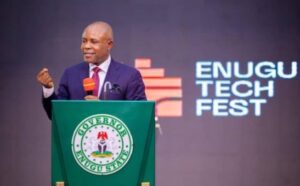
Governor Peter Mbah addressing the Enugu Tech Festival 2026 participants
Convener of the festival and Enugu State Commissioner for Innovation, Science and Technology, Prince Lawrence Ezeh, described the turnout as proof that Enugu’s digital vision is gaining real traction.
“We set out to inspire 50,000 innovators, thinkers, founders and investors. Seeing nearly 60,000 people actively engaged shows that African tech is moving beyond talk to real impact,” he said.
Organisers revealed that Day One recorded 20,000 participants, followed by 15,000 on Day Two, 13,000 on Day Three and 5,000 on the final day — each carefully structured around governance, investment, emerging technologies and ecosystem building.
With the theme, “Coal to Code: Energy in New Form,” the festival symbolically linked Enugu’s coal heritage to its emerging identity as a digital hub.
Governor Peter Mbah, who declared the festival open, delivered a keynote that set the tone for the event. He described the global tech revolution as an economic renaissance powered by ideas, code and data rather than physical assets.
Referencing global giants such as Apple, Microsoft, Alphabet Inc., Amazon and Meta Platforms, the governor said Enugu would not remain a spectator. “We will be participants. We will be producers,” he declared.
Day Two shifted attention to entrepreneurship and capital, featuring a curated “Deal Room” where startups met venture capitalists from Lagos, Nairobi, London and Dubai.
Though investment figures were not disclosed, several founders reportedly secured follow-up funding engagements.
Dr Ezeh described the initiative as a bridge between talent and capital, noting that Enugu is positioning itself as the investment gateway to Southeast Nigeria’s technology corridor.
The third day focused on artificial intelligence, blockchain and Web3 technologies, with a live hackathon producing solutions in fintech, healthcare diagnostics and climate-smart agriculture.
Panels also debated responsible AI governance and decentralised finance regulation.
Skills development remained central throughout the festival, as hundreds of young participants underwent hands-on training in software engineering, cloud computing and blockchain development.
The closing ceremony combined innovation showcases with awards and cultural performances, highlighting the fusion of technology and creative expression.
Nigeria’s Minister of Innovation, Science and Technology, Kingsley Tochukwu Udeh, reaffirmed federal commitment to strengthening the nation’s innovation ecosystem, stressing that research commercialisation and youth entrepreneurship are key to economic diversification.
Secretary to the Enugu State Government, Chidiebere Onyia, described ETF 2.0 as a landmark achievement that has elevated Enugu’s global standing.
Hundreds of laptops and tablets were distributed to outstanding participants, while selected startups received N10 million grants each to accelerate product development.
Additional teams secured smaller grants to support training, prototype development and community tech hubs.
“Inspiration without tools is incomplete,” Dr Ezeh said, emphasising that the festival was designed not just to motivate but to equip young innovators with tangible resources.

For nearly three decades, the smartphone has been at the heart of our daily lives.
From communication and navigation to entertainment and productivity, it has become an essential tool.
But according to Mark Zuckerberg, the smartphone era may soon be coming to an end.
The Meta CEO has announced his vision for the next major shift in technology—smart glasses—which he believes will replace smartphones as the primary way we interact with the digital world.
● Are Smartphones becoming obsolete?
It might be hard to imagine life without a smartphone, but Zuckerberg predicts that the transition is already underway.
In a recent interview with tech journalist Cleo Abram, he explained that the future of computing wouldl be more immersive, natural, and social, moving away from handheld screens toward wearable technology.
“The trend in computing is to become more omnipresent, more natural, and more social. You want to interact with people around you seamlessly, and I think that will probably be the next big platform after phones,” Zuckerberg stated.
His vision revolves around smart glasses, which he argues will allow users to access information, communicate, and engage with digital content in a more intuitive way—without the need to constantly check a screen.
In the near future, he predicts that people will start reaching for their phones less often, relying instead on the convenience of augmented reality (AR) glasses.
● Smart Glasses: The Future of Technology?
At first glance, the idea of replacing a smartphone with a pair of glasses might sound like something straight out of a science fiction movie.
But tech giants, including Apple and Meta, are already heavily investing in wearable computing.
Meta is developing the Orion smart glasses, while Apple has launched the Vision Pro, marking the beginning of what could be a major transformation in personal technology.
Zuckerberg believes that by the 2030s, smartphones will no longer be our primary device. Instead, AR-powered smart glasses will take centre stage, offering real-time information, hands-free interactions, and even AI-powered virtual assistants capable of answering questions on the go.
“There will come a time when your smartphone is more often in your pocket than out of it,” he predicted.
“Users will opt for the convenience of glasses to get things done.”
This new generation of smart glasses could replace many smartphone functions, including:
● Real-time navigation without the need to glance at a screen.
● Instant access to news, weather, and notifications through an AR interface.
● Seamless communication, allowing users to take calls, send messages, and browse the web without holding a device.
● AI-powered assistance, making it easier to search for information and interact with the digital world hands-free.
What’s Next?
While smart glasses are still in their early stages, the tech industry is rapidly moving toward wearable computing. With advancements in augmented reality, AI, and lightweight display technology, the pieces are falling into place for a future where our smartphones no longer dominate our digital interactions.
The real question is: Will users embrace this change?
Smartphones are deeply integrated into our routines, and switching to smart glasses will require not just technological progress, but also cultural acceptance.
Still, with major tech players racing to develop the next-generation AR devices, it seems inevitable that our digital habits will evolve.
Whether smart glasses will completely replace smartphones or simply become an alternative tool remains to be seen, but one thing is certain—the way we interact with technology is about to change forever.
Additionally, the court imposed a N150 million fine on MultiChoice Nigeria for contesting the jurisdiction of an Abuja court that had previously restrained it from increasing its subscription prices.
The verdict, delivered on Friday, June 7, was handed down by a three-member panel led by Thomas Okosu. The court cited Section 39(2) of the FCCPC Act, which grants the tribunal jurisdiction throughout Nigeria over all profit-oriented commercial activities.
Okosu clarified that the tribunal’s jurisdiction covers all business activities within Nigeria, and he noted that there is no requirement for an aggrieved consumer seeking to enforce their rights to file a complaint with the President of Nigeria or the Price Control Board. He observed that the claimant had written to the FCCPC before filing the case.
“I conclude that this tribunal has the jurisdiction to preside over consumer rights in this case and resolve this issue against MultiChoice,” Okosu stated.
The tribunal also determined that the claimant’s lawsuit was not challenging the price hike itself but the illegality of MultiChoice’s eight-day notice to customers. It noted that MultiChoice had already disobeyed its interim orders and condemned the company’s action of raising DStv and GOtv prices.
The tribunal dismissed MultiChoice’s preliminary objection for disobeying interim orders and imposed an administrative penalty for failing to comply with the tribunal’s directives.
“The first defendant is hereby mandated to pay a N150 million penalty. MultiChoice is hereby ordered to give Nigerians one month of free subscription,” Okosu added.
Previously, the tribunal had restrained MultiChoice from increasing its subscription rates pending the hearing and determination of a motion on notice filed by Barrister Festus Onifade. Onifade had sued MultiChoice Nigeria Ltd and the Federal Competition and Consumer Protection Commission (FCCPC), accusing the PayTV company of unjustly increasing subscription fees without giving customers a one-month notice and seeking interim orders against the organization.
However, in its reaction, MultiChoice said it will appeal against Friday’s ruling of the Competition and Consumer Protection Tribunal, CCPT, which slammed a N150 milliuon fine against it for challenging the jurisdiction of the court.
Multichoice Nigeria said it disagrees with the ruling and will file an appeal against it.
The organisation said in a statement: “MultiChoice Nigeria is aware of the recent ruling by the Competition and Consumer Protection Tribunal (CCPT) regarding its jurisdiction to entertain a price regulation matter. We disagree with the ruling, and will therefore file an appeal against said ruling.
“As the matter is currently sub judice, we are restrained from making further comments.”
-
 News2 days ago
Igbo leaders reject Abuja restructuring communiqué
-
News2 days ago
Enugu Air Lands in Douala, Opens New Air Corridor Between South-East Nigeria, Cameroon
-
International2 days ago
27 feared dead after two mass shootings in South Africa
-
News3 days ago
Toxic Red: Inside deadly trade in dye-laced palm oil, coloured pepper
-
News3 days ago
Police officer who said Obi, Igbo man can never be president arrested, in trouble
-
News2 days ago
Pastor abandons Kwara church, flees with family, members over bandit threat
-
News1 day ago
‘Where is Nigeria’s president?’, Peter Obi questions Tinubu’s absence from UNGA
-
News3 days ago
Senator Umeh commiserates with family of boy swept away by flood