Faith
Why African clergymen said ‘no’ to Pope


By Tajudeen Adigun
It was a revolt of people who had been earlier indoctrinated by the white missionaries to embrace Christianity, belief in God, and persuaded to drop their idolatrous ways of life. The white man’s evangelism hit the bull’s eye as Africans took the white missionaries’ message of God and Christianity hook, line, and sinker. It was wholesomely swallowed, changing and rejecting the perception, belief, and everything that they had earlier believed. The new ways and beliefs brought by Christianity had completely permeated the people’s lives and style of living.

So, when the mentors, the advocates of Christian ways of life, now turned around to sell a new deed that was strange to the earlier doctrine they were imbued with, deeds that incurred the destruction of Sodom and Gomorrah, such as gay marriage, lesbianism, transgender that were not found in the religious dictionary of Christianity, but now advocated by Pope Francis as the new symbols of liberation and freedom, the African bishops had no option, but to say ‘No’. This was fouling the atmosphere of decency and piety as instructed by the Holy Bible. They could not reconcile the belief in God’s ways of life that had been earlier sold to them and the new agenda of the Pope directing Catholic Church priests to bless same-sex couples. It was, therefore, not a surprise that they said ‘No’ and embarked on a collision course with the Pope, who has emerged as the chief spokesperson of same-sex couple marriage and lesbianism. The Pope, in a display of what could be described as an accommodative large-heartedness, advocated the blessing of a same-sex couple by Catholic Church priests.
This did not go down well with the bishops and priests who were indigenes of Africa. The bishops did not make any pretense about their belief that the Pope’s instruction was against the word of God in the Bible. They rose in unison and anger, saying that the Pope’s stance was nothing but a dagger to the church’s heart. A repackaged paganism. With one voice, they opposed what they tagged a march to Sodom and Gomorrah. They reminded the Pope that it is heresy for any man of God to pray for a couple that is not a man and a woman in a holy union. And here is the spiritual and administrative head of the Catholic Church advocating what made God destroy the biblical Sodom and Gomorrah. This is not only profane but a total absurdity.
The biblical narrative said that Abraham had met the holy angels of God on their way to destroy a city, Sodom and Gomorrah, that was steeped in sins that were repugnant to what was holy and God’s ways. The people of Sodom and Gomorrah were neck-deep in lesbianism and gay relationships as men shared anus sexual pleasure among themselves.

Abraham had interceded and pleaded that God should pity the sinners and allow them to repent. God said that if 10 percent of the city’s residents were found to be holy and in compliance with God’s instructions, the city would be spared. In the absence of such people, Abraham said he had family members in the city. Lot was the head of the family and Abraham pleaded that Lot and members of his family should be spared. God accepted the pleadings of Abraham and spared Lot’s family from the calamitous of being burnt to ashes. Members of Lot’s family were, however, under strict instruction not to look back as they were exiting the city. Lot’s wife, either out of folly or pig-headedness, did look back as the family members were exiting Sodom and Gomorrah and she instantly became a pillar of salt.
Most Christians, not to mention those who had undergone theological courses that qualified them to become priests, bishops, and men of God are all aware of this biblical story. Perhaps that was why the African bishops were shocked that the Pope had turned himself into a salesman of priests blessing same-sex couples, which was nothing other than what miffed God to incinerate Sodom and Gomorrah in the past. Is it not, therefore, surprising that the Pope, who is the postal boy of religiosity, spirituality, and regent of God on earth has become the promoter of lesbianism and gay marriage?
The Catholic Church was the first church on earth. It came to life during the Roman Empire. It assumed as it were not only the religious and spiritual supremacy but also the political sovereignty of the Roman Empire. The orthodox churches, such as Methodist, and Anglican, among others, came later after the protest of a German clergyman, Martin Luther. Pentecostal churches were to follow later, emerging from the crucible of the orthodox churches.
Earlier, the Anglican Church or the Church of England had come to Nigeria and perhaps Africa with the sugar-coated tongue selling gay marriage, lesbianism, bisexual, and transgender agenda to the continent. The salesmen, however, met a brick wall as the Anglican Church clergy in Nigeria said no. This was one of the reasons that gave birth to a change of name and the Church of Nigeria came to life. The Church of England came to Nigeria on the wings of the British colonialism expedition.
It was in between the deliberate moves of the two churches, the Catholic and Anglican to ram gay marriage, and lesbianism into African minds that the political version tagged: the European Union-Africa, Caribbean, and Pacific Countries partnership agreement came. The promoters brought with them tempting subsidies and subventions that were not easy to shun. They were, however, surprised that country after country in Africa said no. That was before the clergymen voiced their opposition to the agenda. They said capital’ No’. The clergymen were not alone in this. It’s on record that former President Goodluck Jonathan and many other political leaders in Africa refused to sign what could rightly be tagged a devilish pact.
What put off African clergymen and, of course, governments in the continent were the immediate implication of the pact for any country or association that signed it. First, the policy of the pact would usurp the primary position of the country’s constitution on related issues. In other words, the pact becomes superior to the constitutions of the countries that signed it.
If the pact on transgender, gay marriage, and lesbianism had been ratified by African countries, it would have been a giant step on the path of promoters of the agenda of the New World Order and their resolve to remove the idea of God in the minds of people.
In 1800, a document tagged: The Protocol of Elders of Zion hit the public in Britain. Its major thrust was the promotion of science above God. Most of the promoters, who were members of the Lunar Society, were products of Edinburgh University. They were not only against the monarchies but were also spearheading the promotion of the removal of God’s ideas from people’s minds. Charles Darwin, that popular scientist, was the leading personnel of the Lunar Society’s cause for science. They believed that science was the new champion for solving human problems and overcoming their challenges. If people, who believed in the power of knowledge and science were shouting and singing its praise from the rooftops, it’s an embarrassment, of the highest order, for the clergy to join in the eulogy of science and the relegation of God to the background in the affairs of men.
The New World Order is premised on the belief that freedom should not be compromised. Every person is free to live the kind of life that appeals to him or her. Provided, he or she does not encroach on another person’s right and freedom. No obstacle should be allowed to hinder people’s enjoyment of freedom. Fueled by pragmatism, the advocates insisted that people should live as they wish. Gods or religious injunctions should not be allowed to hinder their freedom. They resolved that dogmatism that hangs everything about life on fate should be kept at bay. Observers have, however, attributed the new quest for rejection of dogmatism to the gift of the sixth sense. The ability of man to engage in abstract thinking and dwell in the realm of imagination, thus indulging in speculation that sometimes has no solid structure in reality could be vague, spelling disaster for the speculators.
On this note, Pope Francis, who was shocked that the clergymen in Africa revolted and outright rejected his direction on blessing same-sex couples, fingered the preponderance of African culture for their uncompromising stance on same-sex couples.
To Africans, only man-and-woman should be husband and wife. Same-sex as advocated by the pope, to them is not in compliance with God’s order. That is why it must not be touched with a 40-meter pole.
Source: The NATION









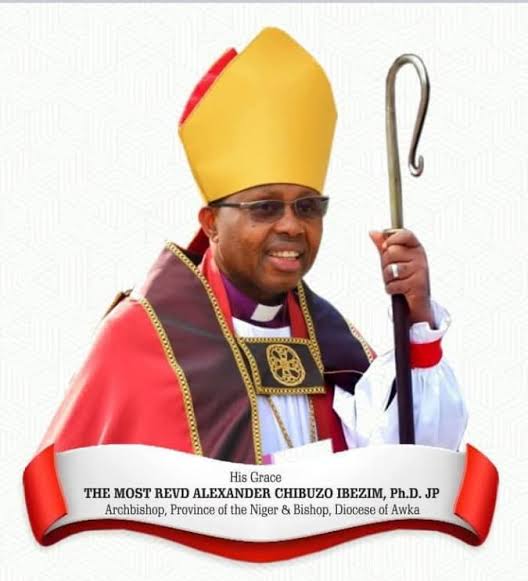
…Insists Archbishop remains in office, warns against interference by Ezeofor
By Tony Edike
The Diocesan Board of the Diocese of Awka, Anglican Communion, has rejected the six-month compulsory leave imposed on the Archbishop of the Province of the Niger and Bishop of Awka Diocese, Most Rev. Alexander Chibuzo Ibezim, by the Primate of the Church of Nigeria, Most Rev. Henry C. Ndukuba.
The board also rejected the appointment of Bishop Samuel C. Ezeofor as Supervising Bishop of Awka Diocese and Coordinating Bishop of the Province of the Niger, describing the decisions as unlawful, unjustified and contrary to the church’s governing provisions.
The resolutions were contained in a communiqué issued after an emergency meeting of the Diocesan Board held on Friday, October 16, 2026, at the Chapel of Divine Favour, Anglican Village, Ifite Awka, Anambra State.
The meeting deliberated on a letter dated October 13, 2026, issued by Ndukuba directing Ibezim to proceed on six months’ compulsory leave and appointing Ezeofor to oversee the diocese and province during the period.
The board argued that the Primate lacked the constitutional authority to compel Ibezim to proceed on leave or transfer his episcopal responsibilities to another bishop.
It maintained that neither the Constitution and Canons of the Church of Nigeria (Anglican Communion) 2020 nor the Constitution and Regulations of the Diocese of Awka 2023 empowered the Primate to take such action.
According to the communiqué, Section 29(1) of the church’s constitution, which the Primate reportedly cited in his letter, did not authorise the compulsory leave or the appointment of another bishop to assume Ibezim’s duties.
The board further argued that the decision violated Ibezim’s constitutional rights, including the presumption of innocence under Section 36(5) of the 1999 Constitution of Nigeria, as amended, and the right to freedom of thought, conscience and religion under Section 38(1).
Cites pending court cases
The board also faulted the Primate’s decision on the grounds that several cases involving Ibezim and allegations against him were pending before the High Court of Anambra State.
It listed three cases: Suit No. A/Misc. 446/2025, involving Ibezim and the Economic and Financial Crimes Commission; Suit No. A/Misc. 494/2026, involving Ibezim and the Inspector-General of Police and others; and Suit No. A/371/2026, involving Ibezim, Ndukuba and another defendant.
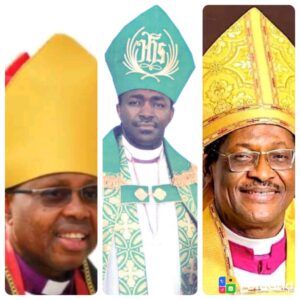
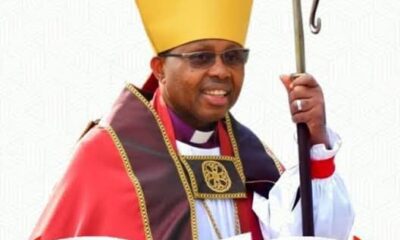
Archbishop Ibezim, Bishop Ezeofor and Primate Ndukuba
The board argued that the matters were sub judice and that the church authorities should refrain from taking actions capable of interfering with the issues before the court.
It further alleged that injunctions granted on September 9, 2025, against the EFCC and Prince Echezona Bonti Onuigbo were renewed by consent of the parties on October 14, 2025.
The communiqué also referred to pending motions seeking to restrain the Primate from issuing suspension letters or taking further steps that could affect Ibezim’s tenure as Archbishop of the Province of the Niger and Bishop of Awka Diocese.
The board maintained that the appointment of a supervising bishop while the legal proceedings remained unresolved amounted to an attempt to pre-empt the outcome of the cases.
Questions inquiry process
The Diocesan Board also challenged the explanation that Ibezim’s compulsory leave was intended to facilitate an impartial inquiry into the affairs of the diocese and promote peace and reconciliation.
It alleged that Ndukuba had previously constituted two panels to investigate allegations against Ibezim but had withheld their reports.
According to the communiqué, the first panel was established through a letter dated August 13, 2025, and headed by Justice Babashola Ogunade, while the second was constituted on June 17, 2026, under the leadership of Archbishop Blessing Enyindah.
The board argued that the failure to release and process the reports violated provisions of the Church of Nigeria’s Constitution and Canons, particularly Sections 75 and 76, which it said prescribe procedures for submitting, considering and ratifying the findings and recommendations of inquiry panels.
It maintained that the reports should be considered by the Episcopal Synod, with the relevant recommendations subjected to the prescribed approvals of the Standing Committee and General Synod.
Reaffirms confidence in Ibezim
Despite the allegations against Ibezim, the board expressed confidence in his leadership and insisted that he remained the duly recognised Bishop of Awka Diocese and Archbishop of the Province of the Niger.
It urged him to continue discharging his episcopal responsibilities, adding that the diocese remained peaceful, united and progressive.
The board also dismissed allegations of financial impropriety against the archbishop, insisting that no diocesan funds had been missing, stolen, misused or misappropriated by him.
It further claimed that neither of the two inquiry panels had indicted Ibezim for financial misconduct.
The board commended the archbishop for what it described as massive infrastructural development in the diocese and urged him not to be distracted by the controversy.
These assertions represent the position of the Diocesan Board as stated in the communiqué.
Warns Ezeofor, threatens withdrawal
The board warned Ezeofor against interfering in the affairs of Awka Diocese, urging him to concentrate on his responsibilities as Bishop of Aguata Diocese.
It cautioned that it would not accept any attempt to destabilise the diocese and threatened to seek legal remedies and involve law enforcement agencies if its warning was ignored.
The communiqué also directed all organs of Awka Diocese to remain loyal to Ibezim and continue their lawful activities, while rejecting what it described as interference or directives from Ezeofor.
It warned that members or diocesan organs that failed to comply with the directive could face appropriate sanctions.
In its strongest warning, the board threatened that Awka Diocese could withdraw from the Church of Nigeria (Anglican Communion) and continue under the Church of England if Ndukuba and Ezeofor persisted in what it described as unlawful interference in the diocese’s affairs.
The communiqué was signed by Sir B.E.I. Nwofor, SAN, Lord Chancellor of the Diocese of Awka; Ven. K.E.N. Chukwukamma, PhD, Synod Secretary; and Mr Eugene Chukwudi Okonkwo, Lay Synod Secretary.
The development marks a further escalation of the leadership dispute within the Anglican Church, with the Diocesan Board openly challenging the Primate’s directive and threatening a possible separation if the disagreement is not resolved.
The Primate and Bishop Ezeofor could not be reached for comments as of the time of filing this report. Their responses will be included in subsequent updates if made available.
Faith
BREAKING: Anglican Church Places Archbishop Ibezim on Six-Month Leave, Bars Him From Church Duties
Primate appoints Bishop Ezeofor to oversee Awka Diocese, Province of the Niger amid investigation
The Church of Nigeria (Anglican Communion) has directed the Archbishop of the Province of the Niger and Bishop of the Diocese of Awka, Most Rev. Alexander C. Ibezim, to proceed on six months’ leave with immediate effect amid investigations into allegations and recent developments within the diocese.
The Primate of the Church of Nigeria, Most Rev. Henry C. Ndukuba, announced the decision in a letter dated Tuesday, October 13, 2026, while appointing the Bishop of the Diocese of Aguata, Rt. Rev. Samuel Ezeofor, as Supervising Bishop of the Diocese of Awka and Coordinating Bishop of the Province of the Niger during Ibezim’s absence.
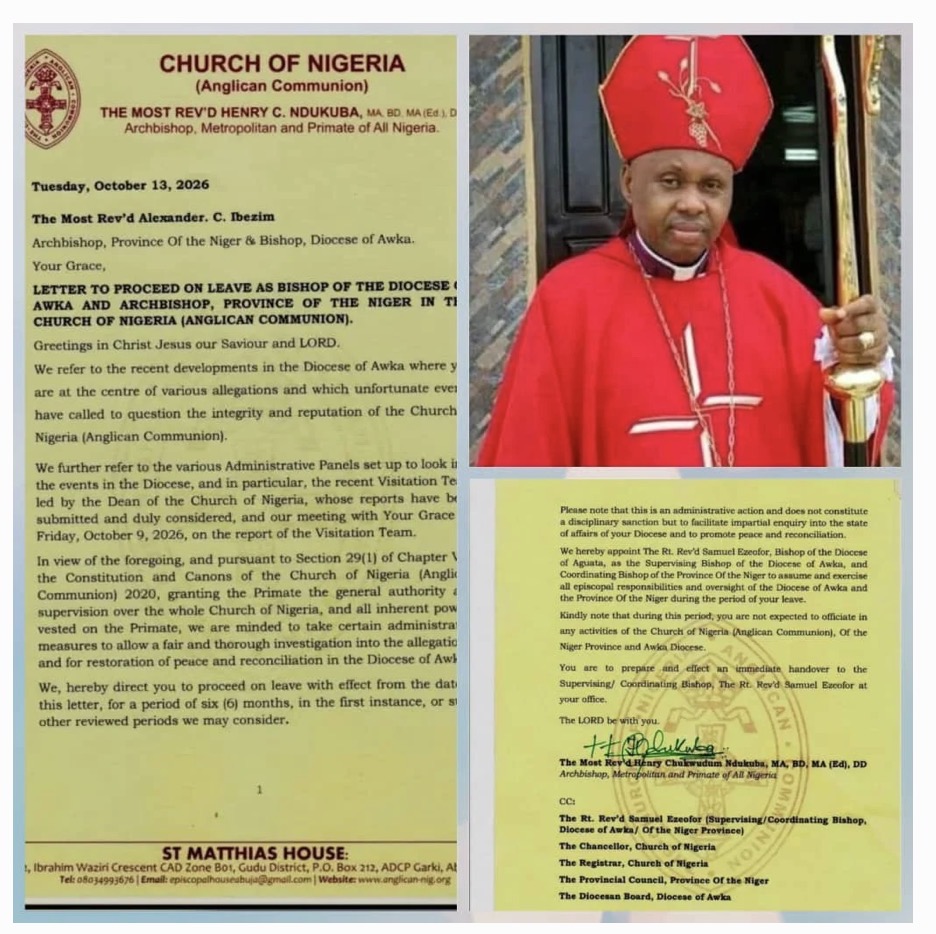
Screenshot
In the letter addressed to Ibezim, Ndukuba said the decision followed developments in the Diocese of Awka that had raised concerns about the integrity and reputation of the Church of Nigeria.
He referenced administrative investigations into the matter, particularly the report of a visitation team led by the Dean of the Church of Nigeria, which had been submitted and considered by the church leadership.
The Primate also cited a meeting with Ibezim on Friday, October 9, during which the visitation team’s report was discussed.
According to the letter, the directive was issued pursuant to Section 29(1) of Chapter V of the Constitution and Canons of the Church of Nigeria (Anglican Communion), 2020, which provides for the Primate’s general authority and supervisory powers over the church.
Ndukuba explained that the administrative measure was intended to facilitate a fair and thorough investigation, while creating an opportunity to restore peace and promote reconciliation within the Diocese of Awka.
He stressed that the leave should not be interpreted as a disciplinary sanction but as an administrative arrangement designed to allow an impartial inquiry into the issues affecting the diocese.
The letter stated that the leave would last for an initial period of six months, subject to any revision the church leadership might consider necessary.
During this period, Ezeofor will assume episcopal responsibilities and oversee the affairs of both the Diocese of Awka and the Province of the Niger.
Ibezim was also directed not to officiate at any activities of the Church of Nigeria (Anglican Communion), the Province of the Niger or the Diocese of Awka throughout the period of his leave.
The Primate further instructed the archbishop to make immediate arrangements to hand over his responsibilities to Ezeofor at his office before departing.
Copies of the letter were sent to Ezeofor, the Chancellor and Registrar of the Church of Nigeria, the Provincial Council of the Province of the Niger and the Diocesan Board of the Diocese of Awka.
Background to the controversy
Although the letter did not disclose the specific allegations against Ibezim or provide details of the visitation team’s findings, reports have linked the controversy to allegations that the archbishop sold church lands valued at more than ₦2 billion without authorisation.
The allegation reportedly triggered a legal and ecclesiastical dispute, alongside speculation that the Economic and Financial Crimes Commission (EFCC) was seeking to arrest the archbishop.
The development followed a petition dated July 28 and submitted to the EFCC’s Enugu Zonal Directorate by Chief G. Tagbo (SAN) of Ike Ike Associates on behalf of Echezona Onuigbo, a member of St. Faith Cathedral, Awka.
However, an arrest was reportedly restrained by the Anambra State High Court sitting in Awka following an order granted by Justice F. I. Aniukwu in response to a motion ex parte dated September 4, 2025. The application was filed by Ibezim through his counsel, B. E. I. Nwofor (SAN).
The controversy also reportedly resulted in the removal of the Chancellor of the Diocese of Awka, Hon. Justice O. J. Okeke (retd.), by the archbishop.
The circumstances surrounding the allegations and the outcome of the church’s ongoing investigation remain unclear, as the Primate’s letter did not disclose the details of the findings or specify the allegations under investigation.
The six-month leave and the appointment of Ezeofor mark a significant administrative development in the leadership of the Diocese of Awka and the Province of the Niger as the church seeks to address the issues and restore stability.
The letter:
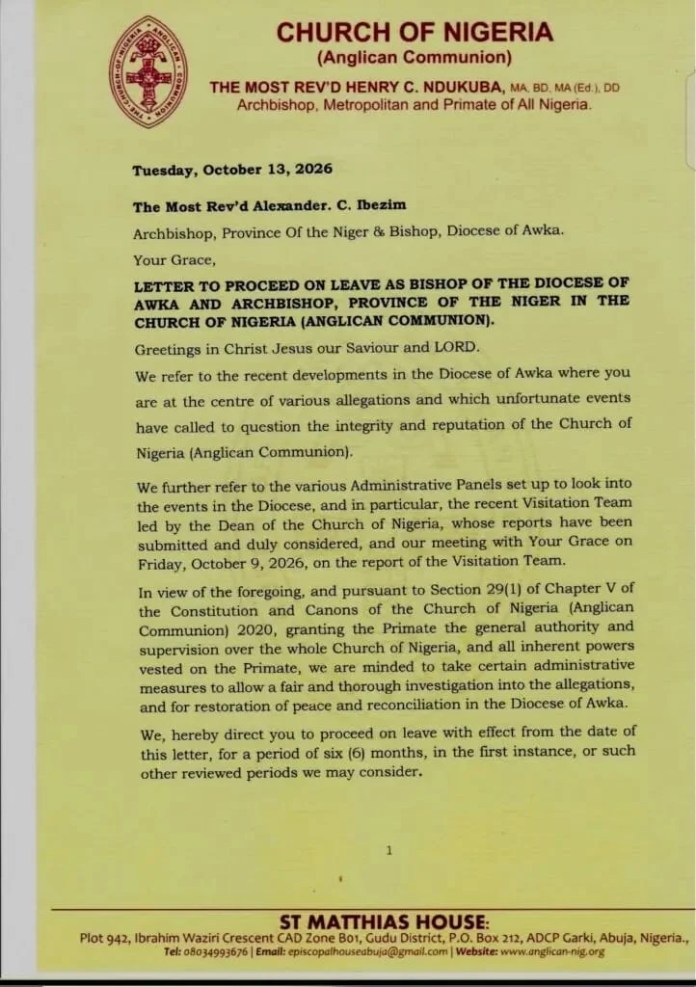
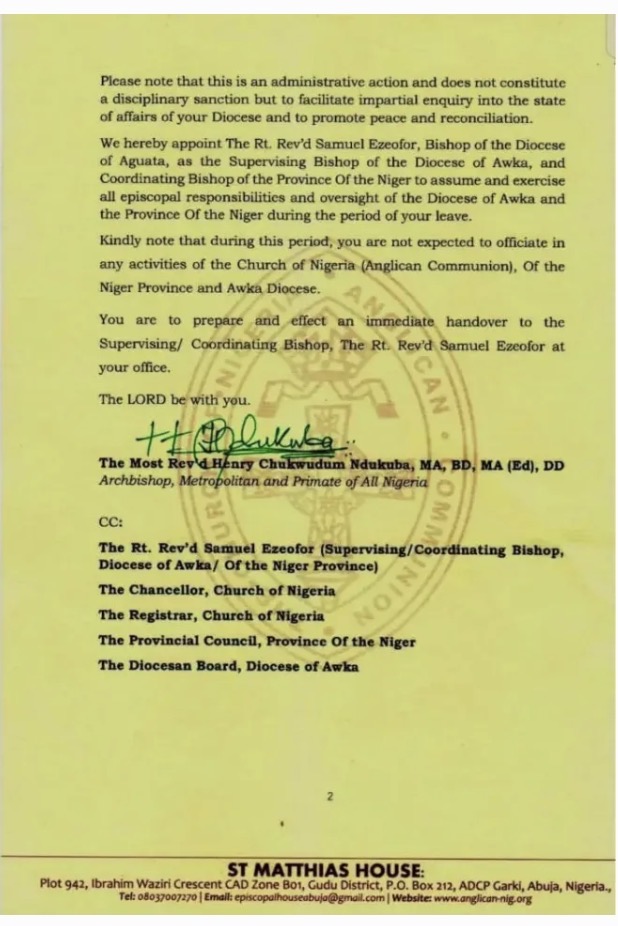
Screenshot

Twelve years after his ministry in Kenya, East African Italian-born Catholic priest Sandro Ferretto has married Sharon Jepng’ok, a Tugen woman from Baringo County.
According to Kenya Times, the couple exchanged vows in a traditional ceremony on 6 September at Seretion Village in Kasiela, a community where Mr Ferretto previously served as parish priest.
The event brought together relatives, local leaders, elders and friends of the bride, who witnessed the Koito ceremony, a significant Kalenjin custom centred on dowry negotiations and family blessings.
Ferretto’s ministry
Mr Ferretto, 55, began his priesthood in Italy before taking his ministry to Kenya, where he spent more than a decade working with local communities.
The Diocese of Padua ordained him as a priest, and he arrived in Kenya in 2008 to begin missionary service. He worked around Kasiela and Mochongoi under the Diocese of Nyahururu and became involved in pastoral outreach, youth programmes and community-based development efforts in Baringo.
He eventually returned to Italy in December 2020 with another missionary, Fr Mariano Dal Ponte.
In 2023, the priest assumed responsibility for a pastoral unit in Saletto, Borgo Veneto, in the Padua diocese. His duties covered eight churches in the area.
His tenure, however, lasted only several months. In December 2023, he celebrated a final Mass before stepping aside from the position to take time for reflection.
The decision reportedly caught some of his colleagues off guard because he gave them little notice.
The Diocese of Padua later acknowledged his withdrawal from pastoral duties, stressing that he continued to serve as a priest and had no connection to any controversy. The diocese described the decision as a requested period away from pastoral ministry.
During his break, Mr Ferretto was reportedly involved in volunteer work with a migrant support group in Padua.
Reunion and law
Mr Ferretto later returned to Kenya and reunited with Ms Jepng’ok, whom he met during his missionary work in Baringo.
Residents of the area widely knew him as “Father Sandro” after he spent more than a decade working with families, youth organisations and church congregations. Baringo is also Ms Jepng’ok’s home region.
Catholic canon law requires Latin Rite priests to observe celibacy and bars them from marrying while they remain in active ministry. The Church considers the commitment a lifelong obligation of the priesthood.
For a priest to marry, he must first be formally removed from the clerical state through a process approved by the Vatican. Known as laicisation, the process ends his status as a priest and normally includes a dispensation from the obligation of celibacy.
Only after receiving the necessary approval can a former priest marry. Without it, the marriage would contravene Catholic canon law and would not be recognised by the Church.
-
 Faith3 days ago
BREAKING: Anglican Church Places Archbishop Ibezim on Six-Month Leave, Bars Him From Church Duties
-
News3 days ago
Gunmen Abduct Catholic Priest in Benue, Police Launch Rescue Operation
-
Faith1 day ago
Awka Anglican Diocese Rejects Ibezim’s Suspension, Threatens to Leave Church of Nigeria
-
News3 days ago
Tinubu Orders Rescue of Kidnap Victims, Demands Peaceful 2027 Elections
-
News2 days ago
BREAKING: Mbah Extends Enugu Movement Restriction to 10pm, Scraps Keke Ticketing
-
Politics1 day ago
Nigeria’s Weak Opposition and the Cost of One-Party Dominance: Can the Opposition Rebuild Before 2027?
-
News2 days ago
2027: Keke Riders Endorse Mbah, Tinubu
-
News3 days ago
Enugu Approves ₦32bn Legacy Gratuity Payment, Begins Disbursement Next Week