International
Veteran BBC journalist Stephen Grimason who broke news of the historic Good Friday Agreement in 1998 dies aged 67


- Stephen Grimason died following a long battle with cancer
- He left the BBC to become Stormont’s director of communications until 2016
The veteran BBC journalist Stephen Grimason who broke news of the historic Good Friday Agreement in April 1998 has died aged 67.
The former BBC Northern Ireland political editor passed away following a long-term battle with cancer.

Following his iconic three-decade-long career in journalism, Grimason, originally from Lurgan, Co Armagh, later went on to work for the Stormont administration as director of communications.
He spoke publicly over the last year about his fight against cancer and said he received well wishes from former Prime Minister Tony Blair among others.
In an interview in January when he, along with former UTV political editor Ken Reid, was honoured with the Chancellor’s Medal for services to journalism, he described leaving it as ‘a bit of a wrench’, recalling ‘being surrounded by tremendous people’.

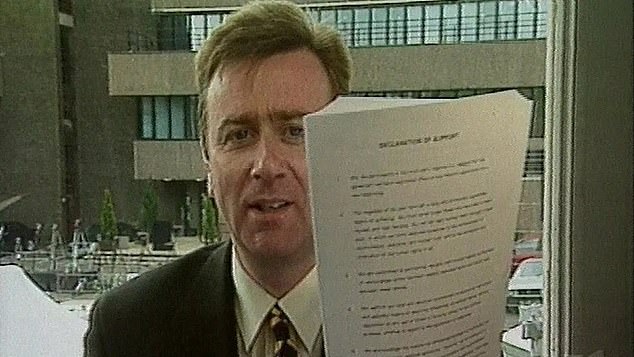
• The icon is widely remembered for breaking the news of the Good Friday Agreement in April 1998 and reporting on The Troubles
Looking back, he said he had a ‘seat at the table for an awful lot of pretty dramatic Executive meetings’ in the 2000s.
Grimason cut his teeth working in local newspapers including the Lurgan Mail, the Ulster Star in Lisburn and Banbridge Chronicle, as well as regional papers, the former Sunday News newspapers and the News Letter.
At just 27-years-old, Grimason had become the editor of the Banbridge Chronicle.
Later, after 12 years in newspaper journalism, he applied for a job at the BBC in Northern Ireland.
‘There were something like 300 of us (who applied) and two of us got jobs – so I must have bluffed my way rightly,’ he said of that time.
Speaking in January at Queen’s University around the then political stalemate, Grimason noted the ‘tide of Irish and Northern Irish politics goes in and out’, adding: ‘If you’re not careful and you don’t lead, you’ll be left on the beach.’
He also spoke of covering some of the darkest days of the Troubles, including atrocities within days in January 1992 – an IRA bomb which killed eight construction workers at Teebane, Co Tyrone, and the killing of five people by loyalists at the Sean Graham bookmakers on the Ormeau Road in Belfast.
‘I was the first reporter at Teebane. In the end, I think that the big success of the peace process was that actually peace, or an imperfect version of it, did win through,’ he said.
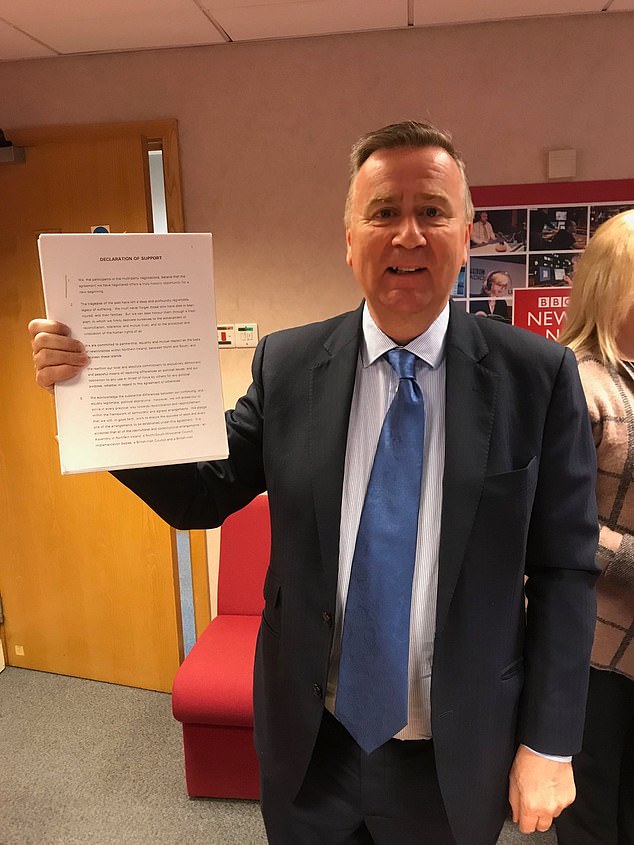
When Grimason memorably broke the news of the peace deal which helped end the troubles, he declared on television: ‘I have it in my hand’.
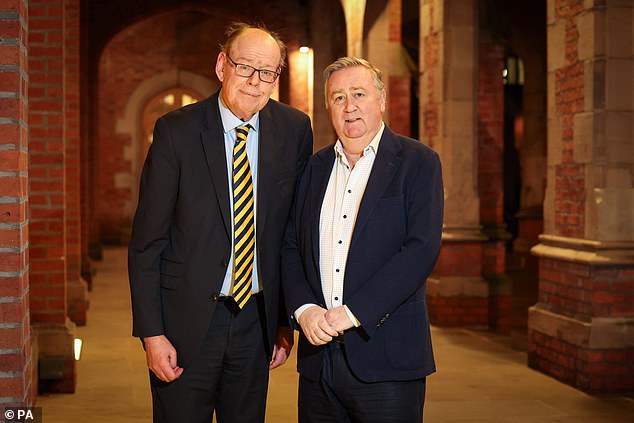
• Former UTV political editor Ken Reid (left) and former BBC Northern Ireland political editor Stephen Grimason (right) at the Queen’s University in Belfast where they were honoured with the Chancellor’s Medal for services to journalism
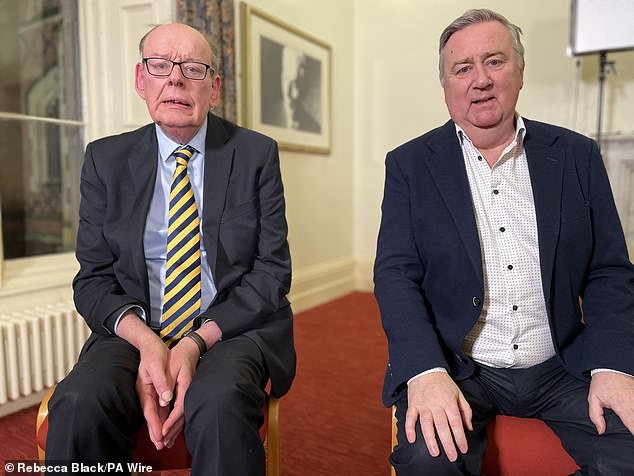
• Ken Reid (left) and Stephen Grimason (right) at Queen’s University in Belfast
Grimason was described as a ‘brilliant political editor’ by former Northern Ireland presenter Noel Thompson, BBC reported.
‘He had the two most important attributes for the job. He loved the gossip – the inside track – and he loved to share it with the rest of us,’ he said.
‘His biggest scoop was of course getting hold of a copy of the Good Friday Agreement before any of the hundreds of other journalists camped out at Stormont.
”I have it in my hand’ he told me live on air, with justifiable pride and excitement. It’s one of the key journalistic moments of the last 30 or 40 years.’
Grimason left the BBC to become Stormont’s new director of communications, a role he held until 2016.
He suffered heartache in 2022, when his younger brother Darryl, who was also a BBC journalist ad presenter, passed away.
Adam Smyth, director of BBC Northern Ireland, also paid tribute to Grimason following his shock death.
He said: ‘Stephen Grimason possessed the special talents that only the very best editors and correspondents exhibit – the audience always came away from his broadcasts feeling they knew and understood the political landscape better, and they trusted what he had to say.
‘Stephen’s list of contacts and sources was so extensive he regularly seemed to be one step ahead of everyone else – including the politicians.
‘His contribution to BBC Northern Ireland is deeply appreciated and we offer our sincerest condolences to Stephen’s family.’
Ken Reid wrote on X, formerly Twitter: ‘Stephen Grimason, my dear friend, has died.
‘He showed enormous courage against the odds right to very end. In over 40 years of friendship and rivalry we never exchanged a cross word.
‘Lucky to have spent time with him in his last days. Sleep well my friend’.
Outside of work, Grimason was reportedly an avid golfer and a keen rugby and football fan, and passionate about Chelsea FC. (Daily Mail)



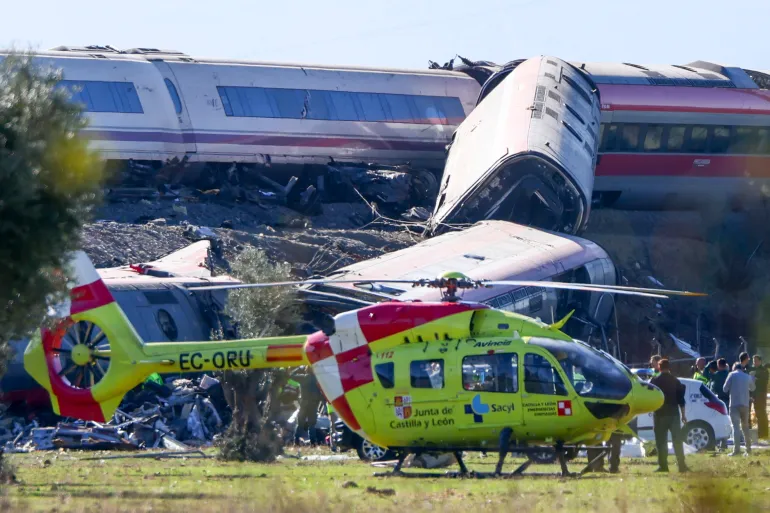
At least 64 people have been killed and about 80 others injured after two high-speed trains collided in central Spain, according to regional authorities.
The accident occurred early Wednesday near Urda in Toledo province, south of Madrid, along the high-speed railway line connecting the Spanish capital with Seville.
The head of the Castilla-La Mancha regional government, Emiliano García-Page, said about 50 of the injured were in serious condition, while 15 others were critically injured. He warned that some of the most seriously injured victims might not survive.
Spain’s Health Minister, Mónica García, said the injured were being transported to several hospitals across the region for treatment.
The collision involved a Renfe-operated AVE high-speed train travelling from Madrid to Seville and another train operated by private railway company Iryo.
Esther Padilla, a spokeswoman for the Castilla-La Mancha regional government, told Spanish public broadcaster TVE that both trains were travelling in the same direction when one struck the rear of the other, which had stopped.
The impact caused carriages to derail, with two carriages of the Iryo train reportedly plunging down an embankment.
Authorities said 397 passengers were aboard the Renfe train, while 147 were travelling on the Iryo train, bringing the total number of passengers involved to 544.
Signalling System Failure Under Investigation
Spain’s Transport Minister, Óscar Puente, said a failure of the railway’s signalling and control system preceded the accident.
Puente explained at a press conference that the LZB train control system went down at about 8:30 a.m. along a 63-kilometre stretch of railway, affecting six trains, although he said the exact number remained uncertain.
Following the failure, control was transferred to the Atocha control post, where a decision was made to allow the Renfe train to resume its journey.
“The decision to resume traffic without the system having been restored corresponds to the control centre,” Puente said, describing the circumstances as “inexplicable”.
Emergency workers were concentrating on rescuing survivors and recovering bodies from the most severely damaged carriages.
More than 200 members of Spain’s Military Emergencies Unit were deployed to the crash site, while local authorities mobilised food and other essential supplies for those affected.
Footage circulating on social media showed wreckage scattered along a slope, with rescue workers and members of the public gathered around the damaged train.
High-Speed Rail Services Suspended
Spain’s railway infrastructure operator, ADIF, suspended high-speed rail services between Madrid and the southern region of Andalusia following the collision.
The disruption resulted in delays and cancellations, with passengers waiting at railway stations, including Sevilla Santa Justa station.
The Civil Guard also deployed a disaster investigation team to the scene to assist with the investigation into the circumstances surrounding the crash.
Madrid Mayor José Luis Martínez-Almeida said the capital was sending emergency medical teams and firefighters to support rescue operations.
Government, European Leaders React
Spanish Prime Minister Pedro Sánchez said he was shocked by the tragedy and was in contact with Transport Minister Puente and Castilla-La Mancha regional leader García-Page as emergency crews continued their work.
“Shocked by the serious train accident in Toledo. My affection, solidarity, and support to all the victims and their families,” Sánchez said in a post on X.
European Commission President Ursula von der Leyen also expressed her condolences to the victims and their families.
“Today, Europe mourns with you,” she said.
French President Emmanuel Macron expressed solidarity with Spain, saying his thoughts were with the victims, their families, the injured and the emergency workers responding to the disaster.
The crash comes nine months after another accident involving high-speed trains operated by the same companies on the same railway line reportedly killed 46 people.
Journalist Graham Keeley, speaking to Al Jazeera from Spain, said the latest tragedy had come at a difficult time for the Spanish government, with an election expected in just over a month.
He noted that following the January accident, the government had promised to conduct safety checks across the country’s railway network.
The investigation is expected to examine the signalling failure, the decision to resume train movements and the sequence of events that led to the collision.
International
France braces for another weekend of protests as authorities launch massive security operation
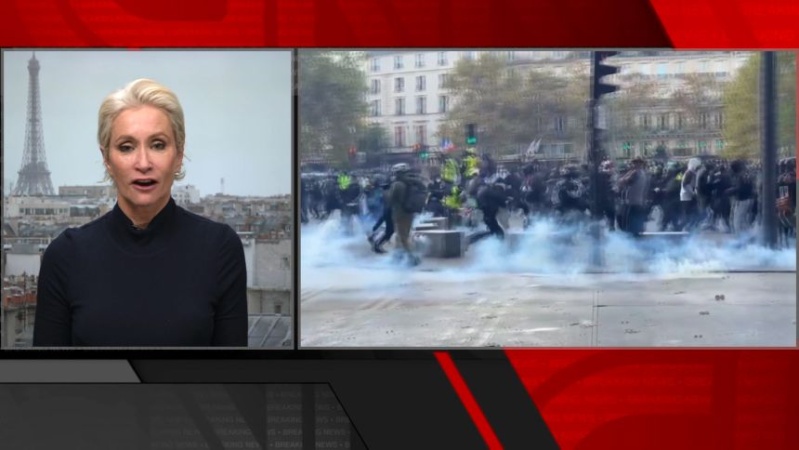
France is bracing for yet another wave of protests this weekend with authorities racing to prevent a repeat of the kind of violence and riots that hit the nation last week.
French authorities will be launching a massive security operation with some 70,000 police officers deployed across the country over the weekend, according to the interior ministry.
Specialist SWAT units, helicopters, armored vehicles, police dogs and water cannons will all be part of the operation. On top of that, the number of French army soldiers that normally patrol Paris as part of the country’s counter-terrorism measures will be increased to free the police from stationary guard duties.
Interior Minister Laurent Nuñez issued a stark warning on Friday to anyone looking for trouble, saying the government would be “uncompromising with those who engage in destruction.”
Last week’s violence followed weeks of protests over education, dismal job prospects and the cost of living. Initially peaceful and attended mostly by students, the demonstrations quickly turned into the worst wave of deadly, nationwide violence in years.
This week, curfews were imposed in some cities to help maintain calm.
Bracing for Saturday
A large demonstration has been called for Saturday afternoon in Paris and French media are expecting hundreds of thousands of people to attend.
The protest is organized by France’s main student union, UNEF, with one of the country’s biggest trade unions, CGT, announcing it would join. Other groups are expected to attend, including farmers, climate activists and the Yellow Vests, the movement that first emerged in 2018 during the protests over fuel costs.
While the protest in Paris has been authorized by the authorities, French President Emmanuel Macron on Thursday banned all non-trade union protests on Saturday as he seeks to control the civil unrest.
But the preparations go well beyond bans and police warnings, especially since last week’s riots sparked criticism of the authorities for not taking the threat seriously enough.
A police officer ties in place a perimeter tape near Chatelet – Les Halles to enforce a curfew, in central Paris on October 20.
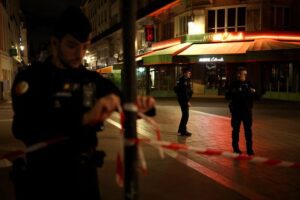
A police officer ties in place a perimeter tape near Chatelet – Les Halles to enforce a curfew, in central Paris on October 20.
Simon Wohlfahrt/AFP/Getty Images
The City of Paris announced earlier this week it was clearing public spaces of equipment and materials that could be used to cause damage, including barriers, bins, construction material and other items.
Many of the main tourist sites in the French capital, including world-famous museums like the Louvre, the Musée d’Orsay and the Musée de l’Orangerie will be closed on Saturday.
Art Basel finished the Paris version of its fair on Friday, two days earlier than scheduled. The Paris National Opera cancelled its performances on Saturday, citing the protests as the reason, and at least two dozen metro stations will also be closed for much of the day, according to Paris municipal authorities.
An NFL game between Pittsburgh Steelers and New Orleans Saints is set to take place at the Stade de France just outside of the capital on Sunday. While the match is scheduled to go ahead, a Steelers fan event in Paris was cancelled by the NFL.
During last weekend’s riots, at least two people died and multiple others suffered serious injuries, including two people who lost their hands. French Justice Minister Gérald Darmanin said some 2,700 people were held for questioning and 232 have been incarcerated in connection to the riots. (CNN)
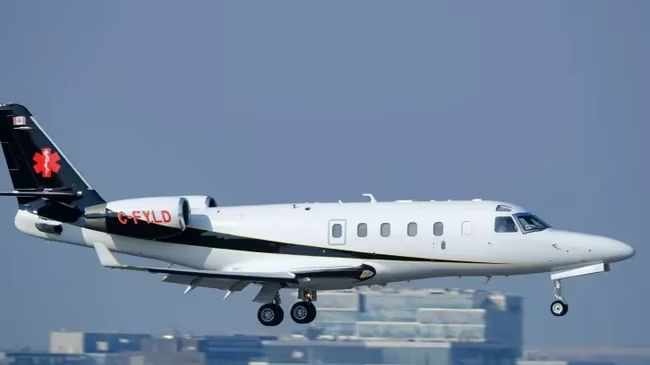
There are grave fears for the passengers of a private plane that suddenly vanished mid-flight, sparking a major search off the coast of the US.
US authorities say the Gulfstream G100 lost contact with air traffic control about 2am local time on Saturday (4pm Saturday AET) while flying from L.F. Wade International Airport in Bermuda to Boston Logan International Airport.
The US Coast Guard said the Federal Aviation Administration alerted it after contact was lost with the aircraft – which plummeted from 23,500 feet to 11,000 feet in just three minutes, according to FlightAware data.
“We are praying for a safe outcome,” a spokesperson for Latitude Air Ambulance, which operates the missing plane, told City News.
A search is now under way off Nantucket in the air and on water as crews work to locate the missing jet, the Coast Guard said. Data from FlightRadar24 showed a number of aircraft searching south of the island.
Six people are missing after a private jet vanished, sparking a major search off the coast of Nantucket in the US.
The plane was en route from Bermuda to Boston when it vanished.
“Air & surface crews have launched in search of the aircraft. Updates will be provided here as info becomes available,” the Coast Guard Northeast District said on X.
The plane was carrying out a medical evacuation in Bermuda – a British overseas territory in the north Atlantic Ocean, according to Clarence Togeretz, Director of Flight Operations at Latitude Air Ambulance.
“We always get rather concerned when our crew doesn’t report to us in a timely manner,” he told NBC News.
“But I will say that again, optimistically and positively, that doesn’t mean that the worst has happened.”
-
 News3 days ago
BREAKING: Tension as Video Shows Islamic Group Members Allegedly Calling for AK-47 to Kill Christians in Enugu, Jos
-
News1 day ago
BREAKING: El-Rufai Tests Positive for Drug-Resistant Bacteria, Shows Signs of Possible Severe Infection—Report
-
News2 days ago
Ifeanyi Ubah’s Elder Sister, Fidelia Chigbogu, Dies Suddenly at 61
-
News23 hours ago
FG kicks off $100m Southeast gas pipeline project
-
News2 days ago
Terrorists Abduct Sunday Igboho’s Iru Ekun Security Group Members in Kwara
-
News2 days ago
Apologise to Igbos: Senator Umeh Challenges Gowon to Write Book on Civil War
-
News3 days ago
Ngozi Okonjo-Iweala loses mother
-
News2 days ago
Mbah Vows to Sign Bill Curbing Excessive Agency, Lawyers’ Fees in Enugu