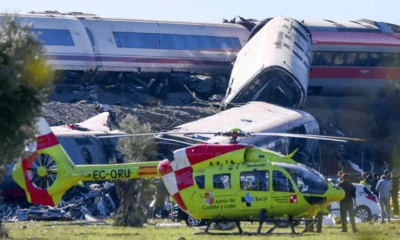
At least 64 people have been killed and about 80 others injured after two high-speed trains collided in central Spain, according to regional authorities.
The accident occurred early Wednesday near Urda in Toledo province, south of Madrid, along the high-speed railway line connecting the Spanish capital with Seville.
The head of the Castilla-La Mancha regional government, Emiliano García-Page, said about 50 of the injured were in serious condition, while 15 others were critically injured. He warned that some of the most seriously injured victims might not survive.
Spain’s Health Minister, Mónica García, said the injured were being transported to several hospitals across the region for treatment.
The collision involved a Renfe-operated AVE high-speed train travelling from Madrid to Seville and another train operated by private railway company Iryo.
Esther Padilla, a spokeswoman for the Castilla-La Mancha regional government, told Spanish public broadcaster TVE that both trains were travelling in the same direction when one struck the rear of the other, which had stopped.
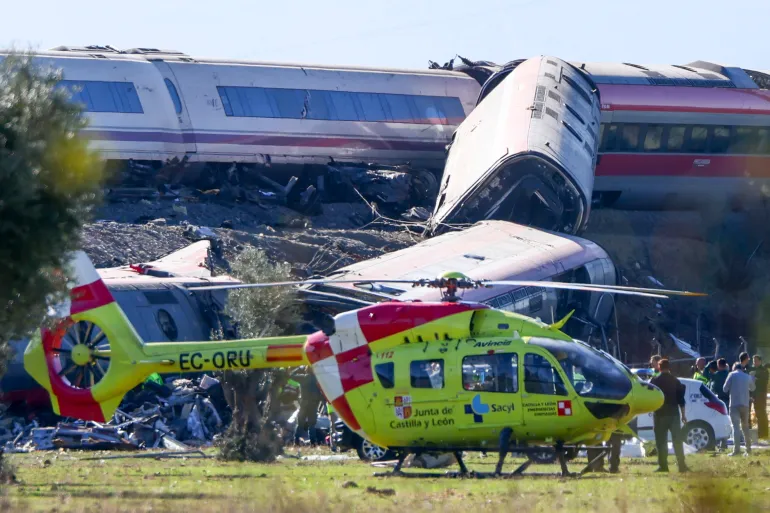
The impact caused carriages to derail, with two carriages of the Iryo train reportedly plunging down an embankment.
Authorities said 397 passengers were aboard the Renfe train, while 147 were travelling on the Iryo train, bringing the total number of passengers involved to 544.
Signalling System Failure Under Investigation
Spain’s Transport Minister, Óscar Puente, said a failure of the railway’s signalling and control system preceded the accident.
Puente explained at a press conference that the LZB train control system went down at about 8:30 a.m. along a 63-kilometre stretch of railway, affecting six trains, although he said the exact number remained uncertain.
Following the failure, control was transferred to the Atocha control post, where a decision was made to allow the Renfe train to resume its journey.
“The decision to resume traffic without the system having been restored corresponds to the control centre,” Puente said, describing the circumstances as “inexplicable”.
Emergency workers were concentrating on rescuing survivors and recovering bodies from the most severely damaged carriages.
More than 200 members of Spain’s Military Emergencies Unit were deployed to the crash site, while local authorities mobilised food and other essential supplies for those affected.
Footage circulating on social media showed wreckage scattered along a slope, with rescue workers and members of the public gathered around the damaged train.
High-Speed Rail Services Suspended
Spain’s railway infrastructure operator, ADIF, suspended high-speed rail services between Madrid and the southern region of Andalusia following the collision.
The disruption resulted in delays and cancellations, with passengers waiting at railway stations, including Sevilla Santa Justa station.
The Civil Guard also deployed a disaster investigation team to the scene to assist with the investigation into the circumstances surrounding the crash.
Madrid Mayor José Luis Martínez-Almeida said the capital was sending emergency medical teams and firefighters to support rescue operations.
Government, European Leaders React
Spanish Prime Minister Pedro Sánchez said he was shocked by the tragedy and was in contact with Transport Minister Puente and Castilla-La Mancha regional leader García-Page as emergency crews continued their work.
“Shocked by the serious train accident in Toledo. My affection, solidarity, and support to all the victims and their families,” Sánchez said in a post on X.
European Commission President Ursula von der Leyen also expressed her condolences to the victims and their families.
“Today, Europe mourns with you,” she said.
French President Emmanuel Macron expressed solidarity with Spain, saying his thoughts were with the victims, their families, the injured and the emergency workers responding to the disaster.
The crash comes nine months after another accident involving high-speed trains operated by the same companies on the same railway line reportedly killed 46 people.
Journalist Graham Keeley, speaking to Al Jazeera from Spain, said the latest tragedy had come at a difficult time for the Spanish government, with an election expected in just over a month.
He noted that following the January accident, the government had promised to conduct safety checks across the country’s railway network.
The investigation is expected to examine the signalling failure, the decision to resume train movements and the sequence of events that led to the collision.