


News
Mbah advocates experiential learning, unveils Enugu’s human development model at UNN convocation
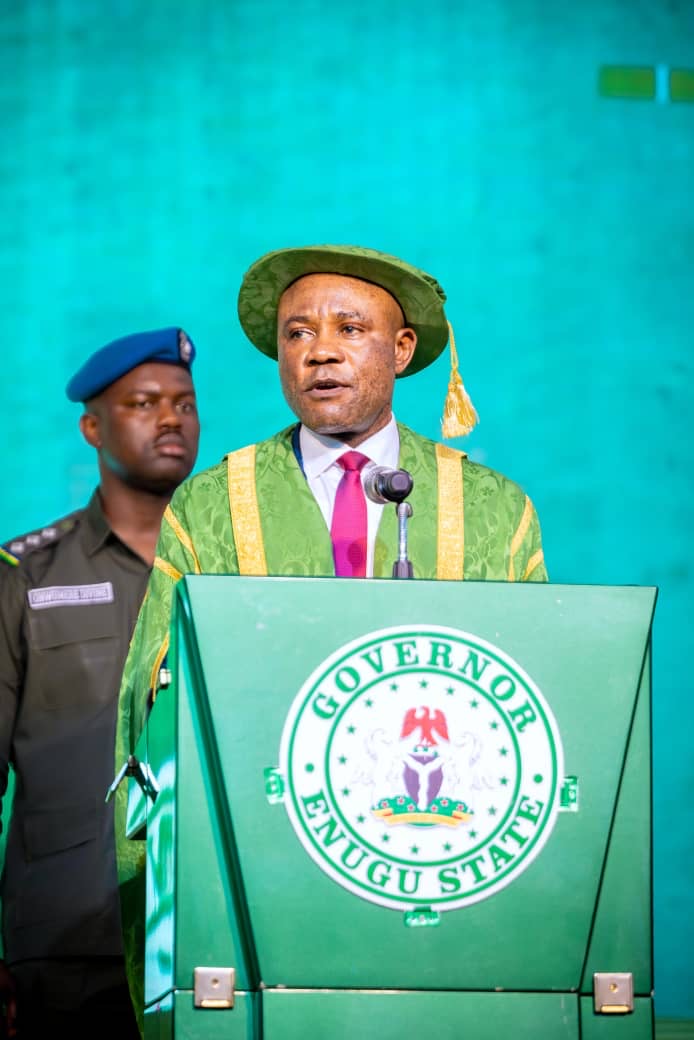
Governor Peter Mbah of Enugu State has called for a fundamental overhaul of Nigeria’s education system, urging schools to focus on producing problem-solvers and innovators rather than graduates armed only with certificates.
Speaking on Thursday while delivering the 55th Convocation Lecture of the University of Nigeria, Nsukka (UNN), Mbah said education must become the driving force for restoring human dignity through experiential learning, innovation and inclusive prosperity.
Delivering the lecture titled, “Restoring the Dignity of Man: Enugu’s Quantum Leap in Human Development and Inclusive Prosperity Through Experiential Learning,” the governor described UNN’s motto as a timeless mission whose relevance has become even greater in the era of artificial intelligence, biotechnology and the knowledge economy.
He argued that true development should be measured by citizens’ ability to transform knowledge into productivity and shared prosperity rather than by physical infrastructure alone.
“True dignity exists when people possess not merely the freedom to aspire, but the capability to transform aspiration into achievement, potential into productivity, and possibility into shared prosperity,” he said.

Mbah said Enugu’s education reforms were inspired by the Igbo apprenticeship system, which, according to him, embodies learning by doing, mentorship, trust, discipline and entrepreneurship.
“Our purpose is not to romanticise the past, but to apply its deepest principle to the future. This is why we embraced experiential learning—not as a foreign educational idea, but as a modern expression of our knowledge tradition and a twenty-first-century development imperative,” he said.
The governor explained that through experiential learning, the state seeks to democratise opportunities by ensuring that access to quality education, technology, healthcare, infrastructure, mentorship, capital and connectivity is no longer determined by birthplace, income or social status.
He disclosed that the Centre for Experiential Learning and Innovation (CELI), Enugu, is driving reforms in curriculum development, teacher training, research, digital literacy, technical education and industry partnerships to bridge what he described as the “activation gap” between knowledge and opportunity.
Mbah said his administration’s vision of growing Enugu’s economy from about $4.4 billion to $30 billion is anchored on human capital development rather than conventional infrastructure projects alone.
He noted that about one-thirds of the state’s annual budget has consistently been allocated to education, leading to the construction of 268 Smart Green Schools across the state’s 260 political wards, equipped with smart classrooms, laboratories, digital libraries, innovation studios, clinics, smart farms, solar power and internet connectivity.
According to him, over 23,000 teachers have undergone digital literacy training, while the state has approved the recruitment of 4,698 teachers to strengthen the Smart Green School initiative.
The governor added that students in the state’s Technical and Vocational Education and Training (TVET) colleges were already receiving practical industry training in ICT, mechatronics, aquaponics, precision welding, fashion and design through partnerships with industries, including the Enugu Haier Factory.
He also announced plans to establish three specialised universities dedicated to Artificial Intelligence and Technology, Education and Technology, and Agriculture, Agro-industrialisation and Technology, while new degree programmes in Automation, Artificial Intelligence and Mechatronics have already been introduced at ESUT and IMT.
To demonstrate the impact of experiential learning, Mbah narrated the story of Arinze Edeoga, a pupil of a Smart Green School in rural Owo community, who recently taught digital literacy to pupils in Enugu metropolis.
“A village child became a teacher of urban peers. In Arinze, you see restored confidence, democratized opportunity and a child once defined by geography becoming a creator of knowledge rather than merely a consumer of it. You see the dignity of man,” he said.
Mbah, however, said education reforms alone would not guarantee prosperity unless supported by investments in healthcare, electricity, roads, aviation, tourism and technology, stressing that Enugu’s development strategy integrates all sectors into a single human development architecture.
He cited projects such as the 300-bed Enugu International Hospital, the transport terminals, Enugu Air, the expansion of primary healthcare centre, the Enugu Command tourism infrastructure, and the proposed 660-megawatt power plant, as interconnected investments designed to unlock productivity, attract investment and improve citizens’ quality of life.
Mbah concluded by urging governments, universities, communities and the private sector to reject what he described as the “poverty of imagination,” insisting that the future belongs to societies willing to invest boldly in human capability.
“Let us measure leadership by the capabilities it develops in others, education by the lives learners become able to shape, and development by the dignity and opportunity it extends to every citizen,” he said.
Meanwhile, in their various remarks, the Vice Chancellor of UNN, Prof. Simon Ortuanya and Chairman of the event and former Minister of Power, Prof. Chinedu Nebo commended Mbah’s milestones in human capital development.
They noted that Mbah had, in three years, made a resounding impact in development across all sectors.
The event was attended by notable dignitaries, including the Deputy Governor of Enugu State, Barr. Ifeanyi Ossai; Deputy Speaker, Enugu State House of Assembly, Hon. Ezenta Ezeani; Minister of Innovation, Science and Technology, Dr. Kingsley Udeh and Catholic Bishop of Nsukka Diocese, Most Rev Godfrey Igwebuike Onah and Senator Ikeje Asogwa.
News
Security guard allegedly kills employer two weeks after resuming duty
• Guard arrested, blames devil for the murder
A security guard identified as Abdul Latiff has reportedly been arrested for allegedly killing his employer, Mrs Marbel Okafor, at her residence on Victoria Island, Lagos.
According to reports, Mrs Okafor employed Abdul as her security guard during the first week of August 2026. However, barely two weeks after he resumed work, tragedy struck.
On August 16, Abdul allegedly entered his employer’s room and stabbed her several times in the stomach.
A neighbour reportedly heard Mrs Okafor screaming and repeatedly calling Abdul’s name. When the neighbour approached him to find out what was happening, Abdul allegedly claimed that his employer was frightened by a cockroach and that this was why she was shouting.
He was said to have subsequently taken three mobile phones, ₦10,000 from her purse and other valuables before fleeing in a vehicle to Jalingo, Taraba State, his reported hometown.

Neighbours later discovered Mrs Okafor’s body and alerted the police. Following an investigation, officers reportedly traced the suspect to Taraba State, where he was arrested.
When questioned about what his employer had done to provoke the alleged attack, Abdul reportedly replied that she did nothing to him, describing his action as “the devil’s work.”
The matter is reportedly being investigated by the police but no official statement has been issued on the incident, which has gone viral on the social media.
News
Uber exit a wake-up call, exposes Nigeria’s business crisis
Uber officially shut down its operations in Nigeria on Wednesday, September 2, 2026, bringing an end to 12 years of business in the country.
While the company has diplomatically described the move as part of a review of its business priorities and investment focus, its exit comes at a difficult time for businesses operating in Nigeria.
Companies are facing a combination of rising operating costs, inflation, currency instability, weaker consumer purchasing power and an increasingly unpredictable business environment.
And that is where the bigger conversation begins.
Why is Nigeria struggling to remain an attractive destination for businesses despite being one of Africa’s largest consumer markets?

The Tinubu-led APC administration inherited a fragile economy and introduced major reforms aimed at stabilising it. But Nigerians cannot ignore the reality that businesses are still under enormous pressure, while some companies are shutting down, scaling back or redirecting investments elsewhere.
Economic performance should not be measured by statistics alone. It should also be measured by whether businesses can survive, expand, employ more people and confidently invest in the country.
Uber’s exit should therefore serve as a wake-up call.
Nigeria needs an economic environment that makes businesses want to come, stay and expand—not one that gradually pushes them toward the exit.
If the government wants to attract serious local and foreign investment, it must urgently address the conditions making it increasingly expensive and difficult to do business in Nigeria.
Because when major companies leave, the consequences go beyond corporate boardrooms. Jobs, investment, competition and opportunities for millions of Nigerians are affected.
And that leaves Nigerians with a very uncomfortable question:
Is Tinubunomics creating an investment-friendly Nigeria—or are we simply being asked to endure the pain and “bole ka ja”? (The Guardian)
News
Uber shuts down operations in Nigeria
Ride-hailing company, Uber, has shut down its operations in Nigeria.
In a statement, the company, which came into Nigeria in 2014, said its exit is effective from September 2, 2026.
“We are writing to share some difficult news. After a thorough review of our business, we have made the tough decision to wind down our operations in Nigeria, effective 2 September 2026.
“Since we first launched in Lagos in 2014, it has been an absolute privilege to be a part of your daily life connecting you with independent transportation providers.
“Whether it was a morning commute, a ride to see loved ones, or exploring the city, thank you for trusting the platform to connect you to a driver to get you there safely. We know this may cause disruption to your routine, and we sincerely apologize for the inconvenience.”

In a memo on Wednesday, the ride-hailing company also announced elimination of roughly 3,300 positions.
The job cuts focused on management and coordination roles, according to its CEO, Dara Khosrowshahi.
“Today, we’re making a number of significant organizational changes across Uber. We are removing layers, simplifying team structures, refining our global location strategy, and focusing our people and investments against the biggest opportunities ahead of us.”
“As a result, we will be reducing the size of our team by about 10%. Everyone whose role has been affected has already been notified, except in countries where we will follow the required local process.
“This wasn’t a decision we made lightly, because it will have a real impact on our teammates and friends who have worked hard for Uber. It’s important to say that these changes are about how we’re organized and what we’re prioritizing, not about anyone’s contributions to Uber, which we will always value.
“I’m sure you’re asking, ‘Why, and why now?’ particularly since our business is performing so well. Over the last 5+ years, Uber has grown by orders of magnitude, with our top line nearly tripling. We’ve built new products, expanded into new businesses, reached more consumers and supported more earners, and become a much larger and stronger company. But that growth has also brought complexity: more layers, more coordination, more fragmented ownership, and in some cases structures that made sense when businesses were smaller but no longer serve us well at our current scale.
“Our opportunity from here is enormous: we have the chance to bring Uber to hundreds of millions more people; to invest even more in drivers, couriers and merchants; and to innovate across our core businesses and build the autonomous future.
“The changes we’re making today are designed to do two things: make Uber simpler and faster, and create more capacity to invest in our future. A leaner organization will mean clearer ownership, faster decisions, and more time spent building rather than coordinating. It will also generate savings that we intend to reinvest in growth, innovation, and the capabilities that will matter most over the coming years.
“It’s our job as leaders to make these difficult calls, and to give you transparency into our thinking and our decision-making process.”
The layoffs are the latest round of job cuts for Uber, which eliminated roles in customer service and HR earlier this year.
-
News2 days agoEFCC sacks over 40 staff for corruption, prosecutes 5 others
-
News3 days agoEx-Bayelsa Gov, Timipre Sylva dumps APC, gives reasons
-
News2 days ago15 NYSC members abducted in Kogi regain freedom, recount ordeal
-
News2 days agoEFCC summons ex-gov Sylva over alleged $14.86m fraud
-
News1 day agoFG launches ‘Hire from Nigeria’ campaign to connect local talent with global jobs
-
Politics2 days agoPeter Obi questions President’s past, demands transparency over Educational Records
-
News2 days agoFamily of four die in Kwara building collapse
-
News16 hours agoGunmen abduct APC Chairman, kill two