Politics
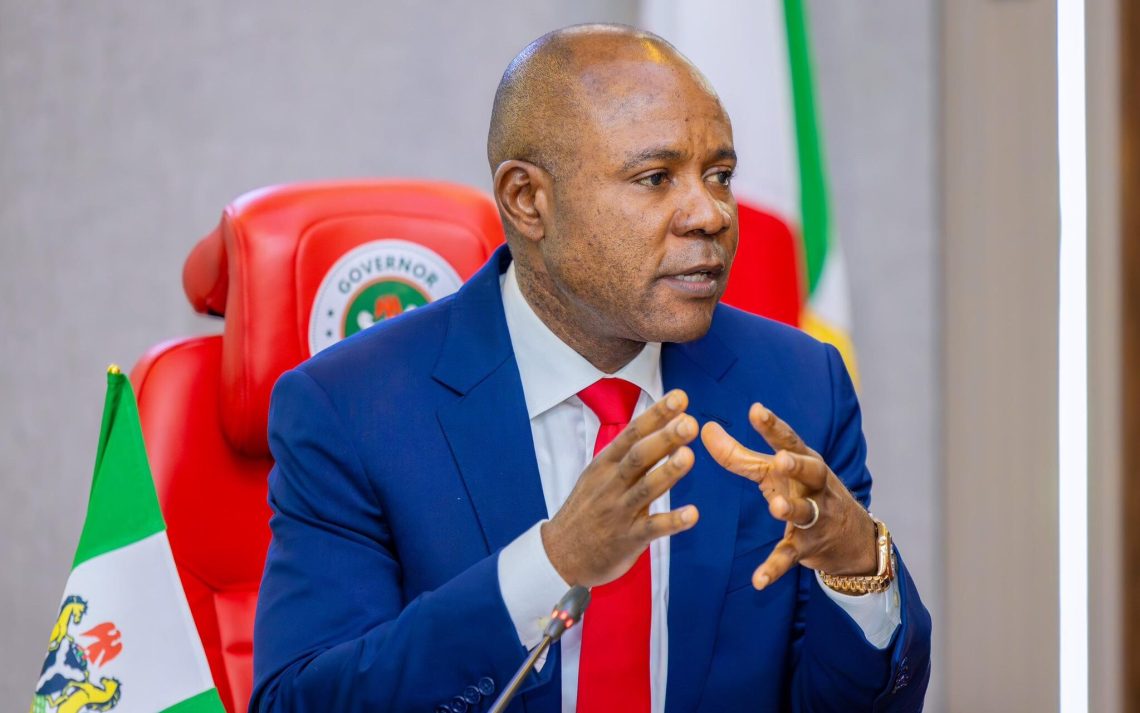
2027: Between Gov. Mbah And Social Media Traducers

By Samson Ezea
As a graduate of Mass Communication and a journalism practitioner for years now, I am totally baffled and at a loss over how Nigerians have abused social media platforms, using them to spread falsehood and fan the embers of war, discord, disunity, and crises.

In doing this, they throw caution, ethics, decorum, professionalism, and facts to the wind, forgetting the fundamental principle of news gathering and reporting: that the authenticity or genuineness of the source(s) of information is more important than the information itself.
For this reason, every news item must not only be attributed to a source or sources, but such attribution must also be verifiable, factual, and authentic. This was the standard, approved, and globally accepted practice before the advent of social media platforms.
Social media is, no doubt, a remarkable technological advancement, considering its efficiency and speed in disseminating information.
Unfortunately, in Nigeria, it has become a platform for spreading falsehood, maligning individuals, and throwing tantrums at people, often without consequences, despite the existence of cybercrime laws.

Today, almost everybody in Nigeria claims to be a journalist, writer, political analyst, or social media influencer. It has become a situation where professionalism is eroded. Quackery now takes precedence over excellence. It appears that all it takes to become a “journalist” or “expert” is to purchase a smartphone, subscribe to data, open social media accounts, sometimes under pseudonyms, and begin fabricating stories while pouring invectives on others, without any form of accountability.
In such an environment, freedom of speech is misconstrued as absolute. Yet, it is well established in law and journalism that there is no absolute freedom of speech anywhere in the world, not even in the developed societies from which Nigeria borrowed its democratic and media practices.
This narrative aptly reflects the recent falsehoods about Enugu State trending on social media platforms. These are clearly orchestrated campaigns, wiles, and gimmicks by sponsored actors and their data boys to undermine the tangible achievements of Governor Mbah’s administration in repositioning the state for investment, peace, security, and economic growth.
Just like during the 2023 elections, ahead of 2027, Gov. Mbah has again been subjected to coordinated social media attacks and a campaign of calumny, ranging from defamation and misinformation to slander and mudslinging, by political opponents and their online surrogates.
Their modus operandi remains largely unchanged, even though the faces may differ slightly.
It is on record that Gov. Mbah was one of the most vilified governorship candidates in 2023, yet he emerged victorious at the poll.
It is therefore surprising that his social media traducers have not learned from that experience. Instead, they have once again embarked on the same failed tactics, delusionally believing that a different outcome will emerge, despite Gov. Mbah’s administration’s commendable performance and giant strides across virtually all sectors of the state economy.
Sincerely speaking, if there is any criticism to be made, it is that Governor Mbah’s administration is in a hurry to deliver democratic dividends across all sectors simultaneously, thus transforming the state into a construction hub and investment destination.
This is despite the enormous backlog of age-long infrastructural deficits across the state, challenges that no government, even with sufficient funds, could completely address in sixteen years, let alone eight. Yet, within less than four years, remarkable progress and substantial achievements have been made by Governor Mbah’s administration.
However, sponsored social media actors and their sponsors feign ignorance of these facts. Instead, they amplify isolated cases, minor infrastructural gaps, natural challenges, and unverified claims in a desperate and political bid to discredit the administration’s numerous verifiable achievements.
For instance, the issue surrounding the Uwani Healthcare Centre, allegedly highlighted by some Industrial Training students of a private nursing school, has been unnecessarily exaggerated. Even if such claims were true, they represent isolated cases and cannot justify dismissing the administration’s significant strides in the health sector, including the near completion of a 300-bed international hospital, the completion and equipping of SUMAS Teaching Hospital, Igbo Eno, the commissioning of Ogbaku General Hospital in Awgu, and the construction of Type-2 hospitals across nearly all wards in the state.
Similarly, what is so extraordinary about the leakage of one newly roofed smart school out of about 260, some completed, others under construction? Why should such an isolated incident overshadow a massive educational transformation?
What is also the hullabaloo about the Governor exercising his discretion and applying his legal power to grant tax waivers to petty traders? What is illegal about it? Why are some hired social media hirelings and their godfathers making a mountain out of a molehill on social media platforms? It is worth recalling that the immediate past administration also granted tax waivers to traders, hotel owners, and others in the state during the COVID-19 pandemic, and nothing adverse happened.
Ironically, none of these social media purveyors of falsehoods have ever acknowledged or promoted Governor Mbah’s administration’s achievements. To them, success is routine, but any minor lapse is amplified as failure.
This is not constructive criticism, but bias. Constructive criticism involves factual engagement, the offering of better alternatives, and practical solutions, not the peddling of falsehoods, insults, and baseless attacks.
If the opposition’s only strategy to win elections remains social media propaganda, then it is clearly weak. Elections are not won on social media, but through performance, strategy, and results.
Voters have become more discerning and no longer rely on online noise or false narratives to form opinions.
Notably, improved security in areas such as the Ugwuogo-Nike-Nsukka road, once associated with kidnapping incidents, has gone largely unacknowledged by these social media critics. Yet, such progress speaks volumes.
Interestingly, Governor Mbah has remained focused and undistracted. He has his eyes firmly on the ball and has continued to strengthen the state’s security architecture, fully aware that safeguarding lives and property is the primary responsibility of government and a prerequisite for development.
It is deeply troubling that some individuals fabricate and spread fake news, even on sensitive issues involving security and human lives. One begins to wonder whether such individuals truly care about the victims, the security agencies, or the government.
At times, these purveyors of falsehood appear to celebrate infrastructural deficits and security challenges rather than approach them with empathy and concern. Yet, by available indicators, Enugu State remains one of the most peaceful and secure states in the country today.
This does not mean that Governor Mbah’s government is complacent, far from it. Continuous efforts are being made to enhance security and sustain development in the state.
Meanwhile, one must ask: why should anyone in a sane society take these purveyors of fake news seriously, if not for the growing gullibility among the populace, including the elite? The erosion of ethics, law, and professionalism in information dissemination has created a dangerous environment where falsehood is easily believed.
With the reckless abuse of social media, particularly by mischief makers, it is not surprising that some countries have imposed restrictions or outright bans to safeguard societal stability.
In conclusion, the misuse of social media as a tool for misinformation, character assassination, and political manipulation is a dangerous trend that must not be normalized.
As 2027 approaches, Nigerians must rise above propaganda, embrace critical thinking, and prioritize truth over sensationalism.
Ultimately, leadership should be judged by performance, integrity, and measurable impact, not by the noise of social media purveyors of falsehoods. History has consistently shown that deception is temporary, but truth and results endure.
_Ezea writes from Independence Layout, Enugu State_














By Ken Harries, Esq.
There is a point at which political contestation ceases to be an argument about ideas and becomes an assault on the very boundaries that make civil society possible. That point is reached when a private telephone conversation is allegedly recorded, extracted from its original context and released into the public domain as political ammunition.
The latest controversy surrounding an audio recording purported to be a telephone conversation between Senator Godswill Akpabio and Sandra C. Duru, a.k.a. Professor Mgbeke, therefore deserves to be examined beyond the personalities involved. It raises a much larger question: What happens to a society when private conversations become raw material for public propaganda?
Recent reports indicate that Sandra Duru released a nine-minute audio recording on social media and presented portions of it as a private conversation involving the Senate President. Yet, significantly, the recording has not been independently authenticated, and questions remain about the identity of the voices, the circumstances in which the conversation was recorded, and whether the excerpts constitute the complete conversation. Those uncertainties are not minor technicalities; they are at the heart of responsible public communication.
PRIVACY IS NOT A POLITICAL LUXURY
Nigeria’s Constitution is unequivocal in recognising privacy as a fundamental right. Section 37 guarantees and protects the privacy of citizens, including their homes, correspondence and telephone conversations. That constitutional safeguard does not disappear because the individuals involved are politicians, public officials, activists or controversial personalities. Indeed, public office should never be interpreted as a wholesale surrender of personal privacy.
The Nigeria Data Protection Act 2023 reinforces this principle by establishing a legal framework for protecting personal information and regulating its processing. Among its stated objectives are the protection of fundamental rights and freedoms, the safeguarding of personal data, and the requirement that personal data be processed in a fair, lawful and accountable manner.
The central question, therefore, is not whether an audio recording can generate political excitement; it obviously can. The question is whether private communication can be captured, processed, edited, reproduced and disseminated for political purposes without lawful justification, proper authorisation or regard for the rights of the people whose voices and personal information are involved. That is a much more serious question.
THE CYBER DIMENSION CANNOT BE IGNORED
The Cybercrimes (Prohibition, Prevention, etc.) Act, as amended in 2024, also contains provisions concerning unlawful interception of non-public computer communications and judicially authorised interception of electronic communications. The legislation defines interception broadly enough to include listening to or recording communication data in specified circumstances. But legal precision matters, particularly when criminal liability is being discussed.
It would be premature for commentators to declare, without establishing the facts, that the mere existence or publication of this particular audio automatically constitutes a criminal offence under the Cybercrimes Act. If, however, the evidence establishes that a private electronic communication was intercepted or obtained without lawful authority, the circumstances could raise serious questions under the applicable constitutional, data-protection and cybercrime frameworks. That is precisely why an independent investigation matters: the law should determine the legality, not social media.
PUBLIC INTEREST IS NOT A BLANK CHEQUE
There is another important distinction that the Nigerian public must begin to make. A matter involving a public official may be of public interest without every private conversation involving that official becoming public property. Public interest is not the same thing as public curiosity.
A genuine public-interest disclosure ordinarily requires more than the ability to attract clicks, outrage or political engagement. It requires consideration of authenticity, context, provenance, relevance and the legitimate rights of the people involved. A fragment of an alleged private conversation, detached from the circumstances in which it occurred and presented to millions of people without independent authentication, can easily become something very different from responsible whistleblowing.
It can become narrative engineering, particularly when selected material is used to encourage the public towards a predetermined interpretation. When such narrative engineering is repeatedly used to shape public perception, it begins to resemble propaganda rather than public accountability.
THE MORAL QUESTION
There is also a moral dimension that no statute can completely capture. Politics is already a theatre of suspicion, rivalry and competing narratives. If every private conversation is potentially a future weapon, trust disappears from public life. People stop speaking candidly, officials become afraid of legitimate conversations, and citizens become unwilling to engage public figures.
Political communication then gradually degenerates into a marketplace where the most sensational fragment—not necessarily the most truthful account—commands the greatest attention. This is where the conduct surrounding the dissemination of private conversations raises profound ethical questions.
A society that normalises the conversion of private conversations into political weapons risks producing a culture in which nothing is private, context is disposable and reputation is collateral damage. That is not democratic accountability; it is the erosion of the ethical architecture upon which democratic accountability depends.
THE PROBLEM WITH THE “MERCHANT OF PROPAGANDA” MODEL
There is a growing phenomenon in digital politics in which controversy itself becomes a political commodity. The objective is no longer necessarily to establish facts, but to generate a continuous stream of allegations, recordings, screenshots, insinuations and counter-allegations until the public becomes emotionally exhausted and truth becomes indistinguishable from repetition.
The danger is particularly acute when the communicator becomes both the source of the allegation and the narrator of the evidence. That model creates an obvious credibility problem because the public is effectively being asked to accept not merely the allegation but also the interpretation supplied by the person disseminating it.
That is why independent verification is indispensable. A recording should be authenticated, its provenance established, its full context examined and any editing disclosed. The circumstances of its acquisition should also be investigated. Where there are allegations of unlawful interception or misuse of personal data, the appropriate regulatory and law-enforcement authorities should be allowed to do their work.
FREEDOM OF EXPRESSION HAS RESPONSIBILITIES
Freedom of expression is indispensable to democracy, but so is the right to privacy. These principles should not be presented as enemies. Responsible journalism, legitimate whistleblowing and public-interest disclosure have their place, but none of them should become convenient labels for every unauthorised exposure of private communications.
The democratic answer to disputed conduct is evidence, investigation and due process—not digital vigilantism. If the recording is authentic and contains evidence of wrongdoing, the proper response is to submit the evidence to the appropriate institutions and allow the facts to be tested. If it is unauthorised, manipulated, selectively edited or misleadingly presented, those facts should also be established through proper investigation. Either way, the truth deserves a process more rigorous than a Facebook post.
THIS IS BIGGER THAN AKPABIO
The most important lesson from this episode should not be about Senator Godswill Akpabio alone; it should be about the Nigeria we are creating. Today, it may be a conversation involving a Senate President. Tomorrow, it could be a judge, journalist, businessman, civil servant, academic, clergy member or ordinary citizen.
If the principle becomes that anyone who possesses a private recording is entitled to publish it whenever politically convenient, then privacy ceases to be a right and becomes merely a temporary privilege enjoyed by those who have not yet been recorded. That is a dangerous trend with implications extending far beyond the personalities involved in the present controversy.
The constitutional guarantee of privacy cannot be selectively defended, data protection cannot become a slogan deployed only when convenient, and cybercrime legislation cannot be invoked selectively. Political communication cannot be allowed to become a free-for-all in which reputations are tried and convicted on social media before evidence is examined.
LET THE LAW SPEAK
There is, therefore, a compelling case for the relevant authorities to establish the facts surrounding any purported private telephone recording now circulating. Who made the recording? How was it obtained? Was consent given? Was the communication intercepted? Was it edited? Who first disseminated it, and for what purpose? What personal data were processed? Was there a lawful basis for that processing? And does the dissemination violate any applicable constitutional, statutory or judicial protection? Those are questions for evidence, not conjecture.
There is, however, a broader principle worth defending: private communication should not become political ammunition merely because it can generate attention. A democracy requires trust, evidence, restraint and respect for the law. Public accountability is strengthened, not weakened, when allegations are subjected to verification and established processes rather than determined by the velocity of social-media circulation.
The real moral deficit in contemporary public discourse is not that people disagree. It is that the boundaries between legitimate scrutiny and intrusion can become dangerously blurred when private material is circulated without adequate attention to authenticity, context, provenance and applicable law. Once society becomes indifferent to those boundaries, everyone—not merely public officials—has reason to be concerned about the future of privacy.
• Ken Harries, Esq., is an Abuja-based Development Communication Strategist.
….GMN challenges ruling party to publish register, accuses APC of preparing ground for 2027 rigging
The Grassroots Mobilization Network (GMN), a support group of the African Democratic Congress (ADC), has dismissed the All Progressives Congress (APC)’s claim of 12.9 million registered members as “a scam and outright fraud,” challenging the ruling party to publish its membership register for public verification.
The group alleged that the membership figure was fabricated to create a false impression of massive nationwide support for the APC ahead of the 2027 general elections and potentially provide cover for an alleged plan to manipulate the polls.
The allegation was contained in a statement issued on Monday in Abuja by GMN spokesperson, Comrade Peter Emeka.
Emeka said the APC’s claim was an attempt to deceive Nigerians and the international community about the party’s actual strength, arguing that genuine political popularity could not be manufactured through unverified figures.
“The APC’s so-called 12.9 million membership claim is nothing but fraud and a scam by a party that has lost the confidence of Nigerians,” the group said.
“You cannot manufacture members on paper when your government has failed to deliver food, security and jobs to the people.”
GMN further alleged that the figures could be deployed as part of preparations to manipulate the 2027 presidential election.
“The main aim of manufacturing these figures by the desperate APC is to use it to support their impending rigging plans,” Emeka alleged.
“But that plan will fail. Nigerians are ready to foil whatever illegal and dubious plans to frustrate or win the 2027 presidential election.”
The group also accused the APC of attempting to create a misleading picture of its grassroots support base before the Independent National Electoral Commission (INEC), election observers and the wider international community.
“It’s simply a gimmick to hoodwink Nigerians and the world, but it’s a mockery of our democracy,” Emeka said.
GMN challenged the APC to substantiate its claim by making its membership database available for scrutiny.
“If APC truly has 12.9 million members, let them publish the register, state by state, ward by ward, for Nigerians to verify. The party has not done that because there is nothing to show,” the statement said.
The group argued that political parties should build their support through credible leadership, performance and public trust rather than what it described as propaganda and inflated statistics.
“If APC truly wants to grow its membership, it should first address hunger, insecurity and economic hardship.
“Nigerians will join a party that gives them hope, not one that gives them lies,” it added.
GMN warned that unverified membership figures could further damage public confidence in Nigeria’s electoral system and deepen voter apathy.
“Nigerians are not children. We can see the empty rallies, the deserted party offices and the anger on the streets,” the group said.
“This fake membership claim will only deepen the disconnect between the government and Nigerians.”
The ADC support group accused the APC-led Federal Government of using propaganda to divert attention from what it described as worsening poverty, inflation, unemployment and insecurity.
“Governance is not a census of ghosts. Leadership must be accountable, measurable and people-centred,” GMN declared.
“The APC should stop chasing headlines and face the real problems confronting Nigerians.
GMN called on civil society organisations and the media to demand evidence from the APC and subject its claimed 12.9 million membership figure to independent scrutiny.
The group maintained that Nigerians deserve a credible and transparent electoral process ahead of the 2027 elections, rather than what it described as “manufactured statistics” designed to create a perception of electoral dominance.
The Nigeria Democratic Congress (NDC) has disowned a purported announcement of a Presidential Campaign Council (PCC) under the name “OK Movement”, saying the publication credited to one John Ugulu did not emanate from the party.
The National Chairman of the party, Senator Cleopas Moses, made the position known in a statement on Saturday, stressing that only the party’s leadership has the authority to constitute and announce a Presidential Campaign Council.
Moses said the NDC “dissociates itself in totality” from the purported announcement and urged members of the public and the media to disregard it.
According to him, all candidates contesting under the platform of the NDC must recognise that they are not independent candidates but products of the party and are therefore subject to its authority and discipline.
“The party wishes to state categorically that only the party’s leadership can constitute and announce a Presidential Campaign Council, PCC,” he said.
The NDC chairman warned that no member, candidate or support group should take actions capable of undermining or demarketing the party, adding that no individual or group was authorised to announce, constitute or publish any campaign council, structure or organ in the name of the party without prior approval from the National Working Committee (NWC).
Moses acknowledged the contributions of support groups to the party, saying the NDC appreciated their efforts and remained open to welcoming more groups committed to its mission of “rescuing Nigeria”.
He, however, cautioned support groups against presenting themselves as alternative structures or parallel organs of the party.
The chairman also urged members and support groups with grievances against the party to use established internal channels rather than resorting to public attacks.
“We expect a stop to unnecessary attacks against the party on whose platform our candidates are running. If there are any differences or grievances, support groups and members are advised to refer such matters to the party through appropriate internal channels for resolution rather than resorting to public attacks,” Moses said.
On Ugulu, the NDC chairman said the party had decided to refer him to its appropriate disciplinary organ over what he described as “this act of affront and his excesses during the primary election in Lagos State” as well as his alleged repeated disregard for party authority.
He said the disciplinary action would be taken in accordance with the provisions of the party’s constitution.
Moses reaffirmed the NDC’s commitment to its issue-based campaign, saying the party remained focused on delivering what it described as “a New Nigeria that is Possible.”
-
 Politics2 days ago
WHEN PRIVACY BECOMES CONTENT: The Dangerous Normalisation of Leaked Private Conversations
-
News2 days ago
UK excludes Nigerian, Ghanaian-trained teachers from teaching qualification list
-
News2 days ago
BREAKING: Gov Mbah appoints 101 new aides
-
Opinion2 days ago
Who is in Charge of Nigeria?
-
Business2 days ago
Enugu Air Launches New Website
-
News3 days ago
Flood Alert: 8,000 communities, 4,500 schools at risk – FG
-
News19 hours ago
Nigerian cleric flees after body found buried in Cameroon church
-
Politics3 days ago
APC’s 12.9m membership claim fraud, says ADC group