Connect with us
Maduka University Advert

Politics

2027: INEC laying landmines to prevent us from fielding candidates — ADC

Published

on

ADC Chieftains
Spread the love

—APC doesn’t want me on ballot – Obi

—We’ve no hand in Obi’s travails – Yilwatdal

 The Independent National Electoral Commission, INEC, on Monday, kept mum as the opposition African Democratic Congress, ADC, accused it of laying landmines to stop it from fielding candidates in the 2027 polls.

The electoral umpire was also silent on the 72-hour ultimatum given it by ADC youths to reverse its non-recognition of the Senator David Mark-led National Executive Committee, NEC, of the party or face nationwide protests.

This happened on a day the Media Office of Mr Peter Obi, the Labour Party’s 2023 presidential candidate and a leading contender for 2027, alleged a coordinated plot by the All Progressives Congress, APC, to stop Obi from getting on the ballot for the 2027 polls.

In a quick response, Mr Abimbola Tooki, Special Adviser (Media and Communication Strategy) to  APC National Chairman, Professor Nentawe Yilwatda, said the ruling party has no hands in the travails of the former Anambra State governor and urged him to look elsewhere.

INEC’s landmines to stop ADC

In a statement by its National Publicity Secretary, Mallam Bolaji Abdullahi, the ADC alleged that deliberate administrative landmines are being laid by INEC to prevent the party from fielding candidates in the upcoming general elections.

The party stated that at the heart of this emerging crisis is INEC’s position that it would no longer receive any correspondence from the ADC, pending the determination of a matter before the Federal High Court.

ADC said on its face, this might appear procedural, adding that in reality, it has created a direct and dangerous conflict with the clear timelines imposed by the Electoral Act (2026), which provides defined windows, including the mandatory 21-day notice period and subsequent submission requirements, within which political parties must complete critical electoral processes.

Maduka College Advert

The statement read: “We are compelled to raise serious concerns about a developing situation that appears designed to prevent  African Democratic Congress, ADC, from fielding candidates in the upcoming elections.

“It is based on documentary evidence which we are now placing before the Nigerian public, including certified INEC records, attendance logs, monitoring reports, and excerpts from the commission’s own sworn affidavit. Taken together, these documents establish a clear and consistent record of events.

“INEC received formal notice of the July 29, 2025 National Executive Committee, NEC, meeting of the ADC. It deployed officials to monitor that meeting. It documented the proceedings and received formal reports from its field officers.

“Following this, INEC updated its internal records and uploaded the names of the new leadership, including Senator David Mark as National Chairman and Ogbeni Rauf Aregbesola as National Secretary.

‘’These are not claims. They are facts contained in INEC’s own records.  In addition, the commission’s sworn affidavit before the Federal High Court, in its response to Nafiu Bala Gombe on September 12, 2025, particularly in Clauses 14 to 19, affirms key legal principles: that the leadership transition had already been completed and recognised, that such internal party matters fall outside the scope of judicial interference, that completed acts cannot be reversed by injunction, and also recognises the David Mark-led NWC.

“Yet, despite this clear documentary trail, INEC has now taken the position that it will no longer receive any correspondence from the ADC, pending  determination of a matter before the Federal High Court. This is where the contradiction becomes dangerous.

“The Electoral Act imposes strict timelines on political parties, including the 21-day notice requirement and submission deadlines. INEC itself has fixed May 10 as the deadline for the submission of relevant documents. However, by refusing to receive communication from the ADC within this same period, the commission is effectively preventing the party from complying with the law.

“In simple terms, INEC is effectively threatening that unless the courts deliver judgment on the ADC leadership issue by May 10, it will prevent the ADC from producing candidates.

“This places the ADC in an impossible position and creates a clear pathway to artificial non-compliance, which can then be used to justify excluding the party from fielding candidates. That is the landmine.

“INEC has claimed that its April 1 decision was taken to avoid rendering the proceedings before the Federal High Court nugatory. The reality is the opposite. By intervening in a matter already before the court and issuing a pronouncement with clear legal and operational consequences, the commission has itself undermined the very process it claims to protect.

“What is even more concerning is that this position contradicts INEC’s own prior conduct and legal stance. The same commission that monitored, documented, recognised, and swore to an affidavit confirming the ADC leadership is now acting in a way that contradicts its earlier position.

“We, therefore, call on the commission to immediately reverse this position, resume the acceptance of all lawful correspondence from the ADC, and uphold its constitutional responsibility to ensure a level playing field for all political parties.

“We also call on Nigerians to be wary and remain vigilant about these dangerous machinations to subvert Nigeria’s democracy and impose a civilian dictatorship on the country.”

Obi’s camp alleges plots to deny him ballot access

In like manner, the Media Office of Peter Obi, in a statement by its spokesman, Ibrahim Umar, alleged plots by the APC to stop him from being on the ballot in the 2027 presidential polls.

“This under-handed plan has been in motion since the conclusion of the 2023 election, deliberately injecting crises into Obi’s Labour Party to prevent him from securing a foothold for the election,” the statement said.

The media office pointed to the prolonged crisis in the Labour Party, arguing that it was not accidental but part of a sustained effort to weaken Obi politically, despite attempts to restore order.

“Despite Obi’s relentless efforts to restore peace within the party, government infiltrators, aided by a compromised judiciary, have consistently thwarted these attempts.

“As predicted by this scheme, when Obi left on December 31, 2025, the courts that had previously ignored the Supreme Court of Nigeria’s ruling suddenly took action on January 7, 2026, dismissing the meddlesome intrusions of Julius Abure and his faction,” the statement read.

The media office said the pressure intensified after Obi aligned with the ADC coalition.

“They pursued bizarre legislative changes that culminated in a detrimental amendment to the Electoral Act, explicitly designed to exert pressure on the ADC and undermine Obi’s presidential ambitions.

“In a desperate move, the government manipulated the Independent National Electoral Commission to reinterpret an Appeal Court ruling, leading to the delisting of the ADC’s leadership and putting Obi and other aspirants at serious risk of being denied a platform.

“They are attempting to create an illusion of democratic choice by propping up surrogates in various political parties while scheming for a one-party system in a nation of over 200 million people with rich diversity.

“We, therefore, call on all stakeholders to uphold the values of democracy, ensuring that Peter Obi has the opportunity to present his vision for Nigeria to the electorate,” it added.

We’ve no hand in Obi’s travails0—Yilwatda

Pooh-poohing Obi’s allegation, Mr Abimbola Tooki, Special Adviser to the APC National Chairman, Professor Nentawe Yilwatda, said the ruling party has no hands in the travails of the former Anambra State governor and urged him and his associates to go and settle their party problems.

His words: How can Obi and his people accuse the APC of denying access to the ballot? Is he a member of the APC? Do we belong to the same party? They blame APC for every problem they have. They have been jumping from party to party and having problems in all the parties.

‘’How is that the problem of the APC? They can’t manage internal problems in their party. They should call APC to manage the problems for them.

“INEC set guidelines and rules for all the parties. It didn’t set a different rule for the APC. The APC is facing the same guidelines. They want to be president at all cost, their personal interest has beclouded their thoughts. They should go and quench the fire in their house and leave APC out of it.”

ADC youths give INEC 72 hrs, demand chairman’s removal

Meanwhile, the youth wing of the ADC has given the INEC 72 hours to reverse what it describes as unconstitutional actions of removing its chairman, warning that failure to comply would trigger nationwide civic protests.

Speaking at a briefing at the party’s national headquarters in Abuja, yesterday, ADC National Youth Leader, Balarabe Rufa’i, accused INEC of interfering in the party’s internal affairs and overstepping its constitutional role.

“Nigeria is under democratic siege. What should have been a steady consolidation of 27 uninterrupted years of civil rule since 1999 is now being deliberately undermined by those entrusted to protect it,” he said.

The youth wing anchored its position on a NEC meeting held on July 29 2025, which it said was conducted under INEC supervision and produced a new National Working Committee, led by Senator David Mark.

According to the group, INEC initially accepted the outcome, verified the process, and officially recognised the leadership on September 9, 2025, without objection, before later reversing its position.

“There was no dispute, no objection, no ambiguity. So, what changed? Power, pressure and political interference,” Rufa’i said.

The youth wing argued that although the matter is before the courts, the Court of Appeal had ordered parties to maintain the status quo ante bellum, which it interpreted as preserving the last uncontested leadership under Mark.

“That position is clear: the leadership under Senator David Mark. Yet INEC chose to ignore established facts, disregard due process and unlawfully interpret a court order.

“INEC has no constitutional authority to interpret court orders. That duty belongs strictly to the courts.

What INEC has done is not neutrality; it is complicity, partisanship and institutional sabotage.

“We hereby issue a three-day ultimatum to INEC to immediately restore the Senator David Mark-led leadership on its official portal.

“We also demand the immediate resignation or removal of the INEC Chairman for presiding over actions that have undermined credibility of the commission,” the ADC National Youth Leader said.

They warned that failure to act within the 72-hour window would trigger coordinated nationwide protests.

“We will initiate nationwide, peaceful, and lawful civic action across all 36 states and the FCT.  ADC youths and concerned Nigerians, including civil society organisations, will lawfully occupy INEC offices nationwide and sustain civic resistance until full restoration of democratic order.

“We will not retreat, we will not be intimidated, we will not be silenced. This is bigger than ADC. This is about Nigeria,” Rufa’i said.

Addressing the administration of President Bola Ahmed Tinubu, the youths warned against any attempt to weaken opposition parties.

“Nigeria is not a one-party state. Any attempt to weaken opposition forces is a direct threat to democracy,” Rufa’i said.

They called on the National Assembly to urgently intervene, investigate the commission’s actions, and consider removal of the INEC chairman.

“Time is of essence. Democracy must be defended with action, not silence,” the ADC youth wing said.

They also urged the judiciary to clarify its orders to prevent misinterpretation and  reaffirm its authority as the final arbiter of the law.

At the same time, the youths cautioned against any military involvement, stressing that the issue remains strictly civil and constitutional.

“The military must remain neutral and stay away from civic democratic actions. This is a civil and constitutional matter. Nigeria must not witness any attempt to use force against lawful democratic expression,” Rufa’i said.

Don’t truncate Nigeria’s democracy, CISLAC warns INEC

Meanwhile, the Executive Director of Civil Society Legislative Advocacy Centre, CISLAC, Auwal Rafsanjani, has faulted the INEC over its handling of the ADC, warning that the development could trigger a crisis in Nigeria’s democratic process.

Rafsanjani said INEC’s alleged refusal to recognise ADC, despite timelines it earlier issued, poses a threat to the country’s multi-party democracy and the credibility of forthcoming elections.

He argued that Nigeria’s constitutional democracy requires the encouragement of political parties, not actions that could exclude them from the electoral process.

According to him, “INEC’s move has automatically created a deep crisis in our democratic consolidation and the forthcoming election. Nigeria operates a multi-party system and political parties should be encouraged to participate freely.”

He expressed concern that many opposition figures are aligning with ADC, noting that any attempt to undermine the party could raise suspicion among Nigerians.

“Nigerians will conclude that INEC has a hidden agenda. That is not good for our democracy. Political parties must be allowed to participate so citizens can choose candidates that reflect their aspirations,” he said.

Rafsanjani also described the situation as contradictory, recalling that INEC had previously recognised the same leadership it is now allegedly disputing.

He warned that such actions could worsen what he described as democratic backsliding and erode public confidence in the electoral system.

“It is a very unfortunate development capable of heating up the polity and truncating confidence in free, fair and credible elections,” he added.

The CISLAC boss, however, backed ADC’s call on INEC to halt its move, describing it as lawful and necessary to safeguard democracy.

“The call by ADC is appropriate, constitutional and in the interest of protecting the electoral process. INEC should refrain from actions that could escalate tension,” he said.

He further cautioned that the commission must avoid creating the impression that it is compromised or acting under external influence.

Rafsanjani urged INEC to focus on restoring public trust by adhering strictly to its rules and constitutional provisions.

“INEC must not truncate democracy. It should concentrate on delivering free, fair and credible elections, not actions that suggest a state-managed process,” he said.

He warned that failure to act responsibly could deepen public suspicion and damage Nigeria’s image before the international community. (Vanguard)


Politics

Court stops INEC from recognizing congresses conducted by David Mark-led ADC

Published

on

Spread the love

Justice Joyce Abdulmalik of the Federal High Court Abuja, has restrained former Senate President David Mark and other party figures from interfering with the functions and tenure of elected state executives of the African Democratic Congress, ADC.

The Judge also barred the Independent National Electoral Commission (INEC) from recognising or participating in any congress organised by a disputed caretaker leadership of the ADC.

The order made on Wednesday followed an originating summons filed by Norman Obinna and six others on behalf of ADC state chairpersons and executive committees.

They challenged the legality of actions taken by a caretaker or interim national leadership.

The plaintiffs argued that the caretaker body lacked the constitutional authority to organise state congresses or appoint committees for that purpose.

They asked the court to affirm their tenure and stop any parallel process.

Maduka College Advert

In her judgment, Justice Abdulmalik noted that she found “the issue in the originating summons meritorious”.

She said the germane issue was whether the second to sixth defendants, including Mr Mark, had constitutional or statutory authority to assume the powers of an elected state organ of the ADC, whose tenure is constitutionally guaranteed.

According to her, section 223 of the 1999 Constitution provides that political parties shall conduct periodic elections on a democratic basis, while article 23 of the party’s constitution provides that national and state officers shall hold office for a maximum of two terms of eight years.

Justice Abdulmalik, therefore said that “the question is whether there is any infraction committed by Mr Mark and co-defendants when they convened meetings and appointed a body known as a congress committee to organise state congresses.”

On the issue of internal affairs of political parties raised by the defendants, she noted that “the law is settled that courts will not interfere. However, where there is an allegation of breach of constitutional or statutory provisions, the court has a duty to intervene.”

“Where a party alleges that its constitution has been violated, the court is bound to adjudicate. Any argument that this court lacks jurisdiction on that basis fails,” she ruled.

She held that political parties must comply strictly with their constitutions and that courts can intervene where there is a breach of constitutional or statutory provisions.

She found that the procedure adopted by the defendants, including the appointment of a “congress committee”, is not recognised by the party’s constitution.

The judge ruled that the tenure of state executive committees remains valid and must be allowed to run its course.

She said only those elected structures have the authority to organise state congresses.

The court set aside the appointment of the committee and restrained INEC from recognising any congress organised by it.

The court also restrained Mr Mark and other defendants from organising congresses or conventions outside the provisions of the party’s constitution.

The judge further restrained them from taking steps that could undermine or disrupt the authority of the state executive committees.

The suit was instituted by way of originating summons by the plaintiffs, led by Mr Obinna and six others. They sued on behalf of state chairmen and
executive committees of the ADC.

The defendants include the ADC, David Mark, Patricia Akwashiki, Malam Bolaji Abdullahi, Ogbeni Rauf Aregbesola, Oserheimen Osunbor, and INEC.

The plaintiffs challenged the legality of caretaker or interim national working committees and urged the court to restrain INEC from recognising or participating in any congress organised by the caretaker committee.

The plaintiffs contended that, under the party’s constitution and the 1999 Constitution (as amended), the tenure of state executive committees subsists until valid congresses are conducted, and that any attempt to bypass them undermines internal party democracy.

However, the defendants, in preliminary objections, counter affidavits and written addresses, urged the court to dismiss the suit.

Mr Mark and others argued that the matter relates to internal affairs of a political party, is not justiciable, that the plaintiffs lack locus standi, and that the suit is incompetent.

Before delivering judgment, the court also ruled on the preliminary objections and counter affidavits filed by the defendants.

On jurisdiction, Justice Abdulmalik held that “the subject matter of the plaintiff’s action pertains to the affairs of INEC,” and therefore falls within the jurisdiction of the Federal High Court under section 251 of the Constitution.

On the argument that the plaintiffs failed to exhaust internal dispute resolution mechanisms, the judge declined to uphold the objection at that stage. She held that determining that issue would amount to deciding substantive questions prematurely.

On locus standi, she held that “the plaintiffs’ locus standi and capacity emanate from the alleged violation” and that they share a common grievance, making the representative action proper.

Consequently, she held that the objections lacked merit and were resolved in favour of the plaintiffs.

Continue Reading

News

Enugu North Zone to host Mega Endorsement Rally for Mbah, Tinubu May 2

Published

on

Enugu Gov Dr Peter Mbah
Spread the love

…Reaffirms support for 2027

The Enugu North Senatorial District will, on May 2, 2026, host a mega endorsement rally in honour of Governor of Enugu State, Dr. Peter Ndubuisi Mbah, and President Bola Ahmed Tinubu, in appreciation of what they described as their impactful leadership and contributions to the development of the zone.

The rally, which is expected to draw stakeholders from across the senatorial district and beyond, will hold at the Nsukka Township Stadium by 10 a.m.

The organizers, in a statement issued by the Chairman of the Central Planning Committee, Chief Ikeje Asogwa, said the event would also serve as a platform for the people of Enugu North Senatorial District, also known as Nsukka Zone, to reaffirm their resolve to support both leaders to return to Government House, Enugu, and the Aso Rock Presidential Villa, Abuja, in 2027.

They noted that the Mbah administration had executed many impactful projects across the Enugu North zone, including the establishment of Smart Green Schools and Type 2 Primary Healthcare Centres in each of the 102 electoral wards, the revamp and re-equipping of the Type 3 Primary Healthcare Centre at Adani, and key road infrastructure such as the ongoing dualisation of the Abakpa–Ugwuogo Nike–Ekwegbe–Opi Road.

Also listed is the Ama Brewery–Eke–Akama Oghe–Iwollo–Umulopka Road, which is currently at an advanced stage of completion, alongside numerous other projects being executed directly by the state government and through local governments, as well as those in the pipeline.

Expected at the rally are political leaders across party lines, traditional rulers, religious leaders, business and market leaders, women and youth groups, farmers, artisans, civil society organisations, academics and professionals, students, among others.

Maduka College Advert

Continue Reading

Politics

IBADAN SUMMIT: Opposition parties agree to field one presidential candidate in 2027 polls

Published

on

Spread the love

Opposition parties across Nigeria have declared their determination to challenge the dominance of the ruling All Progressives Congress (APC), warning of threats to democratic governance ahead of the 2027 general elections.

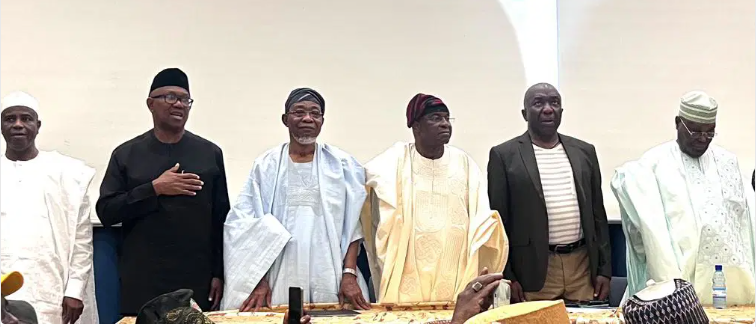
The declaration was made in a communiqué issued after a national summit held in Ibadan on Saturday, where key opposition figures, including Atiku Abubakar, Rabiu Musa Kwankwaso, Rotimi Amaechi, Peter Obi and Rauf Aregbesola, met to chart a common strategy.

Reading the communiqué, the factional chairman of the Peoples Democratic Party (PDP), Taminu Turaki, said: “We shall resist all machinations by the APC to foist a one-party State on Nigeria and fight for the survival of multi-party democracy in our country.”

On the 2027 elections, the opposition dismissed claims of a predetermined outcome, stating: “Despite the onslaughts and manoeuvrings of the ruling party… we shall field candidates and contest the 2027 Presidential and other elections.”

The parties also signalled plans for a united ticket, declaring: “We shall work towards fielding one Presidential Candidate for the 2027 elections, which shall be agreed and supported by all participating opposition parties to rescue our nation and her long suffering masses.”

Raising concerns about the electoral umpire, the communiqué stated: “The INEC Chairman, Joash Ojo Amupitan, having shown bias and partisanship in favour of the ruling APC, should not conduct the 2027 general elections.”

Maduka College Advert

It further warned: “His continuous stay in office is vexatious and capable of triggering widespread crisis in our nation.”

On electoral reforms, the opposition urged lawmakers to act swiftly, saying: “The National Assembly should immediately review the Electoral Act, 2026 to remove all sections that threaten the sanctity and integrity of the elections.”

The communiqué also addressed alleged political repression, stating: “All leading politicians that are being detained or harassed on bailable offences be released with immediate effect and allowed to exercise their fundamental rights of participation and inclusivity as Nigerians.”

Criticising recent electoral guidelines, the parties said: “We consider the recent guidelines released by INEC as obstacles, deliberately engineered to impose conditions and deadlines on the opposition parties,” adding, “INEC [should] extend the deadline for primaries till the end of July, 2026.”

Earlier in his address, the host governor, Seyi Makinde, warned that Nigeria’s democracy was facing a gradual erosion due to increasing political concentration and the weakening of opposition parties.

He stated: “Across Nigeria today, we are witnessing a level of political concentration that should concern all of us… taken together, they point to a pattern where the space for real political competition is disappearing.”

Makinde cautioned that democracy “is not destroyed overnight,” but “weakened step by step,” stressing that “when opposition becomes ineffective, democracy itself begins to lose meaning.”

He emphasised that democracy must be defined by “the existence of real alternatives” and warned that without this, “what we have may still be called democracy, but it will no longer function as one.”

Highlighting the significance of Ibadan as the venue, he noted: “Ibadan has always served as the political capital of southwest Nigeria… this gathering… carries that same responsibility” as past historic constitutional conversations.

The governor also clarified the intent of the summit, saying: “It is not a gang-up against one man; and it is not about individual ambitions to be president. It is about the collective ambition of the Nigerian people to have a democracy properly defined.”

Makinde, however, warned that: “Democracy without opposition is not democracy, it is a slow drift toward a one-party State. And Nigeria must not make that drift,” urging stakeholders to “think clearly, speak honestly, and act with a sense of responsibility that goes beyond party lines.”

In his intervention, political economist and strategist, Pat Utomi, painted a stark picture of the country’s economic hardship, using a personal experience to illustrate the widening gap between living costs and citizens’ income.

He said: “Let me begin with a simple experience from yesterday. I set out to buy fuel, and by the time I was done, I had spent nearly 250,000 naira just to fill my tank.“

“At the same time, I came across a report showing that a large percentage of Nigerians live on less than 100,000 naira a month. That contrast is not just troubling, it is absurd. If that doesn’t reveal something fundamentally broken in our system, then nothing will.”

Utomi noted that the crisis extended beyond fuel prices, stressing: “Food prices are rising, insecurity continues to disrupt agriculture, and ordinary people are struggling to survive.“

“Yet we are often told to ‘be patient,’ that things will improve with time. But patience means very little to those who are hungry today.”

Reflecting on Nigeria’s past, he added: “In the years leading up to independence, Nigeria was not industrialised, but there was a clear vision. Within a few years, manufacturing began to grow significantly. There was direction, there was purpose.”

He argued that the country’s challenges were not only economic but moral, stating: “Leadership without character cannot build a nation. The crisis we face today is not only economic—it is moral.”

Utomi further emphasised Nigeria’s untapped potential, saying: “Every region has resources, talent, and potential. Yet we have become overly dependent on oil, neglecting other sectors and weakening our economic foundation.”

Calling for urgent reforms, he said: “We need leadership with character. We need policies that reflect our realities, not borrowed solutions that do not fit our context. Above all, we must listen to the voices of the people.”

He expressed optimism that: “The situation we face is serious, but it is not hopeless. With the right leadership, the right values, and a shared commitment to progress, we can rebuild this nation and create a future that works for all.”

Also addressing the summit, the National Chairman of the African Democratic Congress (ADC), David Mark, described the gathering as a critical moment in Nigeria’s history, calling it “an urgent response to our nation’s call to patriotic duty.”

He said: “My prayer is that history will remember us, that when the nation cried out to be rescued, we answered. When children went to bed hungry, we answered, when proud, hardworking citizens were turned to beggars; we answered.”

Raising alarm over insecurity, Mark stated: “Across the length and breadth of our country, insecurity has become a defining feature of daily life. Nigeria faces a historic challenge.”

Citing grim statistics, he added: “In 2025 alone, Nigeria recorded more than 12,000 conflict-related deaths. Nigeria is now ranked 4th in global terrorism index. At least 15 Nigerians are killed daily, while about 19 people are abducted.”

He criticised the government’s response, saying: “We are a nation that is constantly in mourning, yet the APC-led government is behaving as if all is well,” accusing it of being “preoccupied with election matters and politics of self-succession.”

On democracy, Mark warned: “The essence of democracy is to provide the people with a choice… however, the ruling party has done everything to deny the people of Nigeria this very right to seek an alternative.”

He described the opposition’s task as a “national rescue mission,” stressing: “No single opposition political party, can confront a system so entrenched. We must be united to salvage our nation.”

Mark further alleged deliberate efforts to weaken opposition parties, stating: “The move towards a one-party state is real, institutions that should safeguard our freedom, are increasingly under assault.”

He insisted that the struggle transcended politics, declaring: “This contest is between the ruling party APC, and the Nigerian people, we are on the side of the people.”

Questioning the credibility of the electoral body, he said: “When the referee clearly and proudly wears the jersey of one of the teams, then the legitimacy of the entire process is undermined,” adding that Nigerians had lost confidence in the Independent National Electoral Commission (INEC).

He called for unity and sacrifice, noting that: “Let this summit go down in history as the moment when everything changed, we chose unity over division, sacrifice over self, and country above all.”

Continue Reading

Trending

Maduka College Advert