International
Iran names Khamenei’s son Mojtaba new supreme leader


Iran has named Mojtaba Khamenei as the country’s new supreme leader following the killing of his father, Ali Khamenei, according to state media reports cited by Al Jazeera.
Iran’s Assembly of Experts announced the decision on Sunday, saying Mojtaba Khamenei was selected after what it described as a “decisive vote.”

In a statement circulated by state media, the clerical body called on Iranians to maintain unity and support the new leader.
It urged citizens, “especially the elites and intellectuals of the seminaries and universities,” to pledge allegiance to the leadership and preserve national unity.
The appointment comes days after the death of Ali Khamenei, who had served as Iran’s supreme leader since 1989.

He was reportedly killed on February 28 during a joint United States and Israeli air operation targeting leadership sites in Tehran amid escalating conflict in the region.
His death triggered intense speculation over who would succeed him, with Mojtaba Khamenei widely considered one of the frontrunners despite concerns within Iran’s political and religious establishment about the possibility of hereditary leadership.
Mojtaba, a mid-ranking cleric believed to have strong ties to Iran’s powerful Islamic Revolutionary Guard Corps, has long wielded significant influence behind the scenes in the Islamic Republic’s political system.
Before the announcement, Donald Trump had publicly opposed the prospect of Mojtaba becoming Iran’s leader, reportedly describing him as a “lightweight” and suggesting he should not be allowed to play a role in determining the country’s leadership.
Iran’s constitution assigns the Assembly of Experts the responsibility of selecting the country’s supreme leader, the highest authority in the Islamic Republic, with ultimate control over state policy, the military and the judiciary.
Mojtaba Khamenei’s selection marks one of the most consequential political transitions in Iran in decades and comes amid ongoing regional tensions following the killing of his father.
But Tehran’s top diplomat said Sunday that the decision was Iran’s alone, adding it would “allow nobody to interfere in our domestic affairs”.
Speaking on NBC’s “Meet the Press”, Foreign Minister Abbas Araghchi went on to demand Trump “apologise to people of the region” for starting the war.
The younger Khamenei is regarded as a conservative figure, notably because of his ties with the Revolutionary Guards, the ideological arm of the Islamic republic’s military.
Israel’s military had previously warned any successor that “we will not hesitate to target you”.
Air ‘Unbreathable’
Overnight, Israel struck five oil facilities in and around Tehran, killing at least four people and sparking blazes that left the skies filled with acrid smoke.
Tehran’s governor told the IRNA news agency that fuel distribution had been “temporarily interrupted” in the capital.
A dark haze hung over the city of 10 million people, blocking out the sun, and the smell of burning fuel lingered in the air.
Authorities warned the fumes could be toxic and urged citizens to stay indoors, but many windows were blown out by the force of the blasts.
“The blaze has been burning for more than 12 hours; the air has become unbreathable. I can’t even go out to do the daily shopping,” said one 35-year-old from Tehran.
“At first, I supported this war. After Khamenei’s death, I celebrated with my friends: we drank wine and we danced.
“But since yesterday… people say there’s not even any gasoline left at the gas stations,” she said, in a text message to contacts in Europe.
As the war extended into its ninth day, Iran’s Revolutionary Guards said they had enough supplies to continue their drone and missile war over the Middle East for up to six months.
Several blasts were heard over Israel’s commercial hub Tel Aviv after the Israeli military said it had detected a salvo of missiles from Iran. The Magen David Adom emergency services said six people were wounded in central Israel.
Advanced Missiles
Trump again refused to rule out sending American ground troops into Iran but continued to insist that the war was all but won despite the ongoing Iranian missile and drone strikes.
Guard’s spokesman, Ali Mohammad Naini, said Iran had so far used only first- and second-generation missiles but would use “advanced and less-used long-range missiles” in the coming days.
Saudi Arabia said on Sunday that two people were killed and 12 wounded by a “military projectile” in Al Kharj province, having earlier said it intercepted a wave of drones headed for targets including the diplomatic quarter of its capital, Riyadh.
Kuwait, meanwhile, said an attack hit fuel tanks at its international airport, and Bahrain reported a water desalination plant had been damaged.
Iran’s health ministry said Sunday that at least 1,200 civilians had been killed and around 10,000 wounded — figures AFP could not independently verify.
Lebanon’s health minister said at least 394 people had been killed in Israeli air strikes since Lebanon was dragged into the war a week ago, including 83 children and 42 women.
Two Israeli soldiers have been killed during the fighting in southern Lebanon, the military said.
Trump, meanwhile, attended the return of the bodies of six American service members killed in a drone strike on a US base in Kuwait last Sunday.
No Clear Way Out
Analysts warn there is still no clear path to ending a conflict that US and Israeli officials say could last a month or longer.
Trump has suggested Iran’s economy could be rebuilt if a leader “acceptable” to Washington replaces the late Supreme Leader.
On Sunday, Pope Leo XIV prayed “that the roar of the bombs may cease, the weapons may fall silent, and a space for dialogue may open.”










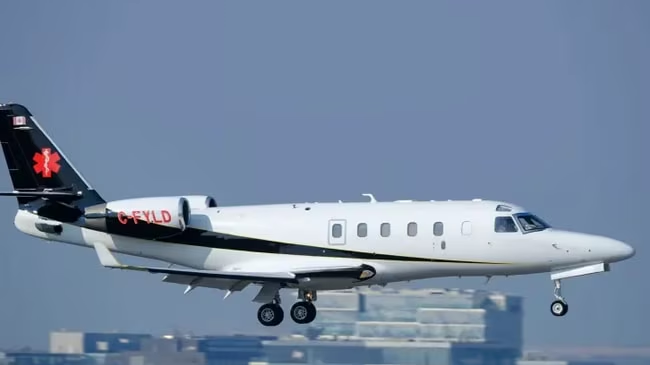
There are grave fears for the passengers of a private plane that suddenly vanished mid-flight, sparking a major search off the coast of the US.
US authorities say the Gulfstream G100 lost contact with air traffic control about 2am local time on Saturday (4pm Saturday AET) while flying from L.F. Wade International Airport in Bermuda to Boston Logan International Airport.
The US Coast Guard said the Federal Aviation Administration alerted it after contact was lost with the aircraft – which plummeted from 23,500 feet to 11,000 feet in just three minutes, according to FlightAware data.
“We are praying for a safe outcome,” a spokesperson for Latitude Air Ambulance, which operates the missing plane, told City News.
A search is now under way off Nantucket in the air and on water as crews work to locate the missing jet, the Coast Guard said. Data from FlightRadar24 showed a number of aircraft searching south of the island.
Six people are missing after a private jet vanished, sparking a major search off the coast of Nantucket in the US.
The plane was en route from Bermuda to Boston when it vanished.
“Air & surface crews have launched in search of the aircraft. Updates will be provided here as info becomes available,” the Coast Guard Northeast District said on X.
The plane was carrying out a medical evacuation in Bermuda – a British overseas territory in the north Atlantic Ocean, according to Clarence Togeretz, Director of Flight Operations at Latitude Air Ambulance.
“We always get rather concerned when our crew doesn’t report to us in a timely manner,” he told NBC News.
“But I will say that again, optimistically and positively, that doesn’t mean that the worst has happened.”
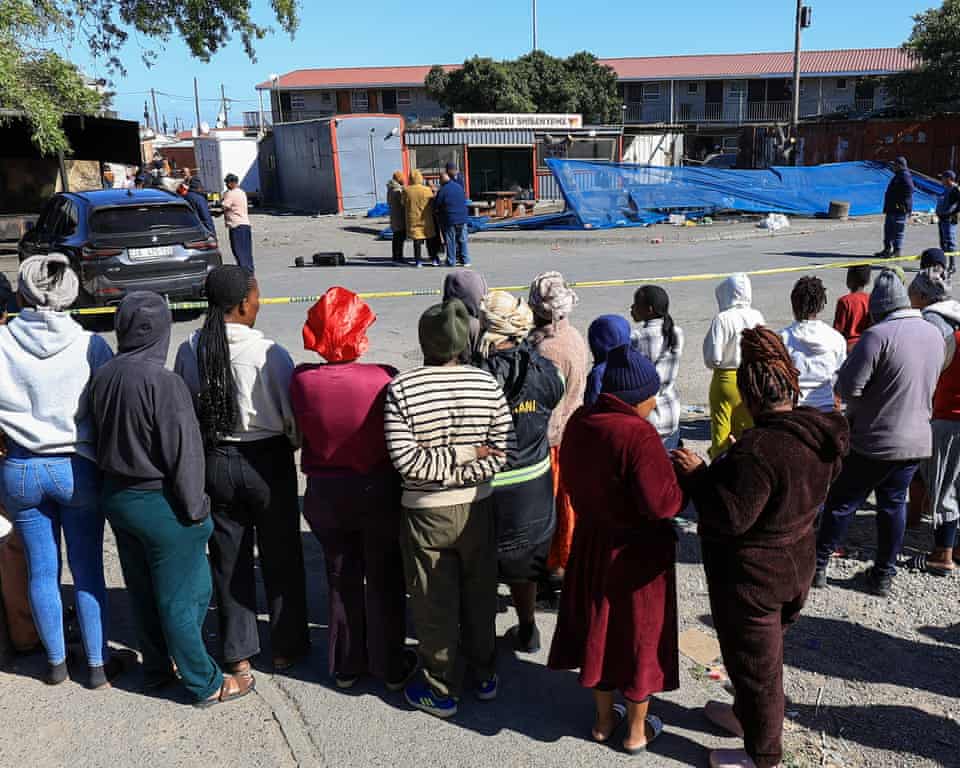
Seventeen people were killed when eight gunmen stormed a bar close to Johannesburg on Saturday evening, with 15 more injured.
In a separate shooting in the early hours of Sunday morning, 10 people were killed outside an entertainment venue in a township near Cape Town and a further 11 were injured.
South Africa has one of the highest murder rates in the world and has struggled to contain gang-related gun violence in recent years. Police have not indicated a motive for either of the latest attacks.
In Johannesburg, gunmen opened fire on customers outside the bar before continuing the attack inside and torching two vehicles before fleeing.
Police said thirteen men and four women were killed.
Deputy provincial police commissioner Maj Gen Fred Kekana said the attack may have been a retaliation for an incident last month, in which one person was killed and another wounded, according to AFP news agency.
Speaking at the scene, he said police had clear pictures and in some cases names for the suspects.
In Cape Town, five victims died at the scene and a further five people died in hospital.
No arrests had been made in either case on Sunday morning.
The two mass shootings came days after 11 people were killed in the city of Duban when gunmen stormed a house in the KwaMakhutha township.

Illegal weapons are prevalent in South Africa and gun violence has been a persistent problem for decades, with about 60 murders recorded every day in the country of 62 million.
But a recent spate of mass shootings has raised fears that the problem is deepening, with violence often linked to turf wars between gangs engaged in drug trafficking and illegal mining.
In February, President Cyril Ramaphosa called organised crime “the most immediate threat to our democracy, our society and our economic development”.
Earlier this year the military was deployed alongside police in areas with the highest murder rates in an effort to reduce armed violence.
On Saturday a tenth woman’s body was found in Ekurhuleni, to the east of Johannesburg, with local police saying they were unable to rule out a serial killer operating in the area with similarities between the deaths. (BBC)
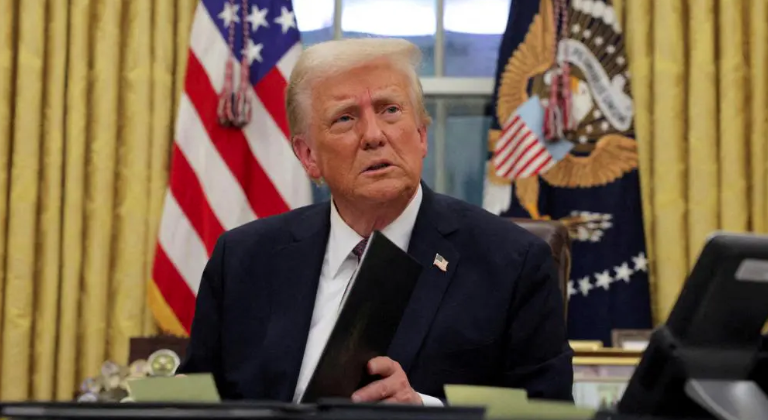
The United States has deported more than 25,000 people under secretive agreements with 35 countries to take migrants with no ties to those nations, according to an investigation published Monday.
Since US President Donald Trump took office in January 2025, Washington has been signing deals with developing countries to take migrants who cannot legally be sent home.
The investigation by Forbidden Stories found the administration has earmarked $410 million to be paid directly to the receiving countries, or to UN agencies to facilitate the returns.
At least 25,447 people had already been deported to third countries by August 31, 2026, according to data compiled by Forbidden Stories with a consortium of international journalists.
The vast majority — around 20,000 — were sent to Mexico, but the rest were dispersed to 27 other countries across Latin America, Africa, and the Pacific, and agreements have been finalised with seven more.
The deals vary, including over which nationalities can be deported and whether people with criminal records can be accepted.
An AFP investigation earlier this year found Washington is using visa bans and restrictions on African countries to strongarm them into accepting deportees.
Lawyers told AFP that deportees were being thrown into a “legal black hole”, held without charge in countries where they have no ties and few if any rights.
Forbidden Stories said 49 of Africa’s 54 countries had been approached about accepting third-country deportees.
A little-known State Department division called the Office of Remigration, created in May 2025, has handled most of the negotiations and payments, according to Forbidden Stories.
The office is headed by Christian Jove Ehrhardt, a 41-year-old diplomat who previously worked as a security officer.
The report details his visits to Cameroon, which signed a memorandum of understanding with the US in December on accepting deportees. A week later, it also signed a five-year health assistance programme worth nearly $400 million.
The following month, the State Department said it would provide a further $30 million to the UN Refugee Agency (UNHCR) in Cameroon to “facilitate the voluntary return of refugees and combat illegal immigration.”
The first plane carrying deportees arrived in Cameroon on January 14.
– Payments –
Other agreements have involved direct payments to governments.
Palau, a small Pacific island nation with a population of under 18,000, signed an agreement in December 2025 to accept up to 75 third-country nationals in return for $7.5 million.
However, only three people have so far been sent under the agreement.
In Eswatini, 32 people have arrived since July 2025 out of a possible 160 under an agreement worth more than $5 million. It has accepted deportees with criminal records, the investigation found.
Of the $410 million planned for the agreements, internal State Department records showed that $81 million was earmarked for signatory governments.
The rest was intended for aid organisations, including more than $178 million for the UN’s International Organisation for Migration, and $123 million for UNHCR.
The agencies have faced criticism over their involvement, although UNHCR told Forbidden Stories that it was not party to the bilateral agreements and that US funding was being used in line with its mandate to strengthen asylum systems.
An IOM spokesperson told Forbidden Stories that the agency’s decisions to accept funding rested “on a single question: whether our engagement will improve the lives of the migrants affected. In these instances, we believe strongly it does.”
-
 News2 days ago
Why UK varsities are cancelling Nigerians’ admission — Report
-
News1 day ago
2027: Enugu Accuses Opposition of Plotting to Import Armed Thugs, Bandits
-
News3 days ago
US asks American business executives to be wary of insecurity, corruption, detention risk in Nigeria
-
News2 days ago
Alleged Magistrate Court Order To Arrest Araraume, Okorocha Is Fake, Non-Existent — Imo First Group
-
News2 days ago
2027: Over 30,000 Enugu Teachers Endorse Mbah, Tinubu, List Welfare, Increased Education Funding
-
News2 days ago
Benue APC Delegation Involved in Ghastly Accident En Route to Rally
-
News2 days ago
Why men with braids, tattoos were banned from mosque, Ogun Chief Imam clarifies
-
News2 days ago
Man stabs wife in Anambra community, kills himself with poison