News
UNIJOS dental students protest against 10 years without graduation

…As ESUT Medlab Department fails to induct graduates after nine years on a five-year programme
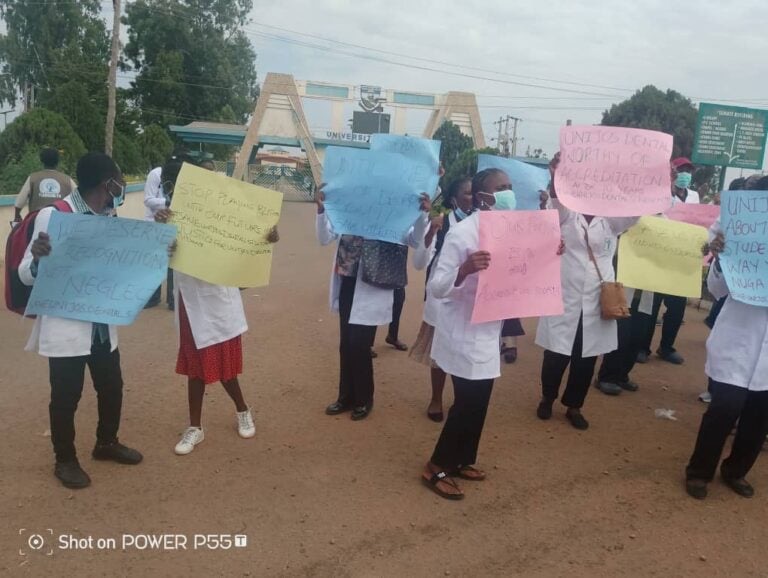
Dozens of University of Jos dental students have taken to the streets to protest the non-accreditation of their courses, which has resulted in them spending over ten years in school without graduating.
This is as the graduates of Medical Laboratory Sciences of the Enugu State University of Science and Technology (ESUT) have been frustrated on one spot for nearly four years.

The UNIJos students, on Wednesday, blocked the university gate at its Permanent site, singing solidarity songs and carrying placards with different inscriptions which read, “Save us from unending depression,” “Our future is on hold,” “Accredit us now,” and “We are tired of UNIJOS,” among others.
The President of the Jos University Dental Students Association, Mr. Johnson Titus, who spoke on behalf of the students, demanded that the management address their plight and provide a solution to their predicament.
“What you see behind me is the frustration of dental students who have been in the university for the past ten years without graduating. We have been stagnating because of the non-accreditation of our programme.

“The students are calling on the university management and relevant authorities to come forth and address their issues, which include getting a date for accreditation and resolving the curriculum problems,” Titus said
The student leader who blamed the university for their plight added, “Nobody should blame us because if the university is going to do screening and admission, they don’t usually inform students that there is no accreditation for the affected programme.
At ESUT, the Vice-Chancellor and Dean of Faculty of Basic and Allied Medical Sciences, could not offer any explanation as to why they have not been able to conduct any further Induction of their Medical Laboratory Sciences graduates since 2022.

This is irrespective of the Council of Medical and Laboratory Sciences having given approval for 250 graduates for the institution.
Several of ESUT Medlab students who had since completed all they were required to have done prior to induction, passing all the internal and professional examinations as prescribed and after having paid the necessary fees required for their induction, are facing despondency, frustration and getting dejected as to why they chose that University.
Of the backlog graduates of the department, still awaiting induction, those who took exams and passed in 2022 up to the batch that qualified in June, this year, are all holes up from progressing with their career path, simply because the university has refused to perfect the necessary arrangements with the Laboratory Sciences Council, the professional/accrediting body to fix a date for their induction.
The Vice-Chancellor and Dean of the Faculty are aware that the students are still required to embark on another process of their training, known as Internship and thereafter proceed for the National Youth Service Corps (NYSC) programme.
However, with this needless and wicked delay, most of their students would have clicked 30 years and so, would automatically be exempt from NYSC and become ineligible for apply for employment, especially in organisations or agencies where entry age limit is required.
Unlike the UNIJos students whose President elected to speak, the Student Union President of ESUT Medical Laboratory Sciences Students, refused to speak for fear of intimidation.
The Head of Department of Medical Laboratory Sciences, Dr. Miriam Aniagolu, when contacted said the university is doing its best to see that the induction is carried out before the end of the year, a statement she has repeated severally since her appointment over a year ago.
“We are doing our best. The Senate has approved their results, it is remaining for us to get a date from the Council for their induction,” she stated.
However, when asked why they should subject their students to such debilitating situation, she has nothing more to say.
When she was also reminded that same set of students had three years ago demonstrated over the protracted delays in the academic programme, she cut off the telephone interview.
Neither the Vice-Chancellor of ESUT, Prof. Aloysius-Michaels Okolie, nor Chairman of the Governing Council, Sir. Chinyeaka Ohaa, were willing to make any comment on the matter, when they were contacted.




The Anambra State Police Command has arrested a man, identified as Chima Ofoeke, over the suspected murder of 23-year-old Mmesoma Umeorini in Uga, Aguata Local Government Area of the state.
The arrest followed a report by the deceased’s mother to the Divisional Police Officer (DPO) of Umuchu Division that her daughter had been missing since October 16, 2026, despite efforts to locate her.

According to the police, operatives, working with members of the Agunechemba security outfit in Uga, apprehended the suspect following intelligence-led information.
The suspect was identified as the deceased’s alleged former boyfriend.
During preliminary interrogation, Ofoeke allegedly confessed to killing the young woman following the breakdown of their relationship. He reportedly led detectives to the location where her remains were discovered and recovered.
Following the development, the Commissioner of Police in Anambra State, CP Nnanna Oji Ama, has directed that the case be transferred to the State Criminal Investigation Department (SCID), Awka, for a thorough investigation.
The police said the investigation would establish the full circumstances surrounding the incident and ensure that justice was served.
The command reiterated its commitment to protecting lives and property, urging residents to promptly report missing persons and suspicious activities to the appropriate authorities.
It added that further information would be made available as the investigation progresses.
…Assures defects will be addressed
…Threatens to blacklist contractors over defects
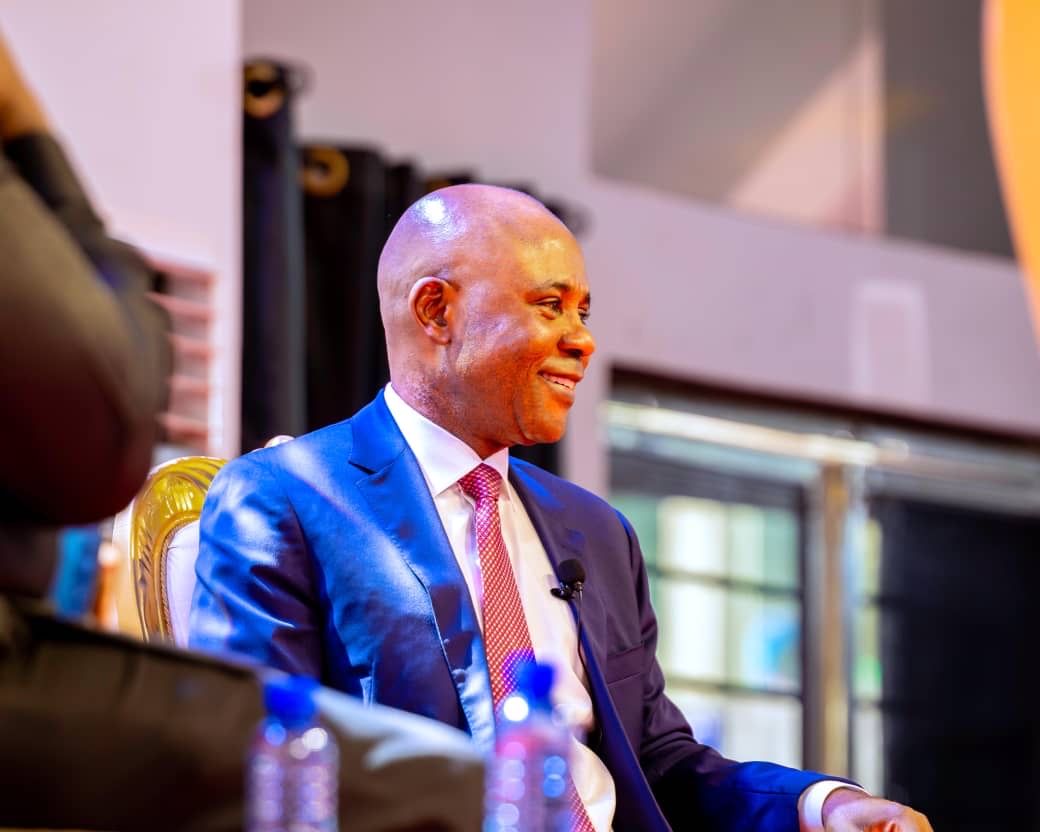
Enugu State Governor, Dr Peter Mbah, has defended the construction of 268 smart green schools across the state, assuring residents that structural defects and other challenges identified in some facilities will be addressed.
Mbah gave the assurance during a town hall meeting, where he explained that the state government deliberately adopted an accelerated approach to the construction of the schools to ensure that every child in Enugu had access to quality education.
According to the governor, the scale of the projects delivered within three years would ordinarily take between 10 and 20 years to accomplish under conventional implementation timelines.
He acknowledged that the speed of execution had resulted in some teething problems, including defects in certain buildings and roofing challenges, but maintained that the government was committed to ensuring that all the facilities were fit for purpose.
“When you have fast-tracked projects at that scale, you are bound to have teething problems, and we are not oblivious of it,” he said, adding that the government was resolved to address the identified shortcomings.
Mbah explained that the decision to build 268 smart green schools was driven by the administration’s determination to expand access to quality education rather than concentrate resources on a few model institutions.
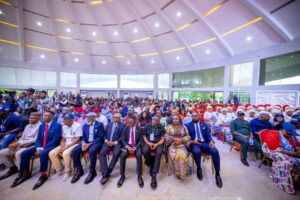
Participants at the Town Hall meeting
He said the government could have opted to construct only three smart schools, one in each senatorial zone, or 17 schools across the state, but chose a broader approach to reach more children.
“We said every child in this state must have access to quality learning, and we did 268 smart green schools,” the governor stated.
He stressed that the administration would not abandon the projects because of the defects identified, adding that corrective measures were already part of the government’s response.
The governor’s remarks come amid concerns over defects reported in some of the newly constructed school facilities.
He maintained that the administration remained committed to ensuring that the projects delivered their intended educational benefits to pupils across Enugu State.
Mbah Threatens to Blacklist Contractors Over Defective School Projects
Governor Mbah also warned contractors handling the state’s smart green school projects that they will face consequences for failing to address defects in their work.
Mbah gave the warning while responding to questions about structural defects and other problems reported in some of the 268 smart green schools constructed by his administration.
The governor said the government had records of the contractors responsible for the projects and would require those whose work was found defective to return to their sites and carry out necessary repairs.

He, however, warned that contractors who refused to comply with the government’s directives would be blacklisted.
“For those that have been recalcitrant, we blacklist. And there are consequences for that,” he said.
Mbah explained that although the projects were executed on an accelerated timeline to expand access to quality education, the fast-tracked approach did not absolve contractors of responsibility for the quality of their work.
He also disclosed that the government obtained advance payment guarantees from the contractors, providing an additional mechanism for enforcing compliance where necessary.
“We do have an option to call those up if it becomes necessary,” the governor said, referring to the guarantees.
The administration has come under scrutiny over reported defects in some of the newly constructed school buildings, including roofing and other structural concerns.
Mbah acknowledged the existence of such challenges but described them as issues the government was determined to resolve.
He said the overriding objective was to ensure that all the smart green schools were fit for purpose and capable of providing the learning environment intended by the state government.
The governor’s comments signal the administration’s intention to hold contractors accountable while continuing its investment in education infrastructure across Enugu State.
News
UBA Commences Contempt Proceedings Against WEMPCO Directors over Alleged Disobidence of Court Order
The Federal High Court, presided over by Honourable Justice Aluko, has granted an application by United Bank for Africa (UBA) Plc for substituted service of Form 49 on directors of Wempco named as alleged contemnors in the case of UBA v. Wempco.
The application forms part of proceedings seeking to determine whether the named individuals disobeyed an order of the court and whether they should be committed to prison for contempt.
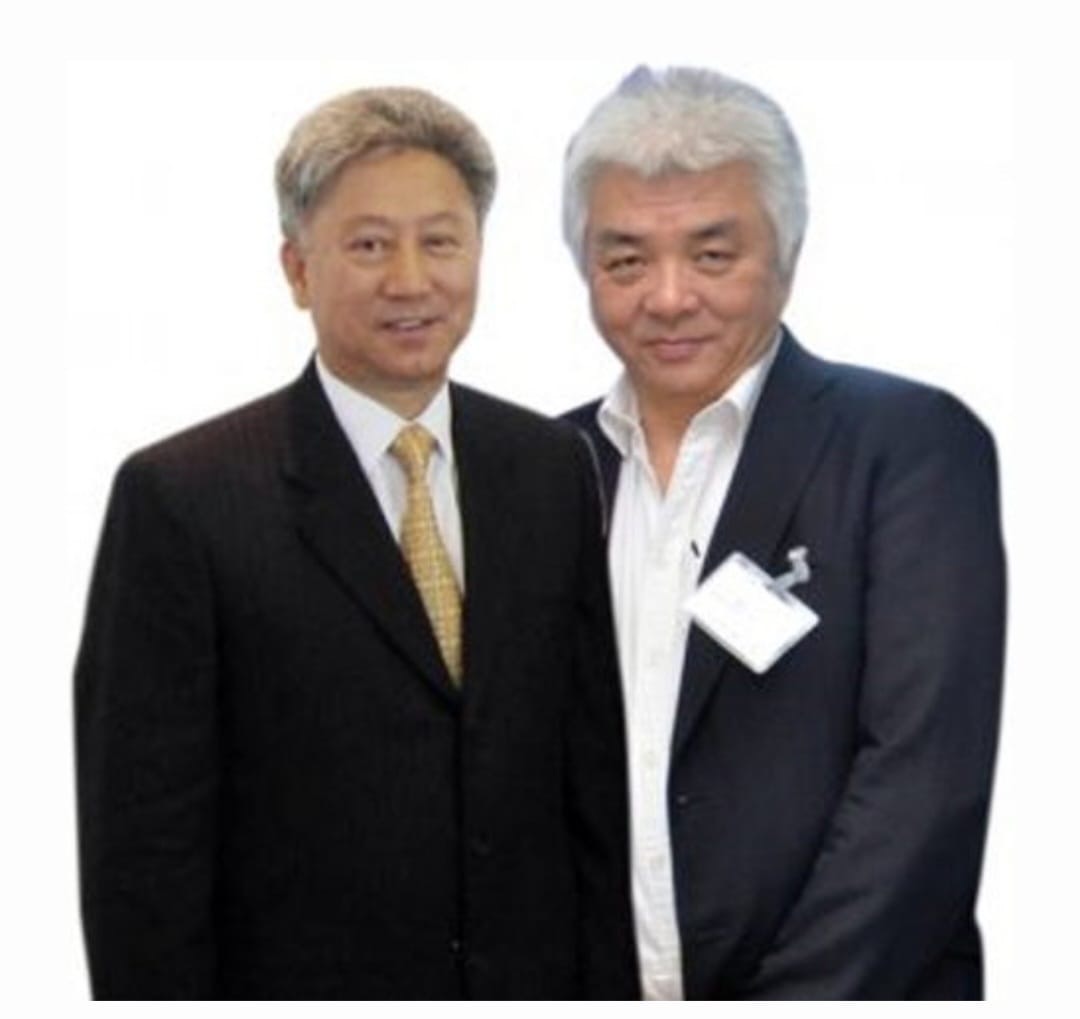
The directors named as alleged contemnors are Lewis Shui Ngor Tung, Phillip Shui Chei Tung, M.A. Ola Yusuf, Tung Lawrence Blake, Aali Aare Hadji Tokunbo, Paul Shui Po Tung, Tung Robert, C.L. Ip and Taiwo Alli.
In advancing the application, counsel to UBA argued that service of Form 49 on the alleged contemnors was necessary to enable them to appear before the court and show cause why an order of committal should not be made against them.
He also argued that the Directors of Wempco and some members of staff took illegal steps in an attempt to disobey the Order of Court.
The court’s decision to grant substituted service provides a procedural step towards bringing the notice to the attention of the individuals concerned in accordance with the court’s directions.
Form 49 is a notice requiring an alleged contemnor to show cause why an order of committal to prison should not be made against them for alleged disobedience of a court order.
The Federal High Court had earlier made an Order of Mareva Injunction and appointed a Receiver/Manager over some of the Assets of Wempco following the indebtedness of Wempco to UBA in the sum of N61,445,695,993.76 (Sixty One Billion FourHundred and Forty-Five Million Six Hundred and Ninety Five Thousand, Nine Hundred and Ninety Three Naira, Seventy Six Kobo).
-
 Features2 days ago
Kogi’s Kidnapping Crisis: Why Do Forests Remain Safe Havens for Criminals Under Ododo’s Watch?
-
News2 days ago
Kidnappers kill seven-year-old boy after ransom demand
-
News3 days ago
“It’s not debatable, we can’t go back,” Mbah Backs Tinubu on Fuel Subsidy Removal
-
News3 days ago
Mbah: Enugu Now Produces 120 Million Litres of Water Daily, Expands Agricultural Investment
-
Politics3 days ago
Mike Igini: Politicians Infiltrate Agencies Responsible for Election Personnel as Electoral Laws Go Unenforced
-
News19 hours ago
Macron Postpones Planned Visit to Nigeria Until 2027
-
Politics20 hours ago
2027: Atiku, Obi, Duke, Others in Talks on Single Opposition Candidate – Coalition
-
News17 hours ago
Enugu CP Orders Probe into Death of Izuchukwu During Police Raid