Connect with us

News

Dangote Refinery promises steady fuel supply during festive season, says output exceeds demand

Published

on

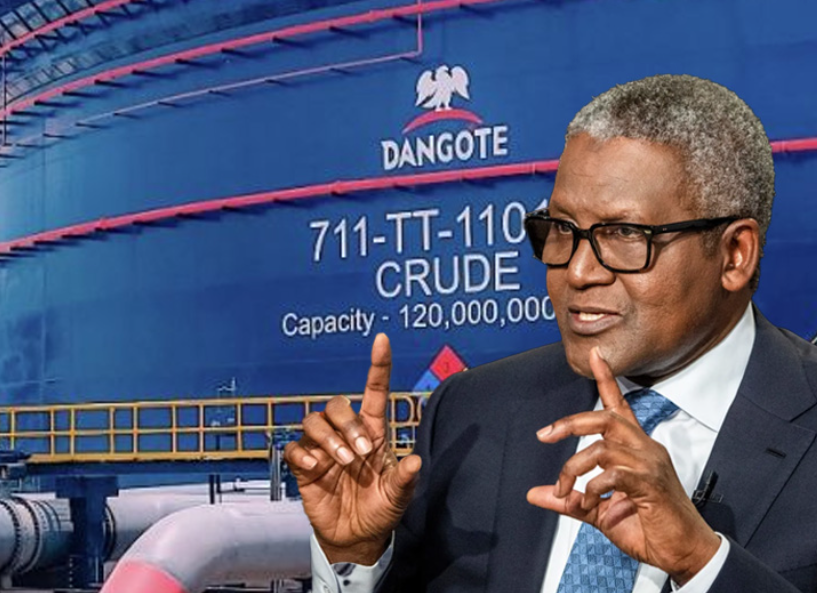
Aliko Dangote at the Refinery
Spread the love

The Dangote Petroleum Refinery has pledged a steady supply of petrol and diesel nationwide during the upcoming festive period, as its daily output now exceeds Nigeria’s consumption capacity.

The Group Chief Branding and Communications Officer of Dangote Industries Limited, Anthony Chiejina, said in a statement on Saturday, that the refinery currently dispenses over 45 million litres of petrol and 25 million litres of diesel daily.

He stated, “Our production capacity surpasses national demand.

“We are collaborating with regulators and distributors to ensure efficient delivery across the country. Dangote remains committed to powering Nigeria.”

He noted that increased domestic refining has helped stabilise the naira by reducing foreign exchange outflows and supporting local currency inflows.

Defending the government’s new tariff policy, Chiejina described it as a necessary measure to shield local industries from unfair foreign competition and product dumping.

Maduka College Advert

“Dumping destroys jobs and discourages industrial growth,” he warned, urging stricter enforcement to stop the importation of substandard petroleum products that threaten public safety and local producers.

Chiejina also commended President Bola Tinubu for endorsing the tariff regime, calling it a “bold and visionary step” toward energy independence and economic renewal.

He cautioned that without such protection, cheap petroleum imports from Asia and Europe could cripple domestic refineries and derail ongoing reforms.

Equipped with cutting-edge technology, the Dangote Refinery aims to eliminate Nigeria’s reliance on imported fuels and maintain price stability.

The President of Dangote Industries Limited, Aliko Dangote, assured all that fuel prices would remain steady during the Christmas and New Year celebrations.

“Nigerians can expect a festive season without fuel queues,” he said.

Since commencing petrol production in September 2024, the refinery has been instrumental in lowering fuel prices.

Petrol, which sold for about N1,030 per litre a year ago, now averages N841–N851, while diesel has dropped from N1,700 to roughly N1,020 per litre.

Meanwhile, petrol costs between $1.20 and $2.00 per litre in neighbouring West African countries.


News

Stop bringing cows, rams to judges, retiring S’Court Justice tells politicians

Published

on

Spread the love

• Reveals how judiciary ‘frustrated’ military before June 12, 1993 annulment

A retiring Justice of the Supreme Court, Ibrahim Saulawa, yesterday cautioned politicians against attempting to sway judicial officers with what he described as “Greek gifts.”

Retiring from the bench on reaching the mandatory age of 70, the jurist insisted that action must be taken against the practice of politicians gifting cows and rams to judges, adding that he had previously raised the matter with the Chief Justice of Nigeria.

“Why should a politician send a ram, cow or other items to a Supreme Court Justice? It is unheard of in other countries.

“I am calling on the CJN to do something about this. I once raised the issue. It is demeaning and equally frustrating,” added Justice Saulawa, who bowed out of the bench after a 44-year journey in the legal profession.

He spoke at a valedictory court session the apex court held in his honour.

While urging judges across the federation to embrace a culture of integrity, honesty and morality, the retiring Justice recalled a case in which an influential person he later convicted had tried, before judgment was delivered, to influence him through proxies after he declined a gift of a car.

Maduka College Advert

“Prior to the case, the Alhaji had donated to me a brand new Peugeot motor vehicle, which I flatly rejected.

“He went to the extent of seeking the intervention of some prominent personalities, including the Emir, Alhaji Muhammadu Kabir Usman, the District Head, Alhaji Balan Goggo, et al., with a view to influencing me to accept the ‘Greek gift,’ but to no avail,” Justice Saulawa added.

Only six Senior Advocates of Nigeria (SANs) and 13 other lawyers attended the jurist’s valedictory session on Tuesday, in contrast to similar ceremonies in the past that attracted serving and former governors and other eminent personalities.

A representative of the Body of Senior Advocates of Nigeria (BoSAN), Mr. Damien Dodo, SAN, who declared that he was embarrassed by the poor attendance of lawyers, blamed it on miscommunication, saying it was not a reflection of the personality of Justice Saulawa, who, he said, served the country “with granite integrity.”

The outgoing jurist disclosed that, while in service, he had, in a bid to safeguard his principles, turned down several invitations to attend social gatherings.

“But some of my learned friends are always there, even if they didn’t need to be there,” he noted.

Recalling the crisis that led to the annulment of the June 12, 1993 presidential election, Justice Saulawa said that, as the Chief Registrar of the Court of Appeal at the time, he took steps to stem the tide of conflicting court orders which, he said, were orchestrated by the military.

He noted that while the FCT High Court issued two interim orders that restrained the Professor Humphrey Nwosu-led National Electoral Commission (NEC) from conducting the presidential poll and from announcing the results, some state high courts issued conflicting orders directing that the results be announced.

Insisting that the legal confusion was masterminded by the military, Justice Saulawa said he acted on the directive of the then President of the Court of Appeal (PCA), Justice M. Akanbi, by swiftly moving to Kaduna to take control of the appellate court’s registry.

“Appeals were filed at the Court of Appeal, Kaduna Division, by the NEC. As the Chief Registrar of the Court of Appeal, and the only spokesperson thereof, I flew from Lagos to Kaduna and took effective control of the Registry and supervised the registering of the appeals and the issuing of the appropriate court processes to the respective parties to the appeals.

“I equally issued a press release regarding the circumstances surrounding the two appeals and motions relating to..”

“Later in the evening, I flew back to Lagos and briefed the PCA, Hon. Justice MMA Akanbi, a man of unquestionable integrity and unwavering courage. Upon my advice, the Hon. PCA called for an emergency meeting of the Hon. Presiding Justices over the crisis,” he added.

He said it was after every effort the military made to infiltrate the judiciary “was frustrated by myself and Justice Akanbi” that the then Head of State, General Ibrahim Babangida, annulled the outcome of the presidential contest on the excuse that he was saving “the judiciary from self-destruction.”

While faulting the military for engaging in “forum shopping,” which he said led to all the conflicting court orders, Justice Saulawa insisted the judiciary at that time deserved “a gold medal.”

“We actually did all we could do to frustrate the military,” he added.

Meanwhile, the CJN, Justice Kudirat Kekere-Ekun, in her address at the valedictory court session, extolled Justice Saulawa’s virtues, describing him as “a man whose life has been defined by service.”

The CJN recalled the time the retiring Justice was serving as the Presiding Justice of the Port Harcourt Division of the Court of Appeal, saying: “There was, during that period, a particular moment which has remained with me, because of what it revealed about the values we both held dear.

“A situation arose which called for a clear and principled response to an attempt, however discreetly made, to place a matter of personal benefit in the path of judicial duty.

“Without hesitation, we each took the position that the integrity of the judicial office admits of no compromise and that even the appearance of impropriety must be guarded against.

“What followed was a quiet but unmistakable affirmation of a principle that needed no elaborate expression: that the honour of the judicial office is preserved not merely in our judgments from the Bench, but also in the choices we make when no judgment is being written.

“I believe that moment deepened my appreciation of my Lord’s character and, in its own quiet way, helped to define the mutual respect and understanding that have characterised our relationship since,” the CJN added.

Continue Reading

News

Flood kills 9 in Bauchi mining pit

Published

on

Spread the love
Nine miners have died after floodwater submerged a mining pit in Nahuta Village, Gwana District, Alkaleri Local Government Area of Bauchi State.The state Police Public Relations Officer, SP Nafiu Habib, confirmed the incident on Wednesday.

He said the incident occurred on Sunday, September 27, when the miners were working at a mining pit that was flooded following heavy rainfall.

According to him, Kasim Abdulsalam, the purchase manager of Zurfi Mining Company in Nahuta, reported the incident to the police.

Habib said the miners were contract workers operating at Pit Three when water flooded the pit after heavy rainfall around 3pm on September 25.

He said some of the miners were rescued, while one victim was electrocuted and rushed to General Hospital, Kashere, in Akko Local Government Area of Gombe State, where he was confirmed dead.

Maduka College Advert

“The DPO Alkaleri led a team of detectives to the scene, where three water pump generators were seen evacuating water from the pit to enable the rescue of the remaining victims,” he said.

Habib said the remaining eight miners were eventually removed from the pit at about 6:20am on September 28 and taken to the same hospital.

He said they were all confirmed dead by a medical doctor.

The deceased were identified as Hamidu Ali, 40, Saidu Abubakar, 29, and Olije Abdulrazak, 25, all from Nasarawa and Kogi states.

Others were Musa Abdullahi, 29, Abdulrahman Mu’azu, 23, and Jafar Abbas, 24, from Bauchi State; Jose Ukese, 28, from Nasarawa State; and Haruna Alkali, 30, from Kebbi State.

Habib said the corpses were released to their relatives after medical examination for burial according to their respective religious rites.

He added that investigation into the incident was ongoing.

Rivers relocates school as flooding submerges homes

The Rivers State Government has relocated students and staff of Community Secondary School, Rumuapara, to State Primary School, Nkpolu, in Rumuigbo, Obio/Akpor Local Government Area, following severe flooding in the area.

The relocation took effect on Wednesday, September 30, 2026, to protect students and staff from the effects of flooding that has submerged the school premises and several nearby houses.

The Commissioner for Education, Dr Peters Nwagor, approved the relocation in a circular obtained by Daily Trust in Port Harcourt.

He said the decision was necessary to safeguard the lives and well-being of students and staff while the government worked towards finding a lasting solution to the problem.

Flooding has affected several communities in Rivers State, particularly in Port Harcourt, displacing residents and destroying property.

NEMA places 15 states on red alert

Meanwhile, the National Emergency Management Agency (NEMA) has placed 15 states on flood red alert as it steps up preparations for possible flooding across the country.

The affected states are Imo, Cross River, Ebonyi, Benue, Anambra, Akwa Ibom, Lagos, Rivers, Edo, Kogi, Taraba, Delta, Bayelsa, Enugu and Abia.

The Head of Operations, NEMA Kaduna Operations Office, Halima Dauda Sulaiman, disclosed this on Wednesday in Kaduna at the opening of a refresher course on Urban Search and Rescue (USAR) for flooding.

Sulaiman, who spoke on behalf of the Director-General of NEMA, said flooding remained the most recurring disaster in the country.

She said the agency was strengthening the capacity of emergency responders to deal with the changing nature of flood disasters.

According to her, lessons from NEMA’s flood operations in 2022, 2024 and 2025 showed that urban flooding was becoming increasingly complex.

“The 2022, 2024 and 2025 flood operations have taught us a hard lesson that urban flooding is becoming more complex.

“We are not just rescuing people from open water; we are navigating through urban settlements with submerged houses, collapsed walls, live electrical hazards and panicked populations,” she said.

Continue Reading

News

Nigeria @66: Difficult reforms over, prosperity next – Tinubu

Published

on

Spread the love

President Bola Tinubu on Thursday declared that the harshest phase of his economic reforms was over, telling Nigerians in his Independence Day broadcast that the country has moved from an “age of reform” into an “age of prosperity,” while issuing a pointed warning against politicians pushing for a return to fuel subsidies ahead of the 2027 general election.

Marking Nigeria’s 66th Independence anniversary, Tinubu used the nationwide address themed “From Reform to Prosperity”  to defend the removal of petrol subsidy and the unification of the naira exchange rate, likening the country to a cancer patient who chose painful treatment over the “morphine” of denial administered by his predecessors.

“Nigeria was like a sick patient who receives the terrible news that he has cancer,” the President said. “His doctor explains that the treatment will be difficult and painful, but that it offers a strong prospect of recovery. The patient has a choice. He can begin treatment, endure its discomfort and fight the disease. Or he can ask only for morphine, dull the pain and leave the cancer to spread.

“For too long, Nigeria’s leaders chose morphine while praying for a miracle that never came.”

Subsidy return agitation

Maduka College Advert

In an unmistakable swipe at opposition figures — including former Vice President Atiku Abubakar, who has in recent weeks pledged to restore a “targeted” petrol subsidy if elected in 2027 — Tinubu urged Nigerians to resist what he called a “siren song” of returning to subsidy payments.

“Now, as certain influential but regressive voices would have us abandon the treatment and return ourselves to the abuse of addictive subsidies, we must resist their siren song,” he said. “We must remember why we began this journey and how far we have already come.”

The President insisted his administration’s reforms had not created Nigeria’s economic weaknesses but had confronted problems that previous governments postponed. “Our reforms did not create the weaknesses in our economy. They confronted them,” he said.

Three and a half years after coming to office, Tinubu said the results of the reforms were “undeniable.” He told Nigerians the economy had grown by more than four per cent in 2026, with both oil and non-oil sectors contributing to what he described as a renewed period of stable growth.

He said oil theft had declined, inflation had fallen substantially from its peak, foreign reserves had been rebuilt, and the foreign exchange market had stabilised. He further disclosed that Nigeria recorded its highest-ever revenue from non-oil exports in 2025, exceeding $6bn.

“This is real money being made by real Nigerian businesses,” he said, adding that international observers, journalists, NGOs and multilateral institutions had all concluded that the reforms strengthened Nigeria’s economic stability and resilience, and that foreign direct investment continued to rise.

‘Emergency treatment over’

Declaring a turning point in his administration’s economic messaging, Tinubu said the “central economic task” before the country had now changed from correcting Nigeria’s course to delivering “shared and widespread prosperity.”

“The emergency treatment is over. The foundation has been repaired,” he said. “For three years, our overriding purpose was to correct our nation’s course. Now, our purpose is simple: shared and widespread prosperity.”

He described prosperity in personal terms rather than macroeconomic statistics: a farmer who can cultivate safely and earn a decent return, factories with reliable power, businesses with access to credit, young people in productive work, and families who can afford food, transportation and education.

Cost of living

On the cost of living, which remains a dominant concern for Nigerian households, Tinubu said his government’s priority was to lower the cost of producing and moving goods Nigerians consume. He listed plans to expand mechanised irrigation and dry-season farming, improve access to seeds and fertiliser, deepen agricultural mechanisation, and invest in storage, transportation, roads, railways and ports connecting farms and factories to markets.

“Our logic is simple,” he said. “When a farmer produces more cheaply, when fewer crops are lost between the farm and the market, when a manufacturer spends less on electricity, when a truck reaches its destination faster, and when the business environment fosters fair competition, all those savings will ultimately find their way into the price of goods in the market.”

Tinubu promises jobs

The President said his government would place “jobs, enterprise, and industrial growth” at the centre of policy going forward, pledging to use domestic gas to power new industries, revive factories in Nigeria’s industrial centres, expand digital connectivity into underserved communities, and invest in skills demanded by employers.

“I want to see more Nigerians making things,” he said. “I want to see more Nigerian farms feeding our cities and supplying our factories. I want to see Nigerian businesses selling Nigerian goods to the whole world. I want young Nigerians building unicorns and creating opportunities for others here at home.”

Poverty, welfare programmes

Acknowledging that millions of Nigerians “cannot wait for tomorrow,” the President said his government was strengthening direct support to the poorest households and improving the National Social Register to ensure assistance reaches those who need it most. He cited the Nigerian Education Loan Fund (NELFUND), which he said allows children of low-income families to pursue higher education regardless of their parents’ finances, and CREDICORP, which provides working Nigerians consumer credit to acquire vehicles, solar systems and other assets without years of prior savings.

He said salaries and pensions had been paid “on time and in full” since 2023, and that the national pension programme had been reformed to benefit retirees and the vulnerable.

“These programmes are not substitutes for prosperity. They are a bridge,” he said. “Our objective is not to manage poverty more efficiently. We will defeat it.”

Red Sea crossed

Tinubu closed the address on a biblical note, describing Nigeria’s economic turnaround as analogous to Israel’s exodus from Egypt. “Nigeria has corrected its course. We have passed through our own Red Sea. This is not the time to look back,” he said. “Our destination is in sight. Our foundations are strong. Our direction is clear. So let us go forward. No looking back.”

The President’s speech comes against the backdrop of continued public pressure over the high cost of living and mounting political positioning ahead of the 2027 election, in which subsidy policy has already emerged as a flashpoint between the ruling All Progressives Congress and opposition candidates, including Atiku, whose camp has faced criticism from the Presidency over shifting positions on petrol subsidy restoration. Punch

Continue Reading

Trending

Maduka College Advert