News
CBEX resumes operations as EFCC probes N1.2tn fraud


Despite the alleged N1.2tn digital trading fraud that reportedly affected over 600,000 Nigerians, the embattled Crypto Bridge Exchange trading platform, accused of these acts, has resumed operations, announcing fresh withdrawal options in a move to restore investor confidence.
Two traders on the CBEX platform confirmed Wednesday that the digital trading firm has quietly resumed operations, allowing new users to register, trade, and withdraw profits, despite ongoing investigations by regulatory agencies.

According to the sources, an insurance verification process and an external audit of the company’s financial records are currently underway to ascertain the actual amount lost in the scheme, which collapsed in April.
They added that existing investors, many of whom have been unable to access their funds for weeks, will be able to take out their funds starting from June 25, 2025, when the audit is expected to be concluded by an insurance firm based in the United Kingdom.
This development comes barely weeks after the Securities and Exchange Commission declared the platform illegal, and the Economic and Financial Crimes Commission confirmed an ongoing investigation into the firm’s operations.

CBEX, a digital investment platform, offered investors 100 per cent profit after 30 days of purported AI trading. The trading platform started operations in 2024 after receiving registration approval from the Corporate Affairs Commission on September 25, 2024, and the EFCC’s Special Control Unit Against Money Laundering on January 16, 2025.
No fewer than 600,000 Nigerians reportedly invested in the scheme and lost N1.2tn after it collapsed on April 14, 2025.
Miffed by the development, the EFCC declared eight persons wanted for promoting the program. They include Johnson Oteno, Israel Mbaluka, Joseph Michiro, Serah Michiro, Adefowora Olanipekun, Adefowora Oluwanisola, Emmanuel Uko, and Seyi Oloyede.
On Monday, Adefowora Abiodun, a prominent leader and trader on the platform, voluntarily surrendered himself to the anti-graft agency for interrogation.
Other regulatory agencies, such as the SEC, also condemned the operations of the suspected Ponzi scheme, warning Nigerians to exercise extreme caution and steer clear of investment platforms that offer unrealistic returns under the guise of digital trading.
However, in defiance of regulatory warnings, fresh findings by The PUNCH on Wednesday revealed that more Nigerians are still being lured by promises of quick profits, with new users flocking to the platform in hopes of cashing in on its resumed operations.
One of the sources told one of our correspondents in confidence due to lack of authorisation to speak on the matter, that withdrawal options on the CBEX platform had been reactivated, noting that while new accounts could process withdrawals, funds from older accounts—allegedly wiped—remained inaccessible for now.
The trader noted that the platform is making efforts to clear its name of any allegations of fraud or any association as a Ponzi scheme.
The source said, “People can now withdraw from the CBEX platform. The withdrawal option has been activated. Let me explain the withdrawal. The old account was wiped; you can’t take out funds from it yet. On the 14th of this month, the Artificial Intelligence on the platform traded 100 per cent, lost its trade, and wiped people’s money out.
“But now, the promoters are saying that the platform and the CBEX application are insured, with verification of funds ongoing by the insurance company. Now, previous investors who have $1,000 as their capital would have to inject $100, and the former account balance would be restored, while persons with over $1,000 would have to put in $200 to bring back the account balance. And we have started seeing people put in these funds to get back their money, and are using it to trade now, as I talk to you.
“According to the latest information shared, previous investors can only trade but not withdraw because the United Kingdom government is carrying out an audit on their financial account, which will be completed between 30 to 60 days. Hence, the reason why previous investors cannot withdraw their funds yet.
“But from June 25th, you can now withdraw up to 50 per cent of your capital from the old account. For example, if you invested $1,000 and you could only withdraw $200 before, from the 25th, you can withdraw $400 from the remaining $800 capital, then from August 25th, you can withdraw the remaining $400 capital. But if you don’t do the verification, it won’t reflect in your account.”
Another source explained that fresh investors are currently able to register new accounts, fund them, and withdraw profits without restrictions, as the newly created accounts are not subject to ongoing audits.
According to the source, only the old accounts remain under financial review.
The promoters also refute allegations of fraud, insisting that funds remain intact and that the ongoing audit was focused on reconciling discrepancies in old accounts.
“Currently, fresh investors can register a new account, fund it, and withdraw their profit. The new accounts are not under audit. It is the old account that is under review.
“What they are auditing is because the Federal Government said they scammed Nigerians of N1.2tn, and they are insisting that the amount is not up to half of the publicised amount. They are claiming only N126bn was lost, and that is the reason for the audit. But new accounts can now start investing and get their money. There is also a bonus for referrals that you can withdraw immediately, and this is ongoing currently.
“They just want to prove to Nigerians that they are not scammers. It was just because AI traded 100 per cent of the funds that the money was lost. There is a new group where people can say whatever they want to say; they also drop signals for trading three times a day, but it is no longer automated; you have to do it by yourself. They would give you a code; you just have to put it in your account and trade. If you notice any abnormality, you can cancel it. That was how it was before AI started doing the trading,” the source stated.
When questioned on why the audit was not conducted by the Nigerian government, a source explained, “The firm is registered in the United Kingdom, not in Nigeria. They merely extended their operations here. In fact, they also have branches in Kenya, South Africa, and Egypt.”
Similarly, messages sent to a new Telegram group created for information sharing showed that a person could withdraw referral bonuses.
Addressing concerns from interested members in a user group, an admin identified simply as Laura stated that the specific cause of the platform’s issues was still under investigation, adding that the findings of the ongoing probe by the UK government would determine what is eventually made public.
The message read, “There are some factors in the incident on April 14th that I cannot tell you in detail. I can only tell you that Al was attacked and the trading strategy was tampered with.
“This is why some users who did not turn on HOSTING were able to survive. And this attack was definitely not from an individual, because Al’s firewall cannot be easily breached. Including the Bybit hacker incident last month, it was definitely not something that an individual could do. This was an organized and premeditated action.
“The specific cause is under investigation, and we need to wait for the official investigation results of the UK government before we make it public. As for this channel, some scammers affected by ST and online rumour mongers who received donations from scammers deliberately stigmatized the compensation.
“Some rumour mongers even claimed that CBEX administrators transferred more than $800m in assets. These are purely slanderous rumours. An exchange’s payment system can’t have only one common account. The payment system will randomly generate deposit addresses. These are all procedures of the exchange Including any wallet we use now will regularly update the deposit address.”
According to her, users must first accept the claims process initiated by the insurance company linked to the ST Fund firm.
She said, “We need to accept the claims processing of the insurance company that the ST fund company is tied to.”
The process involves verifying the authenticity of each account before any compensation can be issued for losses allegedly caused by the AI-related incident on April 14.
She added that many users have already begun receiving compensation.
“Moreover, the impact of this incident on the Internet has seriously exceeded our expectations. The UK government has also been negotiating with the Nigerian government.
“So the EFCC of Nigeria also contacted the CBEX official yesterday and provided absolute evidence through ST, proving that the ST fund company has indeed compensated users for their losses. You know the EFCC of Nigeria… If they are not absolutely sure, how can they have such courage to say to the public, ‘you will get your money back?’”Efforts to get the EFCC’s spokesman, Dele Oyewale, reaction on the latest development proved abortive. He did not pick up calls to his line and was yet to respond to a message sent to him on the matter.
However in furtherance of its investigation, the anti corruption agency has declared a foreign national, Elie Bitar, wanted for his alleged involvement in a cryptocurrency investment fraud linked to the online trading platform, Crypto Bridge Exchange.
In a bulletin released on Wednesday via the commission’s official social media platforms, the EFCC called on members of the public with useful information about Bitar’s whereabouts to contact any of its offices nationwide or reach out through its hotlines and email.
His last known address, according to the EFCC, is Eng. George Enemoh Crescent, Lekki Phase 1, Lagos.
It read, “The public is hereby notified that ELIE BITAR, whose photograph appears above, is wanted by the EFCC for fraud allegedly perpetrated on an online trading platform called Crypto Bridge Exchange,” the statement read.
Meanwhile, the Nigerian Financial Intelligence Unit has issued a strong advisory warning Nigerians against engaging in unregulated digital asset investment platforms, many of which exhibit traits of Ponzi and pyramid schemes.



News
2027: Over 30,000 Enugu Teachers Endorse Mbah, Tinubu, List Welfare, Increased Education Funding
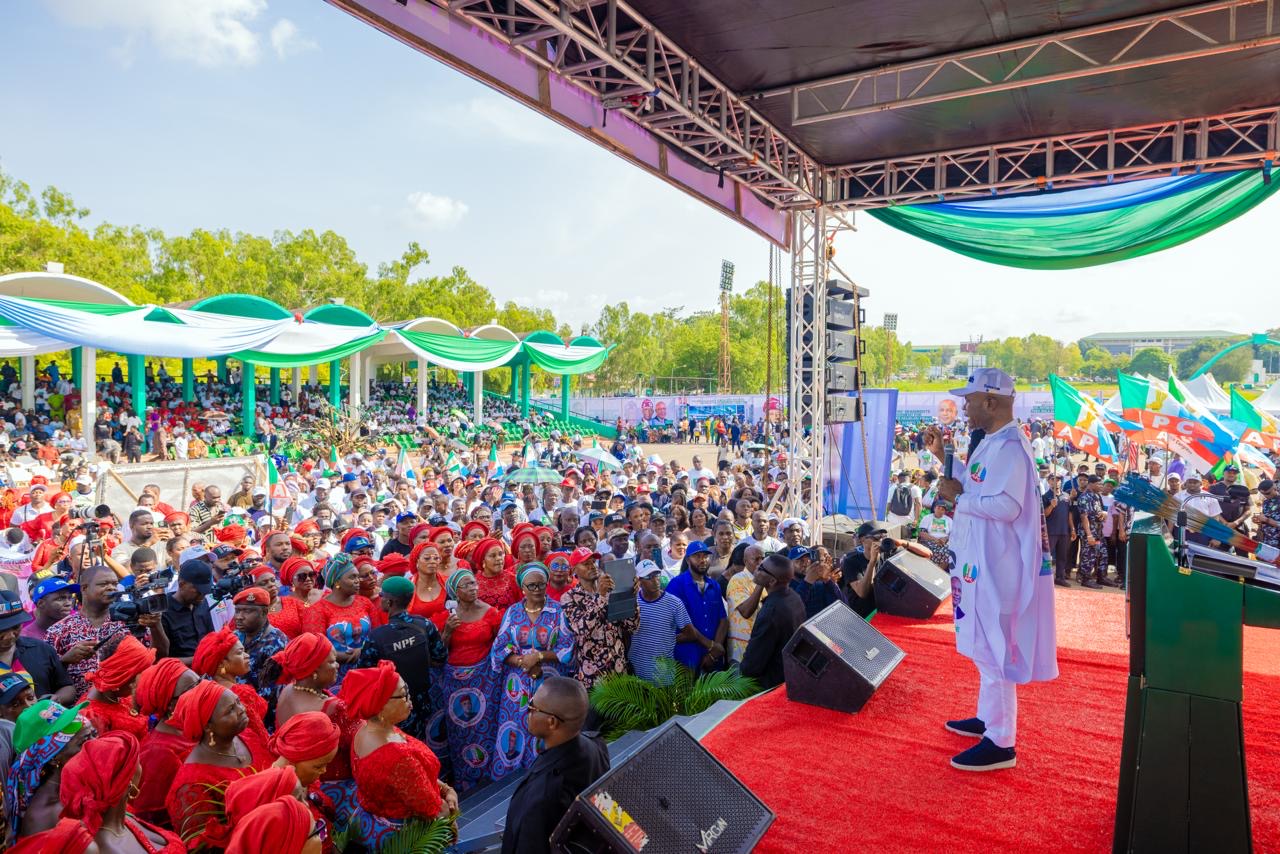
Teachers in both public and private schools in Enugu State have resoundingly endorsed the Governor of the state, Dr. Peter Mbah, for a second term, citing improved teachers’ welfare, increased education funding, promotions and other interventions.
The teachers also endorsed President Bola Ahmed Tinubu, whose economic reforms, Mbah said, had made more resources available to states to embark on massive projects such as the construction of over 267 Smart Green Schools across all the 260 political wards of Enugu State.
The teachers made their position known through over 12,000 of their members, who marched through parts of Enugu metropolis before holding an endorsement rally at Okpara Square, Enugu, on Saturday under the auspices of Teachers for Grassroots Movement (TGM).
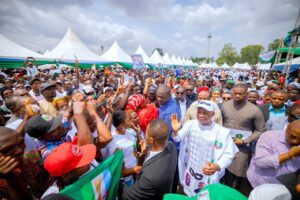
In his address, the Chairman of the Enugu State chapter of the Nigeria Union of Teachers (NUT), Comrade Theophilus Odo, described Mbah as a Godsend, reeling out the concrete steps taken by the Governor to address the challenges that had bedevilled the education sector in the state before now.
“On behalf of the NUT, I want to say that we are happy today because God has given us a caring governor, Peter Mbah.
“He was instrumental to the domestication of the harmonised retirement benefits for the teachers even before he became governor.
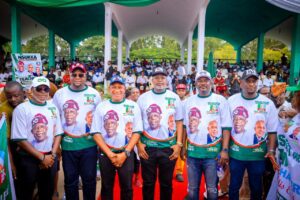
“The building of over 260 Smart Green Schools is a very positive change. Our teachers and children can now compete favourably with their peers in other places.
“He has started recruiting thousands of teachers, and he is also building smart teachers by ensuring that they attend symposiums and other training programmes to gain more knowledge.
“There are no outstanding promotions, and our salaries are coming at the appropriate time.
“So, we, the teachers, are endorsing our governor for a second term in office. The votes of our teachers are only for Governor Mbah,” Odo stated.
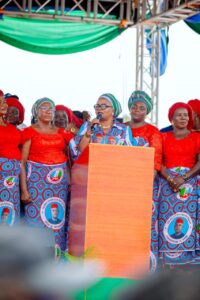
On his part, the Chairman of the National Association of Proprietors of Private Schools (NAPPS) in Enugu State, Nelson Agu, said private school teachers were joining such a rally in the state for the first time ever to encourage what he described as Mbah’s revolution in the education sector.
He noted that the introduction of Smart Green Schools had challenged private schools in the state to improve.
“When you came and started the idea of over 260 Smart Green Schools, we thought we were out of service. But we went and upgraded our schools to meet the required standards.
“Importantly, the idea of allocating 33 per cent of the budget to the education sector for three consecutive years is something to laud your administration for,” Agu told Mbah.
The Chairman of the Trade Union Congress (TUC) in the state, Simeon Akaeme, said the Mbah administration had restored the dignity of teachers and made life better through huge investments in infrastructure and social services.
The Director-General of the Teachers for Grassroots Movement, Dr. Nwakaego Aja, described education as a springboard to liberation, self-reliance and economic development amid the systemic collapse experienced by the nation.
Aja assured him of the total support of the over 30,000 teachers in the state.
“Through experiential learning and innovation, you brought answers to the quest by our nationalists, elevating education to a catalyst for economic development,” she asserted.
“We, the teachers, are not ingrates. We see what you are doing. You promised disruptive innovation, and you have delivered disruptive innovation. That is why we are here.
“We promise you this: we will take your good news to the communities, to the staff rooms, to every market, to every polling unit, and we will deliver. Our vote is for the All Progressives Congress (APC) from bottom to top,” she stressed.
The Commissioner for Education and patron of TGM, Prof. Ndubueze Mbah, said the endorsement by the teachers in their thousands was a tip of the iceberg of the support coming his way and that of the President ahead of the 2027 general election.
He added, “On behalf of every teacher gathered here today, I have one message, and that is to thank you for believing and investing in the vision that it is through education that Enugu State will attain greater heights. You have committed so many resources to giving every Enugu child a future.”
In his remarks, Governor Mbah said the endorsement meant so much to him beyond the 2027 polls, as the future his administration wanted to build for the state depended on education and the teachers.
“Today’s endorsement carries a particular significance, and that is because everything we do, all the promises we have made, all the projections we have made — growing Enugu’s economy, becoming one of the top three states in terms of GDP, making Enugu State the number one state in terms of investment, business, living and tourism — are in the hands of our teachers.
“That is why it appears as if we are insane about education when you consider what we are doing in the sector —building over 7,000 classrooms. And we are not talking about the details because we do not talk about 464 furniture items, we do not talk about 25,000 desktop computers, we do not talk about over 5,000 tablets or the free feeding and uniforms, among others.
“For us, it is about transformation —transforming an education system. And that whole transformation, whether we fail or succeed, would lie largely in your hands.
“That is why, when I say that I see you and I value you, it comes from the depths of my heart because I understand what you go through to inculcate this knowledge into our children so that we can become that great state. So, we love you and appreciate you dearly,” he emphasised.
The wife of the Governor, Mrs. Nkechinyere Mbah, who was represented by the Commissioner for Children, Gender Affairs and Social Development, Mrs. Ngozi Enih, said the endorsement was a great reward for a government that had made education the cornerstone of its development agenda.
The event attracted senior government officials, political and community leaders, among others.
News
Alleged Magistrate Court Order To Arrest Araraume, Okorocha Is Fake, Non-Existent — Imo First Group
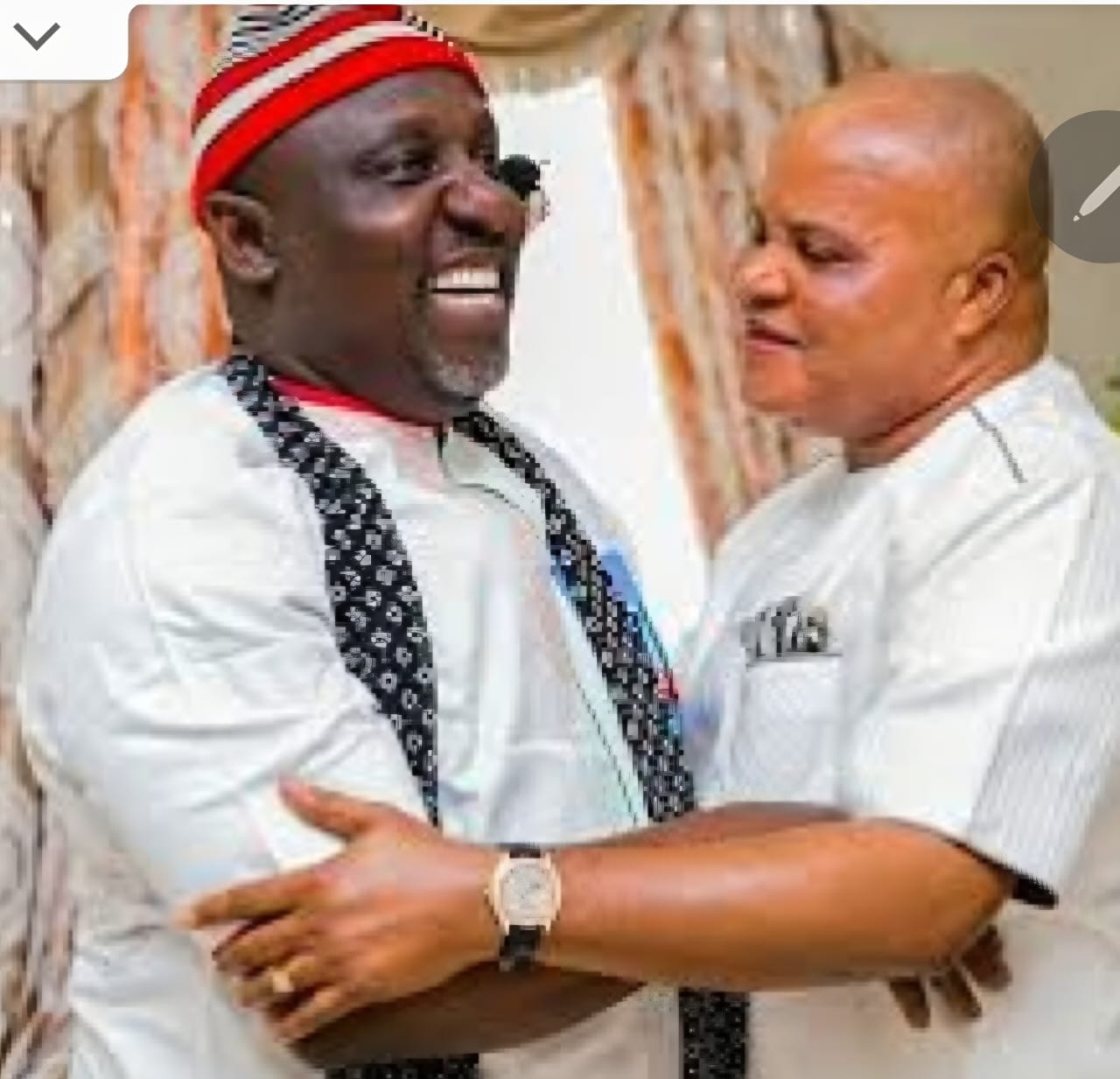
A group, Imo First Group, has described as total falsehood reports circulating online that a Magistrate Court in Abuja has issued an order to arrest Senators Ifeanyi Araraume and Rochas Okorocha.
The group said no such order was ever made, describing it as a hoax fabricated to blackmail two reputable sons of Imo State who have won elections clean and square.
“Purported Magistrate Court Order to arrest Senators Araraume and Rochas Okorocha is a hoax and never existed,” the group said in a statement.
It alleged that purveyors of the falsehood, in what it called their usual gutter politics, attempted to procure an ex parte order from a magistrate but met a brick wall.
“As usual, Imo politics, taken to the gutters, reared its head in a different dimension but was averted by a vigilant magistrate. The purveyors and harbinger of killing anyone who dares to speak the truth came in their guy man way to trick the magistrate via ex parte order but met a brick wall. The magistrate bluntly refused to grant their ex parte (motion) and threatened to arrest them, but yet they carried their falsehood about,” the statement said.
Imo First Group challenged those behind the report to produce the court order or warrant of arrest, insisting that none exists.
“We challenge anyone in this macabre dance to show the court order or warrant of arrest. It’s preposterous to blackmail decent Imo sons on the altar of dirty politics,” it said.
The group took a swipe at the current administration in Imo, questioning its democratic credentials and its record of political elevation.
“What’s the problem of occupants of office that never won free and fair elections before… Those whose palm kernel is cracked by benevolent chi (God) should never forget to be humble. Show us anyone in Imo who has seen light or political elevation in this almost past 7 years of this fraudulent Imo administration. Ask yourself this: Where are those who helped him to move from 4th position in 2019 guber elections to No.1? That issue will soon come up,” it stated.
It warned that the online publication of the fallacy has endangered the magistrate involved, disclosing that the FCT Chief Judge is considering suspending him over the false report circulating on social media.
“Now, the online publication of this fallacy has put the magistrate in danger of losing his job. FCT Chief Judge is about suspending the magistrate based on what is circulating in the social media space,” the group said.
Imo First Group warned that those peddling the falsehood will face prosecution and jail, stressing that politics should not be taken too far.
“Those carrying this falsehood will face prosecution…. People shouldn’t take politics too far. We are in civilised clime, and political matters shouldn’t be treated in a criminal manner. Imo people should be vigilant and say no to those derailing our democracy,” it added.
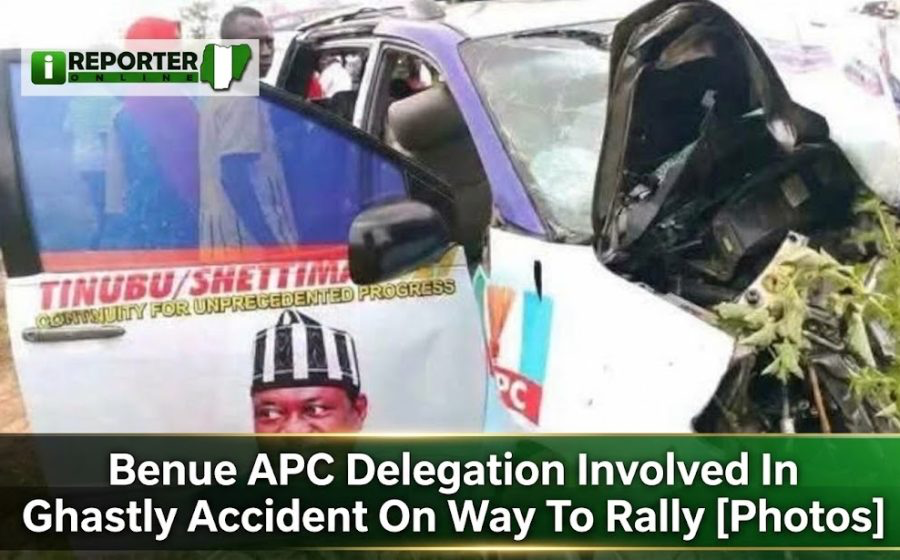
Several members of the All Progressives Congress (APC) from Benue State have reportedly sustained serious injuries following a road accident involving a bus conveying them to a party rally in Lafia, Nasarawa State.
The accident occurred in the early hours of Saturday, October 10, when the bus reportedly collided head-on with another vehicle a few kilometres from the rally venue.
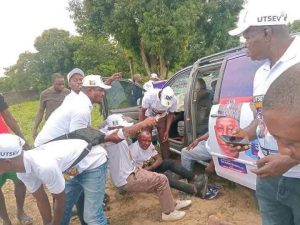
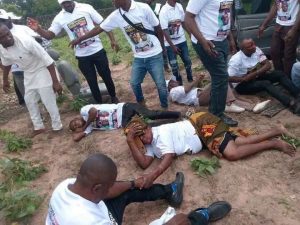
According to reports, the injured party members were rushed to hospitals in Lafia for medical attention following the crash.
The incident was confirmed by Dan-Morgan Ihomun, publicity secretary of the Austin Agada-led faction of the APC in Benue State.
Ihomun reportedly stated that no lives were lost in the accident, although several occupants of the bus sustained injuries.
The circumstances surrounding the collision have not been fully disclosed as of the time of this report.
The incident comes as party members were travelling to attend the APC rally in Lafia, where political activities were scheduled to take place.
SEE MORE PHOTOS FROM THE SCENE…

-
 News20 hours ago
Why UK varsities are cancelling Nigerians’ admission — Report
-
News1 day ago
US asks American business executives to be wary of insecurity, corruption, detention risk in Nigeria
-
News2 days ago
GOCOP conference: Agbakoba urges media to test right to announce election results
-
News3 days ago
Enugu Secures $200m Investment for 100MW Solar Power
-
News3 days ago
How passenger died aboard Kenya Airways flight from Nairobi to Lagos
-
News2 days ago
Ihejirika lauds Mbah’s infrastructure drive as Coal City University inaugurates Governing Council
-
News3 days ago
Hardship: FG proposes N1,350 ceiling for petrol ex-gantry price
-
News1 day ago
Petrol hits N1,900/litre as depot prices surge despite NNPC cut