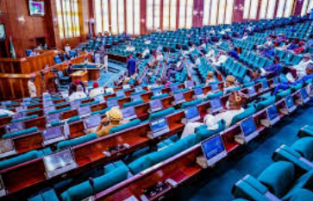
The proposal was contained in a letter to the House of Representatives read during Thursday’s plenary by the Deputy Speaker, Benjamin Kalu, who presided over the session in the absence of the Speaker, Tajudeen Abbas.

However, the proposal was rejected by the Yoruba socio-cultural organisation, Afenifere, and its northern counterpart, the Arewa Consultative Forum, which described it as ridiculous.
The committee, chaired by Kalu, proposed an additional six new states in the North-Central, four in the North-East, five in the North-West, five in the South-South, and seven in the South-West.
The states being considered include Okun, Okura and Confluence from Kogi; Benue Ala and Apa from Benue; FCT State; Amana from Adamawa; Katagum from Bauchi; Savannah from Borno; Muri from Taraba; New Kaduna and Gujarat from Kaduna State; Tiga and Ari from Kano; Kainji from Kebbi; Etiti and Orashi as the sixth states in the South-East; Adada from Enugu; and Orlu and Aba.

Others are Ogoja from Cross River, Warri from Delta, Ori and Obolo from Rivers, Torumbe from Ondo, Ibadan from Oyo, Lagoon from Lagos, and Ogun, Ijebu from Ogun, and Oke Ogun/Ijesha from Oyo/Ogun/Osun States.
The letter read in part, “The Committee proposes the creation of 31 new states. As amended, this section outlines specific requirements that must be fulfilled to initiate the process of state creation, which include the following:
“New state and boundaries; An act of the National Assembly for the purpose of creating a new state shall only be passed if it requires support by at least the third majority of members.
‘’The House of Representatives, the House of Assembly in respect of the area, and the Local Government Council in respect of the area is received by the National Assembly.
“Local government advocates for the creation of additional local government areas are only reminded that section 8 of the Constitution of the Federal Republic of Nigeria, as amended, applies to this process.
“Specifically, in accordance with section 8 (3) of the Constitution, the outcome of the votes of the State Houses of Assembly in the referendum must be forwarded to the National Assembly for fulfilment of state demands.
“Proposals shall be resubmitted in strict adherence to the stipulations. Submit three hard copies of the full proposal of the memoranda to the Secretariat of the Committee in Room H331, House of Representatives, White House, National Assembly Complex, and Abuja.
“Sub-copies must also be sent electronically to the committee’s email address at info.hccr.gov.nj. For further information or contact, please contact the Committee Clerk at 08069-232381.
“The committee remains committed to supporting the implementing efforts that align with the Constitutional provisions and would only consider proposals that comply with the stipulated guidelines. This is coming from the Clerk of the Committee on Constitutional Review.’’
Taking a dim view of the bill, the National Organising Secretary of Afenifere, Abagun Kole Omololu, explained that the proposed state creation negated Afenifere’s demand for true federalism.
He said, “The recent proposal by the House of Representatives Committee on Constitution Review to create 31 new states does not align with Afenifere’s long-standing demand for true federalism.
“Instead of addressing the core structural issues plaguing Nigeria, this initiative appears to be a mere political exercise that will further weaken governance and deepen economic inefficiencies.’’
Afenifere has consistently advocated genuine fiscal federalism, similar to what Nigeria’s founding fathers agreed upon before independence.
Omololu noted, “The creation of more states without a viable economic foundation will only compound the financial burden on the nation, as many existing states are already struggling to generate sufficient Internally Generated Revenue and rely heavily on federal allocations to survive.
‘’Turning every local government into a state is not the solution to Nigeria’s governance challenges. The real issue is not the number of states but the dysfunctional federal structure that has concentrated power at the centre, stifling regional development.’’
Instead of proliferating states that may later be unviable, Afenifere urged the National Assembly to focus on constitutional reforms that would devolve power, return resource control to the regions, and grant states the autonomy to develop at their own pace.
“Nigeria needs a system where states or regions control their resources and contribute an agreed percentage to the federal government, just as it was during the First Republic. This is the only path to sustainable development, not the reckless creation of more administrative units.
“Afenifere rejects this proposal and calls on well-meaning Nigerians to resist attempts to distract from the real conversation—restructuring and true federalism,” Omololu declared.
The Arewa Consultative Forum similarly expressed strong opposition to the proposed creation of 31 new states, describing the idea as unnecessary.
The National Publicity Secretary of the ACF, Prof Tukur Muhammad-Baba, stated that the forum was not in support of the proposed creation of new states, citing the country’s complexity and the potential for creating more problems.
According to him, the more states created, the more demands that will emerge, leading to more acrimonies.
He questioned the economic viability of the existing 36 states, highlighting the administrative burdens and overhead costs associated with governorship and civil service.
The ACF spokesperson emphasised that creating new states would be too expensive and unnecessary, and would only provide opportunities for the elite to assume leadership positions without necessarily improving the economic viability of the states.
He said, “We have not seen the details of the proposed states, but it’s ridiculous. How long are we going to be creating states and creating problems in this country?
“How many of the 36 states are viable economically? How many of the states can carry the administrative burdens of governorship and all it takes – the civil service and the amount of expenditure on overhead?
“Honestly, I don’t think the creation of states is our priority because it’s too expensive and unnecessary, and there is no way it will stop. It’s opening up room for more demands and more acrimony.”
Instead of creating new states, he advised the government to focus on addressing the social and economic challenges facing the people.
“We hope that more rational heads will prevail over the issue, but right now, honestly, it’s not the priority; affecting the lives, and the social-economic standing of the people is a better objective to pursue.
“Creation of state as we have seen will not solve our problems. It will give some elites a chance to assume leadership positions with all the perks that are attached to the office, but honestly, we don’t think economically, they will be viable,” Muhammad-Baba said.
But the National President of the Middle Belt Forum, Dr. Bitrus Pogu, endorsed the proposal for additional states.
Speaking in Jos on Thursday, Pogu described the proposal as a welcome development that addresses the country’s long-standing issues of equity and governance.
As a proponent of the Savannah state, Pogu emphasized that the MBF supports the proposal, citing the need for a more inclusive and representative system of government.
“The challenge of Nigeria requires a lot of tinkering to get it right. There has been no equity in the whole process of governing Nigeria”, he said
Pogu highlighted the example of Southern Borno, which has never produced a governor, with the position always being held by either Northern or Central Borno.
He argued that the proposed creation of new states would help address the plurality of Nigeria and promote a more equitable distribution of power and resources.
The MBF has long advocated for greater autonomy and representation for the region’s diverse ethnic groups
The proposed creation of new states is seen as a significant step towards addressing the historical injustices and imbalances in the country’s governance structure.
The apex Igbo socio-cultural organisation, Ohanaeze Ndigbo Worldwide declared that the South-East should be allocated more states to address ‘’the wrongs that had been done to the region on state creation.’’
Ohanaeze’s National Publicity Secretary, Dr Ezechi Chukwu, stated, “It is unfortunate that such a bill is also aimed at suppressing the South-East as usual. It is completely unacceptable that Southeast should be appropriated only five states.
‘’South-East, all these while, is the only zone in the Federal Republic of Nigeria that has the least number of states irrespective of our population and our contributions both economically and infrastructural development of the nation.
“So, giving southeast such a small number of five states in this bill when others that already have advantages orchestrated by successive governments before now is quite unacceptable and unfortunately, it is above all antithetical to the commonwealth of the South-Easterners and the so-called equity we are preaching in the country.”
He added, “South-East deserves more states more than any other zone in the country because South-East is the only zone that has been short-changed over the years by successive governments. So, if justice and equity should prevail southeast must be given the highest number of states.’’
“So, if the Federal Government fails to correct the wrongs that had been done to the South-East over the years, this is the time to at least give this equation some terms of balance by appropriating more number states to the South-East to make up with the other geopolitical zones.”
The Pan-Niger Delta Forum observed that the creation of more states could be meaningful if all the geo-political zones in the country have equal states as agreed in the last constitutional conference.
The spokesman for PANDEF, Christopher Ominimini, however, queried the viability of new states, pointing out that states should be created based on self-sustainability.
If the creation of more states became necessary, he argued it should be done equally across the board to even with the North-West, which has seven states.
Anything short of that, he noted, would be a perpetuation of the injustice in the country.
He said a situation where more states would be created to depend on the oil and gas from the Niger Delta region, while other states with mineral resources are allowed to exploit theirs is not the way to go.
He stated, “ Well, it is the right of the people to call for the creation of states. However, the most important thing is that in the last constitutional conference, it was agreed that all the geopolitical zones should have seven states each as it is in the North-West.
“So, the South -East should have additional two states so that it would be seven states. The South- West should have additional states to make it seven states.
He added, “But the question we want to ask is ‘will the states be viable?’ Do they have the means of survival if the vision of our forefathers are kept to? Because the vision of our forefathers who fought for the independence of this country is that the various states should control their resources and pay tax to the centre.”
Ex- Senators condemn move
A former Ambassador to Kuwait, Senator Haruna Garba, described the Reps proposal as “unbelievable.”
Garba, who represented Gombe North in the Senate, said, “The number is unbelievable, how can you talk about 30 more states. What are we turning ourselves into? What kind of democracy are we talking about? The number is too much. The number is unacceptable.”
He added, “Can we afford the paraphernalia of 31 more states? Where do we get the resources to take care of 67 states? What we should do is to give every zone one more each to amount to 42 more states, 67 is too much, we are not serious.”
Also, a former Senator representing Ondo South Senatorial District, Nicholas Tofowomo, condemned the proposal of the Reps.
Tofowomo, who was in the Senate between 2019 and 2023, described the proposal of the lawmakers as useless, saying the country should focus more on the development of local government areas, rather than states creation. He added that many of the present states were not economically viable.
He said, “The viability of states in Nigeria should be a pressing concern to the lawmakers, not creation of states. Currently, many states rely heavily on federal allocations, which raise questions about their economic independence. There is the need to reform local governments, which are closest to the people, rather than creating more states.
“In Nigeria, there are 774 local governments, which are struggling to deliver basic services. The 1976 Local Government Reforms aimed to the “basket of Nigeria” due to their rich agricultural land. However, even these states face challenges in terms of infrastructure and economic development. Rather than creating more states, the focus addresses these challenges, but more needs to be done.”
“Some states, like Benue, have been dubbed should be on strengthening local governments and giving them more responsibilities, especially in agriculture.
“Ultimately, Nigeria needs to rethink its approach to governance and economic development. By empowering local governments and promoting agricultural production, the country can move towards a more sustainable and equitable future.”
Ex-Reps kick
In the same vein, a former House of Representatives member from Anambra, Barth Nnanna, kicked against the proposed additional 31 states, saying it would be unmanageable, cumbersome and chaotic to handle.
Nnanna, who represented Ogbaru Federal Constituency between 1999 and 2003, added that “even from the proposal, the South-East is shortchanged with a shortfall of four states compared to North-West and South-West.”
He said what Nigeria needed now was not additional states but a return to regional system of government with federating components making up the state.
He said, “We look at the proposal and we can say that proposing additional 31 states to join the already existing 36 states will be too unwieldy to manage. Most of the existing 36 states are not viable and can’t stand on their own with the exception of three states, every other states depend on the handout from Abuja for survival and now they are proposing additional 31 states.
“What we had expected them to do is to first balance the states of the geopolitical regions. For instance, like the South-East that has five states should be giving additional states to balance the equation.
“Even with the proposal, it means South-East will be given additional five states totalling 10 states. It means the region will be trailing North-West and South-West which may likely have 14 states each. You can see it is not balanced and there is no equity in the whole thing.
“Anyway, it is still a proposal; it will still be subjected to public scrutiny and acceptance. When it comes to that stage, the people will either accept it or reject it. But the truth is Nigeria doesn’t need additional states at the moment.”
Another former member of the House of Representatives, Ogbona Nwuke, has said Governors may not support the creation of additional states.
Nwuke, who represented Etche-Omuma Federal Constituency of Rivers State in the Green Chamber, also questioned the viability of the proposed states.
“It is very clear that state creation will not be possible without the support of the governors. And the way it stands state governors may not back state creation.
“Anyway, as we speak, not all states appear to be viable. And to talk about that number of states being created, if that is the will of the people across the country, then one will perhaps say there is nothing wrong with that. But let me note that state creation has never been handled by any civilian administration in Nigeria
“And previous attempts to create states have also not been successful. So, it will be nice to see what stakeholders will say when the issue of states creation is tabled before them.
“But looking at history, most states created in the country were by fiat by the military and none has been created by any civilian administration.
Asked if he supports the creation of more states, he added, “We have six geo-political zones and we know that in the South East has been clamouring for one additional state.
“Now, in order to achieve a level of balance, which is missing at this time, we need to know the number of states because there has to be some balancing with Nigeria’s geographical expression.
“So, it is a critical matter, very serious matter which will demand more information, additional information on how the committee came to that number of states and then how those states will be distributed when it comes to Nigeria’s geo-political spread.” (PUNCH)