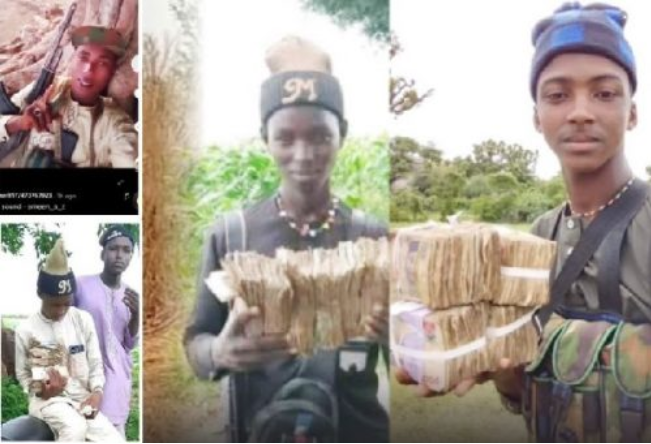
The internet has become a weapon for terrorists. With no meaningful deterrence, a handful of bandits freely operate TikTok accounts, interacting with followers. They frequently showcase weapons, ammunition, and flaunt ransom. The brazen display without any fear of retribution portends more danger to Nigeria. The Nation traces their activities and behavioural display.
Every minute, millions of social media posts, photos and videos flood the internet. In spite of the numerous advantages of the social media, a lot of concerns have been raised about its usage and contribution to the growth of social vices such as terrorism.
TikTok is one of such spaces. It has offered terrorists groups the ability to disseminate images and videos at a rapid pace to a borderless audience.

In Nigeria, terrorist activities have become endemic. A cursory look at these activities will prove that the social media has become a platform for propagating terrorism.
TikTok is very popular with young audiences – and Nigerians are no exception. It appears to be the most popular social media platform in Northern Nigeria. It has gained dominance by the day, and is gradually diverting young Nigerians from other social media platforms like Instagram and Twitter.
DataReportal’s figures show that there were 36.75 million active social media user identities in Nigeria in January 2024. Also, ByteDance’s advertising resources indicate that TikTok had 23.84 million users aged 18 and above in Nigeria in early 2024.

Banditry is a composite crime that includes kidnapping, massacre, rape, cattle rustling, and illegal possession of firearms. The impact of their actions has been devastating, with a staggering 1,087,875 individuals in rural communities displaced as of December 2022. Furthermore, between 2010 and May 2023, approximately 13,485 deaths have been attributed to banditry.
The Nation’s findings revealed that numerous terrorist groups and individuals in Nigeria have adapted the use of social media to recruit and proselytize on the basis of its wide reach, ability to connect individuals around the world and immediate impact on users.
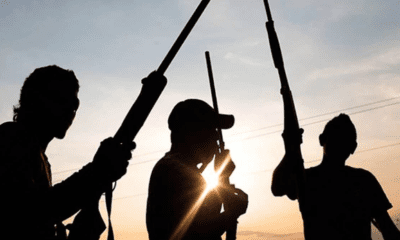
Most of the TikTok accounts show these individuals flaunting cash or images of them in military camouflage wielding a rifle or wearing a bandolier.
On TikTok, they have found an online appeal after their despicable acts of terror and bloodshed. Their digital footprints are now carried beyond their sphere of control, thanks to social media platforms, especially Facebook, X, and TikTok.
Recently, a viral TikTok video featured a terrorist asking Nigerians to share their bank details, promising to reward them for praising their leader, the notorious terrorist, Turji Kachalla, during recent nationwide protests against economic hardship.
This bizzare situation sparked reactions on social media, with many Nigerians expressing displeasure over the security agencies’ inability to apprehend the criminals.
Tiktok handle @RabeMagarya3 had a terrorist saying that their group was grateful and pleased that their leader was referred to as a ‘hero’ by some individuals from the northern region.
He said: “May the peace and blessings be with you all Nigerians.
“Protesters, we heard you guys are praising Mohammed Bello Turji.
“We are grateful, we are grateful to you. May you achieve success.
“Bello Turji is greeting. Send your account details; Bello Turji wants to do something for you people.”
Individuals surprisingly complied with the terrorist’s request, sharing their bank account details in the comment section of the viral video.
Reacting, the Force Public Relations Officer, Olumuyiwa Adejobi, said it was not possible for security forces to arrest all criminals at once.
On many occasions, these accounts flaunted arms to instill fear and attract impressions. They have been seen in several online clips brandishing the Russian Kalashnikov, a shoulder weapon commonly used by jihadi terrorists.
These bandits have become notorious and bold, flaunting their activities on social media without fear of the security agents locating them. They’ve unfettered access to highspeed internet connections free of state controls. They evade detection from the tech company and exploit the online platform for their antics.
The Federal Government formally declared bandits as terrorists in November 2021. This designation meant tougher sanctions under the terrorism prevention act for suspected bandit gunmen as well as their informants and supporters, such as those caught providing these criminals with arms, fuel and food.
Before now, it was Former Minister of Communication and Digital Economy, Isa Pantami, who raised the alarm in 2020 that terrorists were ”exploiting social media, encrypted communications and the dark web to spread propaganda, recruit new followers and coordinate attacks”.
Mode of operation on TikTok
Social media is generally free, open to anyone who can get online, and messages can be more visible than ever before with a global reach. Rather than rely on the press or other intermediaries, extremist groups reach people directly and tailor the message accordingly.
Some bandits share the ransom paid to them on TikTok under the guise of “giveaway”. By their mode of operation, their online presence fit into the various definitional frameworks of an organised criminal group.
They enjoy some acceptance and patronage on social media. These account users spread terror, demonstrating their kidnap-for-ransom escapades and celebrating their cruelty. Videos of the live session garnered millions of views on TikTok, the Chinese-owned social network.
The social network is not alone in finding it difficult to stop extremists from promoting hate on its global platform. Facebook, Twitter and Google’s YouTube similarly have struggled to stop a tidal wave of violent and harmful material from spreading online despite increased efforts
Some members of the Boko Haram terrorist group have been caught using Starlink, the super-fast device owned by billionaire Elon Musk in Sambisa Forest.
Recently, the Nigerian troops “Operation Hadin Kai” successfully killed a top commander of the sect, Tahir Baga, and recovered digital connectives like Starlink Wi-Fi system and mobile phones, among other weapons.
The Nation tracked over 20 accounts linked to bandits on TikTok, which have been used to spread propaganda and messages in local language.
For example, a bandit with the username @8184049848275 shared various videos of himself wielding a gun while entertaining his followers on the platform.
Recall that the Islamic State of Iran and ISIL famously used Twitter for propaganda purpose in 2014 and 2015.
By using local languages, they have enjoyed the freedom to gather audiences and create a false image of themselves in order to push themselves on potential recruits through propaganda messages reaching millions of young people.
The terrorists are not only posting textual information, they also post videos and photos designed to attract new recruits and spread their radical ideology.

Shifting the battle to social media?
Nigeria’s Terrorism Prevention Act outlaws promoting terrorist activities in any form, stating that anyone who directly or indirectly solicits or renders support for terrorism “commits an offence and is liable on conviction to imprisonment for a term of at least 20 years and up to a maximum of life imprisonment”.
The National Security Adviser (NSA), Malam Nuhu Ribadu, has since directed full implementation of the Cybercrimes (Prohibition, Prevention, Etc) Amendment Act, 2024, to prevent use of social media by terrorists.
Nigeria on July 6, 2022 joined the league of 66 other countries that have signed and ratified the Budapest Convention on Cybercrime to enhance international cooperation, provide common platform and procedural tools for efficient and safe cyberspace pursuant to Section 41(2) (a) of the Cybercrime Act 2015 requiring conformity of Nigerian cybercrime and cybersecurity laws and policies with regional and international standards.
Recall that former national security adviser (NSA), Babagana Monguno had said terrorist groups were using social media platforms to recruit and radicalise youths.
Former minister of communication and digital economy, Isa Pantami, corroborated Monguno’s claim. He affirmed that terrorists are ”exploiting social media, encrypted communications, and the dark web to spread propaganda, recruit new followers and coordinate attacks”.
The current Coordinator, National Counter Terrorism Centre, Major General Adamu Laka, also alerted media organisations in the country of plots by terrorist groups to boost their membership through dysfunctional information appealing for easy recruitment using media platforms, networking sites, and online propaganda including mainstream and traditional mediums of communication.
Police react
In a post on X, spokesperson of the Nigeria Police Force, Muyiwa Adejobi, urged Nigerians to appreciate law enforcement’s efforts rather than expecting immediate results.
“They are now posing with the ransom money. Showing that they are balling,” an X user (formerly Twitter) had captioned the post.
Reacting, Adejobi said: “We can’t apprehend all the criminals at once. At least, appreciate us for the ones we have arrested. We arrest them on a daily basis, in large numbers.
“The armed forces and the police are trying their best. Efforts of security forces should be seen, noticed and appreciated.
“We need to look towards having the collective efforts and individualistic involvement in tackling insecurity and other vices in Nigeria.”
Report people behind viral bandit video on TikTok, DHQ tells Nigerians
TikTok has a digital footprint for each user. For example, a user can see who and who visited his page. As you are checking him/her out, he/she also can check you out.
Security agencies have been tasked to utilise tools and intelligence to arrest individuals using social media platforms to heat up the polity.
Director of Defence Media Operations, Major-General Edward Buba, at a recent bi-weekly media briefing in Abuja, called on Nigerians who know anything about people making such posts on the social media to say something, and the military will do something about it.
Our guidelines prohibits posts that promote violent extremist organisations – TikTok
TikTok, responding to The Nation’s query, said: “We are committed to bringing people together in a way that does not lead to physical conflict.
“We recognise that online content related to violence can cause real-world harm.
“We do not allow any violent threats, promotion of violence, incitement to violence, or promotion of criminal activities that may harm people, animals, or property.
“If there is a specific, credible and imminent threat to human life or serious physical injury, we report it to relevant law enforcement authorities.
“We want you to share what inspires you, but TikTok is not a place to spread beliefs or propaganda that encourage violence or hate.
“We do not allow the presence of violent and hateful organisations or individuals on our platform.
“These actors include violent extremists, violent criminal organisations, violent political organisations, hateful organisations, and individuals who cause serial or mass violence.
“If we become aware that any of these actors may be on our platform, we will conduct a thorough review – including off-platform behavior – which may result in an account ban.
“Often the ideas of these actors are amplified by others. We do not allow anyone to promote or provide material support to violent or hateful actors.
“Content that may appear neutral, such as featuring a quote from a hateful organisation or individual, must make clear that there is no intent to promote it.
“We make limited exceptions for discussions about violent political organisations.
Security experts weigh in
Mixed reactions from security experts have placed security agencies on the edge. Some lamented the inability of security forces to locate and neutralise the bandits terrorising the country.
An expert, Lekan Adigun, believes that terrorists have been highly adaptable to changes in how their messages are disseminated around the world.
He said: “In order to keep pace with the evolution of terrorist strategy, states and social media platforms, especially TikTok, must adapt their counter-terrorism measures to meet these inevitable challenges.
“TikTok has become a platform where these terrorists promote their activities, yet the police who claim they can fish out any criminal from anywhere cannot find them. This is very ridiculous”.
A counter-insurgency expert and security analyst, Zagazola Makama, expressed dismay over the promotion of unscrupulous individuals and their activities on TikTok, unrestrained.
He noted that some of them are bandits who openly show off their rifles and are dressed in military or police uniforms.
He wrote: “Audacity: Bandit on Tiktok flaunting and showing off ransom money he collected from his victims.
“The user of the account has 3000 followers, some of them are bandits who openly show off their rifles and are dressed in military or police uniforms.
“Tiktok platform has given room for insurgents to promote their campaign of terror without being restricted.”
The Nation