Connect with us

News

Bayelsa, Imo, Kogi Poll: Results of Polling Units with violence will not be counted, says INEC Chairman Yakubu

Published

on

Kogi Guber: SDP demands relocation of INEC sensitive materials to Abuja
Prof Mahmood Yakubu, INEC Chairman
Spread the love

The Chairman of INEC, Professor Mahmood Yakubu, disclosed this on Tuesday in Yenagoa, the Bayelsa State capital, while addressing election stakeholders during a meeting in preparation for the governorship election on November 11.

Yakubu said the commission would not return to any polling unit, where there was violence, for election.

Equally, on Tuesday, Inspector-General of Police, Kayode Egbetokun, warned individuals and groups intent on disrupting the election to think twice, as the police high command was prepared to deal decisively with troublemakers.

Yakubu, who was represented at the meeting in Yenagoa by INEC National Commissioner supervising Akwa-Ibom, Bayelsa and Rivers states, Mrs. May Agbamuche-Mbu, disclosed that all the Bimodal Voter Accreditation Systems (BIVAS) that would be used for the elections were customised for INEC.

Agbamuche-Mbu said INEC details were in the BVAS, while the list and serial numbers of all the BVAS are with INEC.

Maduka College Advert

According to Yakubu, “I want to let you know that our BVAS have been customised for INEC, so INEC details and the name of the parties are on the BVAS. So any BVAS you see without INEC details cannot be from INEC.

“Another thing, we have all the list of the serial numbers of the BVAS we are going to use, the result sheets will be signed at the polling units.

“Where there is violence, it will be zero. We will not return to that polling unit to conduct election.

“We have recruited and carefully trained all category of ad-hoc staff to be deployed to the fields, all non-sensitive materials have been distributed to all the eight local government area offices of the state; voter education and sensitisation is ongoing.

“We have made arrangement for the transportation of personnel and materials to ensure that polling units open on schedule on election day.”

Speaking further, he said, “For more effective supervision of the process, we are deploying two National Commissioners, eight Resident Electoral Commissioners to support our office in Bayelsa. I wish to assure you of our commitment to free, fair and credible election come Saturday.”

The Inspector-General of Police, Kayode Egbetokun, on Tuesday warned individuals and groups intent on disrupting the elections to reconsider their actions, as the police high command was prepared to deal decisively with troublemakers.

Egbetokun also ordered the restriction of all forms of vehicular movement on roads, waterways, and other forms of transportation, from 12.01 am to 6pm on election day in the affected states, with the exception of those on essential services, such as INEC officials, accredited electoral observers, ambulances responding to medical emergencies, firefighters, media, among others.

Moving in the same direction, the Police Service Commission (PSC) said it had concluded arrangements to deploy staff monitors for the November 11 governorship elections in Kogi, Imo and Bayelsa.

A statement issued by the spokesman of the commission, Ikechukwu Ani, said the staff monitors were expected to be deployed to all the senatorial districts in the three states and were mandated to strictly monitor the conduct of policemen on election duties in the three states.

At a media briefing in Abuja, the Nigeria Police affirmed that in pursuit of its commitment to neutrality and as part of the bid to enhance the supervision of the elections, the IGP had deployed Deputy Inspectors General of Police (DIGs) to oversee the security arrangements and ensure the elections run smoothly in the respective states.

The police stated, “This added layer of supervision is intended to guarantee that the elections meet the highest standards of transparency and credibility.

“Therefore, the Deputy Inspector-General of Police in charge of the Department of Training and Development, DIG Frank Mba, has been deployed to oversee elections in Imo State; DIG Habu Sani in charge of the Department of Force Intelligence to Kogi State, and DIG Daniel Sokari-Pedro in charge of the Department of Information and Communication Technology to Bayelsa State,”

It stated that in a bid to ensure a smooth electioneering processes, the IGP ordered the distribution of an additional 220 operational vehicles, including water cannons, Armoured Personnel Carriers (APCs), gun boats for riverine areas, helmets, bullet proof vests, tear gas canisters among others to the three affected states to intensify security arrangements for the elections to augment the already deployed assets.

The IGP, who spoke through the Force Public Relations Officer, Assistant Commissioner of Police (ACP), Olumuyiwa Adejobi, said, “The IG has ordered a restriction of all forms of vehicular movement on roads, waterways, and other forms of transportation, from 12.01 am to 6 pm on election day in the affected states with the exception of those on essential services such as INEC Officials, Accredited Electoral Observers, Ambulances responding to medical emergencies, firefighters, media, etcetera.

“The order, which is part of measures emplaced to ensure a safe, secure, and conducive environment for the conduct of elections, is aimed at ensuring public order management, the safety of electorates, as well as assisting the security agencies in effective policing, thereby preventing hoodlums and criminally-minded elements from disrupting the electoral process.”

He said residents and travellers in the neighbouring states should note and plan their movements to avoid any untold hardship during the election period.

“Similarly, the IGP sternly warns all security aides and escorts to desist from accompanying their principals and politicians to polling booths and collation centres during the election, as anyone found flouting this directive will be severely sanctioned,” he said.

He maintained that only security personnel specifically assigned to election duties were to be within and around the designated election booths and centres.

According to him, “Also, the ban on the unauthorised use of sirens, revolving lights, covered number plates, and tinted glasses is still in force, and violators would be sanctioned appropriately.

“All state-established and owned security outfits/organisations, quasi-security units, and privately-owned guard and security outfits are also barred from participating in election security management.”

While empathising with well-meaning residents of the affected states on the inconveniences the restrictions may cause, the IGP urged all active electorate to be law-abiding and turn out en masse to exercise their franchise.

“He however warned that the force will deal decisively with any individual(s) or group(s) that might want to test our common resolve and might to ensure a peaceful election,” he said.

The IGP enjoined the electorate and party supporters and leaders to shun vote buying, vote selling, hate speech, misinformation, and disinformation, snatching of ballot boxes, and other criminal acts, as the force and other security agencies will leave no stone unturned in ensuring that all violators of extant laws, most especially the Electoral Act 2022 (as amended), faced the full wrath of the law.

The police said, “The Nigeria Police Force is aware that it is essential for citizens to have quick access to security agencies in case of emergencies or to report any security concerns during the election period.

“Therefore, we have established dedicated emergency contact numbers that the public can use to reach out to the Joint Operation Room for the elections in each state.

“The numbers are ‘Joint Operations Room Imo State – 08034773600 or 08113659301; Joint Operations Room Kogi State – 07038329084; Joint Operations Room Bayelsa State – 07034578208  09167322691.”

Meanwhile, the PSC said it had concluded arrangements to deploy staff monitors for governorship elections in Kogi, Imo and Bayelsa.

A statement issued by the spokesman of the commission, Ikechukwu Ani, stated that staff monitors were expected to be deployed to all the senatorial districts in the three states and were mandated to monitor strictly the conduct of policemen on election duties in the three states.

It added, “The commission will hold these police officers accountable for their actions and inactions throughout the period of the election and will not hesitate to discipline appropriately any officer found wanting in the discharge of his/her election duties.

“Chairman of the commission, Dr. Solomon Arase, who is also a retired Inspector-General of Police, said the IG of Police, Dr. Kayode Egbetokun, deserves commendation for the material support he had made available for proper policing of both the electorate and election materials.”

In Kogi, Egbetokun urged political stakeholders to play the game by it rules to avoid violence before, during and after the election on Saturday. He made this call at a one-day engagement with the critical stakeholders ahead of Kogi governorship election held in Lokoja on Tuesday.

The Inspector General of Police explained that there were laws guiding elections in Nigeria, adding that if everyone abides by the rules there would be no crises during the election.

The Inspector General of Police, who was represented by the Kogi State Commissioner of Police, CP Bethrand Onuoha, explained that a lot had been happening in Kogi State.

He added that some people had been blackmailing the police, stressing that police are neither political nor meant for any political party.

The police warned that anyone caught fomenting trouble before, during and after the election will be dealt with.


News

Court Orders Interior Minister Tunji-Ojo to Respond to Suit Seeking Release of His NYSC Records

Published

on

Minister knocks NIS for asking married women to travel to Abuja for change of name
Bunmi Tunji-Ojo, Minister of Interior
Spread the love

The Federal High Court in Abuja on Monday ordered the Minister of Interior, Olubunmi Tunji-Ojo, to respond to a suit seeking to compel the release of records of his National Youth Service Corps (NYSC) scheme.

Justice Salim Ibrahim gave the order when the matter came up for hearing.

The Incorporated Trustees of Pathway to Equity and Charity Foundation had filed the suit, marked FHC/ABJ/CS/1812/2026.

The group prayed the court to compel the NYSC to disclose documents supporting the minister’s claim that he completed the mandatory one-year national service.

The foundation also sought an order of mandamus directing the Federal Capital Territory Administration (FCTA), the 2nd respondent, to produce records showing that the minister did his primary assignment at the FCTA.

Maduka College Advert

When the case was called, counsel to the applicant, Chief Solomon Akuma, SAN, told the court he was ready to proceed with the hearing.

However, Abiola Olaniji, who appeared for the minister, said he had filed an application for Tunji-Ojo to be joined as the 3rd respondent.

Olaniji said the applicant (foundation) had responded with a counter affidavit raising serious issues, to which he needed time to reply.

The lawyer stated that the minister was ready to take part in the proceedings as an interested party.

But Akuma opposed the application, arguing that the minister was not a proper party.

He said the suit only sought an order of mandamus compelling the respondents (NYSC and FCTA) to produce documents that are not in the minister’s custody.

Justice Ibrahim directed the minister to file and serve his reply to the applicant’s counter affidavit, which opposed his application to be joined as a party in the suit before the next hearing date.

The judge then adjourned the matter until Oct. 18 for hearing.

The applicant had sought from the NYSC the mobilisation or call-up letter issued to Tunji-Ojo in 2006 or any other year; the posting letter to the FCTA in 2006 or any other year; and his application for mobilisation.

It also sought the evidence of approval of his remobilisation by the NYSC’s Director-General; evidence of payment of allowances to him; the record of his Community Development Service and his discharge certificate.

The foundation equally sought from the FCTA, the mobilisation or call-up letter, the posting letter, his attendance record during the service year, evidence of any allowance paid to him, among others.

It said the application was brought under Section 14 of the Federal High Court Act, Order 34 Rules 1, 2 and 5 of the Federal High Court (Civil Procedure) Rules 2019.

It also cited Sections 20, 21 and 25 of the Freedom of Information (FOI) Act, 2011.

(NAN)

Continue Reading

News

Reject money requests from home, Obi tells UK-based Nigerians

Published

on

Labour Party knocks Middle Belt movement for allegedly gagging Peter Obi
Peter Obi
Spread the love

The presidential candidate of the Nigeria Democratic Congress, Peter Obi, has advised Nigerians residing in the United Kingdom to stop sending money to people who seek financial help at home.

Obi also advised them to urge their relatives to vote for productive leaders.

He made the remarks at a town hall meeting with diaspora supporters in Manchester, United Kingdom, on Sunday.

He stressed that Nigeria’s prevailing economic hardship resulted from bad leadership, arguing that continuous financial assistance only cushions the effects of poor governance without addressing the root causes.

“You have people at home in Nigeria today who are begging you for money. Tell them no!” he said.

Maduka College Advert

The former Anambra State governor insisted that his record in public office distinguished him from other governors, claiming none of them matched his achievements in saving public funds.

“I’m not saying I’m a saint, but I saved money. I’ve not seen one governor who has saved 10 per cent of what I saved. No governor has done it.

“Let’s start with this one that is less corrupt. That’s how other countries change.”

He maintained that his conversations with the people reinforced the need for collective responsibility, stressing that building a new Nigeria would require citizens to take an active role in addressing challenges facing the country.

Obi also urged Nigerians to take the 2027 election seriously, describing the contest as a critical moment for the nation.

Continue Reading

News

Federal High Court Upholds ENSSAA’s N150m Political Campaign Billboard Fee, CTC Reveals

Published

on

Spread the love

Contrary to false and misleading reports on social media that a Federal High Court (FHC) sitting in Abuja had nullified the N150 million fee prescribed by the Enugu State Structures for Signage and Advertisement Agency (ENSSAA) for political campaign billboards, findings have revealed that the court actually ruled in favour of the agency, upholding its powers to prescribe the fee.

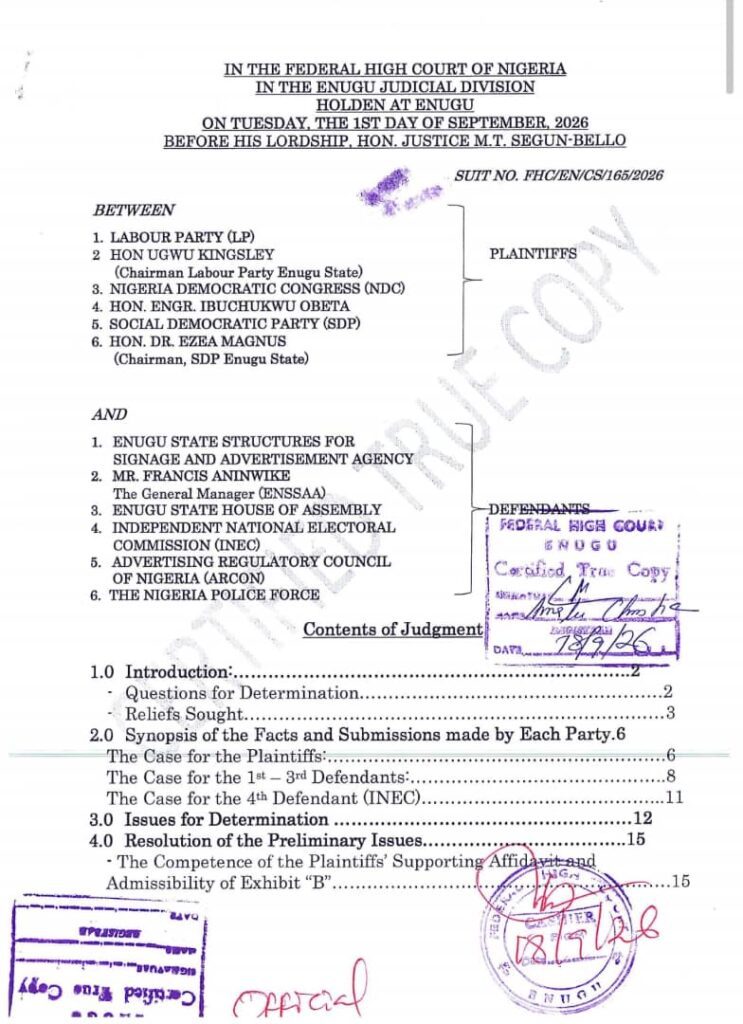
According to a certified true copy (CTC) of a judgment of FHC sitting in Enugu, the court had on September 1, 2026, dismissed a suit by opposition parties and figures challenging ENSSAA’s authority to impose a mandatory N150 million fee on each political party seeking to erect campaign billboards or display posters ahead of the 2027 general election.

The judgment rendered by Justice Mabel Segun-Bello held that it was within the legislative competence of the Enugu State House of Assembly to make laws on outdoor advertising and for ENSSAA to exercise powers donated to it by state law.

The suit marked FHC/EN/CS/165/2026 had the Labour Party; Chairman of the Labour Party (LP) in Enugu, Hon. Kingsley Ugwu; Nigeria Democratic Congress (NDC); NDC factional state Chairman, Engr. Ibuchukwu Obetta; the Social Democratic Party (SDP) and its state Chairman, Hon. Magnus Ezea, as plaintiffs, while ENSSAA; its General Manager, Mr. Francis Aninwike; the Enugu State House of Assembly; Independent National Electoral Commission (INEC); Advertising Regulatory Council of Nigeria (ARCON); and Nigeria Police Force were the respondents or defendants.

The plaintiffs had in June 2026 approached the court seeking a declaration that, by virtue of Sections 99 (1) and (2) of the Electoral Act, 2026, and Section 153 of the 1999 Constitution, which donated exclusive powers to INEC to regulate electoral campaigns of political parties in Nigeria, it was ultra vires the powers of ENSSAA and its General Manager to make executive decisions and publications imposing a mandatory payment of N150 million by political parties and their candidates in the state as an advertisement permit fee for the placement of billboards for the council election and the 2027 election.

Maduka College Advert

They equally sought a declaration by the court that it was unlawful and ultra vires the legislative powers of the Enugu State House of Assembly to make laws regulating the advertisement of political campaigns in the state.

Consequently, the plaintiffs sought an order of the court setting aside the mandatory N150 million fee, as well as an injunction restraining the agency and its GM, the Enugu State Government, its agents and representatives from enforcing ENSSAA’s executive directive.

They finally sought an order of the court mandating the Nigeria Police Force to protect political parties in Enugu State against possible harassment for the placement of billboards and posters for the council election and the 2027 elections.

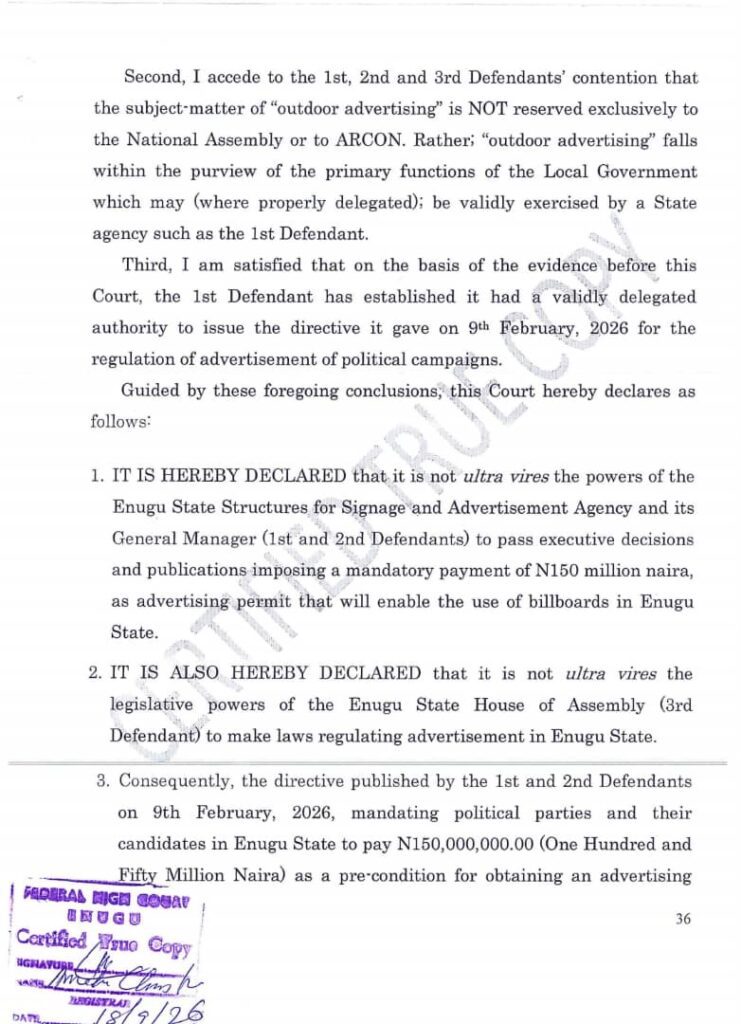
However, delivering her judgment in September, after a careful consideration of the totality of the affidavit evidence, the exhibits, and submissions by both parties, the presiding judge, Justice Mabel Segun-Bello, held, among other things, that the National Assembly does not hold exclusive legislative powers over outdoor advertising.

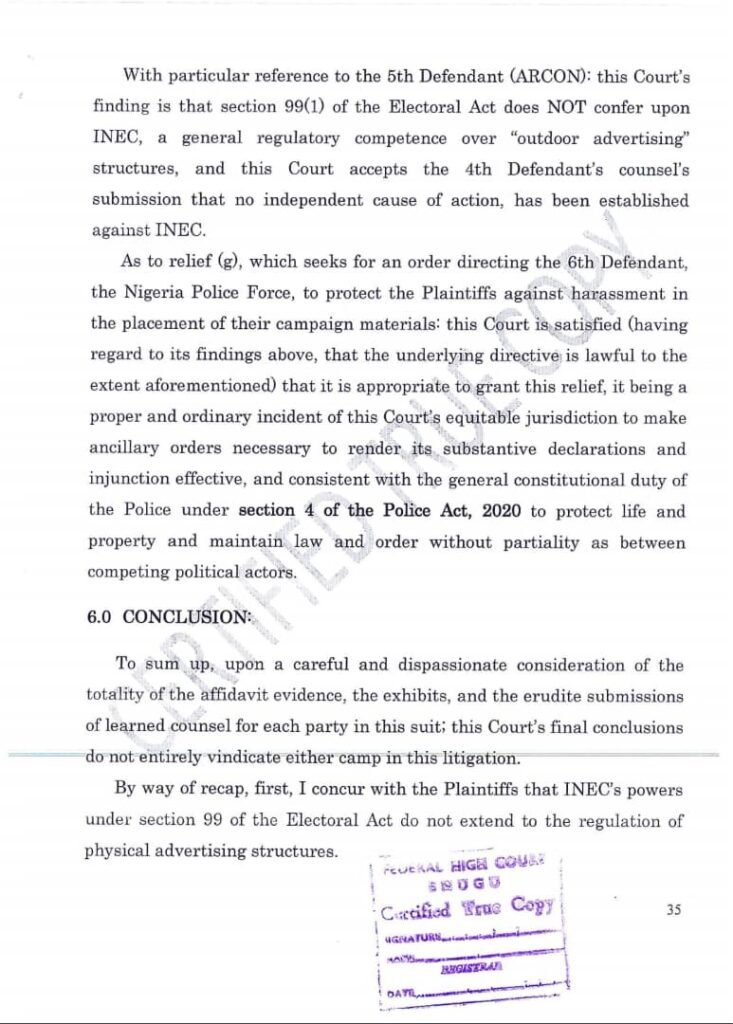
“I accede to the 1st, 2nd and 3rd Defendants’ contention that the subject matter of ‘outdoor advertising’ is NOT reserved exclusively to the National Assembly or to ARCON.

“Rather, ‘outdoor advertising’ falls within the purview of the primary functions of the Local Government, which may (where properly delegated) be validly exercised by a State agency such as the 1st Defendant (ENSSAA).

“Third, I am satisfied that on the basis of the evidence before this Court, the 1st Defendant has established it had a validly delegated authority to issue the directive it gave on 9th February, 2026, for the regulation of advertisement of political campaigns,” she stated.

Guided by these foregoing conclusions, Justice Segun-Bello held that “it is not ultra vires the powers of the Enugu State Structures for Signage and Advertisement Agency and its General Manager (1st and 2nd Defendants) to pass executive decisions and publications imposing a mandatory payment of N150 million naira, as advertising permit that will enable the use of billboards in Enugu State.”

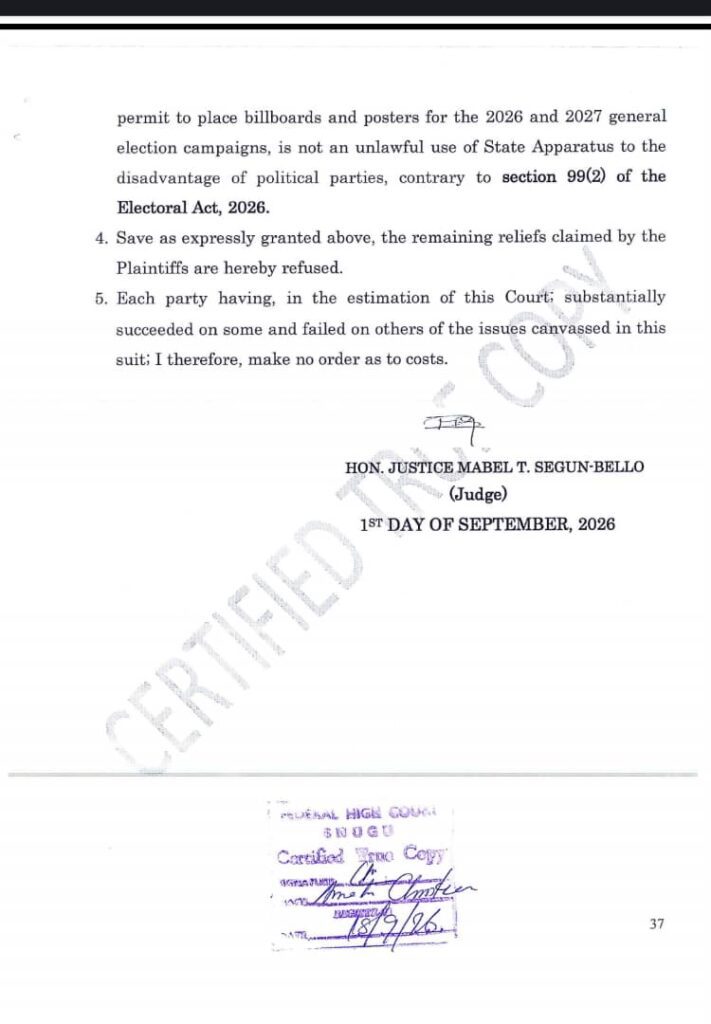
Continuing, she said, “It is also hereby declared that it is not ultra vires the legislative powers of the Enugu State House of Assembly (3rd Defendant) to make laws regulating advertisement in Enugu State.

“Consequently, the directive published by the 1st and 2nd Defendants on 9th February, 2026, mandating political parties and their candidates in Enugu State to pay N150,000,000.00 (One Hundred and Fifty Million Naira) as a pre-condition for obtaining an advertising permit to place billboards and posters for the 2026 and 2027 general election campaigns, is not an unlawful use of State Apparatus to the disadvantage of political parties, contrary to Section 99(2) of the Electoral Act, 2026.

“Save as expressly granted above, the remaining reliefs claimed by the Plaintiffs are hereby refused.”

Meanwhile, the Enugu State Government says that unlike the practice in most states, the N150 million fee is for each political party, not for candidates, as misrepresented on social media and by some commentators.

The Secretary to the State Government, Prof. Chidiebere Onyia, made the clarification recently while fielding questions from Government House correspondents in Enugu, adding that there was no court judgment on the fee by any FHC in Abuja, as falsely circulated.

In a related development, finding show that the Abia State Structures for Signage and Advertising Agency (ABSSAA) prescribed feea for candidates ranging from N20 million for State House of Assembly candidates to N200 million for presidential candidates.

Imo State fees range from N3.55 million for each House of Representatives candidate to N55 million for each governorship candidate, while the permit fees range from N300,000 for local council candidates to N150 million for presidential candidates.

The campaign permit fee ranges from N100,000 for each councillorship candidate to N50 million for each presidential candidate, while Kwara State fixed its fees at N2 million for each House of Assembly candidate and N100 million for presidential candidates.

The Certified True Copy of the Court Judgement :

Continue Reading

Trending

Maduka College Advert