News
Mbah’s Investment Pilgrimage to Jakarta, Indonesia


By Uche Anichukwu
When Governor Peter Mbah unveiled his Statement of Purpose ahead of the 2023 governorship election in Enugu State, his promise to grow the state’s Gross Domestic Product (GDP) seven folds from $4.4 Billion to $30 Billion generated mixed reactions, as many saw it as a tall order for a state renowned as a public service state. Five months down the line, however, Mbah is gaining more converts as he presses towards the target with the right policies, structures, and both local and international partnerships in place.

From tackling the security challenges headlong, including putting an end to the illegal sit-at-home, to improving ease of doing business, hosting the first Enugu State Investment and Economic Growth Plan Stakeholders Roundtable, introducing e-ticketing and automating revenue collection, and the recent flag off of the construction of a New Enugu City and 400 kilometres of various roads to bolster infrastructure needed to attract investments, the governor is not leaving any stone unturned.
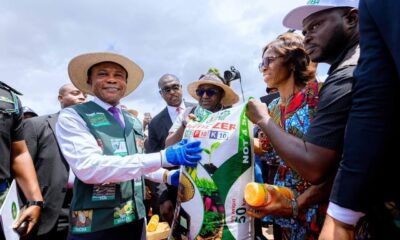
Last week, Mbah took his quest for investments to southeast Asia where he marketed Enugu to investors at the Nigerian-Indonesian Investment Trade Forum in Jakarta, Indonesia. Themed “Rediscovering Business Potentials in Nigeria and Indonesia”, the event, which was facilitated by the Nigerian-Indonesian Chamber of Commerce and Industry (NICCI), came after the first edition in 2022 attended by the then Vice of President of Nigeria, Prof. Yemi Osinbajo. It is an outcome of more than five years of previous trade missions and bilateral business expos by the business communities of both nations that continued this year with the 38th edition of the Nigerian Indonesian Trade Expo. Recently, Nigeria became Indonesia’s largest trade partner in Africa, overtaking South Africa.
But is Indonesia a worthy direction to look in search of economic cooperation and FDI? Yes. In 1967, Indonesian GDP stood at $5.67 Billion, while that of Nigeria was $5.20 Billion in 1967 and $6.37 Billion in 1966. Fast-forward to 2022, Nigeria’s GDP stood at $477.39 Billion, while that of Indonesia stood at $1.319.10 Billion (approximately $1.4 Trillion), driven by the production sector that sees the southeast Asian nation export machinery, steel, textile, footwear, among others. At the same time, Indonesia is doing so well in agriculture, exporting palm oil, rice, rubber, coffee, cocoa, among others, while Nigeria has declined from a net exporter of palm oil to an importer. Nigeria imports about 800,000 metric tons of palm oil annually estimated at over N500 Billion.

Indonesia has done so well for itself despite serious disadvantages imposed by geography. It is the world’s largest archipelago, consisting of 17,504 islands of which only 6,000 are inhabited. These have made it extremely difficult for the country to exploit its 2.5 Billion barrels of crude oil reserves, producing about 0.3 billion barrels only in 2018, according to Worldometer.
Obviously, a return to 1956 to 1966 mentality, Nigeria’s most prosperous era, also known as the golden era of Nigeria’s federalism when the federation units unleashed their potentials in a competitive manner, unhindered by an overbearing, over-bloated, and resource-expropriating central government becomes imperative. Despite the debilitating constitutional constraints, there are a lot the states could do to turn things around. Nigeria’s exit from the present economic quagmire lies in the states reinventing themselves from the status of spoilt, indolent, and uncreative appendages to resourceful sub-nationals. And that is exactly how Mbah’s effort in Enugu and his investment pilgrimage to Jakarta could best be understood.
Speaking at the Forum, Mbah observed that whereas the growth of trade volume between both nations to $4.7 Billion was commendable, they could actually do much more. He went on to enumerate the abundant investment opportunities in the state, spanning agriculture, mineral resources, logistics, aviation, tourism, real estate, mineral resources, ICT, to name a few.
Delivering the keynote address at the gathering, he said: “In the area of Agriculture, Enugu is blessed with 100 per cent arable, fertile land with a high factor of productivity and good access to both surface and subterranean water that makes all year-round agriculture possible.
“The State is climatically disposed to the production of key produce like Cassava, oil palm, Cashew, spices of various types.
“These areas offer not only the opportunity for primary agricultural production, but also the opportunity to invest in industrial facilities to add value to these produce for local consumption as well as export.
“The State is also blessed with significant deposits of minerals. In the area of petroleum, Enugu State has proven deposits of oil but more importantly has extensive deposits of natural gas.
“Other minerals within the state include Coal, gold, kaolin, gypsum, clay and limestone, among others. This makes Enugu ideal not only for mining, but also for the siting of key industries”.
However, while anchoring his $30 Billion GDP target on heavy private sector investment and utilisation of strong local and international partnerships, Mbah, being a successful businessman himself, having founded and nurtured Pinnacle Oil and Gas from ground zero to leadership of the Nigerian downstream petroleum subsector, understands and has also often emphasised that businesses/investors are not philanthropists or Father Christmases. They are in it for profit. They go where the business environment is better de-risked and where ease of doing business is higher.
Consequently, while declaring to the government and business community in Indonesia that “Enugu is open for business”, the governor equally outlined some of his administration’s deliberate steps to improve the investment and business climate of Enugu State. They include expansion of security networks for improved security, functional One Stop Centre for speedy processing of investment interests and needs, massive urban and rural infrastructural development, establishing about 300,000 hectares land bank for both for corporate farmers and special agro-processing zones, establishing of Free Zones, the recently signed Enugu State Electricity Law to create a free market for electric power, and the effort to build a Tier 4 HyperScale Data Center, far-reaching reforms towards stronger contract enforcement, ease of procurement of land titles, which would now take 48 to 72 hours, among others.
The Ambassador of Indonesia to Nigeria, Dr. Usra Hendra Harahap, while acknowledging Mbah’s determination to make Enugu State the preferred destination for business, investment, living, and tourism, said there was an ongoing discussion between Enugu State Government and Pertamina, the national energy company of Indonesian to build a gas power plant in the state. He emphasised the need for greater cooperation between Nigeria and Indonesia for greater mutual prosperity.
“In 2022, the trade volume between Indonesia and Nigeria reached USD 4.7 billion, with the majority of Indonesia import in oil and gas. However, the untapped potential for trade and investment in other sectors are massive and open for future development as long as we all have the commitment to our mutual benefit.
“Last week, we had the Trade Expo Indonesia 2023 (TEI 2023) and we invited 133 businessmen from around Nigeria like Abuja, Lagos, Sokoto, Kano, Enugu, to name a few. They were able to see the other untapped potential of our both countries’ trade relations. Last we heard, there is $12.5 Million of potential transactions made in the TEI 2023.
“The other good news is that we are planning to bring together the potentials between Enugu State and West Java as well as welcoming the cooperation between Enugu and Pertamina in developing gas power plant. We hope there will soon be a team formed to achieve this collaboration with the related stakeholders”, the Ambassador said.
On his part, the Governor of Jakarta Province, Mr. Heri Budi Hartono, said Jakarta presently contributes 15% of Indonesia’s GDP, but was still hungry for growth given her numerous ongoing projects and infrastructure programmes. The Governor said the future was bright for collaborations among leading cities like Jakarta, Lagos, and Enugu, which he said had lately come to the consciousness of Indonesian businesses and government through Mbah’s investment outreach.
In his remarks, Nigeria’s Ambassador to Indonesia, Usman Ari Ogah, reiterated federal government’s commitment to strengthening bilateral economic ties between the Nigeria and Indonesia, while the President of the NICCI, Ishmael Balogun, expressed his strong belief that such ties hold tremendous promise for both nations, paving way for economic growth and prosperity and strengthening bonds of friendship and cooperation.
Among the Igbo, it is said that you do not sell a he-goat standing in one spot. You need to move it around the market square. Likewise, the English say that if you do not say “Here am I”, it is not likely that anybody would say, “There you are”. This point can be gleaned from the statement by the Governor of Jakarta and other investors, who were happy to now know the great potentials and investment opportunities that Enugu possesses.
If things go as planned; if the several meetings held by Mbah and prospective investors are anything to go by, then Enugu is the next big thing to happen in Nigeria. Thanks to Mbah’s focused and investment-oriented government.









News
Court Orders Interior Minister Tunji-Ojo to Respond to Suit Seeking Release of His NYSC Records
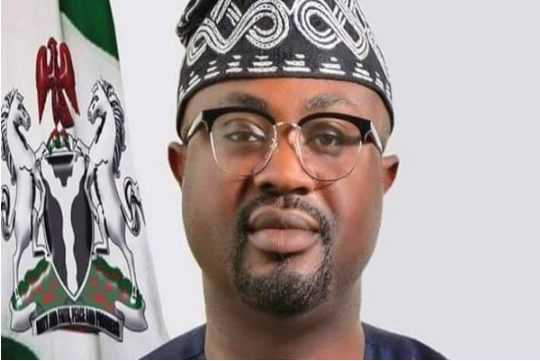
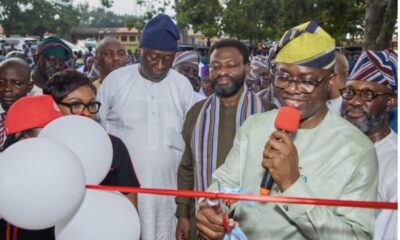
The Federal High Court in Abuja on Monday ordered the Minister of Interior, Olubunmi Tunji-Ojo, to respond to a suit seeking to compel the release of records of his National Youth Service Corps (NYSC) scheme.
Justice Salim Ibrahim gave the order when the matter came up for hearing.
The Incorporated Trustees of Pathway to Equity and Charity Foundation had filed the suit, marked FHC/ABJ/CS/1812/2026.
The group prayed the court to compel the NYSC to disclose documents supporting the minister’s claim that he completed the mandatory one-year national service.
The foundation also sought an order of mandamus directing the Federal Capital Territory Administration (FCTA), the 2nd respondent, to produce records showing that the minister did his primary assignment at the FCTA.
When the case was called, counsel to the applicant, Chief Solomon Akuma, SAN, told the court he was ready to proceed with the hearing.
However, Abiola Olaniji, who appeared for the minister, said he had filed an application for Tunji-Ojo to be joined as the 3rd respondent.
Olaniji said the applicant (foundation) had responded with a counter affidavit raising serious issues, to which he needed time to reply.
The lawyer stated that the minister was ready to take part in the proceedings as an interested party.
But Akuma opposed the application, arguing that the minister was not a proper party.
He said the suit only sought an order of mandamus compelling the respondents (NYSC and FCTA) to produce documents that are not in the minister’s custody.
Justice Ibrahim directed the minister to file and serve his reply to the applicant’s counter affidavit, which opposed his application to be joined as a party in the suit before the next hearing date.
The judge then adjourned the matter until Oct. 18 for hearing.
The applicant had sought from the NYSC the mobilisation or call-up letter issued to Tunji-Ojo in 2006 or any other year; the posting letter to the FCTA in 2006 or any other year; and his application for mobilisation.
It also sought the evidence of approval of his remobilisation by the NYSC’s Director-General; evidence of payment of allowances to him; the record of his Community Development Service and his discharge certificate.
The foundation equally sought from the FCTA, the mobilisation or call-up letter, the posting letter, his attendance record during the service year, evidence of any allowance paid to him, among others.
It said the application was brought under Section 14 of the Federal High Court Act, Order 34 Rules 1, 2 and 5 of the Federal High Court (Civil Procedure) Rules 2019.
It also cited Sections 20, 21 and 25 of the Freedom of Information (FOI) Act, 2011.
(NAN)

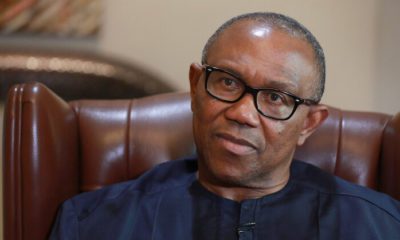
The presidential candidate of the Nigeria Democratic Congress, Peter Obi, has advised Nigerians residing in the United Kingdom to stop sending money to people who seek financial help at home.
Obi also advised them to urge their relatives to vote for productive leaders.
He made the remarks at a town hall meeting with diaspora supporters in Manchester, United Kingdom, on Sunday.
He stressed that Nigeria’s prevailing economic hardship resulted from bad leadership, arguing that continuous financial assistance only cushions the effects of poor governance without addressing the root causes.
“You have people at home in Nigeria today who are begging you for money. Tell them no!” he said.
The former Anambra State governor insisted that his record in public office distinguished him from other governors, claiming none of them matched his achievements in saving public funds.
“I’m not saying I’m a saint, but I saved money. I’ve not seen one governor who has saved 10 per cent of what I saved. No governor has done it.
“Let’s start with this one that is less corrupt. That’s how other countries change.”
He maintained that his conversations with the people reinforced the need for collective responsibility, stressing that building a new Nigeria would require citizens to take an active role in addressing challenges facing the country.
Obi also urged Nigerians to take the 2027 election seriously, describing the contest as a critical moment for the nation.
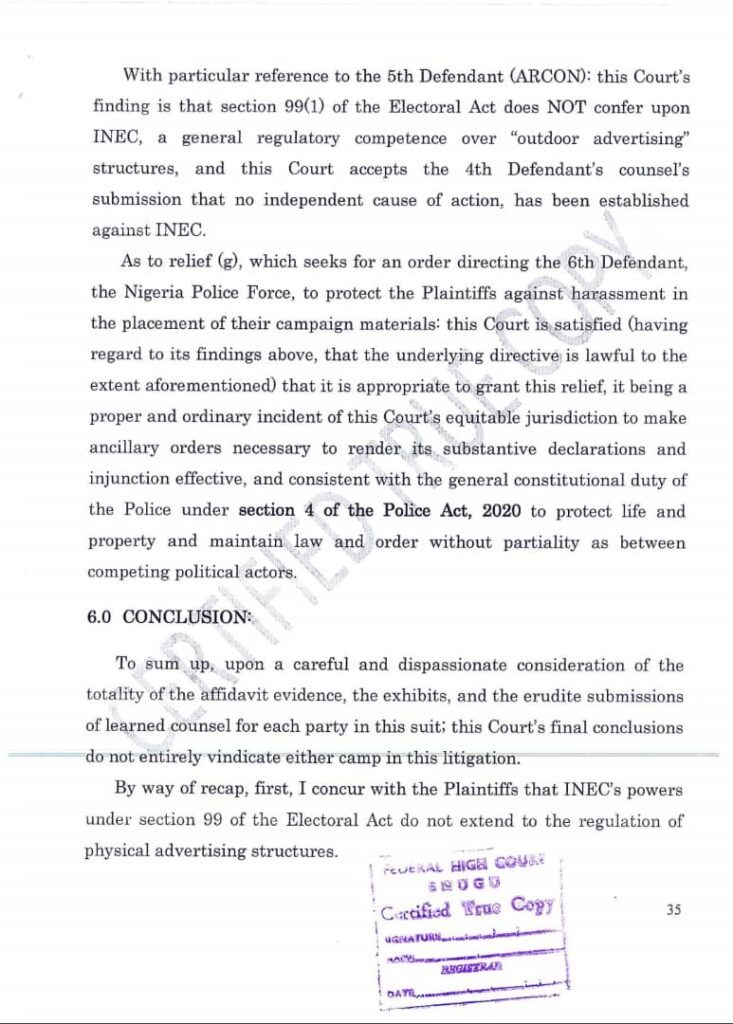
Contrary to false and misleading reports on social media that a Federal High Court (FHC) sitting in Abuja had nullified the N150 million fee prescribed by the Enugu State Structures for Signage and Advertisement Agency (ENSSAA) for political campaign billboards, findings have revealed that the court actually ruled in favour of the agency, upholding its powers to prescribe the fee.
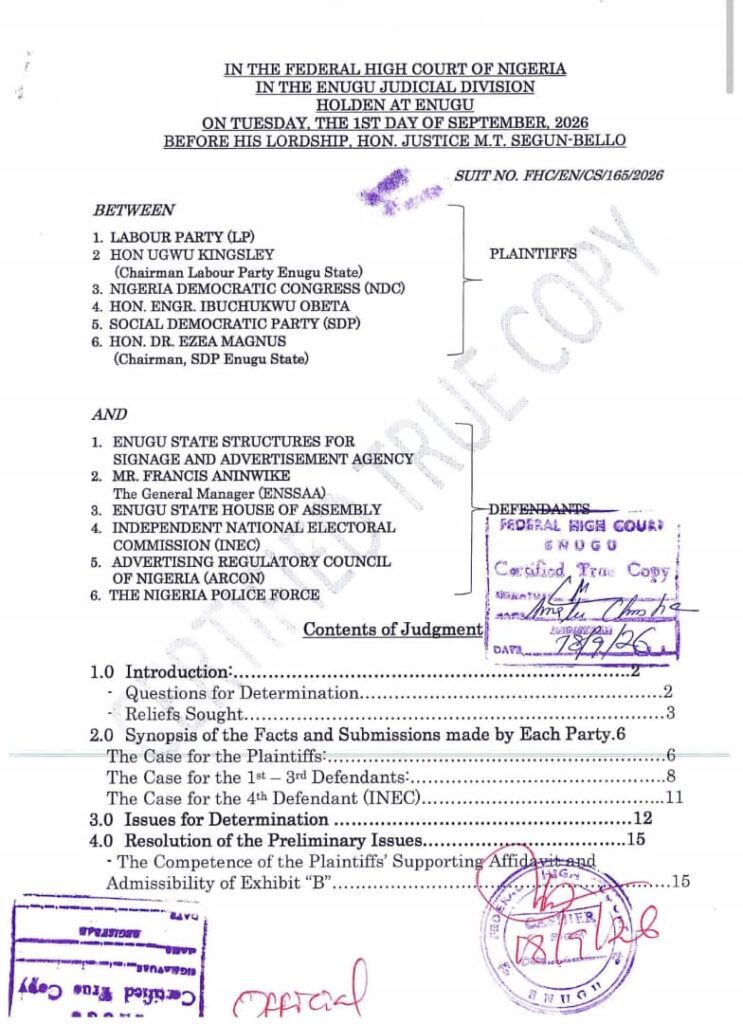
According to a certified true copy (CTC) of a judgment of FHC sitting in Enugu, the court had on September 1, 2026, dismissed a suit by opposition parties and figures challenging ENSSAA’s authority to impose a mandatory N150 million fee on each political party seeking to erect campaign billboards or display posters ahead of the 2027 general election.
The judgment rendered by Justice Mabel Segun-Bello held that it was within the legislative competence of the Enugu State House of Assembly to make laws on outdoor advertising and for ENSSAA to exercise powers donated to it by state law.
The suit marked FHC/EN/CS/165/2026 had the Labour Party; Chairman of the Labour Party (LP) in Enugu, Hon. Kingsley Ugwu; Nigeria Democratic Congress (NDC); NDC factional state Chairman, Engr. Ibuchukwu Obetta; the Social Democratic Party (SDP) and its state Chairman, Hon. Magnus Ezea, as plaintiffs, while ENSSAA; its General Manager, Mr. Francis Aninwike; the Enugu State House of Assembly; Independent National Electoral Commission (INEC); Advertising Regulatory Council of Nigeria (ARCON); and Nigeria Police Force were the respondents or defendants.
The plaintiffs had in June 2026 approached the court seeking a declaration that, by virtue of Sections 99 (1) and (2) of the Electoral Act, 2026, and Section 153 of the 1999 Constitution, which donated exclusive powers to INEC to regulate electoral campaigns of political parties in Nigeria, it was ultra vires the powers of ENSSAA and its General Manager to make executive decisions and publications imposing a mandatory payment of N150 million by political parties and their candidates in the state as an advertisement permit fee for the placement of billboards for the council election and the 2027 election.
They equally sought a declaration by the court that it was unlawful and ultra vires the legislative powers of the Enugu State House of Assembly to make laws regulating the advertisement of political campaigns in the state.
Consequently, the plaintiffs sought an order of the court setting aside the mandatory N150 million fee, as well as an injunction restraining the agency and its GM, the Enugu State Government, its agents and representatives from enforcing ENSSAA’s executive directive.
They finally sought an order of the court mandating the Nigeria Police Force to protect political parties in Enugu State against possible harassment for the placement of billboards and posters for the council election and the 2027 elections.
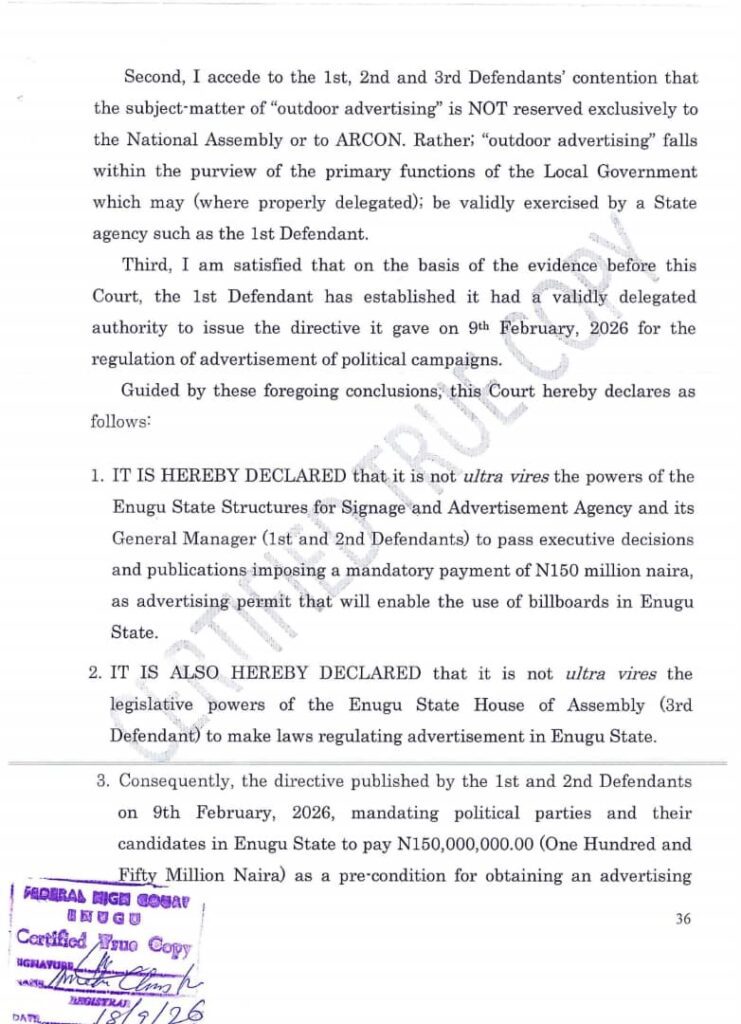
However, delivering her judgment in September, after a careful consideration of the totality of the affidavit evidence, the exhibits, and submissions by both parties, the presiding judge, Justice Mabel Segun-Bello, held, among other things, that the National Assembly does not hold exclusive legislative powers over outdoor advertising.
“I accede to the 1st, 2nd and 3rd Defendants’ contention that the subject matter of ‘outdoor advertising’ is NOT reserved exclusively to the National Assembly or to ARCON.
“Rather, ‘outdoor advertising’ falls within the purview of the primary functions of the Local Government, which may (where properly delegated) be validly exercised by a State agency such as the 1st Defendant (ENSSAA).
“Third, I am satisfied that on the basis of the evidence before this Court, the 1st Defendant has established it had a validly delegated authority to issue the directive it gave on 9th February, 2026, for the regulation of advertisement of political campaigns,” she stated.
Guided by these foregoing conclusions, Justice Segun-Bello held that “it is not ultra vires the powers of the Enugu State Structures for Signage and Advertisement Agency and its General Manager (1st and 2nd Defendants) to pass executive decisions and publications imposing a mandatory payment of N150 million naira, as advertising permit that will enable the use of billboards in Enugu State.”
Continuing, she said, “It is also hereby declared that it is not ultra vires the legislative powers of the Enugu State House of Assembly (3rd Defendant) to make laws regulating advertisement in Enugu State.
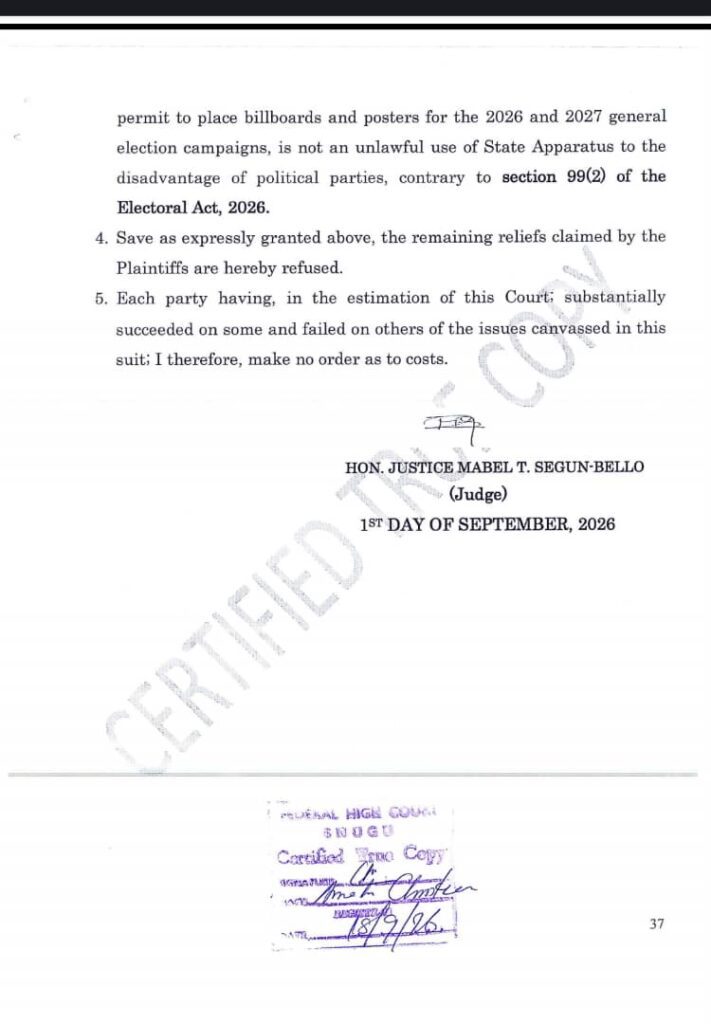
“Consequently, the directive published by the 1st and 2nd Defendants on 9th February, 2026, mandating political parties and their candidates in Enugu State to pay N150,000,000.00 (One Hundred and Fifty Million Naira) as a pre-condition for obtaining an advertising permit to place billboards and posters for the 2026 and 2027 general election campaigns, is not an unlawful use of State Apparatus to the disadvantage of political parties, contrary to Section 99(2) of the Electoral Act, 2026.
“Save as expressly granted above, the remaining reliefs claimed by the Plaintiffs are hereby refused.”
Meanwhile, the Enugu State Government says that unlike the practice in most states, the N150 million fee is for each political party, not for candidates, as misrepresented on social media and by some commentators.
The Secretary to the State Government, Prof. Chidiebere Onyia, made the clarification recently while fielding questions from Government House correspondents in Enugu, adding that there was no court judgment on the fee by any FHC in Abuja, as falsely circulated.
In a related development, finding show that the Abia State Structures for Signage and Advertising Agency (ABSSAA) prescribed feea for candidates ranging from N20 million for State House of Assembly candidates to N200 million for presidential candidates.
Imo State fees range from N3.55 million for each House of Representatives candidate to N55 million for each governorship candidate, while the permit fees range from N300,000 for local council candidates to N150 million for presidential candidates.
The campaign permit fee ranges from N100,000 for each councillorship candidate to N50 million for each presidential candidate, while Kwara State fixed its fees at N2 million for each House of Assembly candidate and N100 million for presidential candidates.
The Certified True Copy of the Court Judgement :
-
 Faith2 days ago
Awka Anglican Diocese Rejects Ibezim’s Suspension, Threatens to Leave Church of Nigeria
-
News2 days ago
BREAKING: Mbah Extends Enugu Movement Restriction to 10pm, Scraps Keke Ticketing
-
Politics2 days ago
Nigeria’s Weak Opposition and the Cost of One-Party Dominance: Can the Opposition Rebuild Before 2027?
-
News8 hours ago
JUST IN: Former Delta Governor, Uduaghan, dies
-
News2 days ago
2027: Keke Riders Endorse Mbah, Tinubu
-
News1 day ago
Catholic priest dies as crucifix falls on him during Mass
-
News22 hours ago
Corruption turning Nigerian Courts to ‘market stalls’ — Retired Justice Augie
-
News3 days ago
Enugu Approves ₦32bn Legacy Gratuity Payment, Begins Disbursement Next Week