Connect with us

News

Israel strikes Gaza, Syria and West Bank as war against Hamas threatens to ignite other fronts

Published

on

Israel strikes Gaza, Syria and West Bank in war against Hamas
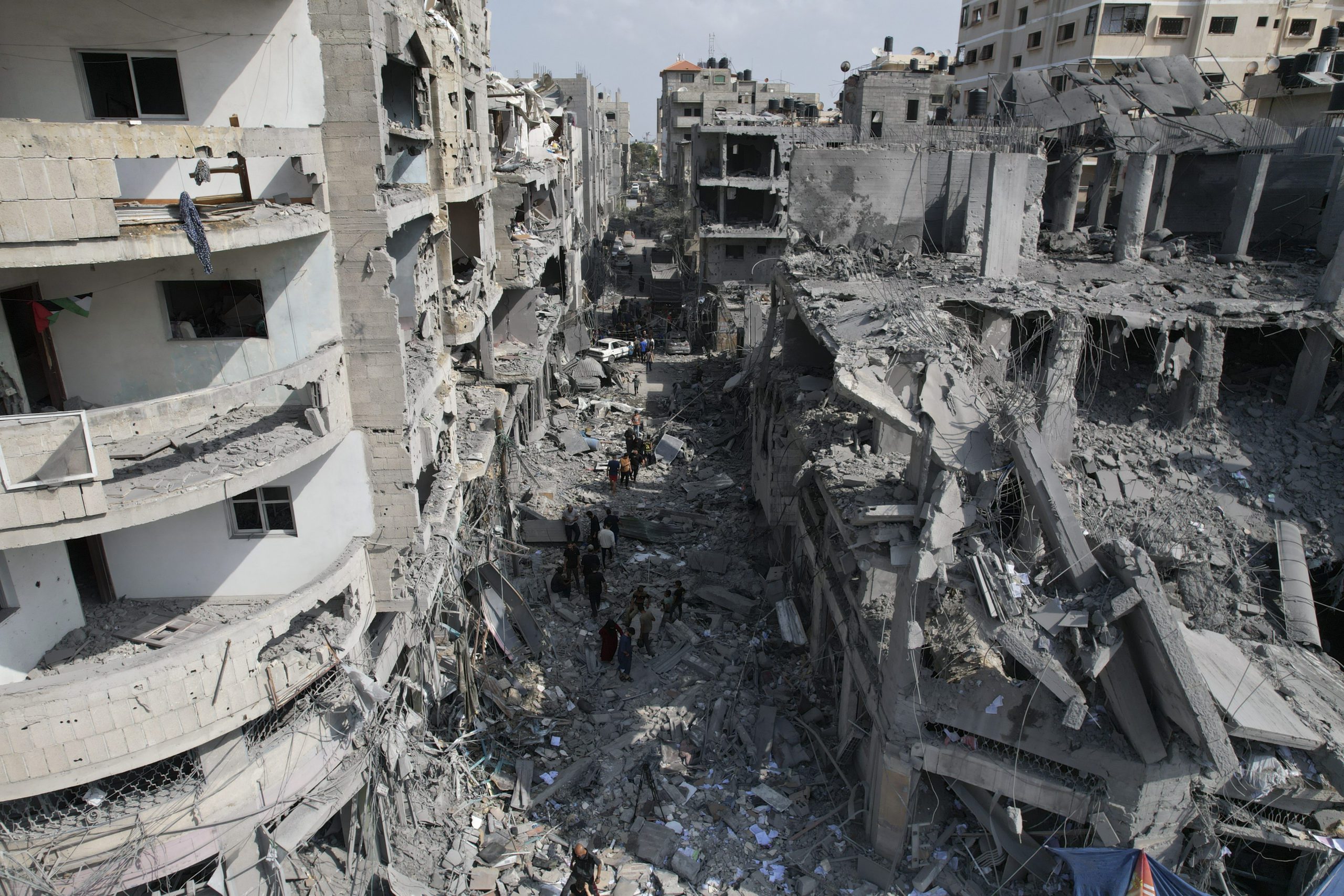
• Palestinians look for survivors after the Israeli bombardment of the Gaza Strip in Deir Al-Balah, Sunday, Oct. 22, 2023. (AP Photo/Hatem Moussa)
Spread the love
Israeli warplanes struck targets across Gaza overnight and into Sunday, as well as two airports in Syria and a mosque in the occupied West Bank allegedly used by militants, as the 2-week-old war with Hamas threatened to spiral into a broader conflict.

Israel has traded fire with Lebanon’s Hezbollah militant group on a near-daily basis since the war began, and tensions are soaring in the Israeli-occupied West Bank, where Israeli forces have battled militants in refugee camps and carried out two airstrikes in recent days.

Israeli Prime Minister Benjamin Netanyahu told troops in northern Israel that if Hezbollah launches a war against Israel, “it will make the mistake of its life. We will cripple it with a force it cannot even imagine and the consequences for it and the Lebanese state will be devastating.”

For days, Israel has seemed to be on the verge of launching a ground offensive in Gaza as part of its response to Hamas’ deadly Oct. 7 rampage. Tanks and tens of thousands of troops have massed at the border, and Israeli leaders have spoken of an undefined next stage in operations.

A convoy of 17 aid trucks was allowed to enter Gaza from Egypt on Sunday, Egypt’s state-run media reported, the second shipment into the territory since Israel imposed a complete siege two weeks ago. On Saturday, 20 trucks entered. Associated Press journalists at the crossing saw seven fuel trucks enter Gaza on Sunday, but did not see any more deliveries.

Relief workers said far more was needed to address the spiraling humanitarian crisis in Gaza, where half the territory’s 2.3 million people have fled their homes. The U.N. humanitarian agency, known as OCHA, said Saturday’s convoy carried about 4% of an average day’s imports before the war and “a fraction of what is needed after 13 days of complete siege.”

The Israeli military said the humanitarian situation was “under control,” as OCHA called for 100 trucks a day to enter.

Maduka College Advert

Israel repeated its calls for people to leave northern Gaza, including by dropping leaflets from the air. It says an estimated 700,000 have already fled, but hundreds of thousands remain. That would raise the risk of mass civilian casualties in any ground offensive.

Israeli military officials say Hamas’ infrastructure and underground tunnel system are concentrated in Gaza City, in the north, and that the next stage of the offensive will include unprecedented force there. Israel says it wants to crush Hamas, but officials have also spoken of carving out a possible buffer zone to keep Palestinians from approaching the border.

Hospitals packed with patients and displaced people are running low on medical supplies and fuel for generators, forcing doctors to perform surgeries with sewing needles, using vinegar as disinfectant, and without anesthesia.

The World Health Organization says at least 130 premature babies are at “grave risk” because of a shortage of generator fuel. It said seven hospitals in northern Gaza have been forced to shut down due to damage from strikes, lack of power and supplies, or Israeli evacuation orders.

Shortages in critical supplies, including ventilators, are forcing doctors to ration treatment, said Dr. Mohammed Qandeel, who works in Khan Younis’ Nasser Hospital. Dozens of patients continue to arrive and are treated in crowded, darkened corridors, as hospitals preserve electricity for intensive care units.

“It’s heartbreaking,” Qandeel told the AP. “Everyday, if we receive 10 severely injured patients we have to manage with maybe three or five ICU beds available.”

Palestinians sheltering in U.N.-run schools and tent camps are running low on food and drinking dirty water. A power blackout has crippled water and sanitation systems. OCHA said cases of chickenpox, scabies and diarrhea are on the rise because of the lack of clean water.

Heavy airstrikes were reported across Gaza, including in the southern part of the coastal strip, where Israel has told civilians to seek refuge. At the Al-Aqsa hospital in Deir al-Balah, south of the evacuation line, several bodies wrapped in white shrouds were lined up outside on the ground.

Khalil al-Degran, a hospital official, said more than 90 bodies had been brought in since early Sunday, as the sound of nearby bombing echoed behind him. He said 180 wounded people had arrived, mostly children, women and the elderly who had been displaced from other areas.

Israel’s military has said it is striking Hamas members and installations, but does not target civilians. Palestinian militants have fired over 7,000 rockets at Israel, according to the military, and Hamas says it targeted Tel Aviv early Sunday.

The military says it plans to step up airstrikes ahead of the “next stages of the war,” without elaborating.

More than 1,400 people in Israel have been killed in the war — mostly civilians slain during the initial Hamas attack. At least 212 people were captured and dragged back to Gaza, including men, women, children and older adults. Two Americans were released on Friday in what Hamas said was a humanitarian gesture.

More than 4,300 people have been killed in Gaza, according to the Hamas-run Health Ministry. That includes the disputed toll from a hospital explosion.

Syrian state media meanwhile reported that Israeli airstrikes have targeted the international airports in the capital, Damascus, and the northern city of Aleppo. The strikes killed one person and damaged the runways, putting them out of service. media reported.

Israel has carried out several strikes in Syria, including on the airports, since the war began. Israel rarely acknowledges individual strikes, but says it acts to prevent Hezbollah and other militant groups from bringing in arms from their patron, Iran, which also supports Hamas.

In Lebanon, Hezbollah said six of its fighters were killed Saturday, and the group’s deputy leader, Sheikh Naim Kassem, warned that Israel would pay a high price if it starts a ground offensive in Gaza. Israel struck Hezbollah targets Sunday in response to rocket fire, the military said.

Israel also announced evacuation plans for another 14 communities near the Lebanon border. Kiryat Shmona’s 20,000 people were told to evacuate last week.

In the Israeli-occupied West Bank, 90 Palestinians have been killed in clashes with Israeli troops, arrest raids and attacks by Jewish settlers since the Hamas attacks, according to the Palestinian Health Ministry. Israeli forces have closed crossings into the territory and checkpoints between cities, measures they say are aimed at preventing attacks. Israel says it has arrested more than 700 Palestinians since Oct. 7, including 480 suspected Hamas members.

Israeli forces killed at least five people there early Sunday, according to the Health Ministry. Two were killed in an airstrike on a mosque in the town of Jenin, which has seen heavy gunbattles over the past year.

The Israeli military said the mosque compound belonged to Hamas and Islamic Jihad militants who had carried out several attacks in recent months and were planning another one.

The internationally recognized Palestinian Authority administers parts of the West Bank and cooperates with Israel on security, but it is deeply unpopular and has been the target of violent Palestinian protests.


News

Gun to my head, I won’t stay beyond four years — Obi

Published

on

Peter Obi not arrested by DSS – Aide
Spread the love

Former Labour Party presidential candidate Peter Obi has said he would serve only one term of four years if elected president, insisting he would serve only one term in office “even with a gun to my head.”

Obi made the statement in a clip from an interview scheduled to air on News Central TV on Thursday.

“I want to be a one-term president because of stability. I would not stay a day, with a gun to my head, longer than four years,” he said in the circulating video.

The former Anambra State governor also criticised the current administration’s economic policies, including borrowing and rising cost of living, saying Nigeria had entered one of its most difficult economic periods.

Obi contested the 2023 presidential election on the platform of the Labour Party, where he came third behind President Bola Ahmed Tinubu of the All Progressives Congress and former Vice President Atiku Abubakar of the Peoples Democratic Party.

Since the election, Obi has remained a key opposition figure, frequently criticising the Tinubu administration’s economic reforms.

Maduka College Advert

Continue Reading

News

NEW ENUGU SMART CITY: Peter Mbah’s Audacious Blueprint For A Global City And A New Economic Frontier

Published

on

Enugu Gov Dr Peter Mbah
Spread the love

By Dr. Collins Ogbu

Cities are the new engines of global prosperity. Across the world, nations are no longer competing merely on the strength of their natural resources; they are competing on the efficiency, innovation, livability and attractiveness of their cities. From Dubai to Singapore, from Kigali to Shenzhen, the story is the same: governments that deliberately build modern urban ecosystems create wealth, attract investors, generate employment, and redefine the future of their people.

This is precisely the philosophy driving *Governor Peter Ndubuisi Mbah*’s ambitious vision for Enugu State.

When Governor Mbah declared his determination to grow Enugu’s economy from $4.4 billion to $30 billion, many saw it as audacious. But history teaches that transformational leadership is often mistaken for impossible ambition; until execution begins to silence doubters. Today, the New Enugu Smart City stands as one of the clearest physical manifestations of that economic revolution: a bold urban expansion project designed not merely as a real estate development, but as a futuristic economic ecosystem that will fundamentally alter Enugu’s economic trajectory.

The New Enugu Smart City

For decades, the old Enugu metropolis has borne the pressure of population growth, rising commercial activity, inadequate housing supply, traffic congestion, urban sprawl, and increasing pressure on public infrastructure. Like many fast-growing African cities, urban expansion often happened without long-term planning. Roads became overstretched, commercial clusters became chaotic, and housing shortages intensified. The answer to such pressures globally has never been to merely manage congestion; it has been to build new cities.

Maduka College Advert

Abuja was built to decongest Lagos and create a more centrally planned capital. _Eko Atlantic_ emerged as a premium urban extension to accommodate business growth. _Konza Technopolis_ was conceptualized as Africa’s Silicon Savannah. _King Abdullah Economic City_ was created to diversify an oil-dependent economy.
_Songdo International Business District_ became a global reference point for smart urban development through integrated digital infrastructure.

The _New Enugu Smart City_ belongs in that class of visionary projects.

It is strategically designed as a modern mixed-income, mixed-use urban settlement that caters to both high-net-worth individuals and middle-income earners. Unlike elitist urban projects that often exclude the average citizen, Enugu’s model deliberately creates opportunities for luxury housing, commercial districts, technology hubs, hospitality centres, industrial clusters, retail spaces and affordable residential schemes. This means that whether one is a corporate executive, diaspora investor, entrepreneur, civil servant, student, artisan or hospitality investor, there is a place for everyone within the emerging urban ecosystem.

At the heart of every smart city lies infrastructure intelligence. The New Enugu Smart City is envisioned with modern road networks, integrated drainage systems, uninterrupted power architecture, smart security systems, broadband-enabled connectivity, efficient waste management systems, green recreational spaces, industrial layouts, commercial districts, healthcare facilities, educational institutions and technologically enabled public services.

This is what separates a smart city from conventional urban settlements.
Traditional cities often expand reactively. Smart cities expand intentionally.
Traditional cities battle traffic chaos. Smart cities deploy intelligent mobility systems.
Traditional cities struggle with utility inefficiency. Smart cities integrate modern infrastructure from inception.
Traditional cities create informal congestion. Smart cities optimize space for productivity.
And productivity is where the real conversation begins.

Land itself is one of the greatest wealth creation tools available to governments. Globally, cities such as Dubai generated billions through strategic land development, infrastructure-led real estate appreciation, tourism expansion, and business investments. The New Enugu Smart City presents similar revenue-generating opportunities through land allocation, property taxes, business licensing, hospitality investments, industrial occupancy, tourism spending and foreign direct investment inflows.

As property values appreciate, internally generated revenue rises.
As businesses move in, employment expands.
As investors arrive, confidence deepens.
As population shifts, congestion reduces in the old city.
It is a cycle of growth that smart economies understand very well.

The decongestion benefits alone are enormous. Existing commercial centres in Ogbete, Independence Layout, Abakpa, Coal Camp and surrounding districts have long experienced infrastructure pressure due to concentrated economic activities. By creating an entirely new urban destination, government is redistributing population density and commercial activity in a way that ensures balanced development across the state.

This is how globally competitive cities are built;not by overburdening old districts, but by creating new economic corridors.

And what makes this even more strategic is that the New Enugu Smart City is not developing in isolation.

It is rising within a broader ecosystem of transformational infrastructure already being built by the Mbah administration.

Enugu Air is opening Enugu to regional and global connectivity while positioning the state as a major aviation hub in southeastern Nigeria. New dual carriageways and modern road corridors are dramatically reducing travel time across urban and rural communities. The development of world-class transport terminals is redefining organized mass transit and improving urban mobility.

The construction of Smart Green Schools across the 260 political wards in Enugu State is creating the human capital pipeline that future industries within the Smart City will require. These schools are embedding digital literacy, innovation and modern learning systems into the educational ecosystem. The ongoing rollout of Type-2 Primary Healthcare Centres ensures healthcare accessibility at the grassroots level, while the 300-bed international hospital is positioning Enugu as a destination for advanced medical services and medical tourism.

The International Conference Centre, alongside the nearly-completed five-star ICC hotels, further strengthens Enugu’s business tourism credentials. Conferences, summits, exhibitions and international business events require premium accommodation, modern residential options and commercial infrastructure; and the New Enugu Smart City provides exactly that complementary ecosystem.

Governor Mbah’s target of attracting three million visitors annually becomes significantly more realistic when supported by a city that can comfortably absorb tourists, investors, conference attendees, returning diaspora citizens and business travelers.

Visitors need hotels.
Professionals need homes.
Investors need infrastructure.
Businesses need certainty.
The Smart City answers all four.

More importantly, this project opens massive opportunities for private sector participation. Real estate developers, construction firms, fintech companies, hospitality brands, logistics operators, retailers, healthcare providers, educational institutions and manufacturing concerns all stand to benefit from the city’s growth trajectory.

This is how new economies emerge.
A construction economy first.
Then a services economy.
Then a technology economy.
Then a tourism economy.
Then a manufacturing ecosystem.
Then sustainable long-term prosperity.

This model has transformed Shenzhen from a fishing settlement into a global manufacturing giant. It transformed Dubai from a desert outpost into a global investment capital. It transformed Kigali into one of Africa’s cleanest and fastest-growing urban destinations.

Enugu is writing its own version of that story.
The symbolism is equally powerful.

For decades, Enugu has proudly borne the identity of the Coal City. But the future demands a broader identity; one rooted in innovation, enterprise, global competitiveness and smart urban planning. This is why the Governor now calls it: THE CITY OF GREAT MINDS!

The New Enugu Smart City represents that transition.
From legacy economy to future economy.
From administrative capital to investment destination.
From regional relevance to global competitiveness.
From potential to performance.

Governor Peter Ndubuisi Mbah understands what many leaders fail to grasp; that economic greatness is often built through infrastructure decisions whose true value unfolds over decades.

The New Enugu Smart City is not just about buildings.
It is about building confidence.
It is not just about roads.
It is about creating routes to prosperity.
It is not just about urban expansion.
It is about economic expansion.

And years from now, when investors, tourists, multinational corporations, technology firms and families choose Enugu as their preferred destination, many will look back at this moment and recognize that this was where the future began.

A city is being built.
But beyond that;
an economy is being born.

• By Dr. Collins Ogbu – SSA to the Governor of Enugu State on Strategic Communications

Continue Reading

News

Anambra Police arrest two over kidnap, murder of Bishop in Delta

Published

on

The two suspects paraded by the police
Spread the love

A middle-aged man has been arrested over alleged involvement in gruesome murder of his employer, a Pentecostal Bishop of End-reconciliation Ministry Asaba, Delta State.

The suspect was said to have also attempted to dispose of the deceased Toyota Prado Jeep in Nkpor, Idemili North Local Government Area of Anambra State before his arrest.

Confirming the incident on Wednesday while briefing newsmen, Commissioner of Police, State Command, CP Ikioye Orutugu said the suspect was arrested together with his accomplice alleged to be the buyer of the stolen vehicle.

The vehicle of the murdered Bishop

He said the stolen vehicle was also recovered from the suspects during the operation.

According to Orutugu, “The breakthrough followed a swift intelligence-led operation by Operatives attached to the Rapid Response Squad (RRS), Awkuzu, which led to the arrest of the suspect and another individual alleged to be the buyer of the stolen vehicle.

Maduka College Advert

“Preliminary investigation reveals that the suspect, who served as the Bishop’s driver and domestic staff, allegedly conspired with yet-to-be-identified criminal elements to murder the cleric before fleeing with the victim’s Prado Jeep to Anambra State for sale.

“Police Operatives, acting on credible information, tracked and intercepted the suspects in Nkpor, successfully recovered the stolen vehicle, and took them into custody for further interrogation.”

According to CP, investigations are ongoing to apprehend other members of the criminal gang involved in the incident and fully unravel the circumstances surrounding the unfortunate murder.

He advised residents to exercise due diligence in the recruitment and management of domestic staff, drivers, and other household employees.

Orutugu also urged members of the public to properly profile and verify the identities of persons employed in their homes and establishments, while also remaining vigilant to suspicious behaviours and activities.

“We assure the public that the Command remains committed to proactive policing, intelligence-driven operations, and collaboration with sister security agencies to ensure the safety of lives and property across the State.

While speaking to newsmen, the bishop’s driver said, “immediately we arrived home and my boss asked me to open the gate, I didn’t know that some people were trailing behind us.

“One of them rushed me, ordered me to lie down and marched my head and hit it with the gun. They went inside and met my master.

“They threatened to kill me if I raise alarm or call the police. They asked me to contact someone from Onitsha who will buy the vehicle. The buyers came this morning and took the vehicle.”

Continue Reading

Trending

Maduka College Advert