Connect with us

News

PEPT verdict: Fate of Nigeria hangs – Catholic Bishops

Published

on

Catholic Bishops
Spread the love

…Say future of democracy stands on edge of precipice

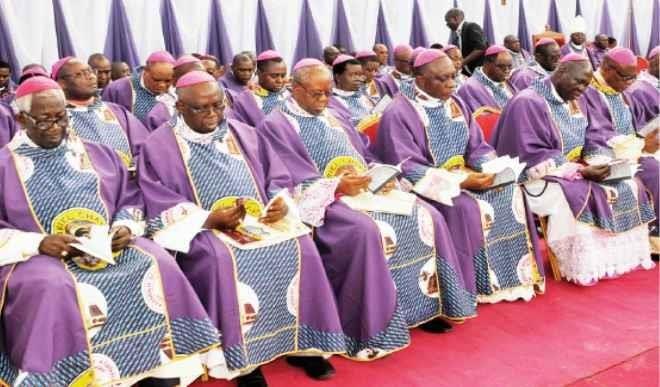
Following the controversies trailing the judgement of the Presidential Elections Petitions Tribunal, PEPT, the Catholic Bishops’ Conference of Nigeria, CBCN, has said Nigeria currently stands on the precipice of uncertainty as the case moves to the Supreme Court.

Addressing the opening ceremony of the 2023 Second Plenary Assembly of the CBCN in Abuja on Sunday, the President of the Conference, Archbishop Lucius Iwejuru Ugorji, voiced concerns over the conduct of the elections, which he said fell short of people’s legitimate expectations and moral and legal standards.

He highlighted the dismissive approach of the Presidential Election Petition Tribunal, PEPT, towards the petitions filed by aggrieved contestants.

The Catholic Bishops stated: “After hearing their petitions, the Presidential Election Petition Tribunal, PEPT, delivered its ruling in a marathon judgement on September 6, 2023.

Maduka College Advert

“The five justices of the Election Petition Tribunal unanimously dismissed the petitions. According to them, they lacked merit.

“Despite the billions of naira of tax-payers money appropriated for the provision of the BVAS technology as a game-changer in our general elections, the judges in their ruling tried, among other things, to suggest that it was wrong to expect INEC to keep its promise or obey the electoral regulation of transmitting election results electronically in real time from polling units.

“While respecting the views of the judges, two of the petitioners rejected their verdict as lacking in justice and so have decided to head to the Supreme Court to seek justice.

“As this case moves to the next level, the fate of the country continues to hang in the balance and the future of democracy in our land stands on the edge of a precipice.

“We pray and hope that the Supreme Court judges will neither bend the law nor seek to satisfy the whims and caprices of any party. We also pray and hope for a day in our nation when all election results will be finally decided at the polling units and not at the court.’’

Persisting insecurity

Ugorji lamented the deteriorating security situation in Nigeria, criticizing the government’s approach to the issue.

“In the face of this dismal situation, we cannot get tired of urging the government to rise to its primary responsibility of securing the lives and property of its citizens,” he stressed.

Ailing economy

Ugorji expressed deep concern over the prevailing state of tension and uncertainty in communities, where residents endure a life of increasing poverty, chronic hunger, hardships, and immense suffering.

He noted that the dire situation had been further exacerbated by the abrupt and poorly planned removal of fuel subsidy, the floating of the naira, and the subsequent galloping inflation.

The CBCN said these factors had significantly affected the prices of essential items such as food and transportation, plunging millions of Nigerians into excruciating economic hardship.

According to Archbishop Ugorji, the government’s efforts to alleviate the harsh effects of subsidy removal have not yielded significant results, leaving countless Nigerians to bear the brunt of the ruling class’s actions.

He said: “People have continued to live in a state of tension and uncertainty in our communities as they are subjected to a life of deepening poverty, chronic hunger, untold hardship and wanton suffering.”

Consider sufferings of Nigerians – Senator Umeh urges leaders

Also speaking on the occasion, Senator Victor Umeh, who represents Anambra Central senatorial district, echoed Ugorji’s sentiments, urging those in leadership positions to consider the sufferings of the people.

“Let me speak plainly; our concern is that urgent action needs to be taken. We implore all those in positions of leadership to consider the sufferings of our people, no matter how difficult they may be. Unless compelled, they often overlook these issues.

“In the National Assembly, we are committed to supporting initiatives that promote the well-being of Nigerian citizens, despite being gravely misrepresented,” Umeh said.

War worse than HIV, Ebola, COVID-19, Malaria put together — Kaigama

Meanwhile, Archbishop Ignatius Kaigama, Catholic Archbishop of Abuja, in his homily during the plenary mass, called on Nigerians to foster peaceful coexistence and resist the temptation to engage in violence. He also urged the appropriate authorities to caution religious leaders who make inflammatory remarks in videos on social media.

Regarding regional conflicts, the Archbishop commended the wise decision to avoid engaging in a war with neighbouring Niger.

Citing the history of endless bloodshed in the region, Kaigama urged the Economic Community of West African States, ECOWAS, to recognise the plight of the people and refrain from contributing to the stories of guns, bombs, and human casualties.

“It was wise that we did not embark in a war in neighbouring Niger. War is worse than HIV, Ebola, COVID-19 and Malaria put together. ECOWAS should realize that the people of this region have seen endless bloodshed. We should be able to win peace through dialogue without firing a shot,” Kaigama said.

There’s hope for Nigeria — CAN

On his part, the President of Christian Association of Nigeria, CAN, Archbishop Daniel Okoh, expressed hope for the future of the country.

Archbishop Okoh, who was represented by Apostle Samson Fatokun, the General Secretary of CAN, said: “This plenary session is coming at a time Nigerians are still going through excruciating pains, arising from harsh economic policies, recklessness of past governments, banditry and kidnapping.

“Prices of basic necessities have skyrocketed beyond the reach of ordinary people, and there appears to be no respite in sight. The living conditions of average Nigerian families today are better imagined than experienced.

“In addition, the new wave of military coups among our close neighbours and calls from certain quarters for military action against the coupists raise fears that living conditions may worsen in our country if that option is eventually taken by the Authority of the ECOWAS Heads of Government.

“In all these, I believe that God Almighty will use faith leaders to fix this country if we do not give up. Nigeria will be great again.”

We must collaborate to tackle hardship, insecurity — Umeoji

The event, chaired by Dame Adaora Umeoji, Deputy MD of Zenith Bank Plc, brought together esteemed guests such as Apostolic Nuncio, Antonio Fillipazi, deputy governors of Imo and Nasarawa states, Chief Placid Njoku and Dr Emmanuel Akabe, respectively, and Senate president, Godswill Akpabio, among others.

Umeoji, in her remarks, encouraged collaboration among the citizens, the church, and the government to reverse the current trend of hardship and insecurity.

“The World Bank classifies people living below $2 daily, approximately N1,960 per day, as poor. The implications of this classification mainly include increased inequality, poor healthcare, hunger, high mortality rates, youth unemployment, social injustice, insecurity, and social unrest.

“In light of these challenges, collaboration amo-ng citizens, the church, and the government is necessary to reverse this trend. “You (Bishops) have always provided the moral compass needed to navigate these troubled waters in which our nation has been sailing for many decades,” she stated.


News

Atiku’s Subsidy Reversal: Desperation For Power Must Not Endanger Nigeria’s Economy-Yilwatda

Published

on

Spread the love
The National Chairman of the All Progressives Congress (APC), Professor Nentawe Yilwatda, has condemned former Vice President Atiku Abubakar’s proposal to reverse the removal of petrol subsidy, describing it as a deeply troubling policy U-turn that raises serious questions about the opposition’s preparedness to govern Nigeria.
Professor Yilwatda said Nigerians deserve more than election-season declarations. He said any proposal to restore a costly subsidy regime must be subjected to rigorous scrutiny, particularly given the enormous fiscal burden subsidies placed on public finances and the distortions they created in the economy.
The APC National Chairman made the remarks during a visit to the headquarters of the City Boy Movement in Abuja, where he inspected the organisation’s facilities and interacted with its leadership.
The APC National Chairman noted that the opposition had been challenged repeatedly over the past three years to tell Nigerians what it would do differently if entrusted with power, yet no serious, coherent and convincing alternative had emerged. He said it was therefore suspicious that, after more than three years of silence on a comprehensive governing agenda, the former Vice President was only now, about four months before the 2027 general election, presenting a policy that could reverse hard-won economic adjustments and set the country’s development trajectory back several years.
“Economic policy cannot be reduced to election-season promises. Nigerians deserve to know precisely where the money will come from, what sectors will bear the cost and whether such a policy can be sustained without reopening the fiscal pressures that necessitated reform in the first place,” Professor Yilwatda said.
He maintained that the removal of subsidy was a difficult but necessary policy decision whose consequences required complementary measures to cushion its impact, expand social intervention and strengthen productive sectors of the economy.
Professor Yilwatda, in a statement by his Special Adviser on Media and Information Strategy, Abimbola Tooki, said the real test of leadership was not the ability to promise immediate relief for electoral advantage, but the courage to take difficult decisions, explain them honestly to citizens and remain committed to policies capable of producing sustainable growth. He said Nigerians are too discerning to hand over the nation to politicians who have yet to demonstrate what they would do with presidential power beyond reversing difficult but necessary reforms.
He added that Nigerians should carefully examine competing economic programmes ahead of the 2027 elections and distinguish between policies designed to address structural problems and promises that may provide short-term political appeal while creating longer-term fiscal difficulties.
The APC National Chairman also criticised the lack of ideological and organisational consistency within the opposition, saying politicians who continually move from one political platform to another cannot credibly claim to offer the stability and clarity required to govern a complex country. He contrasted this with President Bola Ahmed Tinubu, whom he said has remained within the progressive political tradition throughout his political career, apart from periods of political mergers, while Vice President Kashim Shettima has also maintained a consistent political trajectory. He added that key APC stakeholders had remained committed to the party and its progressive platform.
He said the APC-led administration under President Bola Ahmed Tinubu had taken difficult economic decisions and was implementing measures intended to reposition the economy, attract investment, strengthen domestic production and reduce dependence on unsustainable government interventions. He warned that reversing such reforms without a credible alternative could undermine investor confidence, worsen fiscal pressures and jeopardise the gains being pursued under the current administration.
Professor Yilwatda urged Nigerians to be wary of political promises that appear designed primarily to secure votes rather than solve structural problems. He also urged them to scrutinise the records and policy positions of those seeking the presidency, including the history of disputes involving former Vice President Atiku Abubakar and former President Olusegun Obasanjo, particularly allegations surrounding corruption in the privatisation exercise undertaken during the Obasanjo administration. He stressed that questions of accountability and economic governance must not be swept aside in the rush toward another election.
He said the 2027 election should be a contest of ideas, competence and credible policy alternatives, not a competition in which difficult economic realities are glossed over for political convenience.
 He said the 2027 election must be a contest between competing visions for Nigeria’s future, not a referendum on who can make the most attractive promises at the last minute.
Professor Yilwatda reiterated that the APC would continue to defend policies aimed at building a more productive, investment-friendly and economically sustainable Nigeria, while remaining open to constructive criticism and credible alternatives.
Continue Reading

News

Sanwo-Olu, Lai Mohammed, Gbenga Daniel to discuss 2027 elections, insecurity at 7th Freedom Online lecture

Published

on

Spread the love

Challenges facing the economy and insecurity, especially associated with elections in a developing economy like Nigeria, will be the focus of discussion at the seventh yearly lecture of Freedom Online (www.freedomonline.com.ng) on September 3 in Lagos.

Freedom Online, according to a statement by its Managing Director/Editor-in-Chief, Gabriel Akinadewo, is focusing on how to tackle insecurity during the lecture “because it has become a monster, threatening to consume the nation-state called Nigeria.

“What does the future hold for Nigeria after the 2027 general elections? How will the election be conducted in a way that will be acceptable to all? Will the outcome lay a solid foundation for the future of the country?

“We believe that actions of politicians, security agents and INEC officials, before, during and after the election will, one way or the other, decide the fate of the more than 200 million Nigerians in this geographical space. Obviously, insecurity, part of which is thuggery during elections, leads to poverty, underdevelopment and other social vices. Nigeria’s political, economic and social fabric is disintegrating because of this time bomb and the outcome of the election will go a long way to decide Nigeria’s future in global affairs”.

Akinadewo said Governor Babajide Sanwo-Olu of Lagos State is the Special Guest Speaker while former Information & Culture Minister, Alhaji Lai Mohammed and former Ogun State Governor, Senator Gbenga Daniel, are the Chairman and Special Guest of Honour respectively.

Maduka College Advert

The President of the Nigerian Guild of Editors (NGE) and Editor of Vanguard, Eze Anaba, is the Chief Host.

Continue Reading

News

Enugu Govt slashes Land Use Charges, cuts Property Rates

Published

on

Spread the love

…Property Enumeration App to drive new land revenue regime

The Enugu State Internal Revenue Service (ESIRS) has announced a drastic reduction in land use charges payable by property owners across the state  as part of measures to encourage tax compliance and broaden the state’s revenue base.

The Chairman of ESIRS, Mr Emmanuel Ekene Nnamani, disclosed this on Monday while briefing journalists on the activities and achievements of the agency in its three years under his leadership.

Under the revised arrangement, property owners in Independence Layout now pay N70,000 annually, while those in Abakpa pay N20,000. Owners of village houses, according to Nnamani, will pay N10,000 annually as land use charge.

Nnamani also announced plans to commence the implementation of a Property Enumeration App, which will facilitate the identification and enumeration of properties across the state and provide a database for the assessment and collection of land use charges.

He said students would be engaged to participate in the enumeration exercise, with each student expected to receive payment on a weekly basis, based on the number of houses enumerated.
Maduka College Advert

According to him, the initiative would help ESIRS establish an accurate property register while creating opportunities for students to earn income through the exercise.

Nnamani explained that the Property Enumeration App would assign identification to properties and their owners, making it easier for the government to determine taxable properties and improve compliance.

He said the exercise was part of ESIRS’ broader strategy to expand the tax net and bring previously untapped sources of revenue into the formal revenue system.

The ESIRS chairman said the agency was also expanding its revenue collection activities to o other  areas including haulage fees, land use charges, capital gains tax, stamp duties and withholding tax.

He disclosed that withholding tax would soon become operational in the state, urging individuals and organisations required to deduct the tax to ensure that the deductions were properly remitted to the government.

Giving an insight into the performance of ESIRS under his leadership, Nnamani said the agency had recorded a significant increase in internally generated revenue since 2023.

He said the state generated N37 billion in 2023, rising to N108.5 billion in 2024, while revenue increased substantially to N406.7 billion in 2025, representing tax and non-tax revenues.

Nnamani attributed the growth to the reforms introduced under Governor Peter Mbah’s administration, particularly the autonomy granted ESIRS and the deployment of technology for revenue collection.

He said the agency inherited a system characterised by poorly motivated personnel and fragmented revenue collection, but the autonomy granted by the state government enabled ESIRS to embark on fundamental reforms.

“Our Governor came with disruptive innovation and now it is time to give account,” Nnamani said.

He explained that the autonomy granted to ESIRS was backed by legislation, transforming the agency into a one-stop shop for revenue collection in the state.

According to him, ESIRS moved away from a mono-payment gateway operated through Interswitch and expanded the system to seven payment gateways, including UPS and Flutterwave.

He said taxpayers could now make payments through banks, transfers and more than 300 Point-of-Sale (POS) terminals, including from the comfort of their homes and even during weekends.

The development, he said, had significantly improved convenience and reduced opportunities for revenue leakages.

Nnamani said the agency also embarked on extensive training of its personnel and declared an emergency in which every staff member was required to have access to a laptop or tablet.

He added that ESIRS invested in reliable internet connectivity and solar energy to ensure that its operations were not disrupted by power challenges.

The ESIRS chairman said the agency had also banned cash payments as part of measures to strengthen transparency and accountability in revenue collection.

He said several revenue agencies that previously operated independently had been unbundled and brought under a centralised system, while ESIRS collaborated with relevant unions and revenue agencies to improve its operations.

According to him, the reforms were particularly significant in the informal sector, where revenues were previously paid to non-state actors before the new system was introduced.

Nnamani urged residents and businesses to familiarise themselves with the state’s tax laws, stressing that the agency was not interested in imposing arbitrary taxes but in ensuring compliance with existing legislation.

He said the law provides for certain exemptions, but taxpayers seeking exemption must undertake the required tax filing.

He noted that ESIRS was currently not implementing some provisions of the tax law to their full extent, citing the provision requiring the payment of one per cent of turnover in certain circumstances.

“We are only collecting N36,000 and people are complaining. I’m a tax collector and you have to convince me why you should not pay,” he said.

He urged taxpayers to study the tax laws and understand their obligations rather than evade payment.

The ESIRS boss further disclosed that the state was collecting Development Levy from new construction projects, noting that between 20 and 25 new buildings were being commenced daily across the state.

He said the levy was N150,000 in Enugu North Local Government Area, N100,000 each in Enugu South and Enugu East, N80,000 in Nsukka, while the rate for other local government areas stood at N50,000,”and you must pay to be permitted to commence development of the property”.

READ THIS Government Of Dr Peter Mbah Is Interested Practically, Conveniently To Relate With NUJ – _Aka Eze Aka_
He said ESIRS was also strengthening the collection of capital gains tax, particularly from property transactions, as well as stamp duty.

Nnamani maintained that the objective of the reforms was to create a sustainable and transparent revenue system capable of funding government programmes without placing undue pressure on taxpayers.

The chairman also dismissed concerns that the ongoing tax reforms were designed to frustrate businesses, particularly Igbo traders.

He said the forthcoming implementation of enhanced tax-compliance measures at both the federal and state levels should not be misconstrued as an attempt to shut down businesses.

According to him, the reforms are aimed at ensuring that individuals and businesses fulfil their statutory tax obligations.

“It is not aimed at shutting down Igbo business. People should pay their taxes and not evade it,” he said.

Nnamani said ESIRS would continue to expand the tax net while deploying technology to make payment easier, improve transparency and ensure that revenue due to the state was properly collected.

He said the agency’s ultimate objective was to build a modern revenue administration system in which taxpayers could meet their obligations conveniently while the state  would accurately account for every naira collected.

Continue Reading

Trending

Maduka College Advert