Connect with us

Business

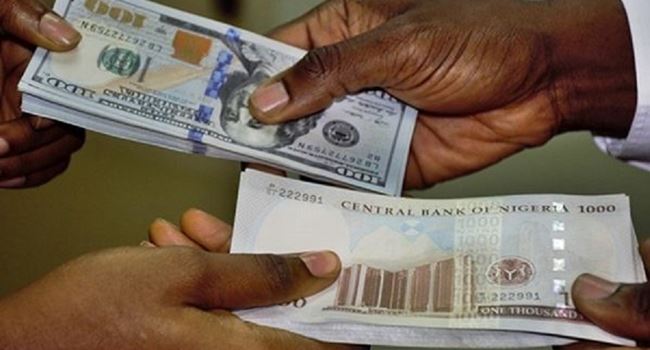
Naira relapses to N900/$ in parallel market

Published

on

CBN injects fresh Dollars into BDCs at N1,021/$1
Naira to Dollar Exchange
Spread the love
The local currency, which regained steam after the acting governor of the Central Bank of Nigeria (CBN), Folashodun Shonubi, threatened forex speculators of losing huge amount, relapsed as the speculators sustained their operations.At the Investor and Exporter (I&E) window, the official market, the naira closed at N773.42 to dollar, creating around N123 premium between the official and parallel markets.

There was $61 million turnover at the I&E window.

One of the forex traders based in Abuja, Mustapha Bakori said he was not surprised to see the naira depreciate, because initial expectation of improved dollar liquidity in the market, was not met with action.

He said: “Many people expected immediate intervention in the market that will boost dollar liquidity, but that is taking too long to happen. Until that is done, the naira will continue to come under pressure,” he said.

A Bureaux De Change (BDC) trader based in Marina, central Lagos, Garuba Sarki, said many forex dealers are still not sure, where the rtes will oscillate in the next few weeks, because the Central Bank of Nigeria (CBN) is still keeping the market in suspense.

Maduka College Advert

He said: “Many speculative dealers were taking the back seat have returned to the trenches. We expect the naira to continue to depreciate until the policy environment is well defined,” he said.

Also speaking, the president, Association of Bureaux De Change Operators of Nigeria (ABCON), Dr. Aminu Gwadabe, advised the Federal Government to enhance financial intelligence by tracking people with proceeds of corruption to sanitize the market.

He said many of the people with proceeds from corruption are the ones putting pressure on the forex market through their manipulative actions.

“The naira is depreciating not by forces of demand and supply, but by the collective action and impact of the people with illicit funds,” he said.

The CBN had in June commenced currency reforms that brought about exchange rate unification and abolishment of multiple multiple exchange rates.

The exercise led to 40 per cent drop in naira rate at the official market, but dollar supply has continued to be a big challenge making it difficult for official and parallel market rates to converge.

Former Executive Director, Keystone Bank Limited, Richard Obire said the weakness of the naira over time has been caused by two broad issues linked to the quality of leadership and governance.

He said Nigeria’s heavy and skewed outward-oriented consumption of goods and services as seen in decades of long substantial bills for food and energy imports remains a hindrance to naira stability.

Also, the massive corruption-driven capital outflows which in turn severely damages Nigeria’s capacity to produce at scale that will enable the country to fully engage its large population to create widespread prosperity works against the naira.

On ways to strengthen the naira, he advised that in the short-term, there is need to find non-market damaging ways to increase the supply of hard currencies and reducing the demand for same.

“Our crude oil export quota is currently 1.74 million barrels per day. In July, we produced 1.081m bpd. Let us get our production up to the full quota. At current market price of about $87 per barrel, this should see us earning an additional about $1.7 billion per month. Nigerian Diaspora Remittances rather than declining should be growing as the population of our Diasporans are growing. Half year January to June 2023, remittances totaled $952 million compared to $1.21 billion for the same period in 2022,” he said.

According to Obire, right pricing for remittances and frictionless processes for their use by recipients should see the volumes growing again.

He said that insecurity hampering food production needs to be tackled with a sense of urgency and effectiveness.

“Priority should be given through deploying pragmatic incentive programs to drive up the volume of food products for domestic consumption and industrial use to reduce our food import bill. All government consumption expenditures requiring the use of hard currencies should be suspended indefinitely, starting now,” he advised.

Continuing, Obire said the Turn Around Maintenance (TAM) status of refineries in Port Harcourt and Warri should be appraised immediately. Effort should be focused on the one which can begin producing quicker. The other one should be made to be up and running, not long after. This should reduce required forex for fuel imports.

He noted: “In the long term, only a strong economy will produce a stable currency. To achieve this will require addressing the fundamental structural defects in our political-economy hampering an accelerated transition from an outward consumption oriented economy into a mainly balanced production driven one.” (NATION)


Business

Dollar to Naira exchange rate today, September 23, 2026

Published

on

Naira rebounds to 1,275/$ at parallel market
Spread the love
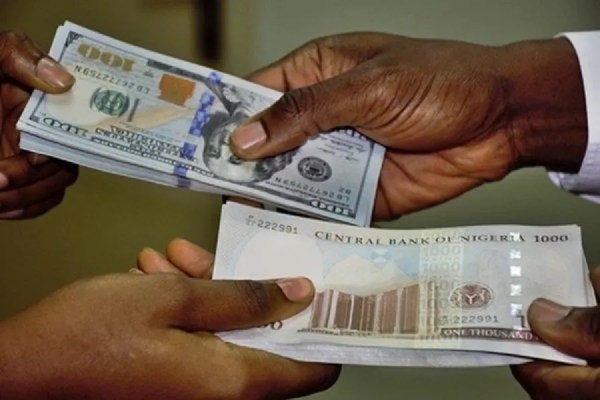
The Nigerian naira is trading at different rates against the United States dollar across the official Nigerian Foreign Exchange Market (NFEM) and the parallel market on Wednesday, September 23, 2026.

The latest available data show that the naira strengthened to N1,327.78 per dollar at the NFEM on Tuesday, from N1,329.80 recorded on Monday.

The latest movement represents a N2.02 appreciation by the naira against the dollar on a day-to-day basis.

In the parallel market, the dollar was quoted at about N1,389 on Tuesday, down from N1,390 recorded the previous day.

The parallel-market rate puts the gap between the official NFEM rate and the street-market selling rate at about N61.22 per dollar.

At the parallel market rate of N1,389, customers buying $100 would need approximately N138,900, while $1,000 would cost about N1.389 million.

Maduka College Advert

The exchange rate available to individuals and businesses may vary depending on the dealer, location, transaction size and prevailing market conditions.

The naira’s recent performance has come amid developments in Nigeria’s foreign exchange market, including changes in dollar liquidity and monetary policy.

The Central Bank of Nigeria has continued to monitor conditions in the foreign exchange market as the naira trades around the N1,300-per-dollar level at the official market. Reuters also reported in September that the naira had remained relatively stable, supported by central bank dollar sales and subdued import demand.

For Wednesday, September 23, the latest confirmed figures put the dollar at N1,327.78 at the NFEM and around N1,389 in the parallel market.

The rates could change during the day as demand and supply conditions shift across both markets.

Continue Reading

Business

Enugu Air Launches New Website

Published

on

Spread the love

…moves online services to www.enuguairlines.ng

Enugu Air has announced the launch of its new official website, enuguairlines.ng, as part of efforts to provide passengers and customers with a better, safer and more convenient digital experience.

The airline said the migration to the new website is designed to improve how passengers connect with Enugu Air and access its services online, including flight bookings, schedules and the latest updates.

Announcing the development, the airline said: “We’ve moved! We’re innovating! We’ve migrated to a better, safer and convenient website to connect you to the world.”

Passengers can now access Enugu Air’s online services through its new web address, enuguairlines.ng, which the airline described as its new digital home.

The airline urged passengers and prospective travellers to save the new web address and use it for flight bookings, checking schedules and obtaining the latest information about its operations.

Maduka College Advert

“Same Enugu Air. New web address,” the airline stated, emphasising that the change represents an improvement in its digital platform while retaining the Enugu Air brand and services.

The airline further encouraged customers to visit, www.enuguairlines.ng for all flight-related information and online services.

It further stated that the old website, enuguairlines•com has been discarded and no longer in use.

Continue Reading

Business

Nigeria records 8.51m terabytes of data use in first half of 2026

Published

on

Nigerian Communications Commission
Spread the love

Nigerians consumed a record 8.51 million terabytes of data in the first half of 2026, underscoring the country’s accelerating shift toward a digital-first economy.

Data from the Nigerian Communications Commission (NCC) confirmed this. Specifically, in January, consumption was 1.385 million terabytes; February, 1.260 million terabytes and March, 1.422 million terabytes.

In April, consumption was 1.414 million terabytes. It climbed to 1.504 million terabytes in May and 1.532 million terabytes in June.

In 2025 alone, Nigerians consumed over 13.2 million terabytes of data, a 35 per cent increase from 2024, reflecting how connectivity has become essential for daily life.

The surge in consumption was driven largely by the twin giants of the telecom sector, MTN Nigeria and Airtel Nigeria, whose half-year reports revealed data services have firmly overtaken voice as the primary revenue stream.

Maduka College Advert

According to industry figures, average monthly data usage per subscriber rose sharply, reflecting the growing reliance on mobile broadband for work, entertainment, and commerce.

Streaming platforms, social media, fintech apps, and remote work tools have all contributed to the spike in demand.

MTN Nigeria reported that its 55.7 million active data subscribers consumed an average of 14.8 gigabytes per month, representing a 15.2 per cent increase year-on-year. Overall, MTN’s data traffic surged by 25.8 per cent across its network in the period.

This translated into a massive N1.70 trillion in data revenue, a 38.4 per cent jump compared to the same period in 2025. Data now accounts for more than half of MTN’s total service revenue, dwarfing its voice earnings of N993.5 billion, which grew at a modest 12 per cent.

Airtel Nigeria also posted strong numbers, recording N691 billion in data revenue ($507 million). While Airtel’s voice services contributed to a combined N1.42 trillion in voice earnings alongside MTN, the clear trend is that data has become the dominant driver of growth.

Together, MTN and Airtel generated N2.4 trillion from data services in H1 2026, cementing their role as the backbone of Nigeria’s digital economy.

MTN invested N620.5 billion in capital expenditure during the period, focusing on expanding 4G coverage, scaling 5G rollout, and strengthening fibre infrastructure. The company’s aggressive push into next-generation networks is aimed at meeting the surging demand for high-speed connectivity.

Airtel, meanwhile, faced challenges with fibre cuts and vandalism, forcing reinvestments to stabilize its network. The operator is blending 5G expansion with satellite partnerships to extend coverage into rural and semi-urban areas, where demand for reliable Internet is rising.

Despite these investments, many consumers continue to express dissatisfaction with service quality. Complaints of slow speeds, unstable connections, and high costs remain widespread, highlighting the gap between consumption growth and infrastructure capacity.

The NCC has repeatedly urged operators to deepen investments in fibre, towers, and spectrum to sustain the country’s digital transformation. Analysts note that the sector is undergoing a structural shift from voice-first to data-led growth, with internet connectivity now central to economic activity.

Industry experts predict that Nigeria’s data consumption will continue to rise exponentially as smartphone penetration increases and more services migrate online. The rollout of 5G is expected to further accelerate usage, enabling innovations in fintech, e-commerce, healthtech, and entertainment.

The consumption of 8.51 million terabytes in H1 2026 marks a historic high for Nigeria’s telecom industry. It reflects not only the appetite of a digitally hungry population but also the broader transformation of the economy.

With MTN and Airtel leading the charge, the challenge now lies in improving service quality, expanding infrastructure, and ensuring affordable access for millions of Nigerians. As data becomes the lifeblood of communication and commerce, the telecom sector’s ability to keep pace with demand will determine how effectively Nigeria harnesses the opportunities of the digital age.

Continue Reading

Trending

Maduka College Advert