News
UPDATED: Niger coup: ECOWAS rejects junta’s 3-year transition plan

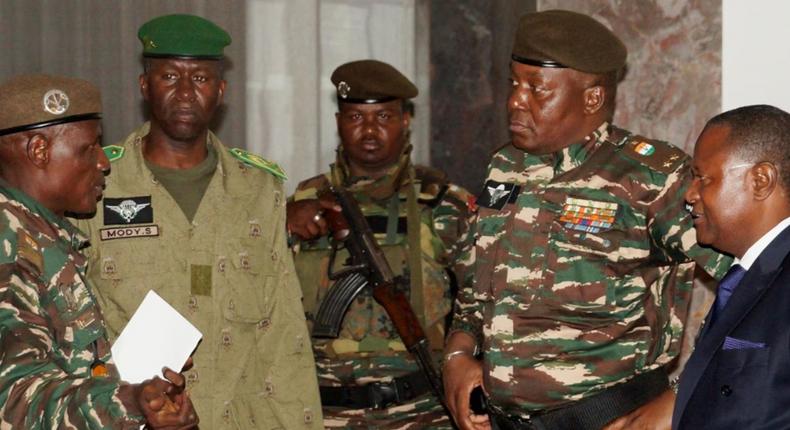
• Junta warns against foreign intervention
The Economic Community of West African States, ECOWAS, has rejected the three-year transition plan proposed by Niger Republic’s military junta.
It will be recalled that the coup leader, General Abdourahamane Tchiani, had at a meeting with ECOWAS delegation, led by General Abadulsalami Abubakar, retd, in Niamey on Saturday, promised the military government would return Niger Republic to democracy in three years.

Abdel-Fatau Musah, ECOWAS Commissioner for Political Affairs, Peace and Security, told BBC in an interview, yesterday, that the proposal was unacceptable to ECOWAS, setting the ground for a military operation.
Meanwhile, thousands of Nigeriens flooded the streets yesterday declaring support for the military junta.
Their demonstration came against the backdrop of ECOWAS’ insistence on invading the country to rout out coupists should diplomacy fail to restore ousted President Mohamed Bazoum to power.

The rally came on a day an official of the government in Niger said talks between the ECOWAS delegation, led by former Head of State, General Abdulsalami Abubakar, retd and the junta achieved very little result.
The official also noted that already, there are deep divisions within the presidential guard, which ousted President Bazoum, saying should ECOWAS launch an attack on Niger Republic, the majority of soldiers in the presidential complex would flee.
This is even as Pope Francis yesterday canvassed a diplomatic solution to the political crisis.
The demonstrators chanted slogans hostile to former colonial power, France and especially ECOWAS, which is considering a potential military operation to reinstate elected President Mohamed Bazoum if ongoing negotiations with coup leaders fail.
The Sahel state’s new military leaders have officially banned demonstrations but in practice, those in support of the coup are allowed to go ahead.
The demonstrators waved placards, saying “stop the military intervention” and “No, to sanctions”, in reference to the financial and trade restrictions imposed by ECOWAS, four days after the coup on July 26.
Yesterday’s pro-coup rally was accompanied by musicians praising the new military regime, according to AFP.
The latest in a string of pro-coup rallies came a day after the new military ruler in Niamey warned that an attack on Niger would not be a “walk in the park.”
‘No wish to confiscate power’
General Abdourahamane Tchiani also said in a televised address at the weekend that he did not wish to “confiscate” power and that a transition of power back to civilian rule will not go beyond three years.
Niger’s new leaders have accused France, a close Bazoum ally, of being behind the anti-coup stance taken by ECOWAS, which again at the weekend made a fresh push for a diplomatic solution.
According to AFP, after ECOWAS chiefs of staff met in the Ghanaian capital, Accra, on Friday, the 17-nation bloc said it had agreed on a date for a potential intervention but nonetheless sent a diplomatic delegation to Niamey at the weekend, led by General Abdulsalami Abubakar.
Niger television showed delegation members shaking hands with Bazoum, who remains in detention.
It also broadcast footage of Abubakar speaking to Tchiani but the content of the exchange had not been made public.
In his televised address on Saturday, Tchiani alleged that ECOWAS was “getting ready to attack Niger by setting up an occupying army in collaboration with a foreign army”, without saying which country he meant.
The coup leader, Tchiani, however, warned that the military and people of Niger would defend the country should ECOWAS go ahead with its invasion plan.
Talks between ECOWAS, Niger’s junta yield little, official tells Associated Press
However, an official in Niamey, Niger Republic’s capital, said on condition of anonymity yesterday that weekend’s two-hour meeting between Niger’s new military regime and a delegation from the West African regional bloc, ECOWAS, yielded very little result.
It was the first time head of the junta, Gen. Abdourahmane Tchiani, met with ECOWAS delegation after rebuffing previous attempts.
Saturday’s meeting was a last-ditch diplomacy scramble by ECOWAS to resolve the crisis peacefully and followed last week’s announcement that 11 of its 15 member states had agreed to intervene militarily if democratically-elected President Bazoum was not released from house arrest and reinstated.
The bloc’s three other countries under military rule following coups, Guinea, Mali and Burkina Faso, were not included.
The latter two had previously warned they would consider intervention in Niger an act of war.
The official noted that during the weekend talks, Tchiani pushed for the lifting of economic and travel sanctions imposed by ECOWAS after the coup, saying Niger’s population was suffering because of them.
‘’The junta said they were under pressure, at times striking a conciliatory tone and apologizing for past disrespect towards the bloc, while also defiantly standing by its decision to overthrow Bazoum and unequivocal about him not returning to power.
“Tchiani also repeatedly expressed concerns that its former colonial ruler France, which has some 1,500 troops in the country and had been providing training and conducting joint operations with Niger’s military, was actively planning an attack,” said the official.
According to the official, Niger was seen by many Western countries as the last democratic partner in the region they could work with to beat back a growing jihadi insurgency by militant groups linked with al-Qaeda and the Islamic State.
He noted that France, the United States and other European nations had poured hundreds of millions of dollars into shoring up Niger’s army, adding that the coup had been seen as a major setback.
He quoted Sahel experts as saying it was not surprising that nothing came from Saturday’s meeting as each party was trying to show they were open to discussions when chances of an agreement were slim.
“ECOWAS and the rest of the international community want to restore President Bazoum and the junta is not on this agenda.
“The next step will be military confrontation … What we don’t know is when this confrontation will take place, how it will go, and what the consequences will be,” the official quoted Seidik Abba, a Nigerien researcher and Sahel specialist and president of the International Centre for Reflection for Studies On the Sahel, a think tank based in Paris, as saying.
Shortly after the meetings Saturday, Tchiani went on state television and laid out a roadmap for the country, saying it would return to civilian rule within three years and that details for the plan would be decided within 30 days through a national dialogue set for immediate launch.
“I am convinced that we will find solutions to all the challenges we face and that we will work together to find a way out of the crisis, in the interests of all,” the official said.
However, Aneliese Bernard, former U.S. State Department official who specializes in African affairs and is now director of Strategic Stabilization Advisors, a risk advisory group, said the transitions for Niger’s multiple previous coups were shorter, stressing that a three-year timeline was unprecedented said .
“What we’re seeing in the region is the emergence of trends just to military rule,” she said.
But some Nigerien soldiers don’t think Tchiani will last three months, let alone several years.
A soldier, who worked directly with Bazoum before the coup, and did not want to be named for fear of his safety, told the AP on Saturday that there were deep divisions within the presidential guard, the unit that overthrew Bazoum.
The soldier noted that of the nearly 1,000 soldiers at the base on the presidential complex, majority of them would flee if ECOWAS attacked, adding that Tchiani would be overthrown in a few months.
According to Andrew Lebovich, a research fellow with the Clingendael Institute, Tchiani is widely unpopular in security circles within Niger and is seen as having reached his current post because of former President Mahamadou Issoufou’s patronage, rather than through his own connections and battlefield achievements,
“While the (junta) has presented a unified public face, it is a partnership of branches of the armed forces that have competed for status and resources in the recent past,” he said.
Pope calls for peace in coup-hit Niger
Meanwhile, Catholic Pontiff, Pope Francis 11, yesterday made case for a diplomatic solution to the political crisis in Niger Republic.
“I am following with concern what is happening in Niger, and join the bishops’ call in favour of peace in the country and stability in the Sahel.
“I join with prayer the efforts of the international community to find a peaceful solution as soon as possible for the good of everyone,” said said Pope Francis while addressing the faithful in St Peter’s Square after his Angelus prayer.
Recall that the coup leader in Niger Republic, General Tchiani, had said on Saturday in a televised address any attack on his country would not be a walk in the park, promising that any transition of power to democratic rule would not go beyond three years.
This is against the demand of ECOWAS which wants immediate restoration of democratic rule in the country, coupled with the reinstatement of ousted President Mohamed Bazoum to power.



News
Court Orders Interior Minister Tunji-Ojo to Respond to Suit Seeking Release of His NYSC Records
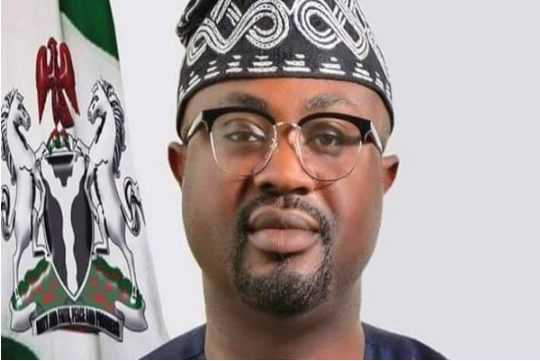
The Federal High Court in Abuja on Monday ordered the Minister of Interior, Olubunmi Tunji-Ojo, to respond to a suit seeking to compel the release of records of his National Youth Service Corps (NYSC) scheme.
Justice Salim Ibrahim gave the order when the matter came up for hearing.
The Incorporated Trustees of Pathway to Equity and Charity Foundation had filed the suit, marked FHC/ABJ/CS/1812/2026.
The group prayed the court to compel the NYSC to disclose documents supporting the minister’s claim that he completed the mandatory one-year national service.
The foundation also sought an order of mandamus directing the Federal Capital Territory Administration (FCTA), the 2nd respondent, to produce records showing that the minister did his primary assignment at the FCTA.
When the case was called, counsel to the applicant, Chief Solomon Akuma, SAN, told the court he was ready to proceed with the hearing.
However, Abiola Olaniji, who appeared for the minister, said he had filed an application for Tunji-Ojo to be joined as the 3rd respondent.
Olaniji said the applicant (foundation) had responded with a counter affidavit raising serious issues, to which he needed time to reply.
The lawyer stated that the minister was ready to take part in the proceedings as an interested party.
But Akuma opposed the application, arguing that the minister was not a proper party.
He said the suit only sought an order of mandamus compelling the respondents (NYSC and FCTA) to produce documents that are not in the minister’s custody.
Justice Ibrahim directed the minister to file and serve his reply to the applicant’s counter affidavit, which opposed his application to be joined as a party in the suit before the next hearing date.
The judge then adjourned the matter until Oct. 18 for hearing.
The applicant had sought from the NYSC the mobilisation or call-up letter issued to Tunji-Ojo in 2006 or any other year; the posting letter to the FCTA in 2006 or any other year; and his application for mobilisation.
It also sought the evidence of approval of his remobilisation by the NYSC’s Director-General; evidence of payment of allowances to him; the record of his Community Development Service and his discharge certificate.
The foundation equally sought from the FCTA, the mobilisation or call-up letter, the posting letter, his attendance record during the service year, evidence of any allowance paid to him, among others.
It said the application was brought under Section 14 of the Federal High Court Act, Order 34 Rules 1, 2 and 5 of the Federal High Court (Civil Procedure) Rules 2019.
It also cited Sections 20, 21 and 25 of the Freedom of Information (FOI) Act, 2011.
(NAN)

The presidential candidate of the Nigeria Democratic Congress, Peter Obi, has advised Nigerians residing in the United Kingdom to stop sending money to people who seek financial help at home.
Obi also advised them to urge their relatives to vote for productive leaders.
He made the remarks at a town hall meeting with diaspora supporters in Manchester, United Kingdom, on Sunday.
He stressed that Nigeria’s prevailing economic hardship resulted from bad leadership, arguing that continuous financial assistance only cushions the effects of poor governance without addressing the root causes.
“You have people at home in Nigeria today who are begging you for money. Tell them no!” he said.
The former Anambra State governor insisted that his record in public office distinguished him from other governors, claiming none of them matched his achievements in saving public funds.
“I’m not saying I’m a saint, but I saved money. I’ve not seen one governor who has saved 10 per cent of what I saved. No governor has done it.
“Let’s start with this one that is less corrupt. That’s how other countries change.”
He maintained that his conversations with the people reinforced the need for collective responsibility, stressing that building a new Nigeria would require citizens to take an active role in addressing challenges facing the country.
Obi also urged Nigerians to take the 2027 election seriously, describing the contest as a critical moment for the nation.
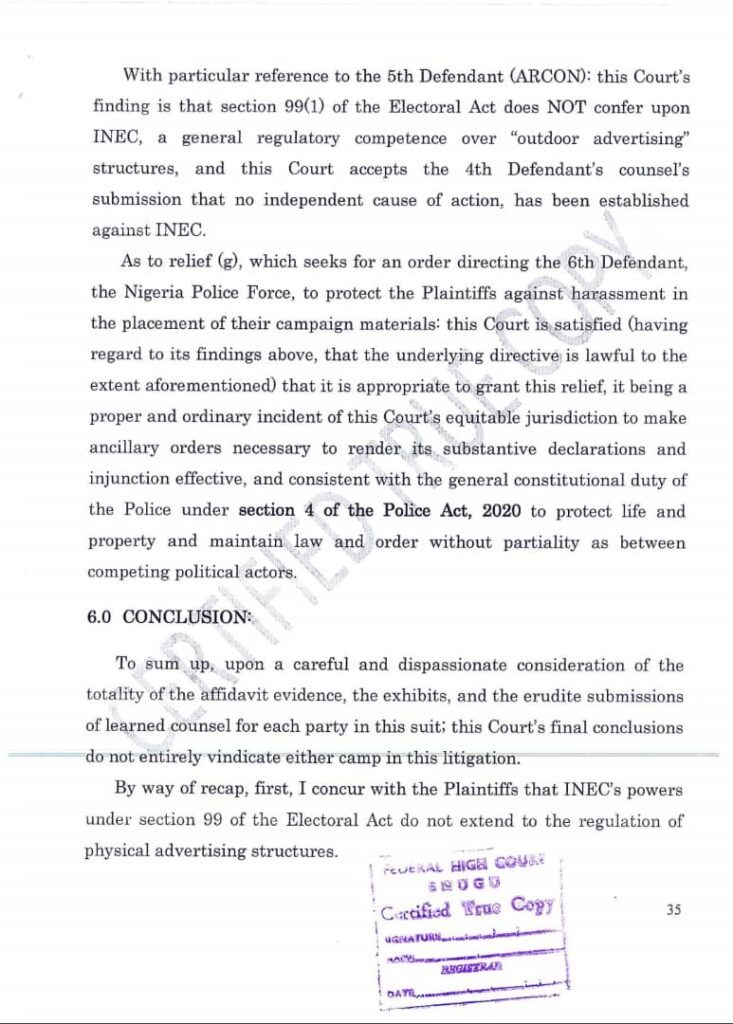
Contrary to false and misleading reports on social media that a Federal High Court (FHC) sitting in Abuja had nullified the N150 million fee prescribed by the Enugu State Structures for Signage and Advertisement Agency (ENSSAA) for political campaign billboards, findings have revealed that the court actually ruled in favour of the agency, upholding its powers to prescribe the fee.
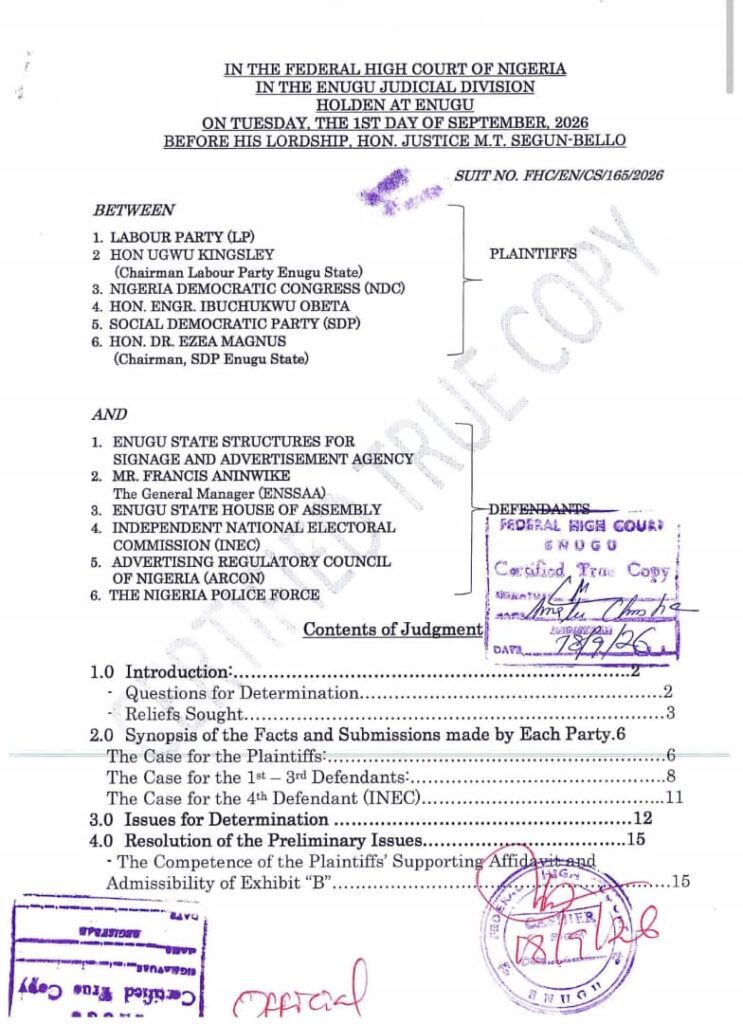
According to a certified true copy (CTC) of a judgment of FHC sitting in Enugu, the court had on September 1, 2026, dismissed a suit by opposition parties and figures challenging ENSSAA’s authority to impose a mandatory N150 million fee on each political party seeking to erect campaign billboards or display posters ahead of the 2027 general election.
The judgment rendered by Justice Mabel Segun-Bello held that it was within the legislative competence of the Enugu State House of Assembly to make laws on outdoor advertising and for ENSSAA to exercise powers donated to it by state law.
The suit marked FHC/EN/CS/165/2026 had the Labour Party; Chairman of the Labour Party (LP) in Enugu, Hon. Kingsley Ugwu; Nigeria Democratic Congress (NDC); NDC factional state Chairman, Engr. Ibuchukwu Obetta; the Social Democratic Party (SDP) and its state Chairman, Hon. Magnus Ezea, as plaintiffs, while ENSSAA; its General Manager, Mr. Francis Aninwike; the Enugu State House of Assembly; Independent National Electoral Commission (INEC); Advertising Regulatory Council of Nigeria (ARCON); and Nigeria Police Force were the respondents or defendants.
The plaintiffs had in June 2026 approached the court seeking a declaration that, by virtue of Sections 99 (1) and (2) of the Electoral Act, 2026, and Section 153 of the 1999 Constitution, which donated exclusive powers to INEC to regulate electoral campaigns of political parties in Nigeria, it was ultra vires the powers of ENSSAA and its General Manager to make executive decisions and publications imposing a mandatory payment of N150 million by political parties and their candidates in the state as an advertisement permit fee for the placement of billboards for the council election and the 2027 election.
They equally sought a declaration by the court that it was unlawful and ultra vires the legislative powers of the Enugu State House of Assembly to make laws regulating the advertisement of political campaigns in the state.
Consequently, the plaintiffs sought an order of the court setting aside the mandatory N150 million fee, as well as an injunction restraining the agency and its GM, the Enugu State Government, its agents and representatives from enforcing ENSSAA’s executive directive.
They finally sought an order of the court mandating the Nigeria Police Force to protect political parties in Enugu State against possible harassment for the placement of billboards and posters for the council election and the 2027 elections.
However, delivering her judgment in September, after a careful consideration of the totality of the affidavit evidence, the exhibits, and submissions by both parties, the presiding judge, Justice Mabel Segun-Bello, held, among other things, that the National Assembly does not hold exclusive legislative powers over outdoor advertising.
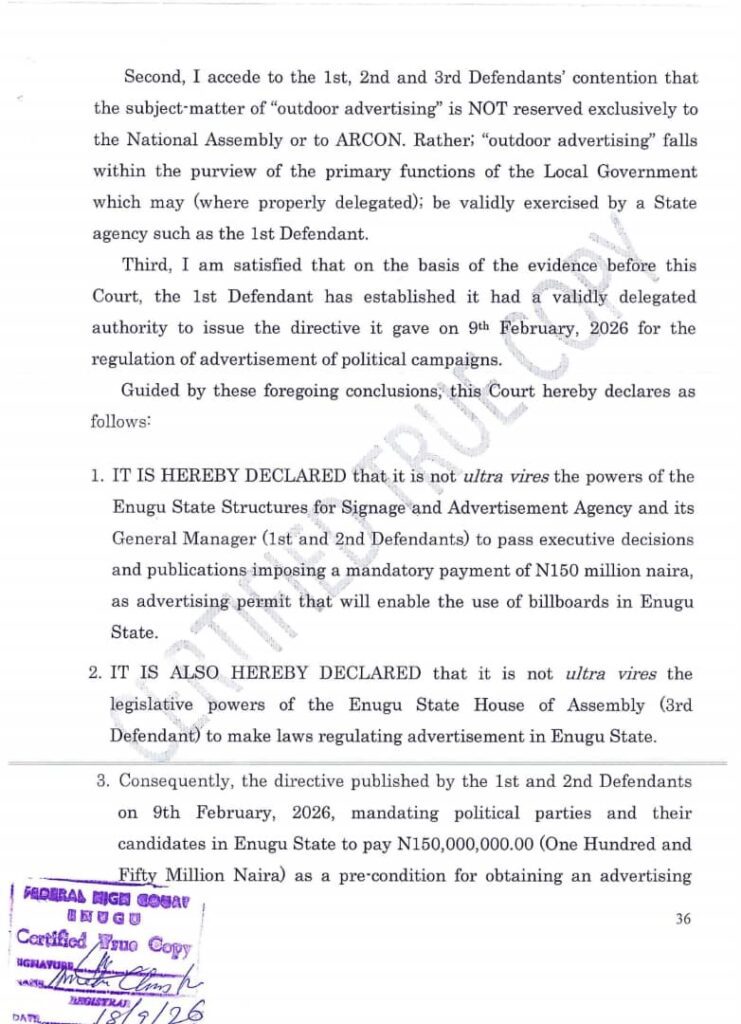
“I accede to the 1st, 2nd and 3rd Defendants’ contention that the subject matter of ‘outdoor advertising’ is NOT reserved exclusively to the National Assembly or to ARCON.
“Rather, ‘outdoor advertising’ falls within the purview of the primary functions of the Local Government, which may (where properly delegated) be validly exercised by a State agency such as the 1st Defendant (ENSSAA).
“Third, I am satisfied that on the basis of the evidence before this Court, the 1st Defendant has established it had a validly delegated authority to issue the directive it gave on 9th February, 2026, for the regulation of advertisement of political campaigns,” she stated.
Guided by these foregoing conclusions, Justice Segun-Bello held that “it is not ultra vires the powers of the Enugu State Structures for Signage and Advertisement Agency and its General Manager (1st and 2nd Defendants) to pass executive decisions and publications imposing a mandatory payment of N150 million naira, as advertising permit that will enable the use of billboards in Enugu State.”
Continuing, she said, “It is also hereby declared that it is not ultra vires the legislative powers of the Enugu State House of Assembly (3rd Defendant) to make laws regulating advertisement in Enugu State.
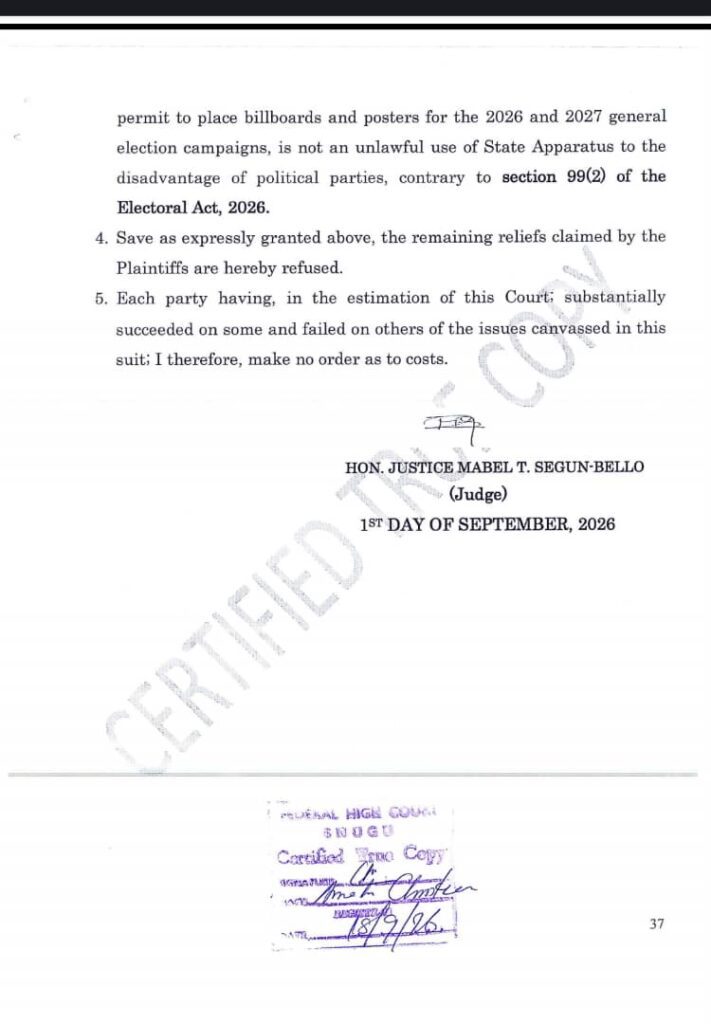
“Consequently, the directive published by the 1st and 2nd Defendants on 9th February, 2026, mandating political parties and their candidates in Enugu State to pay N150,000,000.00 (One Hundred and Fifty Million Naira) as a pre-condition for obtaining an advertising permit to place billboards and posters for the 2026 and 2027 general election campaigns, is not an unlawful use of State Apparatus to the disadvantage of political parties, contrary to Section 99(2) of the Electoral Act, 2026.
“Save as expressly granted above, the remaining reliefs claimed by the Plaintiffs are hereby refused.”
Meanwhile, the Enugu State Government says that unlike the practice in most states, the N150 million fee is for each political party, not for candidates, as misrepresented on social media and by some commentators.
The Secretary to the State Government, Prof. Chidiebere Onyia, made the clarification recently while fielding questions from Government House correspondents in Enugu, adding that there was no court judgment on the fee by any FHC in Abuja, as falsely circulated.
In a related development, finding show that the Abia State Structures for Signage and Advertising Agency (ABSSAA) prescribed feea for candidates ranging from N20 million for State House of Assembly candidates to N200 million for presidential candidates.
Imo State fees range from N3.55 million for each House of Representatives candidate to N55 million for each governorship candidate, while the permit fees range from N300,000 for local council candidates to N150 million for presidential candidates.
The campaign permit fee ranges from N100,000 for each councillorship candidate to N50 million for each presidential candidate, while Kwara State fixed its fees at N2 million for each House of Assembly candidate and N100 million for presidential candidates.
The Certified True Copy of the Court Judgement :
-
 Faith2 days ago
Awka Anglican Diocese Rejects Ibezim’s Suspension, Threatens to Leave Church of Nigeria
-
News2 days ago
BREAKING: Mbah Extends Enugu Movement Restriction to 10pm, Scraps Keke Ticketing
-
Politics2 days ago
Nigeria’s Weak Opposition and the Cost of One-Party Dominance: Can the Opposition Rebuild Before 2027?
-
News6 hours ago
JUST IN: Former Delta Governor, Uduaghan, dies
-
News2 days ago
2027: Keke Riders Endorse Mbah, Tinubu
-
News1 day ago
Catholic priest dies as crucifix falls on him during Mass
-
News19 hours ago
Corruption turning Nigerian Courts to ‘market stalls’ — Retired Justice Augie
-
News3 days ago
Enugu Approves ₦32bn Legacy Gratuity Payment, Begins Disbursement Next Week