






Connect with us

News

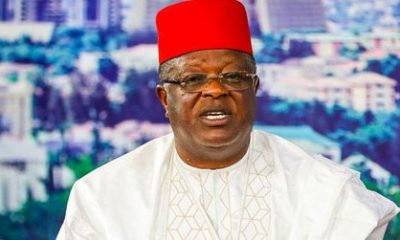
Gov Mbah, others finally dump PDP, join APC

Published

on

Enugu State Governor, Dr Peter Mbah defects to APC
Spread the love
Governor Peter Mbah of Enugu State has formally defected to the All Progressives Congress, APC, saying his former party, the People’s Democratic Party, did not recognize the voice of his people.

Mbah in a broadcast to the Enugu people, Tuesday morning, announced that he had quit the Peoples Democratic Party, PDP.

Mbah left the PDP alongside State and Federal lawmakers, among others.

Mbah’s immediate predecessor, Rt Hon. Ifeanyi Ugwuanyi was present at the event, which took place at the Exco chamber of the Government House.

Former Governor Sullivan Chime and leaders of APC in the state also graced the occasion.

The Governor, who thanked the PDP for standing by him throughout his election period, said there always comes a time when everyone must make a bold choice.

“Today we have made the decision to leave the Peoples Democratic Party, PDP, and join the All Progressives Congress,” he declared.

Maduka College Advert

He said it was not a sole decision but that of National Assembly members, state Assembly members, exco members, over 80 percent of party executives, appointees, among others.

He said for decades the South-East stood behind the PDP, but that despite those supports, “our voices were too often disregarded.”

Mbah said his joining the APC was to seek an alternative where the people’s interest would be represented and respected.

He said he was envisioning a visionary partnership which he saw in President Bola Tinubu, stressing that “we share a vision that transformation must be disruptive”

The governor further defended his decision to switch camp, saying the move was necessitated to connect the South-Eastern state to the central government.

“There comes always a time when everyone must make a bold choice to determine their destiny. Today, after a long reflection, we have made a decision to leave the Peoples Democratic Party and join the All Progressives Congress,” Mbah stated.

The governor thanked the PDP for the support through the years, stressing that the shift is imperative to achieve his administration’s goals.

“To the Peoples Democratic Party which provided us the platform on which we campaigned and won, I extend deep gratitude. The PDP supported us through a demanding campaign and joined us in celebrating the victory.

“Leadership demands difficult, even painful decisions, in the service of higher principles and goals. And there comes always a time where everyone must make a bold choice to determine their destiny,” he added.

According to Mbah, his decision to join the APC is to better serve the people of Enugu and align with the party’s vision for development and progress.

The governor also reiterated his commitment to advancing the state’s interests and expressed confidence that the APC platform would provide greater opportunities for collaboration and growth.

Mbah also commended President Bola Tinubu’s policies, saying the state has enjoyed massive support under the President.

The PDP governor, moved to the ruling party with House of Assembly members, councillors, chairmen of councils and others.

APC Officially presents Membership Card to Mbah

Earlier at a ceremony held at the Lion Building, Enugu, the All Progressives Congress (APC) presented its party membership card to Governor Peter Ndubuisi Mbah, confirming his defection from the Peoples Democratic Party (PDP) to the ruling APC.

The event was announced via the APC’s official X (formerly Twitter) account shortly after Governor Mbah’s public address in which he declared his decision to shift allegiance to the APC under the theme “Charting a New Course: Transition from PDP to APC.”

“The APC National Working Committee has formally presented the Party’s membership card to the Governor of Enugu State, His Excellency, Dr. Peter Ndubuisi Mbah @PNMbah, officially marking his entry into the APC,” read the party’s post.

In his state-wide broadcast earlier in the day, Governor Mbah explained that his decision was not driven by personal ambition or emotion, but was the outcome of months of consultations.

“Joining the APC is about ensuring Enugu’s development aligns more closely with the policies and programmes of the federal government under President Tinubu. We do this for the greater good of our people,” he stated.

He noted that although Enugu and the broader South East have long been loyal to the PDP, the region has often been overlooked during moments that mattered most. He sees this move as a pathway to amplify Enugu’s voice at the national level.

Governor Mbah also praised President Bola Tinubu as not just a political leader, but a “partner in purpose”, one willing to make tough decisions for Nigeria’s advancement.

“This is not a detour; it is a conscious step toward a stronger future for Enugu,” he affirmed.

He gave assurances that existing state projects, such as the Smart Green Schools, health centres, and road works, would continue and be completed on schedule.Buy vitamins and supplements

“Our Igbo DNA does not change; our destiny does not change. What changes is that our vision now finds stronger reinforcement at the federal level,” Governor Mbah said.

The governor said that Enugu will now fully engage with the Renewed Hope Ward Development Programme, which aims to empower 8.8 million Nigerians across 8,809 electoral wards.

Health

NAFDAC urges Stakeholders to lead vigilance on Antimicrobial Resistance, Adverse Drug Reactions

Published

on

Spread the love

The National Agency for Food and Drug Administration and Control (NAFDAC) has called on stakeholders and Nigerians to lead vigilance against Antimicrobial Resistance (AMR) to medicines/drugs and Adverse Drug Reactions (ADR).

The Director-General of NAFDAC, Prof. Mojisola Adeyeye, made the call on during a one-day Pharmacovigilance Workshop and Stakeholders Town Hall Meeting in Enugu.

Represented by NAFDAC’s Director, South-East Zone, Dr Festus Ukadike, the director-general noted that the gravest consequences of irrational medicine use today is AMR.

She explained that the misuse and overuse of antibiotics had accelerated the emergence of resistant microorganisms that no longer respond to conventional treatment.

“This means that infections previously treatable with common antibiotics are becoming increasingly difficult and expensive to manage.

“If urgent action is not taken, antimicrobial resistance may reverse decades of medical progress and place humanity at serious risk.

Maduka College Advert

“This is why Pharmacovigilance is extremely important. Pharmacovigilance refers to the science and activities relating to the detection, assessment, understanding, and prevention of adverse effects or any other medicine-related problems.

“In simple terms, Pharmacovigilance helps us ensure that medicines remain safe and effective even after they have been approved and released into the market,” she said.

Adeyeye noted that no medicine is completely free from side effects.

“However, through effective Pharmacovigilance systems, healthcare professionals and patients can identify harmful reactions early, report them appropriately, and help regulatory authorities take necessary actions to protect the public,” she said.

She said that Pharmacovigilance remained a core mandate of the agency, adding that stakeholders and general public should play active part in monitoring AMR and ADR to ensure effectiveness of medicine and treatment.

Speaking, the Chairman, Enugu State Traditional Rulers’ Council, Igwe Samuel Asadu, commended NAFDAC for the workshop, while urging the agency to put more effort in curbing sales of fake medicines in the hinterlands.

Asadu said that Pharmacovigilance was needed more in the hinterlands of the state to stop people paddling fake medicines and “selling outright chalk as medicine in villages in the state”.

He gave the commitment of royal fathers in the state in providing necessary support to NAFDAC to check paddlers of fake medicines, “as we see our people die due to their activities.”

Corroborating, the State Coordinator of World Health Organization (WHO), Dr Adaeze Ugwu, said that the organisation would continue to support NAFDAC in the agency’s resolve to strengthen food and healthcare in the country.

Also, Dr Oliver Ezemba, Chairman, Nigerian Association of Patent and Proprietory Medicine Dealers (NAPPMED), urged everybody to get concerned on the issues of AMR and ADR to guarantee quality medicines for everyone.

Ezemba called on Nigerians to imbibe the habit of reporting any irregularities observed while using a medicine to NAFDAC for proper investigation, which would serve the benefit of many Nigerians using same medicine.

The participants asked questions on AMR and ADR as well as made pledge on reporting any suspectable AMR or ADR case through the NAFDAC’s Med Safety Mobile App using their cellphone or computer set.

In the workshop, a presentation was made on “Need for Effective Pharmacovigilance by All’, delivered by Mr Chidi Uche and Mrs Ogechi Udeh, who are NAFDAC officials.

Continue Reading

News

Coup trial: Accused colonel rejects military court

Published

on

Col Mohammed Ma’aji
Spread the love

The second accused person in the charges brought against 36 persons accused of alleged mutiny and plot to overthrow the government of President Bola Tinubu, Col Mohammed Ma’aji, has challenged the jurisdiction of the Defence Headquarters Garrison General Court Martial sitting in Asokoro, Abuja, to hear the case.

Ma’aji, in a preliminary objection filed before the court martial in charge No: DHQ/GAR/ABJ/49/ADM, between the Armed Forces of Nigeria and Brig Gen M.A. Sadiq, Col Ma’aji, alongside 35 others, urged the court martial to strike out the charges instituted against him, arguing that the military tribunal lacked the jurisdiction to entertain the case.

Ma’aji, in the objection, contended that the charges were fundamentally defective and incompetent in law.

The objection, brought pursuant to Rules 36(1) and 37(1) of the Rules of Procedure Army 1972, urged the tribunal to make an order striking out and/or dismissing the charges against the 2nd Accused.

“Take notice that the 2nd accused hereby objects to the jurisdiction of the General Court Martial to entertain Counts One to Nine of the charges preferred against the 2nd Accused in Charge No: DHQ/GAR/ABJ/49/ADM, namely ARMED FORCES OF NIGERIA V. BRIG. GEN. M. A. SADIQ (N/10321) & 35 ORS and hereby prays the General Court Martial for the following reliefs:

“An Order striking out and/or dismissing the charges against the 2nd Accused in Charge No: DHQ/GAR/ABJ/49/ADM for lack of jurisdiction. An order declining jurisdiction to entertain the charge as constituted.

Maduka College Advert

“And for such further order(s) as the Honourable General Court Martial may deem fit to make in the circumstances.”

The second accused in the charge also argued that the complainant, listed as the Armed Forces of Nigeria, lacked the legal capacity to institute criminal proceedings.

According to Ma’aji, “The complainant (Armed Force of Nigeria) is not a juristic person and thereby lacks the requisite competence to initiate and prosecute the criminal proceedings in Charge No: DHQ/GAR/ABJ/49/ADM.”

Ma’aji further maintained that because the complainant allegedly lacked legal personality, the General Court Martial was equally deprived of jurisdiction to hear the matter.

Citing several Supreme Court and Court of Appeal authorities, including Green v. Green, Fawehinmi v NBA, and Mothercat Nig Ltd v Reg. Trustees of the Full Gospel Assembly Nig, the defence argued that only natural persons or entities expressly recognised by law could sue or be sued.

The written address submitted in support of the objection stated, “The name ‘Armed Forces of Nigeria’ described as ‘complainant’ in Charge No: DHQ/GAR/ABJ/49/ADM is unknown to law and destitute of any legal capacity to exercise Prosecutorial powers in respect of the charges preferred against the 2nd Accused.”

The second accused also challenged the competence of counts one to nine of the charge, which allegedly accused him of inciting other officers to join a plot to overthrow President Tinubu.

Ma’aji insisted that the allegations contained in the particulars of the charges did not fall within the offence of mutiny as contemplated under Section 52(1)(b) of the Armed Forces Act, 2004.

He argued that the particulars of the charge “disclose offences against the Sovereign State otherwise known as the Federal Republic of Nigeria and constitutional order rather than offences relating to military or service discipline or command structure.”

He maintained that the phrase “plot to overthrow the government of the Federal Republic of Nigeria” contained in the charge could not be equated with “lawful authority in the Federation” as envisaged under Section 52(3) of the Armed Forces Act.

“It is submitted that the Federal Republic of Nigeria does not fall within the phrase ‘a lawful authority in the Federation’ as used in Section 52(3) of the Armed Forces Act, Laws of Federation, 2004,” Ma’aji contended.

Relying on constitutional provisions and judicial precedents, he argued that the court-martial, being a tribunal of limited jurisdiction, could not extend its powers beyond what was expressly granted by statute.
Ma’aji also cited the Supreme Court’s warning against judicial expansion of statutory provisions, insisting that any ambiguity in penal legislation must be resolved in favour of the accused persons.

Quoting the Supreme Court decision in Nigerian Navy v. Lambert, the second accused submitted: “It is settled law that penal statutes are to be construed strictly to the benefit of the accused person and that where there is a reasonable construction that avoids the penalty in any particular case, the court must adopt that construction.”

The preliminary objection further contended that for a charge of mutiny or incitement to mutiny to stand, there must be allegations of concerted insubordination, defiance of military authority or refusal of lawful command or organised military rebellion against superior military command.

According to the defence, the particulars supplied by the prosecution failed to disclose those essential ingredients.

On this ground, he urged the General Court Martial to uphold his preliminary objection and dismiss the charges against him for want of jurisdiction.

Meanwhile, a witness in the ongoing trial of six alleged coup plotters before the Federal High Court in Abuja, on Wednesday, told investigators that Ma’aji allegedly threatened to force his way into the Presidential Villa, even if insiders refused to cooperate.

The fourth defendant, Zekeri Umoru, made the allegation in a video previewed in court during proceedings in the trial-within-trial over the admissibility of the defendants’ extrajudicial statements.

Umoru and five others in April were arraigned before Justice Joyce Abdulmalik on 13 counts of criminal charges over alleged complicity in an alleged coup plot to overthrow Tinubu’s government.

The six defendants: Maj Gen Mohammed Ibrahim Gana (retd), Capt Erasmus Victor (retd), Insp Ahmed Ibrahim, Zekeri Umoru, Bukar Kashim Goni and Abdulkadir Sani, however, pleaded not guilty to all the counts after the charge was read to them.

At the resumed sitting, Umoru, who worked with Julius Berger on the Presidential Villa clinic project, alleged that Ma’aji, through the third defendant, Insp Ibrahim, asked him to recruit between 18 and 19 persons working inside the Villa, including soldiers, Department of State Service personnel and Julius Berger staff.

According to the video evidence played in court, Umoru alleged that plans were discussed to switch off electricity within the Presidential Villa to aid the operation, but he warned that such an action would immediately trigger investigations and lead to the detention of workers on duty.

He further claimed that Insp Ibrahim later demanded N100m from Ma’aji to facilitate access into the Villa through an ambulance route, but Ma’aji allegedly rejected the amount as excessive, insisting he could still gain entry by force, although “there would be bloodshed.”

The witness also told investigators that he became uncomfortable with the alleged plan and repeatedly attempted to return the money given to him, insisting that the Presidential Villa “was not child’s play.”

He denied having access to the Villa’s solar power plant, despite allegations that he intended to sabotage the electricity supply within the complex.

The court further heard that Umoru did not immediately report the alleged plot to authorities because Insp Ibrahim allegedly advised him to delete messages and avoid contacting Ma’aji due to an ongoing audit in their office.

Following the screening of the video evidence, Justice Abdulmalik adjourned the matter until May 21 for continuation of the trial-within-trial.

Continue Reading

News

Terrorists have infiltrated no less than 40 South-West LGs — Gani Adams

Published

on

Gani Adams
Spread the love

Aare Ona Kakanfo of Yorubaland, Gani Adams, has raised fresh concerns over insecurity in the South-West, claiming that terrorists have infiltrated at least 40 local government areas across the region.

While speaking in a recent interview with The Punch, Adams said the threat in the South-West has become more serious than many people realise.

“We have 137 local government areas in the South-West, and we spotted not remnants of terrorists, but a lot of terrorists in no fewer than 40 local governments. We have many terrorists that have infiltrated those local government areas,” he said.

Adams revealed that his group had documented the development but chose not to make the information public immediately because they hoped to work directly with state governments to tackle the problem.

“We kept that document to ourselves because we were more confident that working with state governments, which are the institutions governing the states, would yield results compared to working with law enforcement agents,” he stated.

The Yoruba leader, however, expressed disappointment over what he described as the refusal of governors in the region to engage with his organisation despite repeated warnings over the past two years.

Maduka College Advert

“As a result, we called for collaboration with state governments for the past two years. This is a government that knows your antecedents, knows that you have a structure across Yorubaland, even beyond Yorubaland and in some northern states, yet refuses to talk to you, refuses to agree with you, or even assist you, despite being in power and benefitting from security votes,” Adams said.

“Yet they didn’t call to discuss with you. So, you have to bear in mind that the only assistance you can give to Yoruba people is to talk to the media and give little information that some states have been infiltrated and that there would be attacks in those states, because you are not helping matters by divulging the entire information,” he added.

Reacting to the recent abduction of pupils, teachers and residents in Oriire Local Government Area of Oyo State, Adams said local hunters and vigilante groups may not possess sophisticated weapons but still have a critical role to play in combating insecurity.

According to him, all factions of the Oodua Peoples Congress (OPC) and other local security groups in the South-West are ready to collaborate against criminal elements.

“All hands must be on deck to confront these criminals. You can have less potential and still know the criminals in your area. Security is not always about carrying sophisticated arms,” he said.

“You need intelligent people. You need people who can infiltrate enemy territories. You need multilingual people who can speak different languages and use that advantage to gather intelligence.

“You also need people with spiritual potential. You even need clerics who will pray for the success of your mission. So, the issue of security has different sectors. By combining those sectors, you can achieve victory against criminals,” Adams added.

His comments come days after gunmen attacked schools and surrounding communities in the Ogbomoso axis of Oyo State, abducting several pupils, students and teachers from Baptist Nursery and Primary School in Yawota, Community Grammar School and L.A Primary School in Esin Ele.

Ondo State and several other communities in the South-West have also witnessed repeated attacks by suspected kidnappers and armed groups in recent months.

Continue Reading

Trending

Maduka College Advert