Connect with us

News

Tinubu removes NNPCL boss Kyari, names Ojulari as replacement

Published

on

Mele Kyari
Spread the love

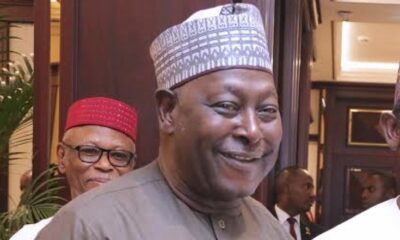
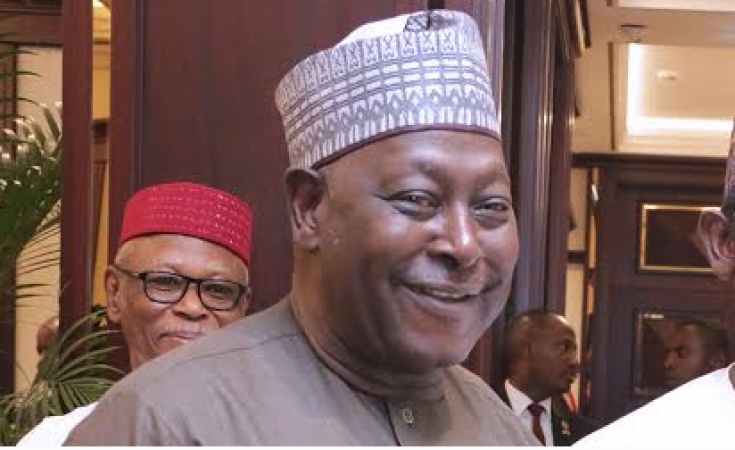
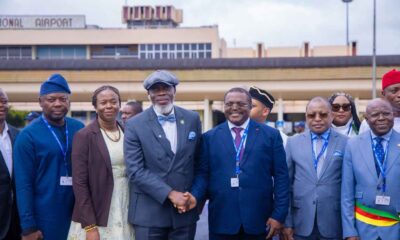
President Bola Tinubu, in a sweeping reconstitution of the Nigerian National Petroleum Company Limited board, on Wednesday, removed the chairman, Pius Akinyelure and the Group Chief Executive Officer, Mele Kyari.

Consequently, the President appointed Bashir Ojulari as the new CEO, effective from April 2, 2025.

Tinubu’s Special Adviser on Information and Strategy, Bayo Onanuga, revealed the development in a statement he signed in the early hours of Wednesday titled, ‘President Tinubu reconstitutes NNPC limited board, appoints new Chairman, Group CEO.’

“President Tinubu removed all other board members appointed with Akinyelure and Kyari in November 2023.

“The new 11-man board has Engineer Bashir Bayo Ojulari as the Group CEO and Ahmadu Musa Kida as non-executive chairman,” the statement reads.

Maduka College Advert

Adedapo Segun, who replaced Umaru Ajiya as the chief financial officer last November, has been appointed to the new board.

Six board members, non-executive directors, represent the country’s geopolitical zones.

They are Bello Rabiu representing the North West, Yusuf Usman representing the North East, and Babs Omotowa, a former managing director of the Nigerian Liquified Natural Gas, who represents North Central.

“President Tinubu also appointed Austin Avuru as a non-executive director from the South-South, David Ige as a Non-executive director from the South West, and Henry Obih as a non-executive director from the South East.

“Mrs Lydia Shehu Jafiya, permanent secretary of the Federal Ministry of Finance, will represent the ministry on the new board, while Aminu Ahmed will represent the Ministry of Petroleum Resources,” Onanuga stated.

All the appointments are effective today, April 2.

President Tinubu, invoking the powers granted under Section 59, subsection 2 of the Petroleum Industry Act, 2021, emphasised that the board’s restructuring is crucial for enhancing operational efficiency, restoring investor confidence, boosting local content, driving economic growth, and advancing gas commercialisation and diversification.

He also handed out an immediate action plan to the new board “to conduct a strategic portfolio review of NNPC-operated and Joint Venture Assets to ensure alignment with value maximisation objectives.”

Since 2023, the Tinubu administration has implemented oil sector reforms.

Onanuga said that in 2024, NNPC reported $17bn in new investments within the sector.

“The administration now envisions increasing the investment to $30bn by 2027 and $60bn by 2030.

“The Tinubu administration targets raising oil production to two million barrels daily by 2027 and three million daily by 2030.

“Concurrently, the government wants gas production jacked to 8 billion cubic feet daily by 2027 and 10 billion cubic feet by 2030,” he explained.

Furthermore, he said the President expects the new board to “elevate NNPC’s share of crude oil refining output to 200,000 barrels by 2027 and reach 500,000 by 2030.”

The new board chairman, Ahmadu Kida, is from Borno State. He is an alumnus of Ahmadu Bello University, Zaria, where he received a degree in civil engineering in 1984.

Kida also obtained a postgraduate diploma in petroleum engineering from the Institut Francaise du Petrol in Paris.

He began his career in the oil industry at Elf Petroleum Nigeria and later joined Total Exploration and Production as a trainee engineer in 1985.

Musa became Total Nigeria’s Deputy Managing Director of Deep Water Services in 2015.

In 2024, he became an Independent Non-Executive Director at Pan Ocean-Newcross Group.

The Presidency stated that apart from his oil industry career, Ahmadu Kida is a former basketballer and the President of the Nigerian Basketball Federation board.

Meanwhile, the new NNPC Limited Group CEO, Ojulari, hails from Kwara State.

Until his new appointment, He was Executive Vice President and Chief Operating Officer of Renaissance Africa Energy Company.

His Renaissance recently led a consortium of indigenous energy firms in the landmark acquisition of the entire equity holding in the Shell Petroleum Development Company of Nigeria, worth $2.4bn.

Like Kida, Ojulari is also an alumnus of Ahmadu Bello University, Zaria, having graduated with a degree in Mechanical Engineering.

He worked for Elf Aquitaine as the first Nigerian process engineer to begin a stellar career in the oil sector.

From Elf, Ojulari joined Shell Petroleum Development Company of Nigeria Ltd in 1991 as an associate production technologist.

Apart from working in Nigeria, he worked in Europe and the Middle East in different capacities as a petroleum process and production engineer, strategic planner, field developer, and asset manager.

In 2015, Ojulari became the managing director of Shell Nigeria Exploration and Production Company.

During his career, he was chairman and member of the board of trustees of the Society of Petroleum Engineers (SPE Nigerian Council) and a fellow of the Nigerian Society of Engineers.

“President Tinubu thanked the old board members for their dedicated service to NNPC Limited, particularly their efforts in rehabilitating the old Port Harcourt and Warri refineries, which enabled them to resume petroleum product production after prolonged shutdowns.

“He wished them well in their future endeavours,” the statement concluded.

News

2027: How Atiku told me to persuade Peter Obi to accept VP slot – Babachir Lawal Ex-SGF Babachir Lawal

Published

on

Babachir Lawal
Spread the love

Former Secretary to the Government of the Federation (SGF), Babachir Lawal, has disclosed that former Vice President Atiku Abubakar asked him to persuade Peter Obi to join the African Democratic Congress (ADC) and accept the position of his running mate in the 2027 presidential election.

Babachir Lawal made the disclosure in an interview with Diaspora Digital Media while recounting events surrounding the opposition negotiations that preceded the eventual divergence of the Atiku and Obi camps.

According to him, Atiku personally contacted him and gave him the task of approaching Obi with the proposal.

“Atiku called me and told me that he wanted to work with me. He gave me a mission to convince Peter Obi to join the ADC and serve as his vice president,” Lawal said.

He said Atiku’s proposal included an arrangement under which the two would serve for four years and subsequently pursue a constitutional amendment to create a single six-year presidential term, which Obi would then benefit from.

Maduka College Advert

“He explained that during their four-year term, they would amend the Constitution to a single six-year term, which Obi would benefit from. I went to Obi with this proposal, but Peter Obi said he was not interested,” he added.

Lawal’s account has, however, been disputed by Obi, who said he could not have rejected an offer that was never made to him.

The disclosure comes amid continuing political realignments ahead of the 2027 presidential election.

Lawal had earlier resigned from the ADC in June 2026, alleging irregularities in the party’s presidential primary that produced Atiku as its candidate. Atiku’s camp rejected the allegations.

Lawal subsequently joined the Nigeria Democratic Congress (NDC) in September and declared support for the party’s Peter Obi-Rabiu Kwankwaso presidential ticket. (Nigerian Tribune)

Continue Reading

News

SDGs: Mbah moves Enugu beyond projects, targets lasting development impact

Published

on

Enugu SSG, Prof Chidiebere Onyia and Frank Nweke Jnr
Spread the love

…Unveils 25-year plan to sustain transformation beyond individual administrations

The Enugu State Government has unveiled a 25-year development plan aimed at ensuring that the state’s ongoing transformation outlives individual administrations, with Governor Peter Mbah declaring that the government’s focus is shifting from simply delivering projects to building strong institutions and achieving lasting improvements in the lives of citizens.

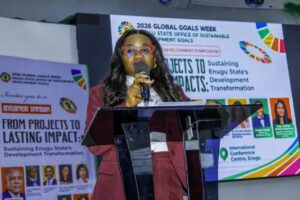
Mbah made the declaration at the 2026 Enugu State Global Goals Week Symposium, held at the International Conference Centre (ICC), Enugu, with the theme, “From Projects to Lasting Impact: Sustaining Enugu State’s Development Transformation.”

Governor Mbah, who was represented by the Secretary to the State Government, Prof. Chidiebere Onyia, said the state’s development agenda was being deliberately aligned with the Sustainable Development Goals (SDGs) to ensure that investments in infrastructure, human capital and critical services produced measurable and enduring impact.

He said the administration had continued to prioritise investments in education, healthcare, roads, agriculture, water, technology, security and other critical sectors, stressing that the projects were not ends in themselves but part of a broader strategy to build systems capable of sustaining development over the long term.

Maduka College Advert

“Our objective is not merely to execute projects, but to build systems and institutions capable of delivering enduring development and ensuring that the transformation we are driving today is sustained beyond the tenure of any single administration,” Mbah said.

He said the 25-year development plan would provide continuity, guide long-term investments, strengthen institutions, expand economic opportunities, improve human capital and promote inclusive development across the state.

Mbah noted that the state’s commitment to the SDGs was reflected in the spread of development interventions across the 260 electoral wards, particularly through the Smart Green Schools and Primary Healthcare Centres.

He assured that the government would continue to strengthen institutions, improve service delivery and put in place mechanisms to sustain the development gains achieved under the administration.

In a welcome address, the Senior Special Assistant to the Governor on Sustainable Development Goals and Enugu State SDGs Focal Person, Onyinye Akubuilo-Okpalanma, said the state’s transformation must remain people-centred, inclusive and sustainable.

She said government programmes should be judged not simply by the number of projects completed or funds spent, but by their impact on residents, the opportunities created and the communities strengthened.

“The success of government programmes should not be measured only by the number of projects completed or the amount of money spent, but by the extent to which those interventions improve the daily lives of our people, expand opportunities and strengthen communities,” she said.

Akubuilo-Okpalanma called for stronger community participation, continuous monitoring, reliable data and greater transparency in public finance and project implementation. She also urged greater attention to vulnerable groups and sustained investment in education, primary healthcare and environmental protection.

She called on development partners, civil society organisations, traditional institutions, the private sector and community leaders to work with government to sustain development gains, stressing the importance of continuity, institutional memory and long-term planning.

“Enugu’s transformation will be judged not only by the projects visible today, but also by the quality of institutions, opportunities and services available to future generations,” she said.

In a keynote address titled “From Projects to Lasting Impact: Sustaining Enugu State’s Development Transformation,” former Minister of Information, Frank Nweke Jnr., commended the scale and pace of public investment in the state over the past three years.

Nweke said the Mbah administration had reported more than 1,500 kilometres of roads constructed or reconstructed, over 7,000 classrooms and 260 Type-2 Primary Healthcare Centres.

He also cited the 2025 budget, in which ₦837.9 billion, representing 86 per cent of the budget, was allocated to capital expenditure, while ₦320.6 billion, representing more than one-third of the total budget, was allocated to education.

He stressed that improved domestic revenue mobilisation was essential to sustaining ambitious development, noting that the financial capacity to fund projects, maintain public assets and support institutions was critical to long-term transformation.

“Projects can transform places, but strong institutions are necessary to ensure that the transformation endures,” Nweke said.

He identified five priorities for sustaining Enugu’s development: linking investments to clearly defined problems and measurable outcomes; embedding the SDGs in planning and budgeting; measuring outcomes rather than expenditure alone; providing for the maintenance of public assets from the outset; and strengthening institutions, professional capacity and accountability mechanisms.

In separate goodwill messages, the UNICEF Field Office, Enugu representative, Juliet Chiluwe; the Special Adviser on Legislative Matters, Rt. Hon. Paul Nnajiofor; and Amb. Amaka Nweke commended the state’s development efforts and emphasised the need for inclusive, accountable and sustainable development that would continue to benefit present and future generations.

The event brought together government officials, development partners, traditional and community stakeholders, civil society representatives and members of the National Youth Service Corps (NYSC), among other participants.

Continue Reading

News

FG slashes interest rate on late tax payment

Published

on

Spread the love

The Federal Government (FG) has reduced the penalty interest rate for late settlement of tax liabilities, with the new regime taking effect from October 1, 2026.

Under the new arrangement, interest on tax liabilities payable in naira will be pegged to the Central Bank of Nigeria’s (CBN) Monetary Policy Rate (MPR) plus one percentage point, down from the previous five-percentage-point penalty.

The measure is contained in the Nigeria Tax Administration (Interest on Late Payment of Tax) Order, 2026, issued yesterday by the Minister of Finance and Coordinating Minister of the Economy, Mr Taiwo Oyedele, pursuant to Section 65 of the Nigeria Tax Administration Act, 2025.

According to the minister, the new Order will apply uniformly to taxpayers dealing with federal, state and Federal Capital Territory (FCT) tax authorities.

However, the applicable interest rate on naira-denominated tax liabilities will not fall below the yield on 364-day Treasury Bills, reflecting the Federal Government’s cost of borrowing when tax payments are delayed.

Maduka College Advert

For tax liabilities payable in foreign currencies, interest will be charged at the Secured Overnight Financing Rate (SOFR) plus six percentage points.

The Order further provides that where SOFR is discontinued, its officially designated successor rate will apply.

Explaining the rationale for the new regime, Oyedele said the objective was to align the cost of late tax payments more closely with prevailing market conditions while providing taxpayers with greater certainty about their obligations.

“Tax that is due belongs to the public. When it is paid late, Government may have to borrow to fill the gap, and the cost falls on everyone.

“This Order ties the cost of late payment to real market rates, so that delaying tax does not become a cheaper form of credit than the market itself,” he stated.

Continue Reading

Trending

Maduka College Advert