News
Ohanaeze: Gov Mbah harps on Igbo unity, collective interest as Azuta-Mbata, Sibeudu emerge PG, Sec Gen

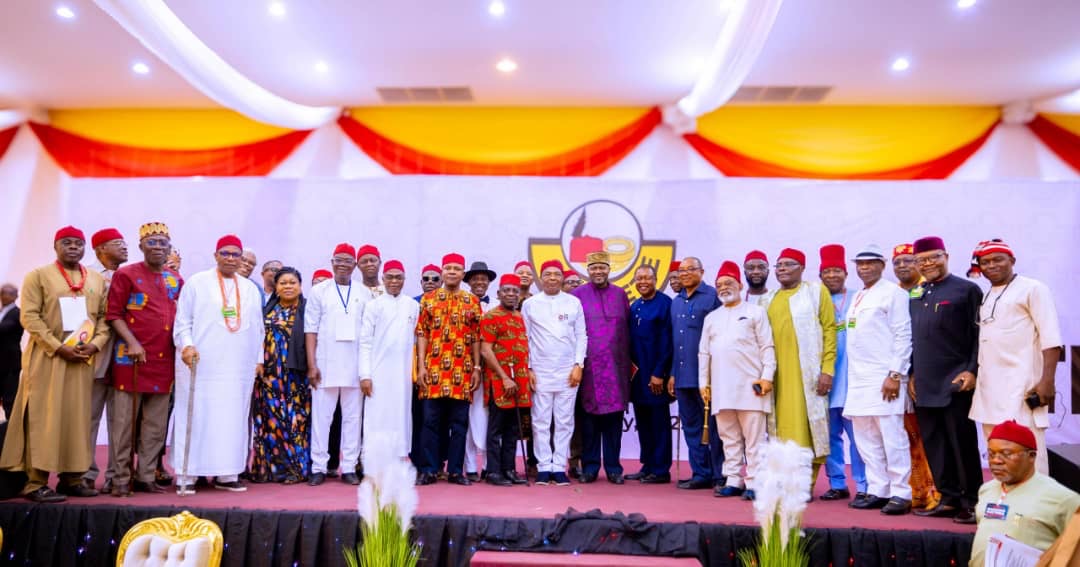
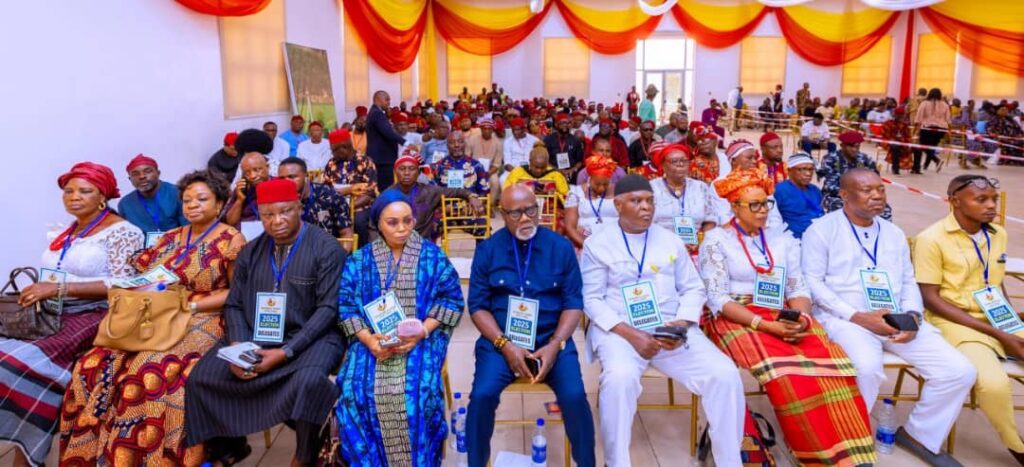
Governor of Enugu State, Dr. Peter Mbah, has stressed the need for a strong and united front by Ndigbo, urging all to put the Igbo interest above narrow interests and partisan politics.
Mbah noted that the socio-political circumstances that gave birth to the pan-Igbo body remained relevant in present-day Nigeria as they were in the 1970s.

He extolled the leadership pedigrees of Igbo leaders such as Dr. Michael Okpara, whom he said demonstrated how so much could be achieved when patriotism, altruism, and sense of brotherhood are at the core of leadership.
The governor made the call during the election of new national leadership of Ohanaeze Ndigbo in Enugu on Friday,
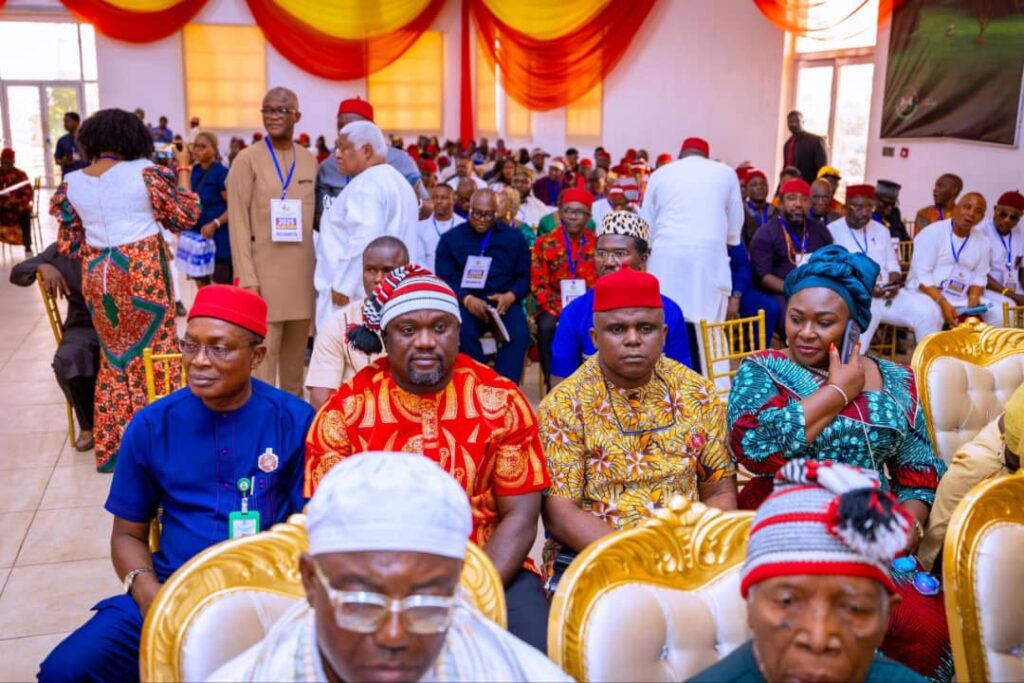

“We may be gathered here for the crucial task of electing members into the National Executive Committee of Ohanaeze Ndigbo Worldwide, but this epic event yet offers a room for introspection, regarding the noble vision that inspired our forebears towards its founding.
“The ties that bind us run deep and transcend geographical boundaries, for we are bound by a common history and cultural heritage. Our forebears clearly understood this. They understood, as well, that unity is a formidable force.
“From the Igbo Federal Union to the Igbo State Union and the Igbo Forum that would later become Ohanaeze Ndigbo in 1979, the motivation had always been the desire to forge unity and deep brotherhood amongst the Igbo.
“
For them, the collective interest was all that mattered; not narrow interest shaped by party affiliation and boundary lines.
“Ohanaeze Ndigbo represents the soul of our people, and is firmly anchored on the conviction that we are stronger together. That soul of the people is our unifying force.
“The socio-political circumstances that gave birth to Ohanaeze Ndigbo are as relevant today as they were in the 1970s. So, we’d never needed this group more than we do today.
“Our founders and forebears were great men and women ahead of their time. They left for us a glimpse of how much that can be achieved when fostering brotherhood is the defining essence of leadership.
“The Premiers of the old Eastern Region, who governed from here, left indelible imprints visible in Enugu as much as in towns like Port Harcourt, Abakaliki, Owerri, Aba, Onitsha, Umuahia, etc.
“That is the definition of statesmanship. Our forebears were statesmen, who appreciated the expediency of rising above partisan politics when the call of unity beckoned.
We will certainly achieve far more when we fully embrace the value of speaking as a collective voice – not as lone, discordant voices,” he stated.
Reiterating the place of unity in achieving the Igbo collective interest, Mbah added, “One of the simplest – but most profound – lessons that best convey the importance of unity is the quiver of arrows metaphor. A single arrow can be broken with much ease. But a stack of arrows stays firm even under an intense squeeze.
“The summary is that failing to unite leaves us prone as a single arrow. Standing as a unit imbues us with the resilience of the entire stack. Let us be like a stack of arrows.
“It is in our collective interest to work towards that goal – not by mere wish but through our actions.”
Meanwhile, at the peaceful election, a lawyer and former lawmaker representing Rivers East Senatorial District, Senator John Azuta-Mbata, emerged the new President-General of Ohanaeze Ndigbo Worldwide, while a former deputy governor of Anambra State, Chief Emeka Sibeudu, was elected as the new Secretary-General.















Presidential candidate of the African Democratic Congress (ADC), Atiku Abubakar, has reacted to the United States Federal Bureau of Investigation’s refusal to publicly release certain records relating to President Bola Tinubu, arguing that citing “danger to lives” cannot justify withholding potentially disclosable information from public scrutiny.
The FBI had filed a motion seeking permission to submit ex parte and in camera declarations explaining why it withheld some investigative records concerning allegations of drug trafficking involving Tinubu.
In an application dated August 20, the agency told the US District Court for the District of Columbia that it could not publicly disclose all the reasons for withholding certain records, hence its request to make the declarations privately before the court.
Reacting in a statement issued on Saturday in Abuja by his Senior Special Assistant on Public Communication, Phrank Shaibu, Atiku questioned the FBI’s justification for secrecy, arguing that Nigerians were already bearing the consequences of the government’s economic policies.
“The FBI says disclosure could endanger lives. Which lives? Nigerians are already dying,” he said.
Atiku linked the hardship to the removal of fuel subsidy, arguing that the policy had triggered increases in transportation costs, food prices and production expenses while putting pressure on jobs and household incomes.
“Fuel affects transportation. Transportation affects food prices. Energy affects production. Production affects jobs. All of them determine whether an ordinary Nigerian family can survive until the end of the month,” he said.
The former Vice President also reiterated his pledge to reverse the fuel subsidy removal if elected, describing his proposed approach as one that would be accountable and protected against abuse.
On the FBI records, Atiku said he was not demanding the release of sensitive information that could compromise investigations, including the identities of undercover agents, confidential sources or investigative techniques.
“Protect your agents. Protect your sources. Protect legitimate investigative methods. Redact whatever American law genuinely requires you to redact. But do not stretch those protections until they become a bulletproof vest for Tinubu,” he said.
Atiku described his position as a democratic appeal rather than an attempt to interfere in Nigeria’s internal affairs, insisting that Nigerians had a right to know the background and character of the person leading the country. (Saturday Tribune)

Four members of the same family have reportedly died after consuming amala in Ihima, Okehi Local Government Area of Kogi State.
The family’s dog was also reported to have died after consuming the same food.
Following the incident, the Kogi State Government has ordered an immediate investigation into the circumstances surrounding the deaths.
The state Commissioner for Information and Communications, Kingsley Fanwo, disclosed this in a statement on Saturday, saying the Governor of Kogi State, Ahmed Ododo, had directed the Commissioner for Health to commence a comprehensive investigation into the incident.
“The Chief Servant is deeply concerned by this tragic incident and has directed the Commissioner for Health to immediately investigate the circumstances surrounding the deaths, with particular attention to the possibility of food poisoning or food contamination.
“The investigation must establish the facts and determine whether the food consumed by the deceased was contaminated or whether any other medical or environmental factor contributed to the deaths.
“Relevant samples and available evidence should be properly examined in accordance with established public health procedures,” Fanwo quoted the governor as directing.
Fanwo said the state government was also concerned by reports that the family’s dog died after consuming the same food, adding that the development would form part of the investigation.
He said the governor had directed the Ministry of Health to work with relevant agencies and stakeholders to ensure that the investigation was thorough and that appropriate public health measures were taken based on its findings.
“The government urges members of the public to remain calm and avoid drawing conclusions about the cause of the deaths until the investigation is concluded and the facts are established by the relevant authorities,” the commissioner said.
Fanwo said the governor commiserated with the bereaved family and the people of Ihima over the incident, praying that God would grant the family the strength and comfort to bear the loss.
He assured the people of Kogi State that the government would make further information available as soon as verified facts emerge from the investigation.

…Demands probe into alleged rights abuse
Amnesty International has re-launched two reports documenting alleged human rights violations in the South-East and called on governments and security agencies to end impunity, unlawful abductions, torture and killings.
The reports, “A Decade of Impunity: Attacks and Unlawful Killings in South-East Nigeria” and “Tiger Base of Atrocities: Human Rights Violations by Nigeria Police Anti-Kidnapping Unit in Owerri,” were unveiled in Umuahia on Wednesday.
Benedicta Ofili, Finance and Office Manager at Amnesty International Nigeria, said the organisation documented at least 1,844 deaths between 2021 and mid-2023 involving non-state armed groups, state-backed outfits and security operations.
Ofili also highlighted allegations of arbitrary detention, enforced disappearances, extortion and deaths in custody, particularly at the Anti-Kidnapping Unit popularly known as Tiger Base in Imo State.
She said Amnesty interviewed 23 former detainees, including 14 women, and recorded cases of torture and poor detention conditions.
Three of those interviewed reportedly died after detention.
The organisation said insecurity has caused displacement, disruption of education, loss of livelihoods and restrictions on movement due to sit-at-home orders.
Amnesty demanded independent investigations, prosecution of perpetrators, reparations for victims, and stronger accountability by state and federal authorities.
The presentation was followed by emotional testimonies from tearful relatives of persons allegedly abducted by security operatives as they chorused, “we don’t know where they are.”
Miriam Onyema, weeping, said her husband, Kingsley Chinedu, was arrested on April 25, 2021, at Hospital Junction, Imo State, and labelled an IPOB member. She said all efforts to locate him failed.
Esther Chinedu told the gathering that her husband, Pastor Godspower Chinedu, was arrested in 2022 and has not been seen since despite repeated searches at police detention facilities.
Caroline Chukwuma said her husband, Chukwuma Nwokike, was allegedly abducted in 2021 at St. Paul Junction, Aba, and detained at CPS Aba. She said lawyers were denied access before he was allegedly transferred to Abuja.
Chinwendu Chidiebere said her husband, Chidiebere Ekwe, was arrested at his workshop in Aba on June 22, 2021, and taken to CPS Aba where the family was denied access.
Nicolas Ejekwu, an elderly man, tearfully recounted how soldiers arrested his sons, Obinna and Onyebuchi, at home. He said he was later told they were tortured and killed, with their bodies deposited at FMC Umuahia mortuary.
He added that over 50 bodies of youths allegedly killed by security agencies on suspicion of IPOB membership were found at the mortuary.
Cecilia Nmaoche said her son, Christian Ifeanyi, was allegedly abducted in 2022 and has not been seen or heard from since.
The families appealed to Amnesty and the government to help locate their loved ones and ensure those arrested are charged to court instead of being detained indefinitely.
The Attorney General of Abia, represented by Chinenye Onyemanonu, said the state has zero tolerance for abuses and forwards complaints to the Citizens’ Rights Department.
He cited a case where a family detained for six months was rescued.
Human rights activist Samuel Agwu urged rights groups to ensure victims get justice and legal representation, calling for an end to what he described as a culture of impunity in the region. (Arise News)
-
 News22 hours ago
APC Chairman slumps, dies during reconciliation meeting in Kogi
-
News1 day ago
Enugu ADC chairman allegedly murdered in his village
-
News1 day ago
2027: Tinubu’ll relocate Nigeria’s capital to Lagos if he wins – Primate Ayodele
-
News3 days ago
Alleged Drug Trafficking: Tinubu seeks 10-day delay in release of records
-
News23 hours ago
Another fake agency uncovered, FG suspends three perm secs, orders arrest
-
News3 days ago
40 feared dead as boat capsizes in Sokoto
-
Business2 days ago
AFRAA welcomes Enugu Air, strengthens Nigeria’s Domestic Aviation growth
-
News3 days ago
Aiyedatiwa appoints 1,004 aides, picks commissioner, three advisers