Connect with us

Business

UBA @ 75: GMD Alawuba recounts milestone achievements, hails Elumelu

Published

on

Spread the love

…says UBA’ll continue to invest in innovative products

The United Bank for Africa, (UBA), has stated that it will continue to invest in innovative products and digital platforms that enhance customer experience and drive operational efficiency.

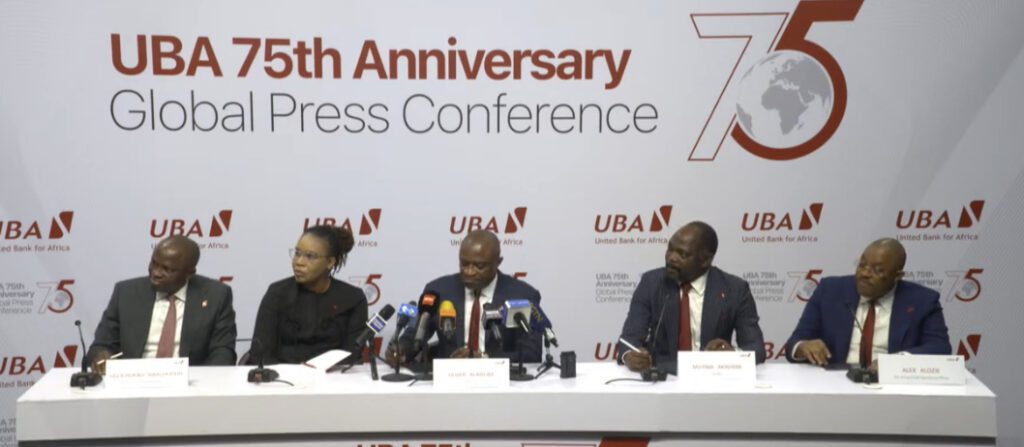
The Group Managing Director of UBA, Oliver Alawuba, who stated this at a World Press Conference to mark the bank’s 75th anniversary in Lagos, Nigeria on Monday, also said that the bank is committed to expanding its presence, seize growth opportunities, and deliver value to all stakeholders.

Alawuba hailed the Chairman of the global financial power house, Tony Elumelu, and other stakeholders for the success recorded by the bank in its 75 years of existence.

Alawuba stated that since its inception in 1949, UBA has evolved from a modest beginning in Lagos Island to a global financial institution with a presence in 20 African countries and 4 global financial nerve centres (New York, London, Paris and Dubai).

He pointed out that the bank boasts of over 25,000 Staff, over 35 million customers served through multiple channels – over 350,000 POS terminals, 2,000 ATM terminals, 1,000 Business Offices and 19.7 million Card Customers.

Maduka College Advert

“Amidst economic challenges and market dynamics, UBA has demonstrated remarkable financial strength and resilience. Our splendid performance, especially within the last year, is a testament to our robust fundamentals and sound strategic decisions. As we navigate through the ever-changing landscape, we remain committed to creating value for our shareholders and capitalizing on emerging opportunities in the market.

“Innovation and digital transformation are at the heart of UBA’s strategy for future growth and competitiveness. We will continue to invest in innovative products, services, and digital platforms that enhance customer experience and drive operational efficiency. Our commitment to Corporate Social Responsibility is strong, with initiatives focused on education, healthcare, entrepreneurship, and environmental sustainability; thus, making a concrete impact on communities across Africa.

“Looking ahead, our vision is clear – to be the role model for African Businesses. UBA is one bank, uniting Africa while connecting Africans to the World and the World to Africa. Our primary focus is to be the payment bank for Capital flows, trade and investments between Africa and the rest of the world.

“We are committed to expanding our presence, seizing growth opportunities, and delivering value to all stakeholders. Collaboration and partnerships as exemplified by the $6bn SME funding agreement signed with the African Free Trade Area (AfCFTA) will be instrumental in achieving our strategic objectives. We are dedicated to deepening relationships with customers, employees, regulators, and other stakeholders for mutual benefit and long-term success,” he said.

The GMD took out time to appreciate all the past and present Leadership of UBA, and well its customers, which he posited, contributed immensely to the success story of the bank.

Alawuba, particularly appreciated the Group Chairman, Tony Elumelu, whom he said his visionary push in 2005 and tutelage over the years, helped brought the bank to where it is today.

He said: “It is with great pleasure and a profound sense of pride that we gather here today to commemorate a momentous occasion – the 75th anniversary of United Bank for Africa Plc.

“As a matter of record UBA commenced operations in 1949 on Kakawa Street, Lagos Island as the British and French Bank.

“First and foremost, I would like to acknowledge and appreciate all our former Chairmen of Group and Subsidiary Boards, Board Members, Group and Subsidiary MD/CEOs, and staff in various capacities over the years.

“As we honour our past leaders, we also commend our present and look forward to future leaders who will continue to raise the bar of banking in Africa and globally.

“To this end, please join me in celebrating our current Group Chairman, Board Members, Executive Management and staff across all our subsidiaries.

“Without your sacrifices, contributions, support, and guidance over the years, we would not be where we are today.

“We appreciate and honour you because you built and nurtured the platform on which we are standing today.

“Our Group Chairman (Mr. Tony Elumelu, CFR) truly deserves special recognition and mention.

“Without his visionary push in 2005 and tutelage over the years, I doubt whether we would be where we are today.

“For these and more, we say a ‘BIG AND RESOUNDING THANK YOU’ to him.

“This milestone is not just a celebration of longevity, but a testament to resilience, innovation, and unwavering commitment to excellence that have defined UBA’s journey over the decades.”

Alawuba said it was important to acknowledge that UBA means different things to different people.

He said of the 75th anniversary: “As we reflect on the significance of this epoch-making event, it is important to acknowledge that UBA means different things to different people.

“For some, UBA is a trusted financial partner; for others, UBA is a beacon of stability and reliability, a development partner in various local communities as well as a catalyst for African development.”

Listing the mileage recorded by the bank in its 75 years, Alawuba said: “Since its inception in 1949, UBA has evolved from a modest beginning in Lagos Island to a global financial institution with a presence in 20 African countries and four global financial nerve centres (New York, London, Paris and Dubai).”

He said at present, the bank has over 25,000 staff, more than 35 million customers it serves through multiple channels, over 350,000 Point of Sale terminals, 2,000 Automated Teller Machines terminals, 1,000 Business Offices and 19.7 million card customers.

According to the GMD, the bank has recorded several firsts in the last 75 years.

He said: “The past 75 years have been marked by stability and excellence, pillars upon which UBA’s legacy stands tall.

“We take pride in being:

“1. The first Nigerian Bank to offer an IPO: UBA was the first Nigerian bank to offer an Initial Public Offering (IPO) in 1970.

“2. The first Nigerian Bank to be Listed on the NSE: UBA was the first Nigerian bank to be listed on the Nigerian Stock Exchange (NSE).

“3. The first Nigerian Bank in the USA and London: UBA was the first Nigerian bank to open a branch in the USA and London.

“4. The first Nigerian Bank to install ATMs: UBA was the first bank in Nigeria to install Automated Teller Machines (ATMs).

“5. The first Nigerian Bank to open a campus branch at the University of Lagos

“6. The first Nigerian Bank to open a subsidiary in Africa (Ghana in 2005)

“7. The first Nigerian Bank to appoint a Female Board Chairperson in Nigeria

“8. The first Nigerian Bank to introduce Mobile Banking: UBA was a pioneer in introducing mobile banking in Nigeria.

“9. The first Nigerian Bank to launch a Multi-lingual Chatbot: UBA introduced Leo, the first multi-lingual chatbot in Nigeria.

“10. The first Nigerian Bank to launch the most successful Prepaid Cards across Africa.

“There are so many other firsts of the UBA Group that time would not permit me to list.

“Amidst economic challenges and market dynamics, UBA has demonstrated remarkable financial strength and resilience.

“Our splendid performance, especially within the last year, is a testament to our robust fundamentals and sound strategic decisions.

“As we navigate through the ever-changing landscape, we remain committed to creating value for our shareholders and capitalising on emerging opportunities in the market.

“Innovation and digital transformation are at the heart of UBA’s strategy for future growth and competitiveness.

“We will continue to invest in innovative products, services, and digital platforms that enhance customer experience and drive operational efficiency.

“Our commitment to Corporate Social Responsibility is strong, with initiatives focused on education, healthcare, entrepreneurship, and environmental sustainability, thus making a concrete impact on communities across Africa.”

On the plan of the bank for the future, Alawuba said: “Looking ahead, our vision is clear – to be the role model for African Businesses.

“UBA is one bank uniting Africa while connecting Africans to the World and the World to Africa.

“Our primary focus is to be the payment bank for Capital flows, trade and investments between Africa and the rest of the world.

“We are committed to expanding our presence, seizing growth opportunities, and delivering value to all stakeholders. Collaboration and partnerships as exemplified by the $6 billion SME funding agreement signed with the African Free Trade Area will be instrumental in achieving our strategic objectives.

“We are dedicated to deepening relationships with customers, employees, regulators, and other stakeholders for mutual benefit and long-term success.

“As I round off, I would like to reiterate UBA’s commitment to Customer First Philosophy, which is our primary business strategy.

“The customer is our employer and the sole reason why we come to work.

“Our three key pillars of service (People, Process and Technology) are all geared towards the delivery of excellent customer experience, which is our promise.

“As we embark on the next phase of our journey, I urge all stakeholders to continue their support and collaboration.

“Together, we will write the next chapter of success for United Bank for Africa Plc.”

Business

Pipeline sale controversy deepens as expert warns of investor confidence risks

Published

on

Spread the love

Fresh controversy has erupted over efforts to revive the sale of a 40 per cent stake in the Amukpe–Escravos Pipeline, with a governance expert warning that any attempt to resurrect a previously terminated transaction could damage investor confidence and raise fresh questions about transparency in Nigeria’s oil and gas sector.

Speaking on Channels Television on Thursday, June 11, 2026, Managing Director of Policy Management Consult Services, Jide Olatuyi, said concerns surrounding the transaction extend beyond commercial interests and strike at the heart of governance, transparency, and the credibility of Nigeria’s investment environment.

“The contract was terminated,” Olatuyi said. “What stakeholders are saying is that there is a need for a new competitive bidding process rather than attempting to revive a failed transaction.”

The controversy has intensified amid scrutiny of the asset’s valuation. The earlier transaction involving the 40 per cent stake was priced at approximately $243 million before collapsing over unmet contractual obligations. Independent assessments conducted in 2025 reportedly valued the same stake at between $544 million and $641 million.

The significant disparity between the earlier transaction price and the more recent valuations has fuelled calls for a fresh competitive bidding exercise to ensure that the asset reflects prevailing market conditions and delivers maximum value.

Rejecting suggestions that opposition to the proposed transaction is driven by sentiment or commercial rivalry, Olatuyi insisted that the debate centres on governance standards within the petroleum industry.

Maduka College Advert

“I don’t think it is about sentiment at all,” he said. “It is about governance in the oil and gas sector.”

According to him, Nigeria’s challenge is no longer limited to attracting investors but also ensuring that investors have confidence in the integrity of the country’s commercial and regulatory processes.

“If you are not committed to transparency, it becomes a problem for investors,” he said. “If you cannot build trust and confidence in the sector, capital will go elsewhere.”

Olatuyi said several stakeholders, including project lenders such as Sterling Bank and AMCON, have advocated a transparent process that reflects current market realities and updated asset valuations.

The Amukpe–Escravos Pipeline, which has a transportation capacity of about 160,000 barrels per day and has maintained uptime above 95 per cent, remains one of Nigeria’s most strategic crude evacuation assets. The pipeline plays a critical role in transporting crude from inland production fields to export terminals in the Niger Delta.

Olatuyi urged authorities to ensure that any future transaction involving the asset is conducted through an open, transparent, and competitive process capable of inspiring investor confidence and safeguarding public value.

The debate comes at a time when the Federal Government is seeking to attract substantial investment into the energy sector and expand critical oil and gas infrastructure.

The eventual outcome of the Amukpe–Escravos Pipeline transaction could serve as a major test of Nigeria’s commitment to transparency, valuation discipline, and investor protection. As global competition for energy capital intensifies, governance standards may prove just as important as resource endowment in determining where investment flows.

Officials of the Nigerian Upstream Petroleum Regulatory Commission and members of the technical committee that supervised the original transaction did not respond to requests for comment as of press time.

Continue Reading

Business

S/East companies shutting down over rising energy costs — MAN

Published

on

Spread the love

The Manufacturers Association of Nigeria (MAN) has raised alarm over the worsening state of manufacturing activities in the South-East, warning that rising energy costs and poor access to finance are forcing many companies in the region to shut down.

Chairman of MAN for Anambra, Enugu and Ebonyi states, Lady Ada Chukwudozie, disclosed this during the MAN South-East Stakeholders’ Industry Conversation held in Awka, Anambra State.

The forum was convened to address concerns surrounding electricity regulation, billing transparency and declining industrial productivity across the region.

Chukwudozie said the few factories still operating were doing so at less than 30 per cent of installed capacity due to soaring electricity tariffs, high energy costs and limited access to credit facilities.

According to her, the harsh operating environment informed the decision to convene the stakeholders’ roundtable, stressing that the manufacturing sector remains critical to economic growth, industrialisation and job creation.

She warned that unless urgent measures are taken to address the challenges confronting manufacturers, industrial activities in the South-East could further deteriorate, with serious implications for employment and regional economic stability.

Maduka College Advert

“The manufacturing sector cannot thrive in an environment of uncertainty,” she said.

She called for reforms in the power sector to be driven by transparency, accountability and measurable performance standards, including agreed electricity supply hours, actual delivery levels and compensation mechanisms where supply consistently falls below expectations.

Chukwudozie also urged regulatory authorities to strengthen oversight of electricity providers and improve power supply to industrial clusters across the South-East.

Stakeholders at the forum expressed concern that manufacturers were increasingly struggling to cope with escalating production costs, worsened by unreliable electricity supply and the rising cost of alternative energy sources.

They noted that without affordable and stable energy, many more companies could either scale down operations or shut down completely.

In his keynote address, former Chairman and Chief Executive Officer of the Nigerian Electricity Regulatory Commission, NERC, Dr. Sam Amadi, urged governments in the South-East to adopt deliberate policies aimed at prioritising electricity supply to industrial clusters.

Amadi also advocated pricing frameworks that would encourage manufacturers to expand production and invest in growth.

The stakeholders’ meeting brought together manufacturers, regulators and other industry players to explore practical solutions to revive industrial output and tackle persistent power challenges affecting businesses in the region.

Continue Reading

Business

Amukpe-Escravos pipeline and the real cost of ignoring current value, By Sufuyan Ojeifo

Published

on

Spread the love

Nigeria’s oil infrastructure has a habit of telling uncomfortable truths. Not just about barrels and flow rates, but about how a country chooses to value what it cannot afford to lose, and what it risks when it gets that calculation wrong.

Take the Amukpe-Escravos Pipeline, for example. A syndicate of lenders, led by Sterling Bank, is pushing back against efforts to revive a collapsed transaction involving a 40% stake in the asset. Their argument is not complicated. It is rooted in numbers and contractual discipline.

To be clear, a deal that fell apart in 2024 is being reconsidered using a valuation from that same year. However, since then, the asset has proved its worth. Independent assessments now place that stake closer to $600 million. The earlier benchmark sits far below that. The gap is not cosmetic. It is material. And if left unaddressed, it becomes a cost.

The original $243 million offer did not collapse by accident. It was terminated in October 2024 after Conpurex Limited failed to meet payment obligations, breached key terms, and sought to shift risk back to the seller. By the time the Technical Committee closed the process, confidence had already drained out of it. That much is settled.

Ordinarily, that should have been the end. Instead, there are moves to return to a September 2025 approval linked to that same process. The lenders describe this as an administrative carryover. Their response is simple. Start again. Set aside the old approval. Bring in an independent adviser. Return the asset to the market and let current value speak.

What is striking is not just the position itself, but how unusual it sounds in the Nigerian context. In a system where strategic assets have too often travelled through corridors of convenience, an insistence on valuation and process can sound almost rebellious. It should not be so.

Maduka College Advert

Because this is not entirely about one pipeline. It is about whether a terminated deal remains terminated. Whether contracts still mean what they say. Whether performance counts for anything once the paperwork has been filed away. And, crucially, who bears the cost when value is ignored.

The numbers, as always, are blunt. A 2025 independent valuation, referenced in the March 2026 edition of Africa Oil+Gas Report, places the 40% stake at a mid-case of $372 million, a high case of $544 million, and an upside of $641 million. These are not speculative figures. They reflect an asset that has quietly done its job in a difficult environment.

With a capacity of 160,000 barrels per day and uptime consistently above 95%, the Amukpe-Escravos Pipeline has become one of the more reliable evacuation routes in a system where reliability is often in short supply. While other corridors struggle with theft and disruption, this one works.

That fact matters a great deal. Because when an asset proves itself under pressure, its value does not stand still. It moves. To price it as though nothing has changed is not just a technical choice. It is a financial one. And every financial choice has consequences.

It says performance can be ignored. It says time does not count. It says administrative continuity can outrun economic reality. To be fair, the earlier process gave enough warning signs. Lenders questioned the assumptions. Coordination was weak. When Continental Oil and Gas stepped back, Conpurex entered without a clean transition and soon began to reopen settled terms, shifting obligations and introducing new conditions that unsettled the commercial balance. The eventual termination was not dramatic. It was inevitable.

What unsettles stakeholders now is the possibility that a process that ran its course may still shape the outcome. If a concluded transaction can reappear without a clear restart, the line between closure and continuity begins to blur. Once that line blurs, contractual uncertainty follows. And when certainty weakens, serious capital takes notice.

This is where the issue widens beyond the pipeline itself. Back in March, Africa Oil+Gas Report described the Amukpe-Escravos matter as no longer just a transaction story, but a test of how Nigeria governs, values, and safeguards strategic oil infrastructure. That reading feels even more relevant now.

Because what is at stake is not simply who acquires a stake in a pipeline. It is how the country signals to those willing to invest in its most critical assets. It is about whether value is recognised only in theory, or protected in practice. It is about whether losses are acknowledged, or quietly absorbed.

The lenders’ position is often described as resistance. It is better understood as discipline. Reset the process. Revisit the approval. Bring in independent oversight. Return the asset to the market through a transparent and competitive process that reflects present realities. Ensure capable counterparties. Align all stakeholders.

These are not extravagant demands. They are the basics. Nigeria has seen too many assets drift from promise to regret. Too many structures that once worked reduced to cautionary tales. When something works, when something proves resilient in a difficult system, the least that can be done is to treat it with the seriousness it has earned.

Moments like this do not announce themselves as turning points. They arrive quietly, dressed as routine decisions.

But they reveal everything. For an economy seeking disciplined capital and trying to rebuild confidence, the signal matters. Let the process be reset. Let valuation reflect reality. Let the outcome show that when Nigeria recognises value, it also knows how to protect it, and what it stands to lose when it does not.

Until then, the lenders’ position stands as a reminder that in a system where too much has been taken for granted, some lines are too important to be crossed and must be held.

● Sufuyan Ojeifo publishes THE CONCLAVE online newspaper.

Continue Reading

Trending

Maduka College Advert