News
EFCC grills Emefiele over alleged $15b foreign debts, new currency


-
AGF seeks Tinubu’s approval for EFCC to take over ex-CBN gov’s probe
-
Special Investigator Obazee submits interim report to President
The Economic and Financial Crimes Commission (EFCC) yesterday began a full-scale probe of the former Governor of the Central Bank of Nigeria (CBN), Godwin Emefiele, with alleged $15 billion foreign debts topping the investigation.
Emefiele will also account for how the apex bank spent N74.84 billion to produce and roll out currencies, including new naira notes.

The allegations are in addition to alleged fraud uncovered by the Special Investigator, Jim Obazee, who is looking into the activities of the CBN.
Obazee, whose committee is collaborating with the Federal Bureau of Investigation of the Nigeria Police, has also submitted an interim report on the CBN to President Bola Ahmed Tinubu.
It was learnt yesterday that the ex-CBN governor was transferred from the Department of State Services (DSS) to the EFCC because the fresh investigation is not covered by the mandate of the security agency.

The DSS does not have the core competence to investigate the weighty allegations of financial crimes against Emefiele, a highly placed source said yesterday.
There were fears that if the DSS continues with the investigation, the ex-CBN governor might win in court on technical grounds.
The source said only the EFCC can put Emefiele on trial, not the DSS, based on the findings made so far.
Emefiele was transferred (technically released) to EFCC on Thursday afternoon to allow for in-depth investigation and trial.
The swap was kept under wraps in order to avoid what the source described as a “distraction.”
Having appraised the allegations against Emefiele and the interim report on the ongoing probe of the CBN, the Attorney-General of the Federation and Minister of Justice, Mr. Lateef Fagbemi (SAN) sent an advisory to the President that the EFCC is the right agency to probe Emefiele, it was learnt.
“As a man of due process, the President approved the advisory of the AGF. It was on this basis that the DSS handed over Emefiele to the EFCC on Thursday,” The Nation learnt yesterday.
About two to three weeks ago, the Special Investigator on CBN activities, Jim Obazee, submitted an interim report to the President with a lot of findings requiring in-depth investigation. This was another reason the AGF was very strong in his opinion that the EFCC should manage the ongoing probe.
“The truth is that such an investigation is not within the mandate of the DSS. Or else, if Emefiele is put on trial by the DSS, he will win on technical grounds,” the highly placed source said.
At press time, it was confirmed that a panel of EFCC operatives had started grilling Emefiele on the allegations against him, including the following:
•Alleged foreign debts of $15 billion
•Spending of N74. 84 billion on Naira redesign, production and roll out of currencies
•Alleged fraud in Anchor Borrowers Schemet
•Suspicious audit of CBN accounts
•Acquisition of bank, Fintech licences by some top officials of CBN
•Award of suspicious billions of Naira contracts
Another source in EFCC added: “Emefiele is in our custody and he is already responding to issues or allegations raised for him from a team under the supervision of the Director of Operation, Abdulkarim Chukkol.
“As a commission, we won’t talk on his case in order not to compromise ongoing investigation.”
The Head of Media and Publicity of EFCC, Mr. Dele Oyewale, was yet to pick his call at press time.




A 21-year-old butcher, identified as Selim Ayodele, has allegedly stabbed his 26-year-old colleague, Ibrahim Wasiu, to death following a disagreement over sweeping their workplace in Ogun State.
The incident reportedly occurred on Sunday, October 18, at a cow meat-selling outlet in the Alagbole area of the Akute/Ajuwon satellite towns in Ifo Local Government Area of the state.
According to reports, trouble started after the day’s business activities when the two colleagues disagreed over the cleaning of their sales outlet, with the argument allegedly escalating into a fatal confrontation.
The Ogun State Police Command’s Public Relations Officer, Oluseyi Babaseyi, confirmed the incident to journalists in Abeokuta on Friday, disclosing that the suspect had been arrested.
Babaseyi said the incident was reported at the Ajuwon Police Divisional Headquarters on Sunday night, prompting police operatives to commence an investigation.
He explained that preliminary findings indicated that the disagreement began after the two men had concluded their day’s work at the meat-selling outlet.
During the altercation, Ayodele allegedly picked up a knife and stabbed Wasiu in the left side of his chest before twisting the weapon.
The victim was reportedly rushed to a nearby hospital for medical attention but was pronounced dead on arrival.
The police spokesperson added that the suspect remained in custody as investigations continued ahead of his prosecution.
He further disclosed that the deceased’s body had been deposited in the morgue of a private hospital for an autopsy.
The Commissioner of Police in Ogun State, Bode Ojajuni, reaffirmed the command’s commitment to prompt response to criminal incidents, thorough investigations and the prosecution of offenders in accordance with the law.
The police commissioner also urged residents to exercise restraint, resolve disagreements peacefully and promptly report criminal incidents to the appropriate authorities.
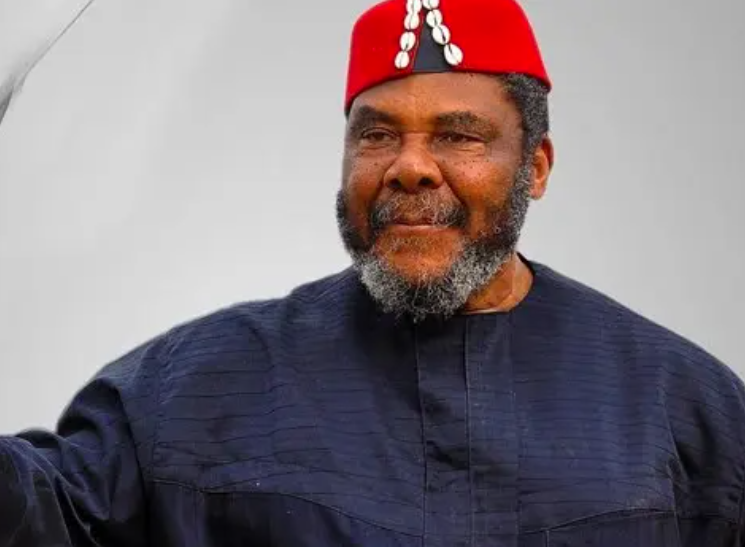
FRED IWENJORA reports that very brave Okonkwo of “Things Fall Apart”, Ebubedike, the Ononenyi of Nteje, Anambra State, and Ibobo Oyi na Omambala shed tears uncontrollably during this tour especially when students and pupils of Knutsford University used his name for different forms of recitations and poetry.
One may ask why Pete Edochie traveled to Ghana?
This visit was for the launching of the Pete Edochie Legacy project, themed “Celebrating the Africa legend; The lion that needs not to roar”.
It is “a cultural initiative created to honor and celebrate one of Africa’s most revered figures” according to the Ghanaian project organisers.
The Legacy project includes a biographical book, a documentary series and international tour with Ghana serving as the launch pad.
The publishers, KPL publishers had noted that the contributions of the 79-year-old screen star to Africa cinema are very noteworthy.
At the end of it all, the star actor had, aside unveiling his autobiography in a gala event, paid courtesy calls to industry and policy makers in Ghana including the visit to Ghana’s Goldbod, the body regulating everything gold in Ghana. Organisers saw the visit as an important segment of the tour because a visit to Ghana may have been incomplete without seeing first hand the reason the country was called Gold Coast.
He had also met and greeted select fans and featured in a public lecture and colloquium in his honor before returning to Nigeria.
From when he landed at Kotoka International Airport Tuesday 29th September, 2026 till his departure from Ghana on Wednesday 7, October 2026, there was no dull moment.
Reception was top notch and indeed out of this world.
Ghanaians as well as Nigerians left businesses and trouped out to see “the president of African screen” according to Elizabeth Ama Tetteh, one of his numerous Ghanaian fans who noted that she had been resident in Enugu, Nigeria. It was indeed heartwarming to see Ghanaian as well as Igbo cultural groups on hand to welcome him to the old Gold Coast. Dispatch riders led his motorcade out of the airport.
On arrival, he first paid a courtesy visit to Eze Dr. Chukwudi Jude Ihenetu, Onyendu Ndi igbo, Ghana and sued for peace between Nigeria and Ghana. The respected Eze Ihenetu had organised a congregation of Igbo and Ghanaian leaders for a traditional cocktail reception.
According to the major propeller of the project Kelvin King Dawie of King Dawie Publishing Ltd (KPL) “When people ask why Pete Edochie, I tell them that no honor for Pete Edochie is too big. He has very much distinguished himself on the continent of Africa and beyond as a custodian of the cultural heritage of Africa and has been consistent in it for decades since mounting the stage at the tender age of 15. He is well known and received a lot of honors and awards globally including Nigeria’s national honor of merit; MON.
“We also looked at the way he has distinguished himself on stage and in communication which has warranted him receiving Honorary Doctorate in Literature and creative arts.
On this continent, Pete Edochie is one of a kind and he needs to be projected and celebrated as that icon of Africa who has held high the heritage of Africa for over six decades of his acting life.
King Dawie, an accountant, business strategist and social impact leader also hinted that “the project is in four phases, the autobiography, a 16-episode documentary to properly chronicle his life’s journey and then also the African youth mentorship initiative to help him pass on information to the next generation and an international tour. It took a lot of several efforts from several people too numerous to mention to set this ball rolling and hopefully achieving. We also remain very grateful to our star guest for accepting our proposal. ” However, there are major take-aways from these nine days Pete Edochie “Presidential visit” to Ghana.
Cultural diplomacy at its highest African peak
Years back, Africa viewers had voted Pete Edochie as their main choice in (AMVCA).
However, this Ghana visit is International cultural diplomacy at its highest African peak.
It seems first in history that a film star would make so much impression in another country that a book would be written and unveiled on him in that country.
It also reveals that Nigeria and Ghana have co-existed as West Africa’s beloved Anglophone countries despite hiccups occasioned by various ‘Ghana must go’ or ‘Nigeria must go’ agitations.
And to see both Nigerians and Ghanaians under one roof because of Pete Edochie, animosities may have been doused even if for a moment.
The unveiling of the autobiographical book; Titan of Africa, the story of Pete Edochie, published by KPL Publishers was a big attraction on its own and first of its kind for a Nigerian actor. The event which held at Kempiski Accra drew together distinguished Ghanaians with highlights including his meeting with Ghanaian legendary actress, broadcaster and musician Grace Omaboe, known to many as Maame Dokono. He also met with 102 years old Warrant Officer 1 and WW2 veteran, Pa Joseph Ashitey Hammond. Their tight hug meant that this meeting for the WW2 veteran was highly anticipated like the story of the nunc dimitis contained in the synoptics.
There are pointers to the huge respect that he commands in the so called Gold Coast and that Africa is so culturally connected in many ways.
Another take away from the tour was that the man Pete Edochie is very well blessed and his star never seems to dim as years roll by.
Despite that he is bound to the wheelchair and could barely walk or sits on the chair in his current films, fans continue to adore him from far and near. (Saturday Vanguard)

Four people were reportedly shot when a convoy of the National Democratic Congress (NDC) came under attack in Ebonyi State, with one of the campaign vehicles set ablaze.
The incident occurred during a campaign movement in the state, according to sources familiar with the development.
The identities and conditions of those injured were not immediately available at the time of filing this report.
The motive for the attack remained unclear, while the attackers had yet to be identified.
Security agencies were expected to investigate the incident and determine the circumstances surrounding the shooting and burning of the campaign vehicle.
Further details were awaited from the NDC, the Ebonyi State Government and the relevant security authorities.
-
 Features2 days ago
Kogi’s Kidnapping Crisis: Why Do Forests Remain Safe Havens for Criminals Under Ododo’s Watch?
-
News2 days ago
Kidnappers kill seven-year-old boy after ransom demand
-
News1 day ago
Macron Postpones Planned Visit to Nigeria Until 2027
-
News1 day ago
UBA Commences Contempt Proceedings Against WEMPCO Directors over Alleged Disobidence of Court Order
-
News1 day ago
Enugu CP Orders Probe into Death of Izuchukwu During Police Raid
-
Politics1 day ago
2027: Atiku, Obi, Duke, Others in Talks on Single Opposition Candidate – Coalition
-
News1 day ago
$242m Petroleum Products Diversion Claim: UBA Secures Court Order Against Vitol, Four Others
-
News18 hours ago
Mbah: Why We Built 268 Smart Green Schools Across Enugu State