Politics
Presidential poll: Governance Index projects victory dance for Obidatti, Obidients!

From Chuks Collins, Awka
The Labour Party(LP) presidential candidate -Peter Obi been projected again to win this weekend’s presidential election.

The Governance Index, an independent consulting firm presented the score sheet to group under the aegis of Peter Obi Support Network(POSN)on its analysis and projections for Nigeria’s 2023 presidential election having, according to it put relevant variables and indices into consideration.
Considering which of the candidates would win in certain areas and by what margin at a World Press Conference in Abuja today, Mazi Tochukwu Ezeoke also used the opportunity to address what he described as the harmful propaganda that the Peoples Democratic Party(PDP), and the ruling All Progressives Congress(APC), have been dishing out against the Labour Party (LP) and her presidential candidate -Mr Peter Obi, Ezeoke said, “As we all know, since the advent of this democratic dispensation, the two major political parties have consistently disregarded the people’s opinion.
We have witnessed growing discontent and the efforts by our decadent political leaders to reinforce ethnic and religious bigotry. All of us are disillusioned that our country has sadly been turned into a killing field where human lives are of no more valuable, a nation that is now rated as the headquarters of poverty despite enormous human and material resources that God has generously bestowed on this nation.
“These are all factors that will swing 2023 outcomes, and now the question is: How will the mainstream politicians handle their imminent defeat?

” Today, we are alarmed to witness the leadership of the ruling party and their restless attacks on President Mohammadu Buhari for the recently promulgated federal government policies. We are also alarmed to find the official spokesman of Bola Tinubu, the APC presidential candidate, and a serving Governor of the ruling party, openly threatening a coup deta’t. The PDP today is also riddled with crisis, all these developments make us wonder whether these two parties that have brought the country to its knees will allow a free and fair election and whether they will accept the result of the presidential election when they suffered election defeat this weekend.
Faced with certain electoral defeat, the APC and the PDP have resorted to propaganda, political bribery and spreading fake news and unfounded information against the labour party to help their demoralized supporters.
“It is now obvious that Labour Party is the party to beat and so their masters have seen the truth and are tactically submitting. Atiku in his broadcast is now saying that people should go out and vote peacefully even if they don’t want to vote for him. That is better.
Meanwhile the Agbado master and his old naira notes delusional governors are now crying for the election to be postponed because defeat is staring them in the face.
These failed politicians have failed to read the signs of times, that a new generation of Nigerians hewed in the blood of innocent Nigerians over the years of their mindless misrule have risen to take back their country and will not stop until the day a new Nigeria is born; the 2023 elections are just the beginning.
“The desperate wicked looters of our commonwealth are no longer saying that the Labour Party has no structure because the Peter Obi Support Network [POSN] and many other support groups, including the coalition for Peter Obi have created a massive network of Peter Obi supporters (Obidients)in every nook and cranny of Nigeria.
WE ARE THE STRUCTURE!
However, taking you down memory lane of the emergence of POSN, the network was formed in December 2018 because of our yearning for a better nation, where everyone can live and have peace of mind and excel in his chosen field of human endeavour.
Then on April 25, 2022, POSN was formally inaugurated by Mr Peter Obi, in Abuja to work and ensure that the former governor of Anambra state is elected as President of Federal Republic of Nigeria come February 25, 2023.
We are proud therefore to announce that the Obidient Movement that sprang out of these early efforts eventually spread like wildfire across the country.
POSN has so far established Functional Network in all 36 states and FCT; set up very functional Diaspora chapters in over fifteen(15)countries overseas, and recruited and submitted about 50,000 thousand Polling Unit Monitors for the 2023 elections.
The support network had also organized regional conferences in Jos, Plateau State; Kaduna in Kaduna State, and Asaba, Delta State. Its noteworthy that POSN recruited and trained about five thousand (5000) LGA and Ward coordinators on mobilizations and sensitization operations.
Equally, the network had also partnered with the Diaspora Medics-4-Good Governance [DM4GG] to organize medical outreaches in flood-ravaged areas of the country.
Under this partnership we are this day executing grassroot mobilisation programmes in Kano, Taraba, Kaduna, Benue, Katsina, Nasarawa and Bauchi states. POSN is currently partnering with Women for Peter Obi [WPO] to mobilize voters with campaign materials in hard-to-reach areas in remote villages nationwide.
According to Mazi Ezeoke, “we have also aided in raising substantial amount for the LP campaign. We Printed and distributed over two million campaign materials for sensitization and mobilization across the Country.
“We initiated a novel project titled “Sponsor your ward project”, which aided individuals to take ownership of their political wards, and sponsor ward activities and political engagements in their various wards through our network of Local Government coordinators and Ward coordinators. These have helped in pushing the Peter Obi’s redemption Gospel deeper down the grassroots.
Our decision to support Peter Obi is as a result of the realisation that the ruling All Progressives Congress (APC) and main opposition party, the Peoples Democratic Party (PDP), do not care about the ravaging insecurity and poverty that has bedevilled every part of our nation.
All they care about is to enrich themselves, their families, and cronies. They have turned Nigeria to personal estate where they can do whatever they like with the lives over the 200 million Nigerians without any repercussion.
THE MAN PETER OBI
While throwing more light on the man, Peter Obi, Mazi Ezeoke on behalf of POSN said, “..the international businessman turned politician came into the political space of Anambra state when the state was in political bondage to the “godfathers”. After a protracted legal tussle that lasted about three years, he finally broke the shackles that had held the state in bondage. From that moment on, he returned and restored Anambra to a peaceful and prosperous state.
We therefore strongly believe that Mr Obi has the Capacity, Competence, and Character to break the political elites’ criminal structures of greed and corruption if elected President of Federal Republic of Nigeria.
Highlighting some key points of his tenure as governor of Anambra State, the POSN reiterated that it was under his watch that Anambra became the first State to commence Sub-Sovereign Wealth savings, the first of its kind under any government in Sub-Saharan Africa.
*The Nigerian Debt Management Office (DMO) rated Anambra as the least indebted state in Nigeria. Despite visible and measurable achievements recorded in various sectors, the State under him did not borrow or raise bonds for her various projects.
*The state also entered strategic partnerships in the health sector. Through the partnership his government funded the transformation of -: A: Iyienu Hospital, Ogidi; B: Our Lady of Lourdes Hospital, Ihiala; C: St Charles Borromeo Hospital, Onitsha; D: Holy Rosary Hospital, Waterside, Onitsha; and E: St. Joseph Hospital, Adazi-Nnukwu.
*His government also built the Joseph Nwilo Heart Centre in St. Joseph, Adazi-Nnukwu, where heart operations are now being performed.
*His government won the Bill and Melinda Gates Foundation (1 million dollars) as the best-performing state in immunisation in the South-East.
*The state was the first to procure and distribute more than 30,000 computers to secondary schools, including 22,500 from HP.
*Anambra State Government under Peter Obi provided Microsoft Academies, and internet access to more than 500 secondary school.
*More than 700 buses were provided to secondary schools in the State by his government, and many other achievements too numerous to mention here.
The POSN spokesman disclosed that it was why “we the Obidients have come together across the globe to put our resources together and actualize the Peter Obi presidency to rescue the Nigerian nation from an “intensive care unit” that it found itself under the administration of President Muhammadu Buhari to prevent Buhari from handing the nation over to another geriatric someone that will supervise the “burial of the nation”.
To ensure victory for Labour Party’s Peter Obi and Datti Baba-Ahmed, we have taken the good news of his forthcoming presidency to 774 Local Governments of the Federation, and we can feel the pain of the people as we moved round the country.
Frankly speaking, Nigerians are tired of the APC and its siamese twin, the PDP. The nation’s 200 million population is tired of insecurity, abject poverty, poor health facilities, youth unemployment, etc in the midst of plenty bestowed on us by God Almighty.
Therefore, POSN wishes to tell Nigerians that their reproach and shame is about to come to an end this Saturday, and for all patriotic electorate to take their destiny in their hands and vote massively for LP, for Peter Obi.
I hereby present to you the Governance Index projections for the 2023 presidency: (Governance Index is a consulting firm hired by POSN to strategy and analysis).
Official Projections of the 2023 Nigeria Presidential Election
Nigeria is the most populous nation on the African continent with an estimated population of over 213 million people. Nigeria doubles as the largest black nation globally and her territory hosts some of the most ancient evidence of human civilization. Not having a political history without turbulence, the world looks on to Nigeria as she attempts to advance into the 7th electoral cycle since the commencement of her fourth republic in 1999.
Governance Index has conducted a series of voter demographic analysis, historical election result analysis, opinion polls as well as current political sentiment analysis between May 2022 and February 2023 to gauge the mood of the Nigerian electorate and determine the voting directions across the various states and geopolitical zones. These surveys captured people in rural, semi-urban and urban dwellings across the country.
While voter behaviour was not seen to have changed significantly, the most notable observations will be a shift in the direction of voting across the various voting segments, the impact of technology and decisions of the mainstream political parties during primary elections. This is indicative of an unexpected outcome in the results of the 2023 general elections.
The biggest potential gainers will be the new entrants; a bloc of electorates who are determined to challenge the mainstream political actors.
Can they withstand the last-minute political upheavals and make this happen?
Leading Political Parties, Candidates and their Running Mates
Party Name
Abbreviation
Presidential Candidate
Vice Presidential Candidate
All Progressives Congress
APC
Bola Ahmed Tinubu
Kashim Shettima
Labour Party
LP
Peter Gregory Onwubuasi Obi
Yusuf Datti Baba-Ahmed
New Nigeria People Party
NNPP
Rabiu Musa Kwankwaso
Isaac Idahosa
People Democratic Party
PDP
Atiku Abubakar
Ifeanyi Arthur Okowa
Projections of Popular Vote Distribution Among the 4 Leading Political Parties
Party
Projected Votes Obtained
Percentage of Total Votes
APC
11,200,590
30%
LP
14,801,944
40%
NNPP
2,203,206
6%
PDP
8,718,396
24%
Total
36,924,137
100%
Projections of how the leading parties meet the 25% requirement in 24 states & FCT
Party
States with 25% requirement
APC
22
LP
25
NNPP
1
PDP
18
Projections of the Percentage of Popular Votes Obtained by the Parties in the Geopolitical Zones.
Geopolitical Zone
APC
LP
NNPP
PDP
South East
4%
91.42%
0.84%
3.74%
South South
16%
68.6%
0.73%
14.67%
South West
64.5%
25%
0.83%
9.67%
North Central
31%
33.57%
4.71%
30.71%
North East
33.17%
23.67%
5.5%
37.67%
North West
30.29%
15.86%
13.29%
40.57%
Geopolitical Zone
APC
LP
NNPP
PDP
South East
166,516
4,024,215
35,853
160,748
South South
839,783
3,962,072
40,715
749,535
South West
4,037,771
2,054,062
92,126
751,585
North Central
1,746,183
2,102,154
260,868
1,769,079
North East
1,725,683
1,159,046
270,613
1,896,412
North West
2,684,655
1,500,395
1,503,030
3,391,038
Geopolitical Zone
Registered Voters
Projected Voters Turnout
Projected Accredited Voters
South East
10,987,738
39.90%
4,387,332
South South
14,440,209
38.33%
5,592,106
South West
17,932,586
40.00%
6,935,543
North Central
15,335,114
38.36%
5,878,284
North East
12,547,855
40.17%
5,051,753
North West
22,278,770
40.29%
9,079,118
93,522,272
39.48%
36,924,137
APC
LP
NNPP
PDP
Political Party
Flag Bearer
Home Geopolitical Zone
Projected Votes obtained in Home Geopolitical Zone
Projected Votes Obtained Nationwide
Percentage of Votes obtained from Home base
APC
Bola Ahmed Tinubu
South West
4,037,771
11,200,590
36%
LP
Peter Gregory Onwubuasi Obi
South East
4,024,215
14,801,944
27%
NNPP
Rabiu Musa Kwankwaso
North West
1,503,030
2,203,206
68%
PDP
Atiku Abubakar
North East
1,896,412
8,718,396
22%
From the above projections, it could be seen that Nigeria’s emancipation is coming! Peter Obi is coming! And a vote for Peter Obi is a vote for prosperity, a vote for security, a vote for employment, a vote for good governance, a vote for good roads, a vote for quality educational system, a vote for quality health care/facilities, a vote against nepotism and a vote to destroy the structures of corruption and mindless “system” that has held the country down for decades!
POSN therefore urge Nigerians to come out en masse to vote for Peter Obi this Saturday, February 25,2023. It’s the pathway to the promised land.
Don’t vote for anyone that will supervise the complete “burial of the nation” that their system has already put in an “intensive care unit’ under President Muhammadu Buhari.
Please let us all stand up, take action, move out on Saturday and vote for restoration of life to the nation, vote to stop the years of bloodshed, vote to stop the mindless looting, vote to stop square peg in round hole, vote to stop official insincerity! Vote Peter Obi, vote LP.



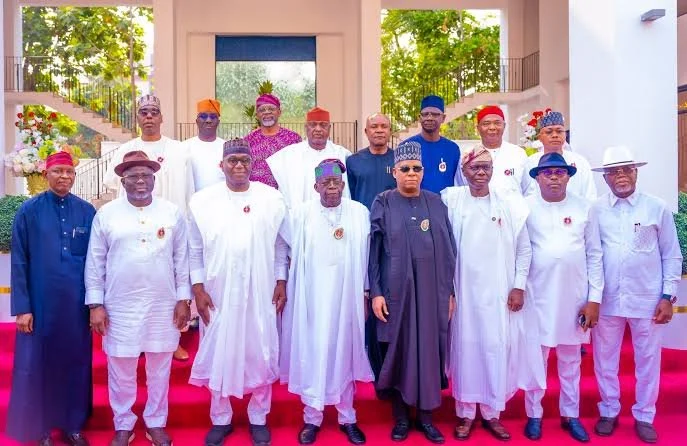
President Bola Tinubu on Thursday held closed door talks with governors elected on the platform of the All Progressives Congress, otherwise known as the Progressives Governors‘ Forum, at the Aso Rock Presidential Villa, Abuja.
Thursday’s meeting is the latest in a back-to-back series of engagements with governors and top chieftains of the party at Aso Rock to resolve the crisis trailing the controversial Presidential Campaign Council list released by the party last Saturday, August 23, 2026.
The governors marched to the President’s office shortly before 4:00pm on Thursday, after emerging from a separate session of the National Economic Council chaired by Vice President Kashim Shettima.
The consultations, which began since Wednesday, were aimed at reviewing and reworking the PCC list which has continued to generate controversy since its release.
The ruling party had faced severe backlash over the inclusion of some controversial party chieftains, particularly those currently facing corruption charges.
It was also alleged that some key sections of the party were not carried along in the drafting of the PCC list.
Multiple party sources, who spoke with The PUNCH on Thursday, said the meeting, which initially held from around 4pm to 11pm on Wednesday, could not be concluded.
Consequently, the meeting continued on Thursday after the regular NEC meeting.
As of press time on Thursday, The PUNCH could not confirm the extent of the changes made to the list.
However, sources close to the APC governors and party heavyweights said the list had been reviewed.
One of the sources said the initial list had been deleted from the party’s X handle and that a new list would be posted as soon as the President approves the deliberations at the meeting and the proposed changes.
“The list is part of the main agenda of the meeting. You can notice that the other controversial list has been deleted from the Twitter handle of the party,” a top source close to the APC governors said.
Also speaking on the list, another top party chieftain said, “Can you believe that the party was not carried along in the formation of the list? The President’s Special Adviser on Political Matters and a few persons in the Presidency came up with the list.
“You can see the backlash that has trailed it. The President is handling the matter, and it is believed that some changes will be made after the two-day meeting.”
Meanwhile, further findings by our correspondent showed that the party would double down on social intervention programmes ahead of the January 2027 poll.
It was learnt that this was part of the ruling party’s plan to reach out to Nigerians and ameliorate the suffering of the masses.
The APC had recently released the complete membership list of its 2027 Presidential Campaign Council.
As earlier reported, President Bola Tinubu will chair the council, with Vice President Kashim Shettima and APC National Chairman, Professor Nentawe Yilwatda, serving as vice chairmen I and II respectively. Senator Abdulaziz Yari was named Director-General, while Imo State Governor, Hope Uzodimma, will serve as Secretary.
The expanded list, numbering 223 entries, adds directorates covering finance, extractive industries, education, manufacturing and MSMEs, support group coordination, faith-based mobilisation, protocol, labour union relations, special duties, stakeholders’ mobilisation, community support, digital operations, grassroots engagement, and welfare.
Following series of controversies that trailed the list, the Special Adviser to the President on Media and Public Communication, Sunday Dare, said later that adjustments would made to the list where necessary.
Dare said the list remained valid because the campaign structure was not yet complete, with several subcommittees still to be constituted.
“As it is with every other list, there’s a room for subcommittees. Those subcommittees have not been formed, and so many other names will come into that subcommittee,” he said.
Dare also referred to a statement issued by the APC, insisting that the party had not withdrawn the list.
“But of course, there will be adjustments. The list is not cast in stone, just like every other list,” he added.
Asked whether the expected changes amounted to a review of the council, Dare drew a distinction between the two terms, saying the changes would only be made where necessary.
“Not a review, just adjustments where necessary,” he said.
Explaining the distinction, Dare said a review would amount to a broader overhaul of the existing structure.
“Review is wholesale, this is not wholesale,” Dare said.
He added that the planned subcommittees would provide room for more party members and political stakeholders to be accommodated within the campaign structure. (PUNCH)
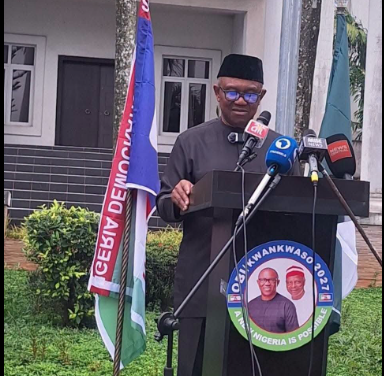
Presidential candidate of the Nigeria Democratic Congress (NDC), Peter Obi, has said Nigeria must move from an economy driven by consumption and imports to one built around production, investment and job creation.
Obi made the declaration on Friday while outlining his economic agenda for the 2027 presidential election, saying the country had the resources, population and entrepreneurial capacity required to build a more productive economy.
He said the key question for any government should be whether Nigerians were actually becoming better off.
“Are Nigerians better off than they were four years ago? Can they afford food, education, and healthcare? Can businesses produce, expand, and create jobs?” Obi asked.
He said his administration, if elected, would place agriculture, manufacturing, agro-processing, technology, construction, energy, creative industries and services at the centre of economic development.
According to him, Nigeria must “produce more of what we consume, process more of what we produce, and compete more effectively in global markets.”
Obi said his economic plan would include improving agricultural productivity through better security for farming communities, irrigation, rural roads, storage facilities, finance and market access.
He also promised to strengthen manufacturing and agro-processing to enable Nigeria to export more finished products and derive greater value from its natural resources.
The former Anambra State governor said government must also create conditions that allow entrepreneurs to invest, employ workers and expand without unnecessary regulatory and infrastructure barriers.
He stressed that public finances would be managed with greater discipline, insisting that government spending must have clear purposes and measurable results.
“Every naira should have a clear purpose, and major public investments should have measurable outcomes,” he said.
Obi also identified Nigeria’s large and growing young population as an economic opportunity rather than a burden, saying government must invest in education, technical training and human capital to enable young Nigerians to contribute productively to the economy.
He said the country’s economic objective should not simply be growth in statistical terms, but an economy capable of producing more, creating jobs, generating wealth and improving living standards.
“The goal is not growth for its own sake, but an economy that produces more, employs more people, creates wealth, and improves living standards,” he said.
Obi, who is campaigning alongside former Kano State governor Rabiu Kwankwaso, said their different governing experiences had led them to a common conclusion that Nigeria must invest in its people and manage public resources responsibly.
He urged voters to examine the records and proposals of all presidential candidates as the 2027 campaign progresses.
MY ADDRESS TO MARK THE COMMENCEMENT OF THE 2027 PRESIDENTIAL AND NATIONAL ASSEMBLY CAMPAIGNS
21 August 2026
Dear Compatriots,
Members of the Press,
Distinguished ladies and gentlemen,
Wednesday, 19 August 2026, marked the official start of the campaign period for the 2027 Presidential and National Assembly elections.
There is no doubt that this is a defining moment for our democracy. This moment gives Nigerians the opportunity to assess the records, ideas, and plans of those seeking their mandate to lead their country at a time of grave uncertainty in our rapidly changing world.
I consider myself quite privileged to be one of those seeking your mandate to deal with these challenges facing our country.
I enter this contest with one firm conviction: Nigeria can work, and Nigeria must work.
Nigeria faces several serious challenges. Some of them are indeed of existential proportions.
According to the IMF, 63%, or over 140 million Nigerians, live at or below the national poverty line, while humanitarian agencies estimate that 35 million people will need food assistance during the 2026 lean season. About 3.6 million Nigerians remain internally displaced, largely because of conflict and insecurity. Each year, millions of young people enter the labour market, yet too many struggle to find productive opportunities. Weak infrastructure, unreliable power, insecurity, and the excessive cost of doing business continue to burden households and constrain enterprise.
These are more than statistics. They reflect the daily realities of Nigerian families, farmers, workers, students, and businesses.
Yet I do not believe Nigeria lacks the ability to overcome these challenges. We have the people, resources, market, talent, and enterprise. What we must do now is turn these strengths into security, productivity, and shared prosperity.
LEADERSHIP MUST DELIVER RESULTS
My successful private-sector experience, studies in institutions of repute on policy and business matters, and my service as Governor of Anambra State have shaped my understanding of public leadership. Government must manage resources responsibly, set clear priorities, and measure the outcomes of its decisions. Public office is not a reward; it is a responsibility to the people.
In Anambra, I prioritised the foundations of long-term development: education, healthcare, infrastructure, fiscal discipline, and institutional capacity. I do not present that record as perfect, but as an experience from which Nigerians can draw their own conclusions.
Senator Rabiu Musa Kwankwaso brings a different but complementary governing experience.
As Governor of Kano State, he focused strongly on education, technical training, scholarships, infrastructure, and human-capital development. His administration’s investments in education and skills showed an understanding that the people are a state’s most important long-term resource.
Our experiences are different, but our conclusion is the same: Nigeria must invest in its people and manage public resources with discipline.
BUILDING AN ECONOMY THAT WORKS
Nigeria needs more than reactive reforms. We must focus on the questions that matter:
Are Nigerians better off than they were four years ago? Can they afford food, education, and healthcare? Can businesses produce, expand, and create jobs? Can young people find productive work? Can farmers work safely and get their produce to market?
These are the measures that matter.
With your mandate, our economic agenda will put production, investment, enterprise, and human capital at the centre of how we lead.
We will raise agricultural productivity by securing farming communities, expanding irrigation, improving rural roads and storage, and linking farmers to finance and markets. We will also strengthen manufacturing and agro-processing so Nigeria can export more finished goods and capture greater value from its resources.
We will create a business environment where entrepreneurs can invest, hire, and grow without unnecessary regulatory or infrastructure barriers.
And we will manage public finances responsibly. Every naira should have a clear purpose, and major public investments should have measurable outcomes.
The goal is not growth for its own sake, but an economy that produces more, employs more people, creates wealth, and improves living standards.
SECURITY IS THE FOUNDATION
No nation can prosper when its people cannot live, farm, travel, or do business safely. Insecurity has displaced millions of Nigerians and continues to disrupt agriculture, education, trade, and investment. Our response must therefore be comprehensive.
We must improve intelligence gathering and coordination among security agencies, strengthen policing and border management, and make better use of technology. We must also support lawful community-based systems that identify threats early and enable effective responses.
The imperative of decentralising security management, but with strong systems of coordination between the levels, is critical to our plans.
Security policy must also address the conditions that make vulnerable young people susceptible to criminal recruitment. Farmers cannot produce food if they cannot reach their farms safely. Children lose the chance to learn when they cannot attend school safely. Businesses cannot create jobs when they cannot move goods securely.
FROM CONSUMPTION TO PRODUCTION
Nigeria, with a population now above two hundred million and projected to continue growing rapidly, has one of Africa’s largest domestic markets and labour forces. That is an opportunity we must seize to turn the future of our country around.
Nigeria cannot import its way to prosperity. We will produce more of what we consume, process more of what we produce, and compete more effectively in global markets.
We will deploy our experiences in public funds management, the private sector, and the civil service to turn our population into productive human capital, our natural resources into value-added industries, and our domestic market into an engine for investment and enterprise.
Agriculture, manufacturing, technology, construction, energy, creative industries, and services all have important roles to play. Nigeria does not lack opportunities; what it needs are the systems that enable its people to turn those opportunities into prosperity.
OUR YOUNG PEOPLE ARE OUR GREATEST ASSET
I reject the idea that Nigeria’s young population represents a burden. It represents an enormous opportunity, but only if we prepare young Nigerians to participate productively in the economy.
We will improve basic education, strengthen universities, and expand technical and vocational training. Nigeria needs doctors, engineers, scientists, and lawyers, as well as technicians, mechanics, builders, nurses, farmers, programmers, manufacturers, artisans, and entrepreneurs. Our goal is to secure a high demographic dividend from our youth bulge.
HEALTH IS HUMAN CAPITAL
A productive economy requires a healthy population, yet Nigeria’s health indicators remain deeply concerning. According to available data, Nigeria’s primary healthcare system is very poor, with infant and maternal mortality among the worst globally. We will strengthen healthcare, improve maternal and child health, expand access to essential medicines, and equip healthcare workers to serve effectively.
EVERY REGION MUST BECOME PRODUCTIVE AND PROSPER
Nigeria’s diversity is an economic strength. Each region has distinct assets, and national policy must unlock those assets while connecting them to one productive economy.
The North-West can expand agriculture, livestock, irrigation, agro-processing, and manufacturing while strengthening education and security.
The North-East can speed up reconstruction, restore livelihoods, and expand agriculture, education, enterprise, and regional trade.
The North-Central can strengthen food production and processing while developing its mineral resources responsibly.
The South-West can build on its strengths in manufacturing, technology, finance, trade, and the creative economy.
The South-East can expand its entrepreneurial and industrial strength through better infrastructure, stronger connectivity, and greater access to investment.
The South-South can derive greater value from oil and gas while expanding maritime services, fisheries, agriculture, and other productive sectors, supported by stronger environmental protection.
The Federal Capital Territory must demonstrate what efficient urban planning, transportation, housing, sanitation, security, and public services can achieve.
Every region must produce. Every region must contribute. Every region must benefit.
A DIFFERENT STANDARD OF GOVERNANCE
Sustainable development requires more than reactive reform. Reform is not the goal; better lives are. The World Bank’s April 2026 Nigeria Development Update makes clear that Nigeria’s challenge is to turn economic reform and stabilisation into improved livelihoods, stronger human capital, wider opportunities, and inclusive growth. We will pursue practical reforms that deliver lasting results, combining fiscal discipline with productive investment, as Senator Kwankwaso and I have demonstrated.
We will cut wasteful spending while protecting investments that create jobs and expand productive capacity. We will raise public revenue without stifling businesses and invest in education, healthcare, security, and infrastructure because they are foundations for future prosperity, not costs to defer. We will also build institutions that endure beyond any single administration. That is the standard by which every government should be judged.
Fellow Nigerians,
The campaign period gives every citizen an opportunity to join the national conversation. I urge Nigerians to examine each candidate’s record and proposals, ask tough questions, and demand evidence behind every promise.
We should debate ideas without hatred, compete without violence, and disagree without weakening the bonds that unite us. When Nigerians make their choice, that choice must be respected.
Democracy does not end on election day. Citizens must continue to demand transparency, accountability, and results from those entrusted with the mandate to govern.
Nigeria’s challenges are real, but so are its opportunities. We have the people, resources, enterprise, and creativity to build a safer, more productive country. Our task is to turn these possibilities into results. We have the credentials, experience, and record to collaborate with Nigerians on this transformative journey.
Our journey will be harder if we do not unite as one people and one nation. A united Nigeria, guided by shared purpose and a commitment to fairness, justice, and equity, will make transformation easier, strengthen our institutions, and help us hold our leaders accountable.
Finally, the 2027 election must be guided by capacity, competence, compassion, character, and commitment. Our campaign will focus on the urgent concerns of Nigerians and not on ethnicity or religion. Nigerians must reject and disregard any campaign driven by propaganda, ethnicity, religion, elitism, or cronyism.
As my team and I travel across the country, we will listen to Nigerians, understand their needs and concerns, and assure them that we have the competence, character, and compassion to lead and reset Nigeria for the benefit of all.
Nigerians deserve leaders who will engage them, listen to their concerns, and present clear solutions to unite the country, defeat insecurity, pull people out of poverty, drastically reduce hunger and the number of out-of-school children, improve education and healthcare, and build growth that serves everyone, especially the most vulnerable. Every candidate must be willing to present their credentials, defend their records, and subject their vision to open scrutiny.
No candidate should hide behind the high walls of power, send proxies or surrogates to the hustings, and expect Nigerians to entrust them with the leadership of the country. Every candidate seeking the presidency must have the courage to come before the people, answer their questions, defend their records, and subject their vision to public scrutiny.
True leadership requires presence and empathy. No one can lead from the front without standing with communities across Nigeria devastated by banditry, criminality, terrorism, and flooding. You cannot truly lead people you are unwilling to visit, listen to, and understand.
Today, I make this clear commitment: my running mate and I will take our message directly to Nigerians. We will listen to them, understand their concerns, and engage them openly. We will not delegate this duty to proxies. We will answer questions, defend our record and character, and present our plan to rebuild Nigeria. Any presidential candidate who lacks the resolve to travel across the country, meet the people, and respond to their questions lacks the capacity to govern it.
I commit to commencing the journey of resetting Nigeria by uniting it, securing it on the path of economic and inclusive growth, and moving our country from consumption to production.
A New Nigeria is possible.
God Almighty bless Nigeria. -PO
-
 News2 days ago
Gunmen abduct 15 NYSC Corps members in Kogi
-
News2 days ago
US publishes fresh names, photos of 10 Nigerians to be deported
-
News2 days ago
FG orders closure of first River Niger bridge for one week
-
News23 hours ago
Married father of two exposed for posing as Catholic priest
-
News2 days ago
Gunmen kill APC chairman in Kogi, abduct another
-
Sports1 day ago
Kipyego, Aberu win Enugu City International Marathon
-
News2 days ago
How doctors unlawfully removed kidneys of over 10 youths — VDM’s Lawyer reveals
-
News2 days ago
Police parade Doctors, others over alleged Organ Trafficking in Nasarawa