News
INSECURITY: Demand for bullet-proof vehicles, special security gadgets surges

• VIPs, politicians, others procure armoured SUVs, demand overwhelms dealers
As preparations for the 2023 general elections gain momentum amid a worsening security situation across the country, the demands for bullet-proof Sports Utility Vehicles have increased significantly.
Investigations by The PUNCH correspondents over the weekend indicate that Very Important Personalities,VIPs, top chieftains and candidates of political parties have been procuring customized vehicles that offer special protection in the run-up to the campaigns and elections.

About three weeks ago, there was an attempted assassination of the lawmaker representing the Anambra South Senatorial District, Senator Ifeanyi Ubah.

Four persons, including police aides, were killed by gunmen who opened fire on the senator’s convoy at the Enugwu-Ukwu junction, Njikoka Local Government Area of Anambra State while he was on his way to his country home in Nnewi.
The Young Progressives Party senator, who is seeking re-election to the Senate in the 2023 general elections, however, escaped death as he was riding in a bullet-proof SUV.
“If not for the bullet-proof SUV the senator was riding in, he would have been dead by now. We were passing the Enugwu-Ukwu junction when they hit us from all sides,” Ubah’s media assistant, Mr Kameh Ogbonna, reportedly said.
In 2017, Dino Melaye, the senator representing Kogi West, escaped death when unknown gunmen attacked him during a rally in Lokoja. His vehicle was riddled with bullets but he narrowly survived the attack.
But a former special adviser to ex-president Goodluck Jonathan on Political Matters, Ahmed Gulak, was not so lucky as he was shot dead while on his way to Owerri airport in May 2021.
Apart from ordering armoured vehicles, it was also learnt that politicians were applying for special police protection and procuring other security wares.
The use of armoured vehicles is regulated by the Office of the National Security Adviser but approval or end-user certificate is granted to private individuals who have evidence of a threat to their lives.
Checks indicate that armoured vehicles could be customised with reinforced suspension, run-flat tires, armoured battery, radiator and fuel tank protection as well as fortified doors, ballistic windows and windshield. These are meant to provide maximum protection to occupants of armoured vehicles during an attack.
Suppliers speak
Confirming the increase in orders for armoured vehicles, the President, Armor Max, Mr Mark Burton said his company had been getting orders from clients, noting that sales were very good in March.
Burton, who said his firm had been importing bullet-proof vehicles into Nigeria for the past 20 years, explained that the high demand was inspired by the political season.
Speaking in a telephone interview from the United States, he said, ‘’We are a United States-based company, we have been based in Nigeria for six years now. We have been armouring cars and sending them to Nigeria for 20 years.
“Obviously, with the political season and the unrest (insecurity), there is obviously a high demand. We have been working with government officials, diplomats, senators, and businesses. There are a lot of things that go into armouring (vehicles).
“It depends on the needs. Sometimes, it is for political purposes, other times, it is for church groups that just need transport for their pastors to and from church and their home.’’
According to the American, Armor Max has been undertaking bullet-proof windscreen replacements and other special vehicle servicing, admitting that its profits had increased due to the increased request for its services.
Asked if sales had increased in recent times, Burton said, ‘’Yes, we are making a profit, but right now, we are doing a lot of replacements. There are lots of bullet-proof vehicles in Nigeria, so we are doing lots of servicing; if someone needs a bullet-proof windshield, we do that.
“We armour vehicles and do servicing. We are making a profit in Nigeria; we get constant sales with people asking for upgrades. Right now, we are working on Jaguars; we do all the Land Cruisers and Prados. In the US, we do Rolls-Royce and Bentley but in Nigeria, we do more of Lexus LX570. In different months, there are different orders or projects.’’
When asked about the categories of his clients and his most profitable month, the businessman stated, ‘’It is hard to know who is placing the orders but our busiest month was in March. March was a crazy time because we were working with a lot of security companies.
“Since March, it’s dropped off a little bit but I see a lot of people before the end of the year wanting to get bullet-proof cars, so we are kind of ramping up (supplies) before the end of the year.’’
Approvals taking time
Burton disclosed that he obtained end-users certificates which enabled him to import the armoured vehicles into the country, adding that the official approval process takes time.
“But we still have products on the ground; it’s just on a case-by-case basis. We make sure we adhere to the local needs in Nigeria. We are trying to make sure the people who need our products get our products.’’
Asked if the insecurity in the country had indirectly benefited his firm, Burton said, ‘’Yes, but we don’t want the world to be unsafe but all we are trying to do is create solutions to different problems.’’
He added, ‘’It’s not because we want violence but because things have been happening and all we are trying to do is create solutions. We have products that can help you have peace of mind. We also get orders from the Nigerian government and private businesses in Nigeria.’’
The Sales Manager, Inkas Armoured Vehicle Manufacturing Nigeria, Mr Haresh Jethmalanito, also affirmed that the armoured vehicle market is presently booming, noting that dealers were making brisk business.
But he lamented that his company was not benefitting from the boom because of the long time it takes to procure the end-user certificate from the ONSA.
He said, “The demand is there in the market, but for us, there is no demand from politicians. They want to see the cars they want to buy. The demand is there, I can’t deny it; only we can’t materialise (fulfil) it because it takes three to four months (to import the cars). But oil and gas companies and telecommunications firms can afford to wait. Those are our main customers.’’
He noted, ‘’People are inquiring about buying but I have not seen any serious customers for now; maybe because prices are very high because of naira devaluation. So, people hear the price and keep quiet.
“The politicians who make requests and didn’t buy from us can’t wait for three or four months. They want to see the car and take it; they want instant delivery.
“The politicians don’t bother about anything, they just drop the cash, any amount. We can’t keep the vehicles on the ground because we have to apply for the end-user certificates before we import. We follow the procedures, we can’t do things like other people. We don’t want any problems in the future.
“Politicians don’t come to us, they go to where they see the car; they inquire from their sources who have cars available on the ground and they buy the available ones. So, it is very difficult for us.
“Our prices are the highest in Nigeria because we pay 100 per cent duty. We do everything legal; we don’t do it like other people. Maybe they (politicians) hear from us and buy from other people.’’
Highlighting the vehicle models preferred by his Nigerian customers, the manager said, ‘’Normally, I always sell Landcruiser and Lexus model of vehicles; the cheapest is the Landcruiser. The Lexus is very costly now. We don’t keep them, it is based on orders. We apply for an end-user certificate; the process is very tough.’’
Jethmalanito, however, said multinational firms, embassies and telecom companies placed orders regularly because ‘’they don’t trust the (open) market.’’
The chief executive of a prominent supplier of armoured vehicles, who spoke to one of our correspondents on the condition of anonymity, said demand was rising, especially from politicians but the security agencies were closely monitoring the supply of bullet-proof vehicles and other security wares.
He said, “We are being careful because of the times we are in. Yes, politicians need armoured vehicles to protect themselves. Definitely! It can provide all the safety, just as Ifeanyi Ubah could have been dead by now if not for the vehicle.”
Dealers react
A car dealer, simply identified as Mr Frank, who also markets special protection vehicles, said the business had become profitable lately.
“Politicians are getting bullet-proof cars, they are buying gradually. But when they come for transactions, we don’t ask if they are politicians. We give them what they want. I don’t import bullet-proof vehicles, I market for others,’’ he clarified.
The Proprietor of Megalio Motors, Mike Omere, said he recently sold an armoured SUV to a politician who wanted to travel to the South-South.
“A politician just bought (a vehicle) so he can travel to the South-South. The cheapest you can buy is an old Landcruiser for N18m. The 2022 model bullet-proof Landcruiser goes for N198m while the G-Wagon of the same year costs over N380m,’’ he stated.
The Managing Director, Globaton Services Limited, Mr Tonye Edwin, who leases out armoured vehicles, expressed the confidence that those who need his products would soon place orders.
“I believe that in the coming days, people will lease our vehicles for campaigns. Politicians lease our vehicles. Most of the calls we get are inquiries but we are prepared to provide services to clients,’’ he assured.
Speaking on the development, Eddy Olafeso and Rufus Aiyenigba, chieftains of the Peoples Democratic Party, and Social Democratic Party, respectively, called for caution.
In separate interviews with The PUNCH, the duo said the ordinary man on the street needed protection as much as the politicians ahead of the 2023 polls.
According to Olafeso, a former South-West Deputy National Chairman of the PDP, “If politicians get bullet-proof vehicles while the common man is left unprotected, what have we achieved? It is escapist and selfish to procure bullet-proof vehicles because not every Nigerian can afford one.
“The security agencies should do their job. Yes, prayer is good but it shouldn’t take the place of the role placed on our security personnel,” he said.
On his part, the National Publicity Secretary of the SDP, Aiyenigba, said, “Who is demanding these vehicles? It can’t be the common man struggling to eat decent meals. The bullet-proof vehicles we need are food, security and welfare for every Nigerian.”
Security experts kick
Retired military personnel, Col Hassan Stan-Labo (retd.), said politicians were rushing to purchase bullet-proof vehicles because they are very vulnerable, having failed to use public resources judiciously.
He said “It is obvious that they need to rush to buy bullet-proof vehicles because they need to protect themselves. And of course, they need to protect themselves because they have not done what they were expected to have done with all the resources placed at their disposal. So, they have not only ended up making the citizens vulnerable but they themselves have become vulnerable.
A retired Assistant Inspector-General of Police, Ali Amodu, sees nothing wrong in politicians acquiring armoured vehicles for their personal safety if they can afford it.
He stated, “Yes, if they have the money they have to do so. This is because there is insecurity in the land. If it’s affordable, then it’s fine. Your life is important first and foremost; before you protect another person you have to first protect yourself. You are not questioning their source of income; they have to live. I want to conclude this conversation with let us pray generally for the nation, let us have a better Nigeria.”
A security expert, Mr Chidi Omeje, noted that the procurement of armoured vehicles by politicians for personal protection showed the level of insecurity in the country, and the political elite’s selfishness.
He noted, “Technically, people have the right to protect their lives. However, would the elite be able to procure armoured vehicles for their entourage and aides, or would they just be left to die when they get attacked?
Pro-democracy groups worry
Two civil rights organisations under the aegis of Yiaga Africa and Transition Monitoring Groups said it was a dangerous signal and reflection of what to expect in the campaigns.
The Executive Director of Yiaga Africa, Samson Itodo and Chairman of TMG, Auwal Musa Rafsanjani, said these in separate interviews with The PUNCH.
Itodo said, “It’s not unsurprising, given the nation’s multidimensional security crisis. However, it provides insight into the nature, temperature and dynamics we should expect this campaign season. It’s important to consider this an early warning sign and begin the process of neutralising these threats of violence.”
Speaking in the same vein, Rafsanjani said, “It is unfortunate that some politicians have created conditions for political violence in Nigeria taking advantage of the hopeless situation of young people who are forced out of university due to the government’s refusal to support proper functioning of our university system.’’
According to him, the purchase of armoured vehicles by politicians ahead of the campaigns is a clear indication that they want to promote violence to win elections.
Reacting to the development, the Director of the Centre for Democracy and Development, Idayat Hassan, expressed worries that the campaigns might not be violence-free.
She noted, “We have to acknowledge that the country is insecure and the ability to campaign in every part of the country without being attacked by either political thugs or criminal elements like bandits is becoming a challenge and that is why people are moving up to self-protection.’’
Meanwhile, the Senate on Tuesday directed the Nigeria Police Force and Department of State Services to carry out a thorough investigation towards fishing out those behind the dastardly attack on the convoy of Senator Ubah some weeks ago. (The PUNCH)


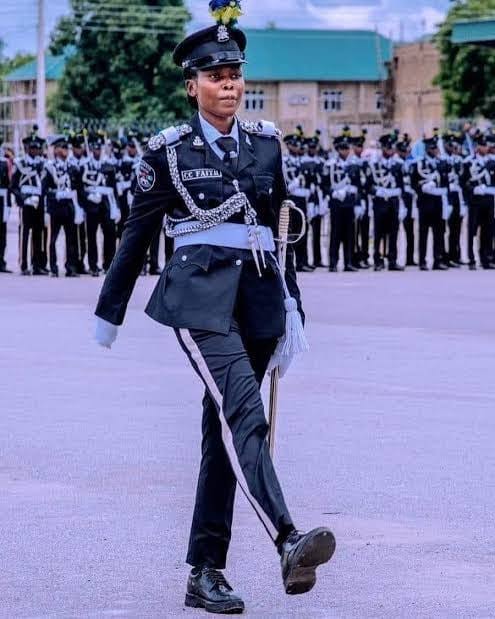
The National Economic Council (NEC) has approved an additional ₦130 billion for the rehabilitation and upgrading of police training institutions across Nigeria, bringing the total funding commitment to ₦230 billion ahead of the proposed establishment of state police.
The fresh allocation is expected to accelerate the renovation of police colleges, upgrade training facilities and strengthen the capacity of the institutions to accommodate increased recruitment and training requirements.
The Council also endorsed two major development programmes involving proposed World Bank financing of $850 million to strengthen disaster preparedness, climate resilience and early childhood development across the country.
These decisions were reached at the 162nd virtual meeting of the NEC, held on Monday and presided over by Vice President Kashim Shettima.
The Council had approved an initial ₦100 billion for the rehabilitation of police training institutions last October, following the establishment of an ad hoc committee on the recommendation of President Bola Ahmed Tinubu.
Presenting an update at the meeting, Enugu State Governor Peter Mbah, who chairs the NEC Ad-Hoc Committee on Police Training Institutions, disclosed that rehabilitation work was ongoing at 13 locations nationwide, with approximately 30 per cent of the work completed.
He assured the Council that the additional ₦130 billion would accelerate the ongoing projects, improve training facilities and strengthen the capacity of police institutions to meet the country’s growing security needs.
The intervention is also expected to support preparations for the proposed recruitment of 50,000 police personnel and provide the necessary training infrastructure ahead of the anticipated transition to a decentralised policing system.
Economy records growth, but household pressures persist
Meanwhile, the Minister of Finance and Coordinating Minister of the Economy, Taiwo Oyedele, presented an update on the country’s economic performance, reporting improvements in several key indicators.
Oyedele said Nigeria’s real Gross Domestic Product (GDP) grew by 4.43 per cent in the second quarter of 2026, compared with 4.23 per cent in the corresponding period of 2025.
He also disclosed that inflation had declined for the fifth consecutive month to 14.06 per cent in October 2026, its lowest level since September 2020, while external reserves stood at $54.87 billion as of November 12, 2026.
According to the minister, Nigeria’s trade surplus increased from ₦10.2 trillion in the first half of 2025 to ₦20.1 trillion in the corresponding period of 2026.
He added that net revenue distributed through the Federation Account Allocation Committee (FAAC) rose by 44 per cent, from ₦15.2 trillion in 2024 to ₦21.9 trillion in 2025.
However, the minister acknowledged that the improving economic indicators had yet to translate sufficiently into relief for households and businesses, particularly in food prices, electricity costs, access to affordable credit and employment opportunities.
He expressed concern that food inflation remained elevated at 19.13 per cent in October, while high lending rates and energy costs continued to put pressure on businesses and household incomes.
NEC considers $850m World Bank-supported projects
The Council also considered two memoranda on disaster management and early childhood development presented by the Minister of Budget and Economic Planning, Senator Atiku Bagudu.
The first concerned the proposed $350 million Accelerating Resilience through Investment Systems and Engagement (ARISE-Nigeria) Project, a six-year World Bank-supported programme designed to strengthen Nigeria’s capacity to anticipate, prepare for and respond to floods, droughts, fires and other natural disasters.
The programme is expected to improve emergency operations centres, early warning systems, weather monitoring and disaster response financing at both federal and state levels.
Between five and 10 states are expected to participate in the initial phase, with selection based on exposure to disaster risks, institutional readiness and commitment to emergency preparedness.
The second memorandum concerned Nigeria’s State-Led Early Childhood Development Programme, which seeks to improve children’s access to healthcare, nutrition, early learning and protection services across the 36 states and the Federal Capital Territory.
The programme is expected to receive funding through a proposed $500 million World Bank financing arrangement, with the Global Financing Facility indicating potential additional grant support of $30 million.
Under the initiative, early childhood development hubs will link primary healthcare facilities with childcare services, preschool education and other essential social services, particularly in underserved communities.
State governors are expected to provide leadership in implementation, resource mobilisation and accountability, while existing institutions will coordinate service delivery.
NEC seeks stronger national identity registration
On the proposed National Identity Management Commission (NIMC) Act 2026, the Council called for stronger collaboration between the commission and state governments to accelerate the registration of Nigerians and improve the integration of the National Identification Number (NIN) into public services.
The initiative is expected to strengthen public service delivery, improve tax administration, eliminate duplicate records and reduce fraud in government payrolls, pension administration and social intervention programmes.
The Council also urged state governments to accelerate identity registration and data capture to ensure wider coverage of the national identity system.
Shettima calls for stronger institutions
In his opening remarks, Vice President Kashim Shettima said Nigeria’s economic future and the long-term success of President Bola Tinubu’s reforms depended on building strong institutions and strengthening cooperation between federal and state governments.
He stressed the need for ministries and state governments to address practical responsibilities while considering the interests of citizens affected by government policies.
Shettima said: “While His Excellency, President Bola Ahmed Tinubu, GCFR, makes the difficult reforms to stabilise the economy, we must all participate in establishing institutions capable of sustaining the benefits of those reforms. This requires ministries and States to settle practical responsibilities without losing sight of the people affected. To achieve this, we must cooperate.
“We must allow a sound practice in one jurisdiction to inform decisions elsewhere, while respecting the differences in capacity and circumstance across the country. The quality of our cooperation will shape the inheritance we leave.”
The Vice President urged Council members to consider the needs of future generations when taking decisions, stressing that the quality of governance and intergovernmental cooperation would determine the country’s institutional legacy.
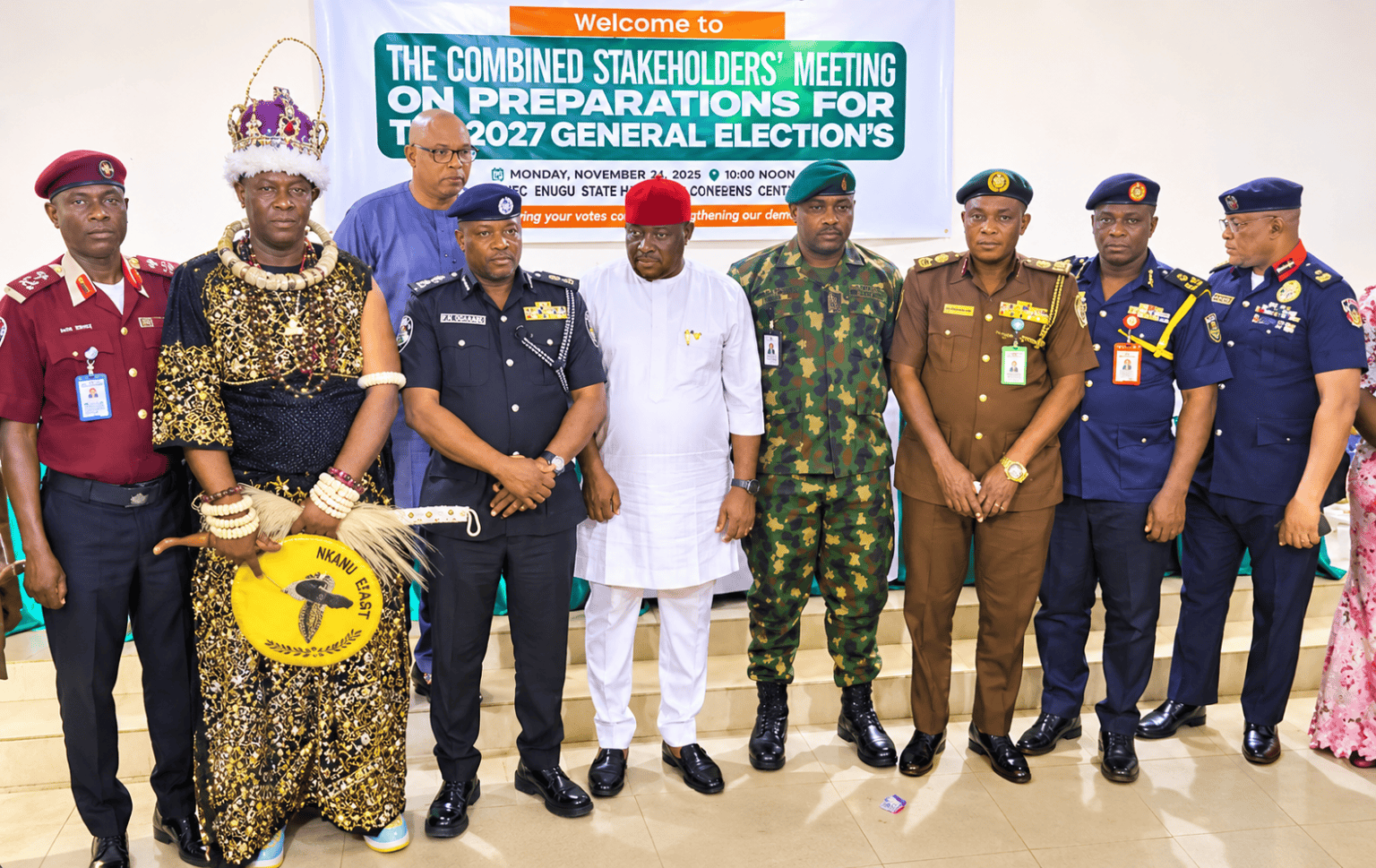
The Independent National Electoral Commission (INEC) has announced plans to conduct a mock accreditation exercise in 520 polling units across Enugu State as part of preparations for the 2027 General Elections.
The exercise, scheduled for Saturday, November 28, will cover two polling units in each of the 260 registration areas in the state.
The Resident Electoral Commissioner (REC) in Enugu State, Dr Chukwuemeka Chukwu, disclosed this on Monday during the Combined Stakeholders’ Meeting on Preparations for the 2027 General Elections held in Enugu.
Chukwu said the nationwide exercise was designed to test the functionality and operational readiness of the commission’s accreditation technology and election-day procedures ahead of the 2027 polls.
He explained that INEC would deploy 1,040 personnel for the exercise, with two officials assigned to each of the 520 selected polling units.
According to him, the arrangement would ensure adequate personnel coverage, effective coordination and a comprehensive assessment of the commission’s technological and operational capacity.
The REC called on political parties, civil society organisations and the media to support the exercise and sensitise voters in the selected communities.
On capacity building, Chukwu disclosed that the commission had concluded a three-day training programme for Electoral Officers (EOs) and Assistant Electoral Officers (AEOs), held between November 16 and 18.
He said the training was aimed at strengthening the officers’ capacity in election planning, coordination, implementation and compliance with established electoral guidelines.
He added that the programme also emphasised professionalism, neutrality, discipline and accountability in the discharge of their responsibilities.
Chukwu further disclosed that INEC held a meeting with the Inter-Party Advisory Council (IPAC) on November 20 to discuss preparations for the 2027 elections and strengthen cooperation with political parties.
He said the commission also organised an Electoral Risk Management Sensitisation Workshop on October 29 to familiarise stakeholders with its Electoral Risk Management Framework and strategies for identifying and mitigating potential electoral threats.
On inclusive participation, the REC said INEC had continued to organise sensitisation programmes targeting persons with disabilities, women and youths.
He disclosed that 540 women drawn from the 17 local government areas of the state had already participated in sensitisation workshops organised by the commission.
Speaking at the meeting, the Commissioner of Police, Enugu State Command, CP Fidelis Ogarabe, who is also the Co-Chairman of the Election Security Committee, assured INEC and residents of the state of adequate security for all electoral activities.
Ogarabe said security agencies were fully prepared to provide protection before, during and after the 2027 General Elections.
“Security agencies are always ready. We are assuring INEC and residents of the state of adequate security before, during and after the elections.
“We are ready; call on us and tell us the security challenges and we will resolve them on time,” he assured.
Also speaking, the Chairman of the Enugu State Traditional Rulers’ Council, Igwe Samuel Asadu, urged INEC to intensify public enlightenment and awareness campaigns on its programmes, particularly those directly affecting residents at the grassroots.
Asadu stressed the need for increased sensitisation on the collection of Permanent Voter Cards (PVCs), the forthcoming mock accreditation exercise and the importance of widespread participation in the electoral process.
He also called for more frequent engagement with stakeholders, noting that traditional institutions could help mobilise and encourage residents to participate actively in the elections.
The stakeholders’ meeting was attended by representatives of political parties, security agencies, traditional and religious institutions, civil society organisations, organisations of persons with disabilities, the media, INEC heads of departments and electoral officers across the state.
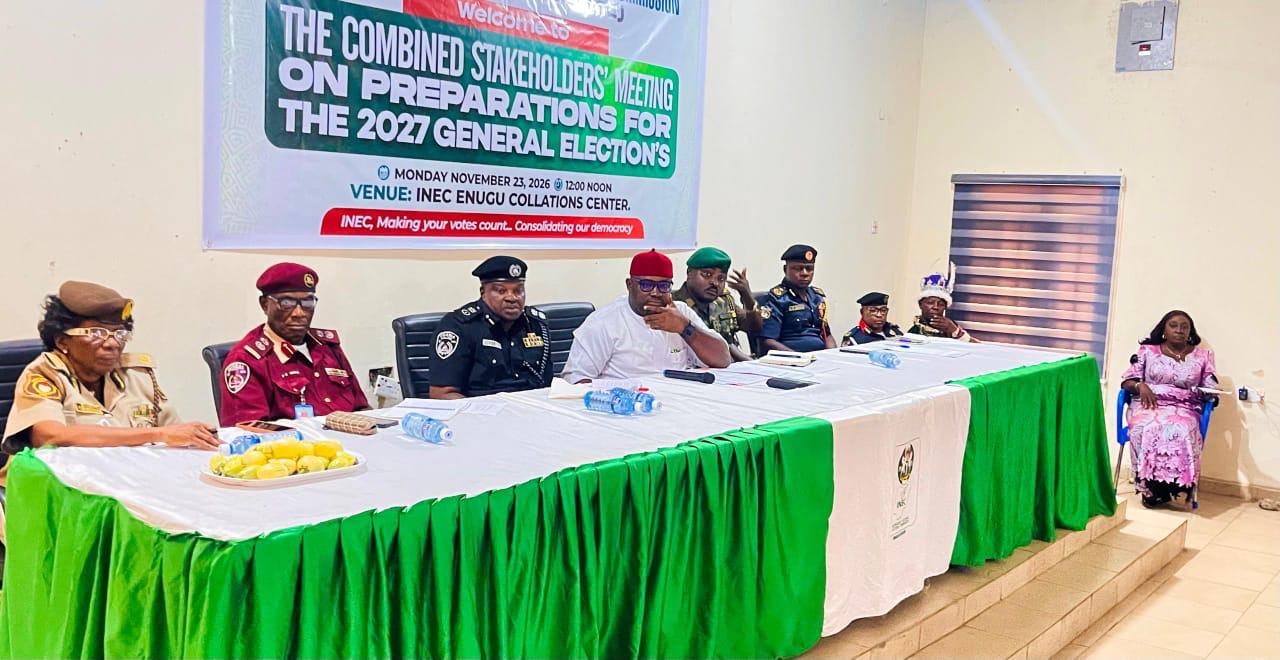
The Enugu State Police Command has reaffirmed the readiness of the Police and other security agencies to provide adequate security before, during and after the 2027 general elections.
The Commissioner of Police, Enugu State Command, CP Fidelis Ndubuisi Ogarabe, gave the assurance on Monday, November 23, 2026, during the Independent National Electoral Commission (INEC) Combined Stakeholders’ Meeting held at the Commission’s State Headquarters, Independence Layout, Enugu.
Ogarabe, who spoke in his capacity as Co-Chairman of the Inter-Agency Consultative Committee on Election Security (ICCES), urged residents, particularly eligible voters, to conduct themselves peacefully and avoid actions capable of undermining the electoral process.
He also called on members of the public to support security agencies by providing credible and timely information that could assist in preventing threats to the electoral process and ensuring peaceful, secure and credible elections.
Earlier, the INEC Resident Electoral Commissioner in Enugu State, Dr Chukwu Chukwuemeka, in his welcome address, highlighted the Commission’s ongoing preparations for the 2027 general elections.
He listed the collection of Permanent Voter Cards (PVCs) and the nationwide Mock Accreditation Exercise scheduled for Saturday, November 28, 2026, among the key activities lined up by the Commission.
The REC also addressed questions and concerns raised by participants during the interactive session.
The meeting attracted heads of security agencies, political party leaders, the Chairman of the Enugu State Traditional Rulers Council, HRM Igwe Samuel Asadu, the State Coordinator of the National Youth Service Corps (NYSC), leaders of town unions, Presidents-General of communities across the state, media representatives, INEC field officers and other stakeholders.
The engagement provided an opportunity for electoral stakeholders to discuss preparations, identify potential security concerns and strengthen collaboration towards the successful conduct of the 2027 general elections in Enugu State.
-
 News3 days ago
2027: Obi Urges Nigerians to ‘Sacrifice One Day for Nigeria to Be Good Again’
-
News2 days ago
Pomp, Pageantry as 37th NAFEST Opens in Enugu; Mbah Champions Cultural Economy
-
News2 days ago
2027: ‘I’ll Defeat Natasha Without Spending a Dime,’ Yahaya Bello Boasts, Calls Dino Melaye Noise Maker
-
Editorial2 days ago
Fake Drugs: NAFDAC Seeks Death Penalty as Counterfeit Products Flood Nigerian Markets
-
News1 day ago
Police Take Over Fountain of Life Church as Jimmy Odukoya’s Leadership Crisis Deepens
-
News2 days ago
Abductions: 640 Nigerians Still in Captivity as Families Cry Out Over Government Silence
-
News1 day ago
South-East Policy and Impact Conference to chart pathway from economic reforms to regional prosperity
-
News1 day ago
2027 Elections: Controversy Trails Inauguration of 200-Man Security Outfit by Umahi’s Son